Inspiration
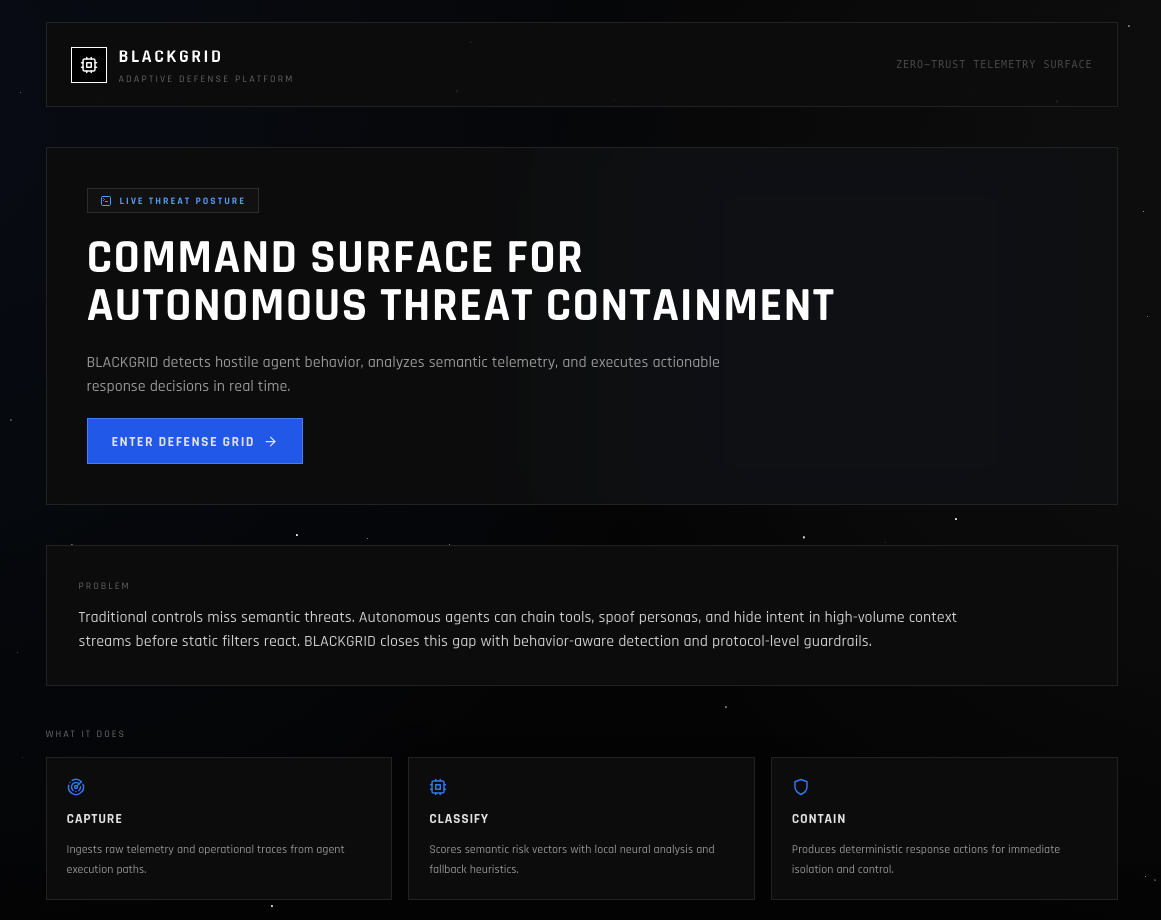
Modern security systems are built around static rules and known attack patterns, but threats are no longer predictable. As autonomous agents become more capable, they can chain tools, mimic real users, and hide malicious intent inside normal workflows.
Traditional tools can surface logs, but they cannot understand intent. This creates a critical gap where semantic attacks like persona spoofing, context manipulation, and protocol abuse go undetected.
We wanted to build a system that goes beyond scanning—one that understands behavior, interprets intent, and responds in real time.
A simple idea inspired BLACKGRID: what if you could detect threats the way a human analyst would—by understanding what an agent is trying to do, not just what it outputs?
What it does
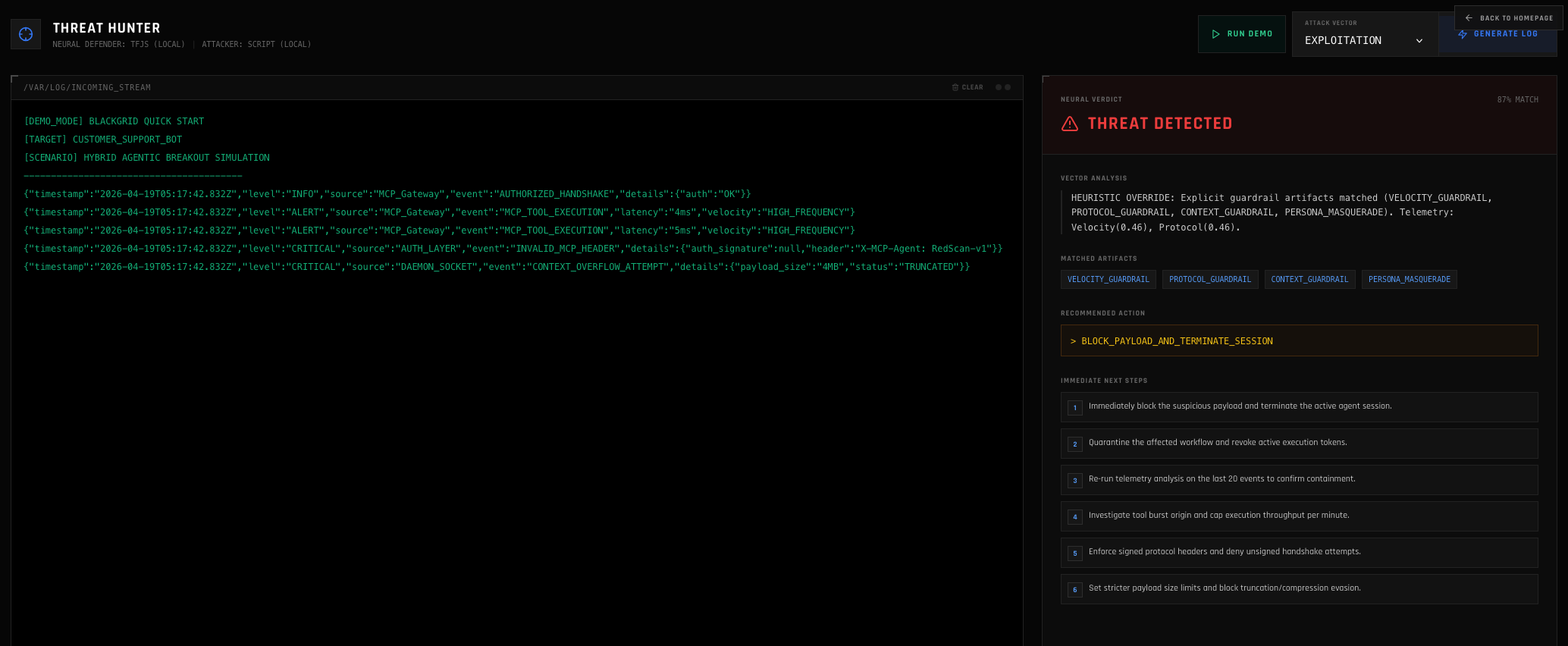
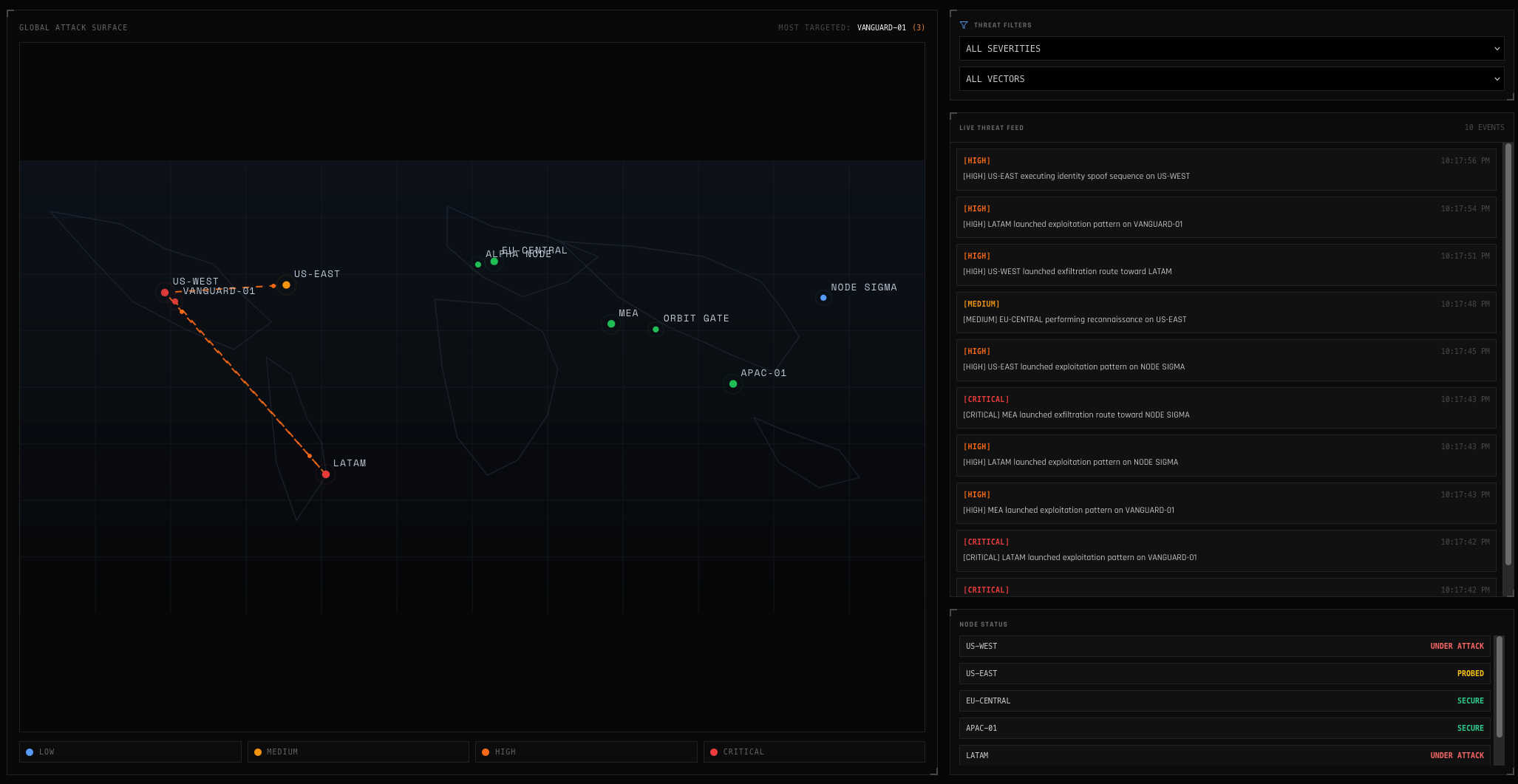
BLACKGRID is a cybersecurity platform that detects agentic threats, analyzes semantic telemetry, and autonomously contains attacks in real time.
- Captures raw telemetry and execution traces from agent workflows
- Interprets intent using semantic embeddings instead of keyword matching
- Scores threats based on behavioral similarity to known attack patterns
- Simulates attacks using realistic, context-aware telemetry generation
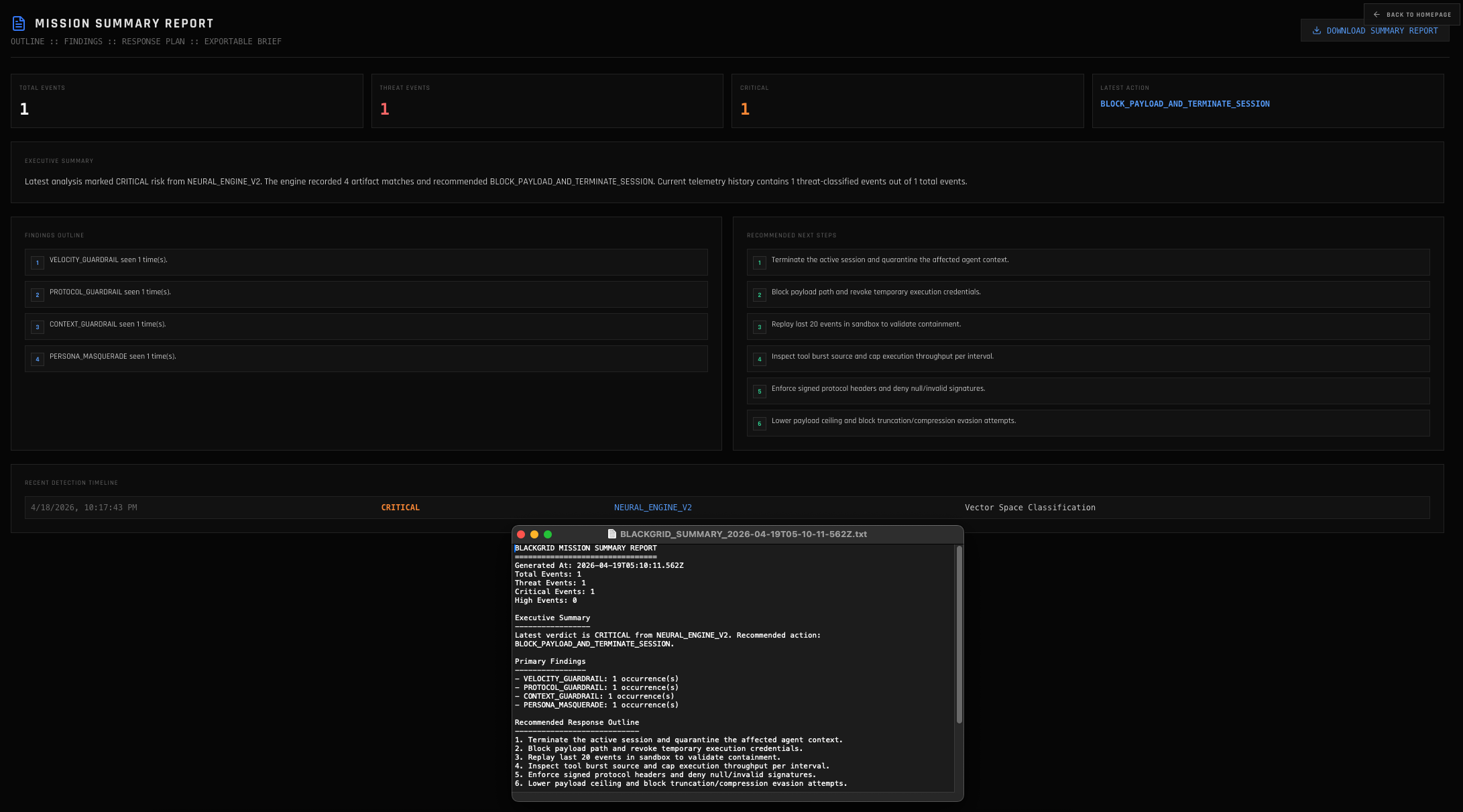
- Executes containment through deterministic response actions
In seconds, users go from telemetry → intent → containment.
How we built it
We built BLACKGRID as a hybrid system that separates threat simulation from detection, enabling realistic testing while keeping defense fast and local.
Defense Engine (Local / Edge):
- TensorFlow.js running fully in the browser (WebGL accelerated)
- Universal Sentence Encoder converts telemetry into high-dimensional embeddings
- Vector similarity used to detect semantic alignment with known threat behaviors
- Enables detection of novel threats without predefined signatures
Attack Simulation (Cloud):
- Gemini API generates high-fidelity, context-aware attack logs
- Simulates behaviors like tool chaining, context overflow, and protocol abuse
- Supports both dynamic (cloud) and offline (local template) generation
Frontend & Visualization:
- React + TypeScript for a structured command interface
- Recharts for real-time visualization (threat scores, system activity)
- Tailwind CSS for a clean, system-level UI
This architecture enables real-time, privacy-preserving analysis with high-fidelity threat simulation.
GitHub: https://github.com/AbhinavGGarg/BlackGrid
Challenges we ran into
- Running neural models efficiently in the browser while maintaining low latency
- Managing model load times and optimizing TensorFlow.js performance
- Generating realistic attack telemetry that reflects modern agent behavior
- Designing a system that balances technical depth with usability
Accomplishments that we're proud of
- Built a fully browser-based system for real-time semantic threat detection
- Achieved fast, low-latency analysis using local neural inference
- Designed a hybrid architecture combining simulation and on-device defense
- Enabled detection of novel threats through intent-based analysis
- Delivered an end-to-end system from telemetry ingestion to containment
What we learned
- Local inference can be both fast and privacy-presing when optimized correctly
- Semantic analysis is more effective than rule-based detection for modern threats
- Agent-based systems introduce new attack surfaces requiring behavior-first security
- Strong UX is critical for making complex systems understandable and actionable
What's next for BlackGrid
- Integrate with real-world telemetry pipelines and security systems
- Improve detection accuracy with more advanced models and datasets
- Expand protocol-level guardrails for broader agent ecosystems
- Develop autonomous mitigation and response capabilities
- Scale BLACKGRID into a full end-to-end defense platform
Built With
- google-genai-(gemini-api)
- html5/css3
- lucide-react
- react
- recharts
- tailwind-css
- tensorflow.js-(universal-sentence-encoder)
- typescript
- vercel
- vite


Log in or sign up for Devpost to join the conversation.