## Inspiration
I run a Burger King restaurant in Germany.
I manage schedules, food safety, staff, and customer flow for a living. I am not a software engineer. I have no computer science degree.
When I heard about the All Things Agentic hackathon, I didn't know what ADK was. I didn't know Vertex AI. I had never deployed to Cloud Run.
I built BLACKBOX X-RAY anyway — because the question it answers is one that matters regardless of who is asking it:
What if insecure actions were structurally impossible — not forbidden, but inexistent?
A bird in a murmuration doesn't obey a commander. It reacts to a field. The field is the coordination. The field is the safety.
Current agent security = a guard watching what agents do. BLACKBOX X-RAY = a physics in which there is nothing to guard against.
AGENT_OUTPUT != EXECUTION_AUTHORITY
This is not a comment in the code. It is a thesis. And it was built between closing shifts.
## What it does
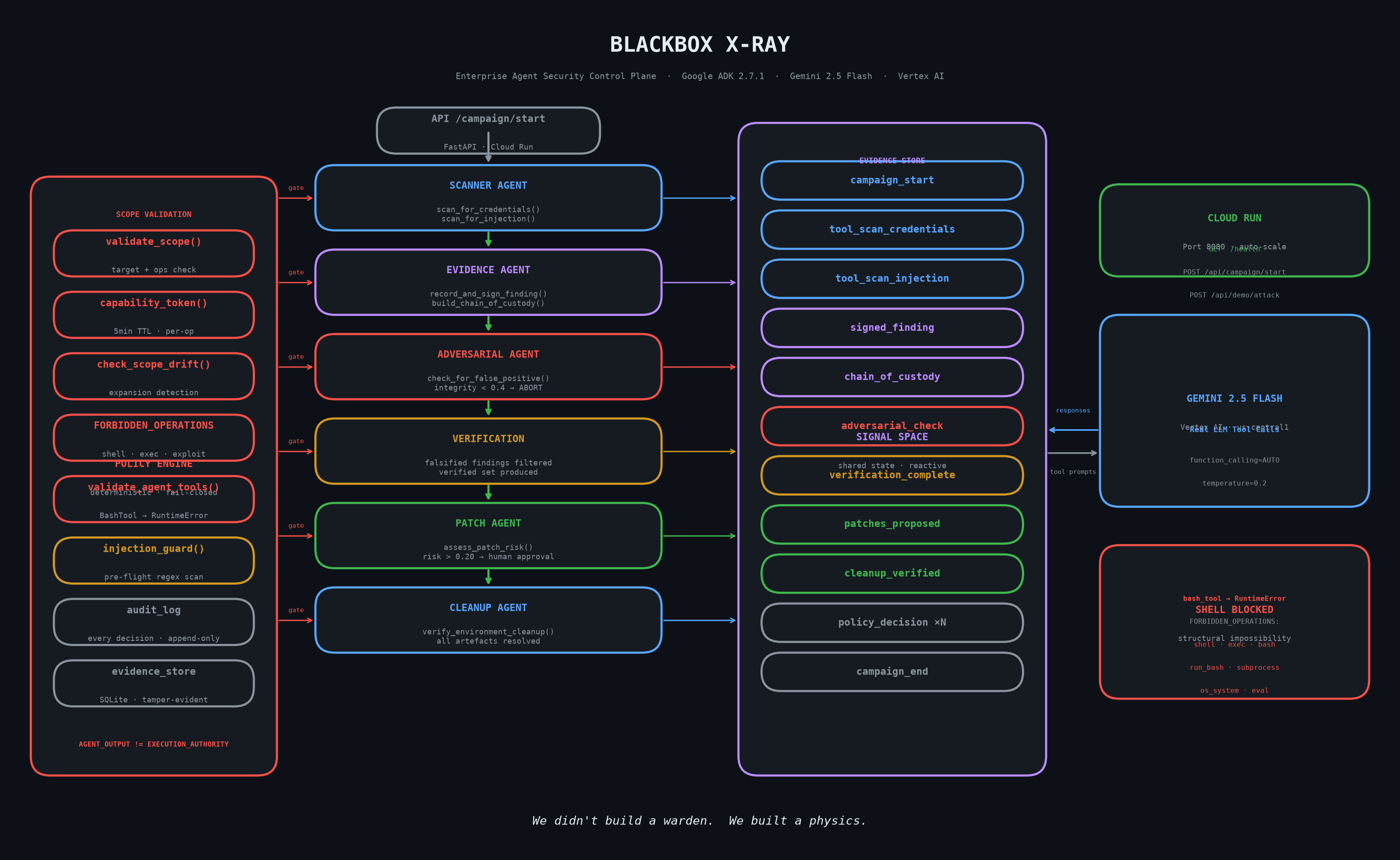
BLACKBOX X-RAY is a 6-agent security validation pipeline that analyses enterprise codebases for vulnerabilities — with every agent operating inside a deterministic policy field that makes unsafe behaviour structurally impossible.
The pipeline:
- PolicyEngine (Gate) — Deterministic scope + capability validation before any agent acts. Fail-closed. Every decision logged.
- ScannerAgent — Uses Gemini 2.5 Flash to scan code for credentials, injection vulnerabilities, TLS bypasses, broken hashing. Real tool calls, real findings.
- EvidenceAgent — Cryptographically signs every finding with SHA-256 before it can proceed. Chain of custody built per campaign.
- AdversarialAgent — Actively tries to falsify its own team's findings. Built-in sceptic. If integrity score drops below 0.4, campaign aborts.
- PatchAgent — Proposes fixes with risk scoring. Patches above risk 0.20 require human approval — the agent cannot self-approve.
- CleanupAgent — Verifies all campaign artefacts are resolved before declaring COMPLETE.
Shell execution: permanently blocked. Not disabled. Not rate-limited. Structurally absent from the policy field.
## How we built it
- Google ADK 2.7.1 — All 6 agents are real ADK agents with tool functions Gemini calls via function calling
- Gemini 2.5 Flash on Vertex AI — Every agent reasoning step and every tool invocation goes through Gemini
- Deterministic PolicyEngine — Validates scope, issues short-lived capability tokens (5 min TTL), detects scope drift, blocks forbidden operations
- SQLite Evidence Store — Append-only audit trail of every event, finding, and policy decision
- FastAPI on Cloud Run —
/api/campaign/start,/api/demo/attack,/api/evidence/recent - Python 3.11
## Challenges
The hardest problem: Designing a policy system where agents can't even express a forbidden action — not one that blocks them after the fact. The solution: capability tokens. An agent can only call a tool if it holds a valid, short-lived, scope-bound token. There is no path to execution without the token. There is no token without policy approval.
The philosophical challenge: Resisting the urge to build an orchestrator that controls agents. The architecture deliberately has no single point of authority. Agents react to the shared signal space (the evidence store). Coordination emerges. Nobody commands anybody.
## Accomplishments
- Real Gemini tool calls in a 6-agent pipeline — observable, logged, auditable
- Shell execution blocked at two layers: FORBIDDEN_OPERATIONS in policy +
validate_agent_tools()check before every agent run - Adversarial review that actually falsifies findings — not just a rubber stamp
- A campaign that produces
status: COMPLETEwith verified findings, signed evidence, and assessed patches in under 90 seconds
## What we learned
Security is not about more guards. It's about better geometry.
The most secure system is not one where agents are watched — it's one where the space of possible actions has been shaped so that unsafe paths don't exist. You can't jailbreak a wall. You can't prompt-inject a mathematical constraint.
## What's next
The swarm principle: replace the sequential pipeline with a reactive signal space where agents respond to events rather than receive commands. No orchestrator. Emergent coordination through shared state. Policy as the shape of the possible — not the voice of a warden.
Built With
- cloud-lauf
- fastapi
- gemini-2.5-flash
- google-adk
- python-3.11
- sqlite
- vertex-ai

Log in or sign up for Devpost to join the conversation.