Inspiration## Inspiration
The idea for BlackBox came while I was watching The Rookie. Detectives often have to interview several people, revisit old statements, compare conflicting memories, and manually reconstruct what happened. Every new interview adds more information, but also creates more details that investigators must remember and connect.
That made me wonder: what if every active case had its own brain?
A brain that already understands everything discovered so far, remembers every statement, learns from new evidence, and knows exactly what question should be asked next.
What BlackBox Does
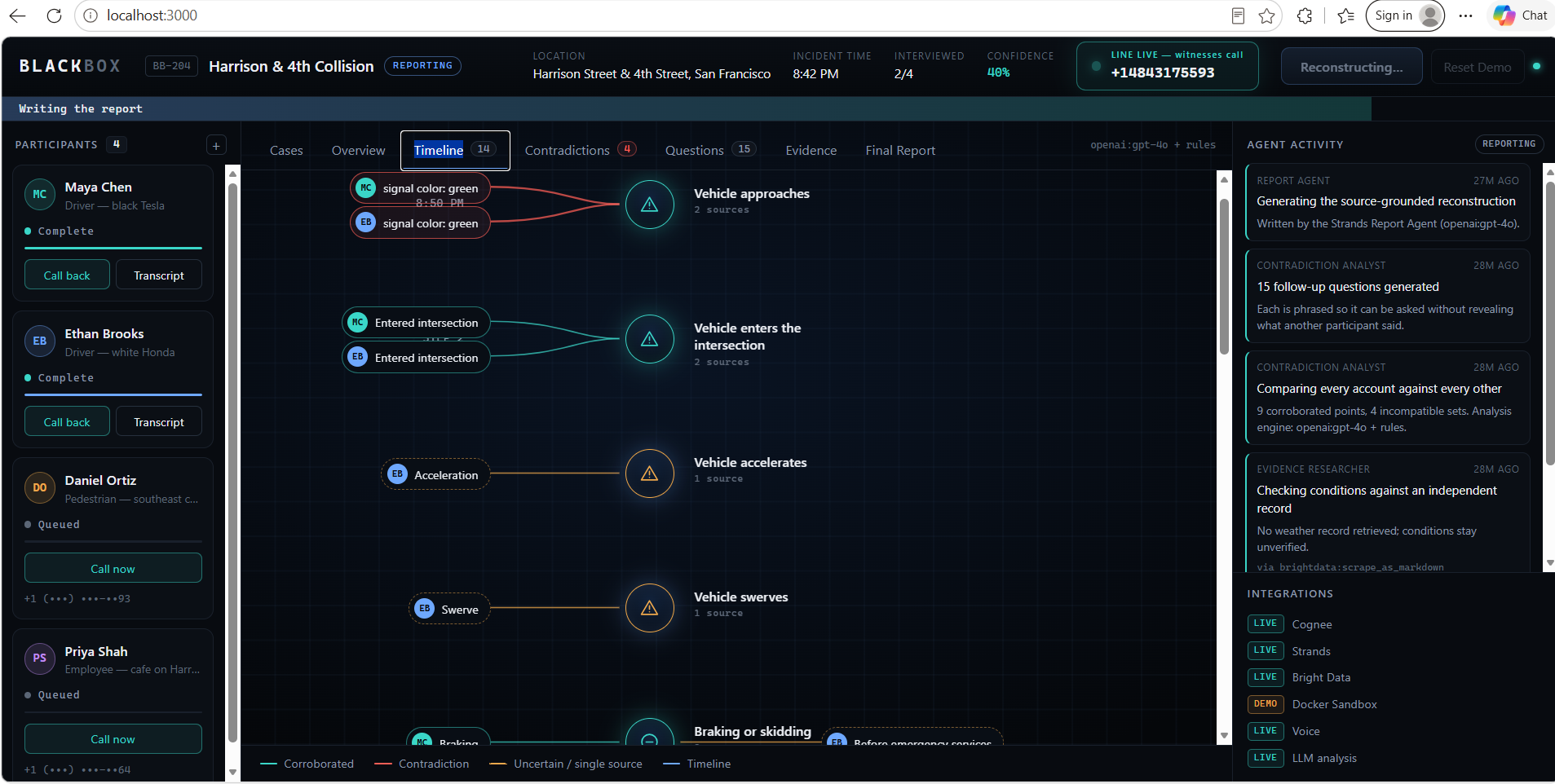
BlackBox is an autonomous incident-reconstruction agent. Investigators provide the initial case details and contact information for the people involved. BlackBox then interviews them, stores their recollections, extracts individual claims, and constructs a shared visual timeline.
As new testimony arrives, BlackBox identifies:
- Statements that support one another
- Accounts that cannot simultaneously be true
- Missing pieces of the timeline
- Claims that require outside evidence
- The best follow-up question to ask next
BlackBox does not decide that someone is lying or assign guilt. Instead, it shows exactly where accounts conflict, links every conclusion to its original source, and helps investigators determine what evidence could resolve the uncertainty.
How We Built It
We used Cognee to give each case persistent, structured memory. Interviews, participants, claims, events, evidence, and contradictions become part of a connected case brain instead of remaining isolated transcripts.
AWS Strands Agents orchestrates the investigation workflow, including interviewing participants, extracting claims, detecting contradictions, researching evidence, and generating the final reconstruction.
Bright Data provides current public context such as weather, road information, nearby locations, and other sources that can support or challenge a recollection.
Docker Sandboxes provide an isolated environment for safely processing uploaded evidence, audio, metadata, and generated analysis.
The frontend presents everything through a live investigative dashboard containing participant calls, transcript activity, evidence, contradictions, and an interactive timeline of the incident.
Challenges We Faced
The hardest challenge was turning subjective human recollections into structured information without presenting AI inferences as facts. People describe time, direction, distance, and sequence differently, so BlackBox must preserve the original statement while creating a normalized claim for comparison.
We also had to distinguish inconsistency from deception. Two people can remember the same event differently without either person intentionally lying. For that reason, every BlackBox conclusion includes its evidence, source, confidence, and unresolved uncertainty.
Another challenge was coordinating several agents and data sources while keeping the reconstruction understandable in real time. We solved this by making every agent action update the same case brain and keeping all derived conclusions traceable to their original sources.
What We Learned
We learned that useful AI memory is more than storing information and retrieving it later. A real case brain must understand how new information changes what was previously believed.
BlackBox became an agent that does not merely remember a case. It actively reconstructs it, recognizes what remains unknown, and helps determine the next step required to get closer to the truth.
What it does
How we built it
Challenges we ran into
Accomplishments that we're proud of
What we learned
What's next for Blackbox
Built With
- amazon-web-services
- brightdata
- claude
- cognee
- guava
- openai


Log in or sign up for Devpost to join the conversation.