-
-
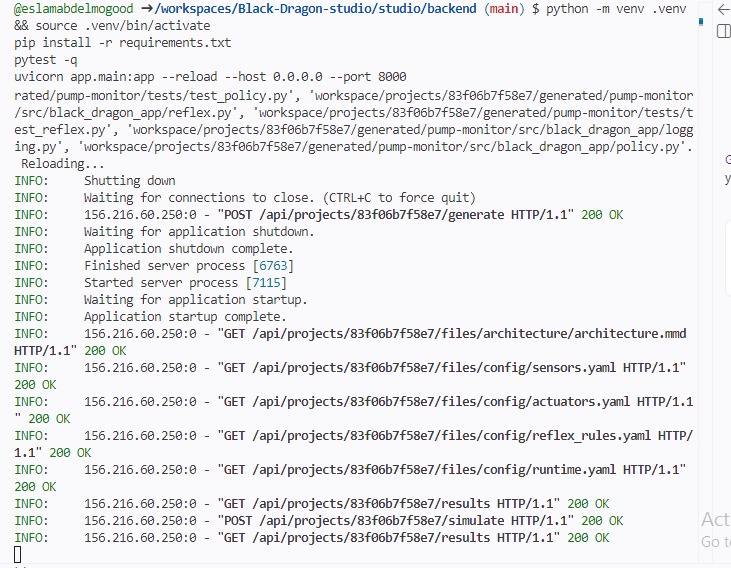
Local Endpoints Live Testing & Fast Response
-
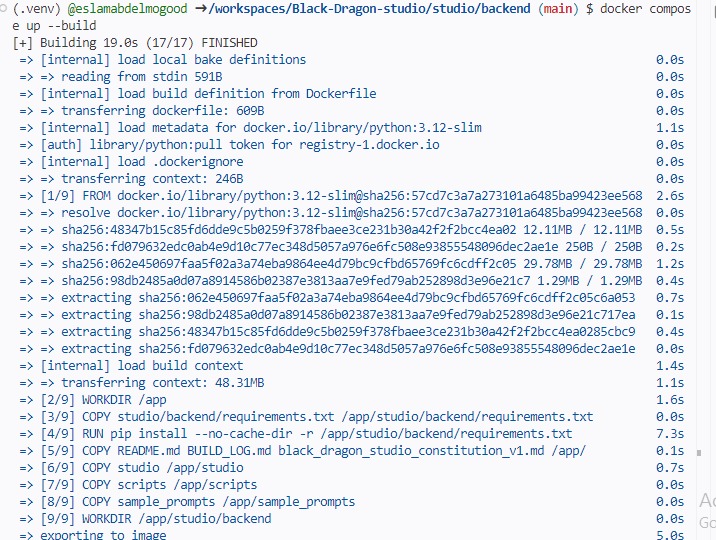
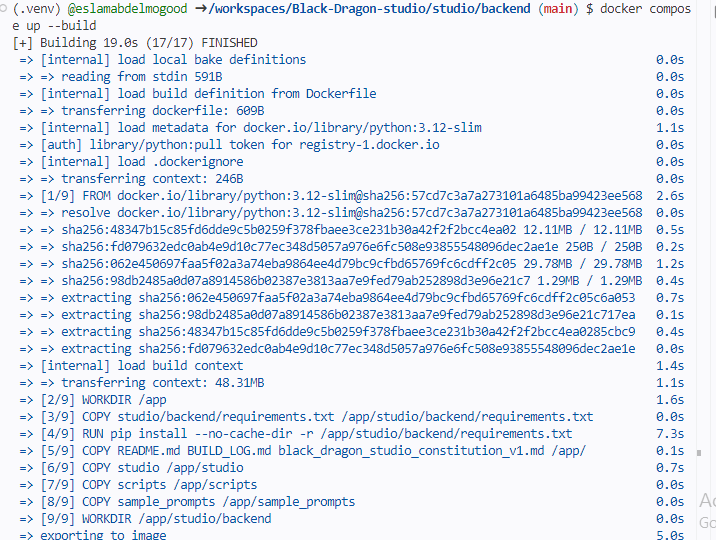
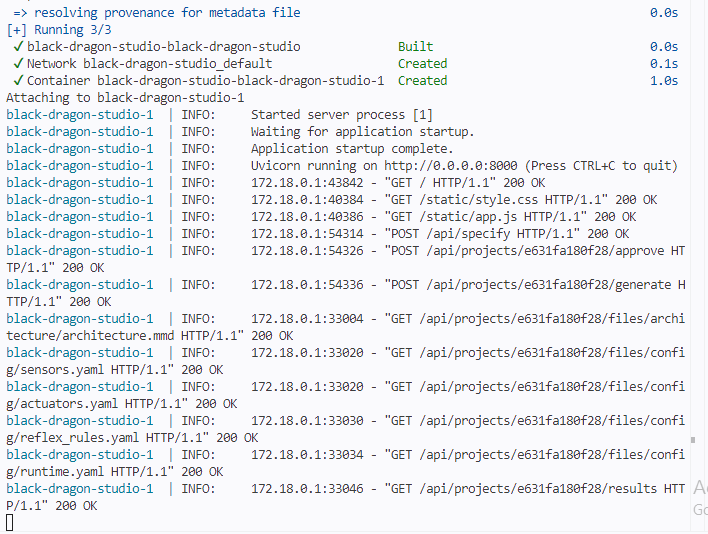
Black Dragon Studio successfully built and deployed using Docker for reproducible evaluation.
-
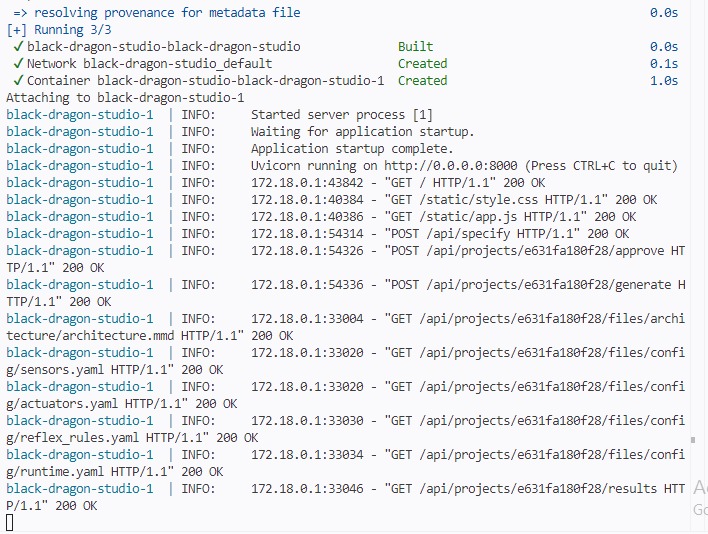
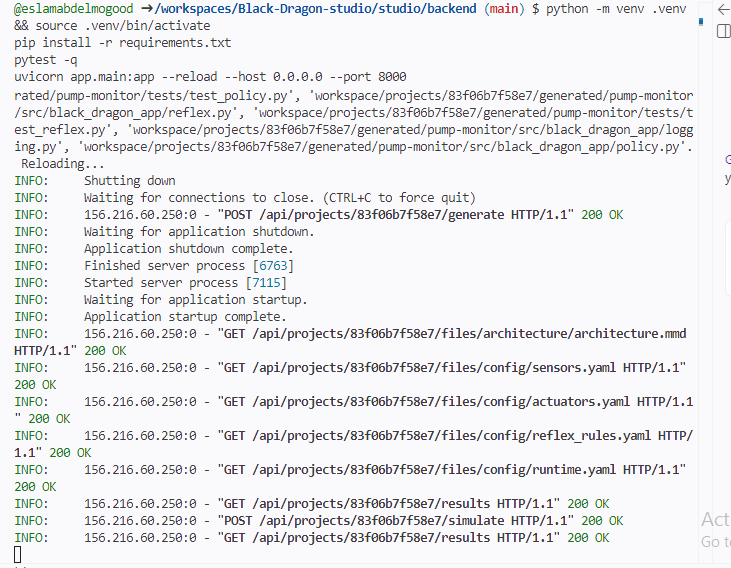
Containerized backend running successfully with the complete API available for project generation and validation.
-

Judge smoke test completed successfully, validating the complete end-to-end workflow.
-
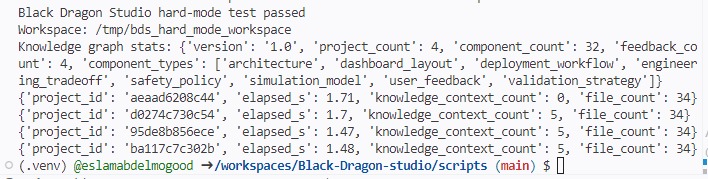
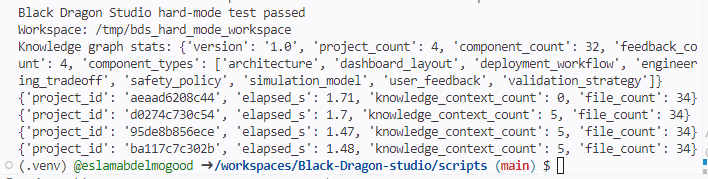
Hard-mode integration test passed across multiple project scenarios with Engineering Knowledge Graph reuse enabled.
-
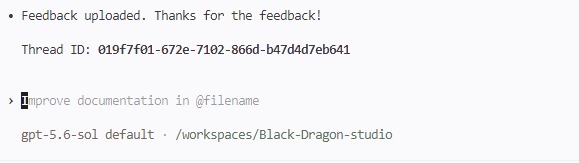
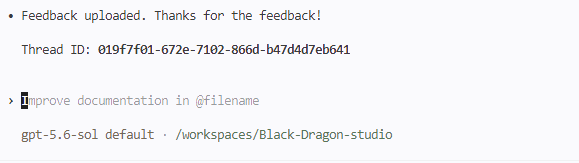
feedback Codex Session ID

Inspiration:
Today's AI coding tools are good at generating files, but Physical AI projects require much more than code. An industrial monitoring system needs requirements analysis, architecture, runtime logic, deterministic safety rules, simulation, tests, a dashboard, documentation, and a deployment package. Black Dragon Studio was inspired by a simple question: what if Codex could act not only as a coding assistant, but as part of an AI engineering team capable of producing a complete, validated system from a natural-language idea?
What it does:
Black Dragon Studio transforms a plain-English Physical AI request into a complete industrial-monitoring starter project. A user describes a system such as an industrial pump monitor, reviews and approves a structured SystemSpec, and the Studio generates runtime code, sensor configuration, reflex safety rules, simulation scenarios, tests, a dashboard, documentation, and a downloadable ZIP.
The product does not return disconnected code snippets; it returns one validated, internally consistent engineering package.
Before export, the generated project passes schema validation, static checks, unit tests, simulation smoke tests, and package validation. After generation, users can submit feedback, and the platform stores reusable engineering knowledge in an Engineering Knowledge Graph. Future projects can then reuse validated architecture, safety, simulation, validation, dashboard, deployment, metric, and feedback patterns from previous projects.
How we built it:
We built Black Dragon Studio with a FastAPI backend, a lightweight browser interface, and a controlled Jinja2 generation engine for the first supported domain: industrial monitoring systems.
The backend converts a user request into a validated Pydantic SystemSpec, requires human approval, runs a deterministic engineering-team handoff, renders the project, validates the result, executes simulations, packages a ZIP, and records reusable components in the Engineering Knowledge Graph.
Codex was used not only to generate individual files, but to coordinate implementation across API design, project generation, validation, testing, frontend workflow, packaging, Docker setup, judge scripts, and documentation while preserving consistency between these layers.
GPT-5.6 is supported through the Specification Agent when OPENAI_API_KEY is configured. A deterministic fallback allows judges to run the complete demo without secrets or network access.
Challenges we ran into:
The biggest challenge was making Black Dragon Studio feel like a real engineering platform rather than a thin code-generation demo. We had to keep the MVP intentionally narrow and honest: one domain, one reliable template, real tests, real simulation, and clearly documented safety limitations.
Another challenge was making the system easy to evaluate in a fresh environment. We added smoke tests, hard-mode tests, Docker support, dependency bootstrapping for judge scripts, and generated evidence showing what the platform created and validated.
We also had to design the Knowledge Graph carefully so that it stores reusable engineering components, validation results, and feedback instead of blindly copying raw generated code.
Accomplishments that we're proud of:
We are proud that Black Dragon Studio now supports a complete end-to-end lifecycle:
natural-language request → approved specification → engineering-team review → generated runtime, simulation, tests, dashboard, and documentation → validation → ZIP export → user feedback → Knowledge Graph update
The generated projects are runnable and include deterministic safety rules, simulation outputs, deployment handoff instructions, transparent limitations, and validation evidence.
We are especially proud of the Engineering Knowledge Graph and Feedback Loop because they create the foundation for future projects to reuse validated engineering experience instead of treating every generation as an isolated task.
What we learned:
We learned that the hardest part of generating Physical AI systems is not writing individual files. It is coordinating engineering decisions across requirements, architecture, safety, simulation, validation, and deployment.
We also learned that a narrow but real MVP is more valuable than a broad collection of incomplete templates. A working industrial-monitoring generator with real validation provides stronger evidence than claiming support for many domains without reliable execution.
Finally, we learned that judge experience matters. One-command tests, clear setup instructions, generated evidence, and transparent limitations make a complex developer tool much easier to understand and trust.
What's next for Black Dragon Studio:
Next, Black Dragon Studio will expand beyond industrial monitoring into additional Physical AI domains such as robotics cells, drones, smart factories, infrastructure monitoring, and industrial IoT. We plan to add more templates, richer simulation engines, background generation progress, persistent multi-user storage, and deeper Knowledge Graph retrieval so new projects can automatically adapt proven patterns from similar systems. The long-term goal is for Black Dragon Studio to become an operating system for AI engineering: a platform that designs, validates, simulates, tests, documents, packages, learns, and improves with every generated project.

Log in or sign up for Devpost to join the conversation.