-
-
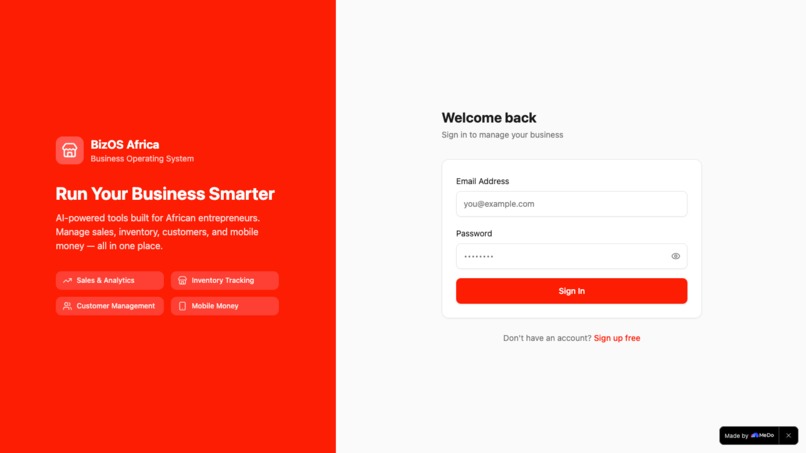
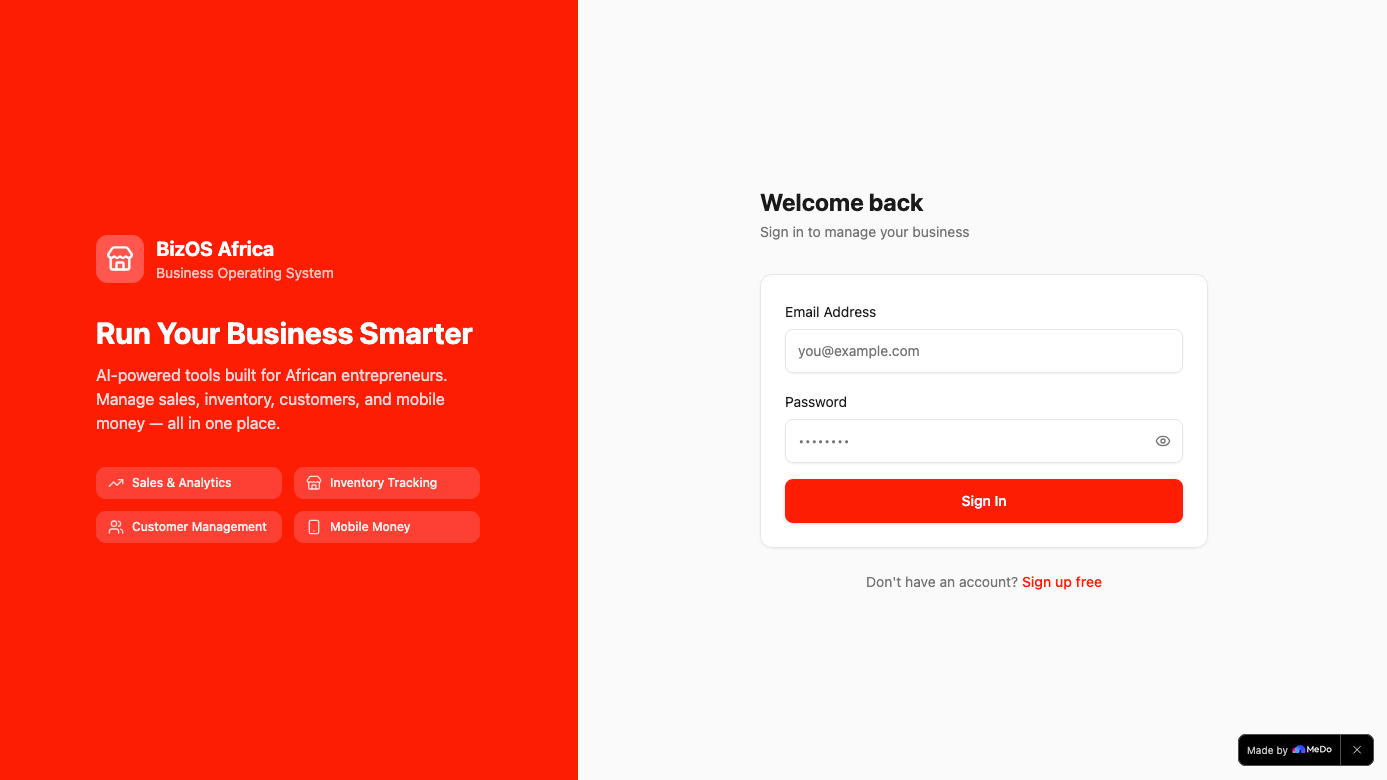
Login
-
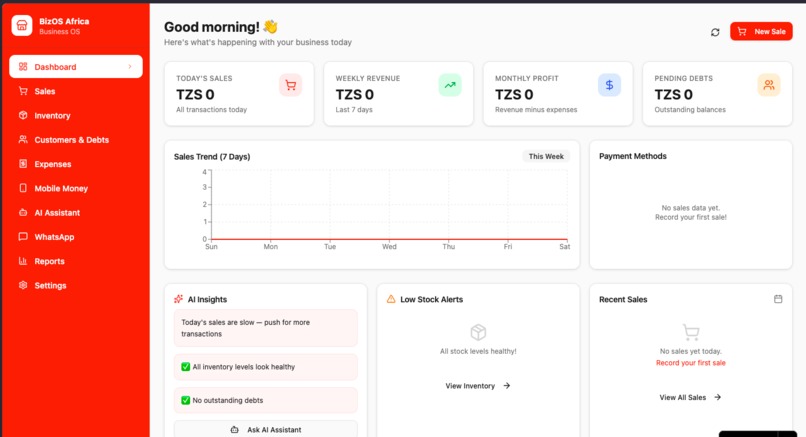
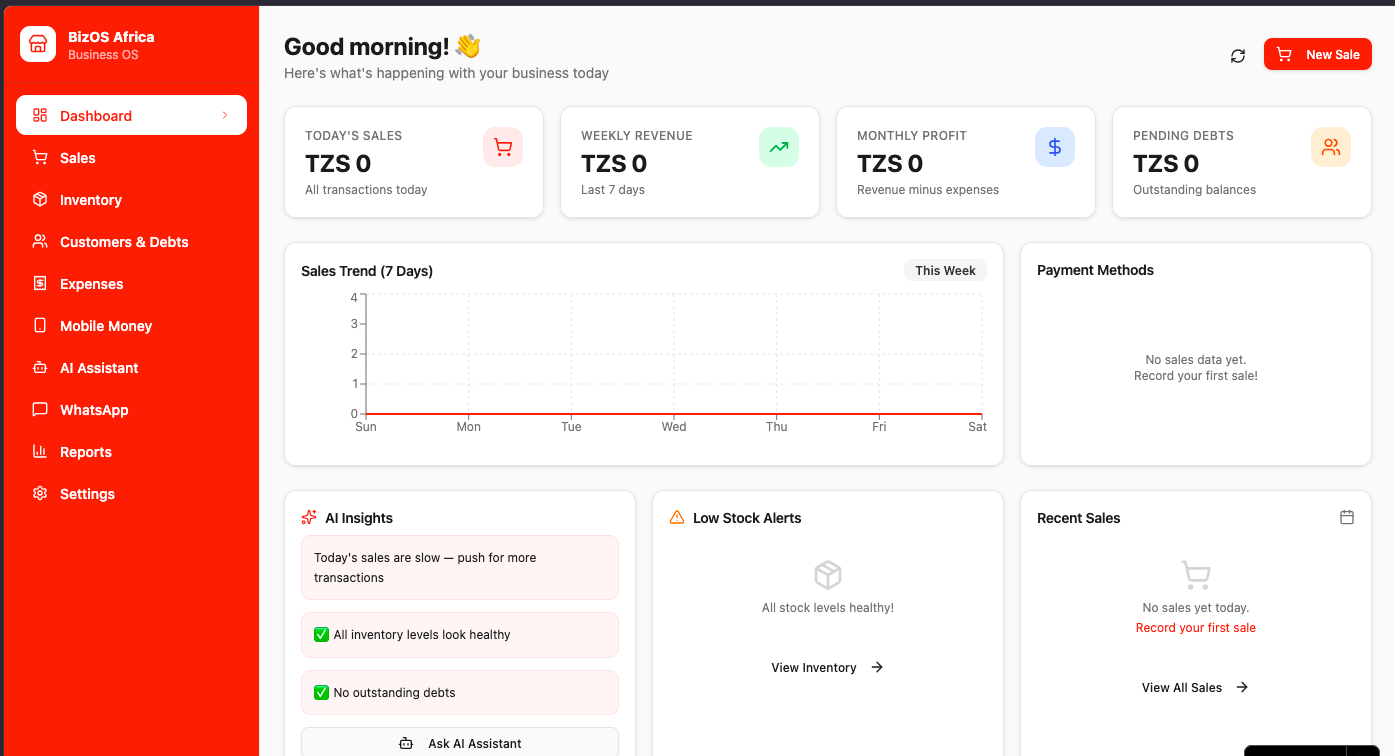
Dashboard
-
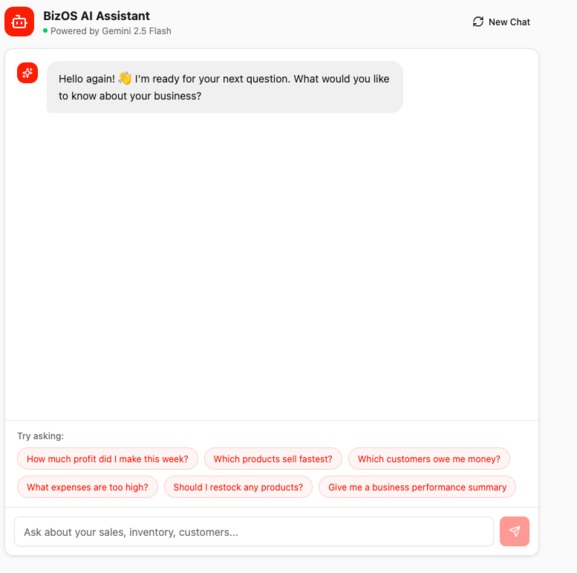
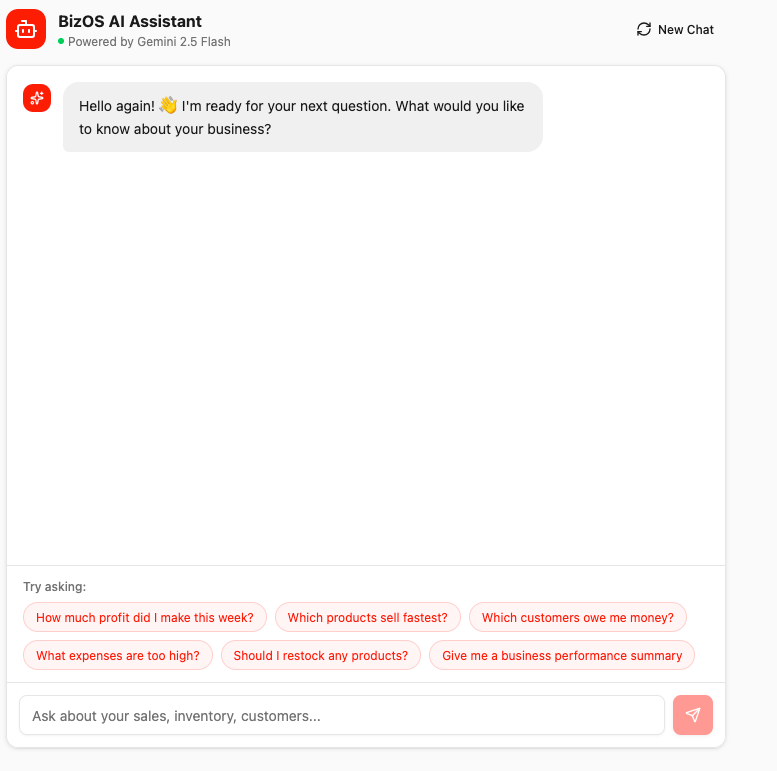
Chat
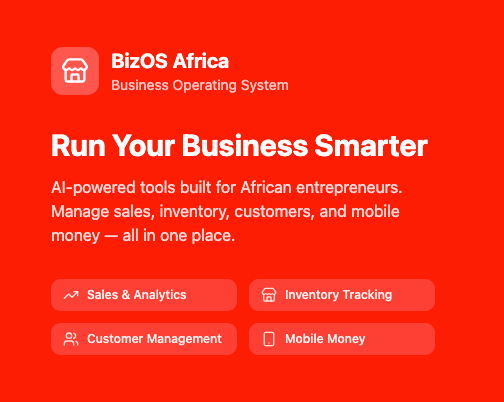
BizOS Africa
Inspiration
Across East Africa, millions of small business owners still manage their businesses manually. Sales are written in notebooks, inventory is tracked from memory, and profits are often unknown until money runs out.
In Dar es Salaam, I saw this problem constantly. Small shop owners, market vendors, and entrepreneurs work incredibly hard, but they lack affordable digital tools designed for their realities. Most business software is built for large companies in Western markets — not for African SMEs using mobile money, smartphones, and unstable internet connections.
I wanted to build something different: an AI-powered Business Operating System made specifically for African entrepreneurs.
The challenge was that I didn’t have a large engineering team or months to build it.
That’s when I discovered MEDO.
Using natural language conversations, MEDO helped me architect, design, and develop an entire production-ready platform faster than I thought possible.
That platform became BizOS Africa.
What it does
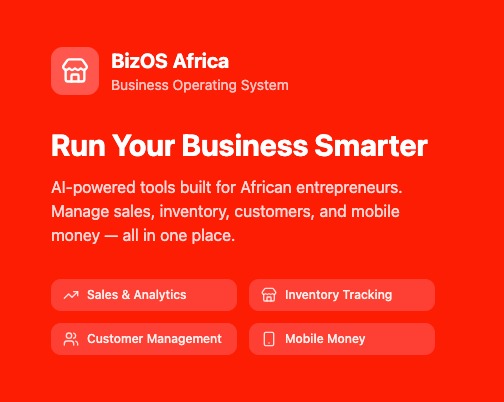
BizOS Africa is a mobile-first AI-powered business operating system for African SMEs.
It helps small businesses manage daily operations from one centralized platform.
Core Features
- 📊 Real-time business dashboard and analytics
- 🛒 Sales and transaction management
- 📦 Inventory and stock tracking
- 👥 Customer relationship management (CRM)
- 💸 Expense tracking and categorization
- 📱 Mobile money transaction support
- 🤖 AI-powered business assistant
- 💬 WhatsApp customer engagement tools
- 📝 Subscription and business settings management
AI Assistant Capabilities
The built-in AI assistant connects directly to the business database and answers natural-language business questions such as:
- “What were my best-selling products this month?”
- “Which products are running low?”
- “How much profit did I make this week?”
- “Which customers buy the most?”
This makes business intelligence accessible even to non-technical business owners.
Designed for Africa
BizOS Africa was built specifically around African business realities:
- Mobile-first design
- Local currency support (TZS, expandable to KES, UGX, NGN)
- Mobile money integration (M-Pesa, Airtel Money, Tigo Pesa)
- Affordable pricing
- Simple and intuitive workflows
- AI assistance in plain language
How we built it
MEDO acted as an AI development partner throughout the entire process.
Instead of manually configuring infrastructure and building everything from scratch, I described the product vision conversationally, and MEDO translated those requirements into production-ready implementation.
Tech Stack
Frontend
- React
- Vite
- TypeScript
- Tailwind CSS
- shadcn/ui
Backend & Infrastructure
- Supabase
- PostgreSQL
- Supabase Authentication
- Edge Functions
AI Layer
- Gemini 2.5 Flash
- Tool-calling architecture for database-aware AI responses
Key Development Workflows
MEDO helped:
- Design the database schema
- Generate frontend UI components
- Build responsive layouts
- Create secure backend APIs
- Implement real-time dashboards
- Connect AI to live business data
- Build mobile-first UX flows
- Implement authentication and subscriptions
- Create scalable architecture patterns
One of the most powerful moments was when I asked MEDO to replace hardcoded dashboard metrics with real analytics.
MEDO:
- analyzed the schema,
- wrote SQL aggregation queries,
- calculated week-over-week growth,
- connected the frontend state,
- and added loading/error handling —
all through a single conversational workflow.
Challenges we ran into
1. Building for low-resource environments
Many African SMEs operate with:
- limited internet connectivity,
- low-end smartphones,
- and inconsistent power access.
This forced us to prioritize:
- lightweight frontend performance,
- mobile responsiveness,
- and efficient API calls.
2. Designing simplicity without removing power
SME owners need advanced business insights, but the interface cannot feel complicated.
Balancing:
- analytics,
- automation,
- AI capabilities,
- and usability
was one of the biggest UX challenges.
3. Real-time AI + Database Integration
Connecting the AI assistant safely to live business data required careful architecture design.
We had to ensure:
- secure query execution,
- accurate responses,
- proper authorization,
- and scalable backend workflows.
4. Localizing business software for Africa
Most existing ERP systems assume:
- bank-centric payments,
- desktop-first workflows,
- and enterprise-level operations.
We had to rethink workflows around:
- mobile money,
- smartphone usage,
- and informal business operations.
Accomplishments that we're proud of
- 🚀 Built a full-stack AI-powered SME operating system in only a few MEDO conversations
- 🌍 Created software specifically designed for African entrepreneurs
- 📱 Successfully implemented mobile-first architecture
- 🤖 Built an AI assistant capable of querying live business data
- 📊 Replaced static dashboards with real-time analytics
- 💸 Added mobile money-aware transaction systems
- 🎨 Built a clean, scalable, dark-mode capable UI
- 🧠 Used conversational AI development to dramatically accelerate product creation
Most importantly, we proved that modern AI-assisted development can empower builders in emerging markets to solve local problems faster than ever before.
What we learned
This project taught us that:
AI development platforms can dramatically lower barriers to innovation
You no longer need:
- massive teams,
- huge budgets,
- or months of boilerplate setup
to build meaningful products.
Local problems need local-first thinking
African SMEs operate differently from businesses in Silicon Valley or Europe.
Software built for these businesses must understand:
- mobile money,
- local pricing,
- connectivity challenges,
- and mobile-first behavior.
Conversational development changes the speed of execution
Instead of spending time configuring infrastructure and debugging repetitive setup tasks, we could focus on:
- product vision,
- user needs,
- and solving real-world problems.
AI should empower, not replace
The goal of BizOS Africa is not to replace entrepreneurs — it’s to give them tools that increase clarity, confidence, and economic opportunity.
What's next for BizOS Africa
The roadmap ahead includes:
🌐 Offline-First Support
Allow businesses to continue operating even without internet access.
🗣 Multi-Language Support
Adding:
- Swahili
- Hausa
- Yoruba
- Amharic
- and more African languages.
📞 USSD Integration
Supporting feature phones for businesses without smartphones.
📈 AI Demand Forecasting
Predicting:
- inventory demand,
- seasonal trends,
- and purchasing behavior.
🛍 SME Marketplace Connectivity
Helping businesses buy and sell inventory directly between each other.
💳 Expanded Payment Integrations
Supporting more African fintech and payment providers.
🤝 Community & Financial Services
Future versions may include:
- micro-loan insights,
- supplier networks,
- and cooperative business tools.
BizOS Africa is more than software.
It’s infrastructure for the next generation of African entrepreneurship.
Built With
- medo


Log in or sign up for Devpost to join the conversation.