BizKit — Small Business Digital Growth Platform
Project Overview
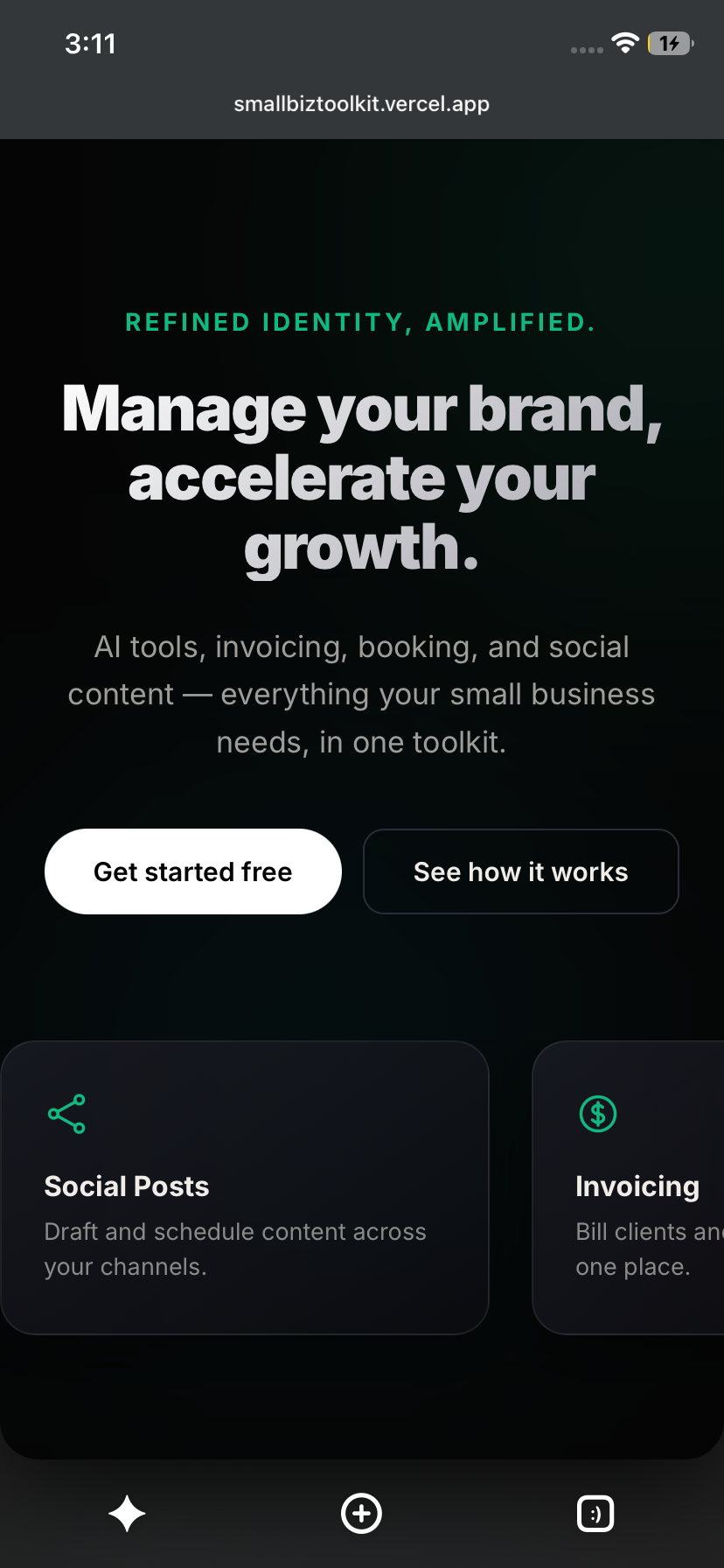
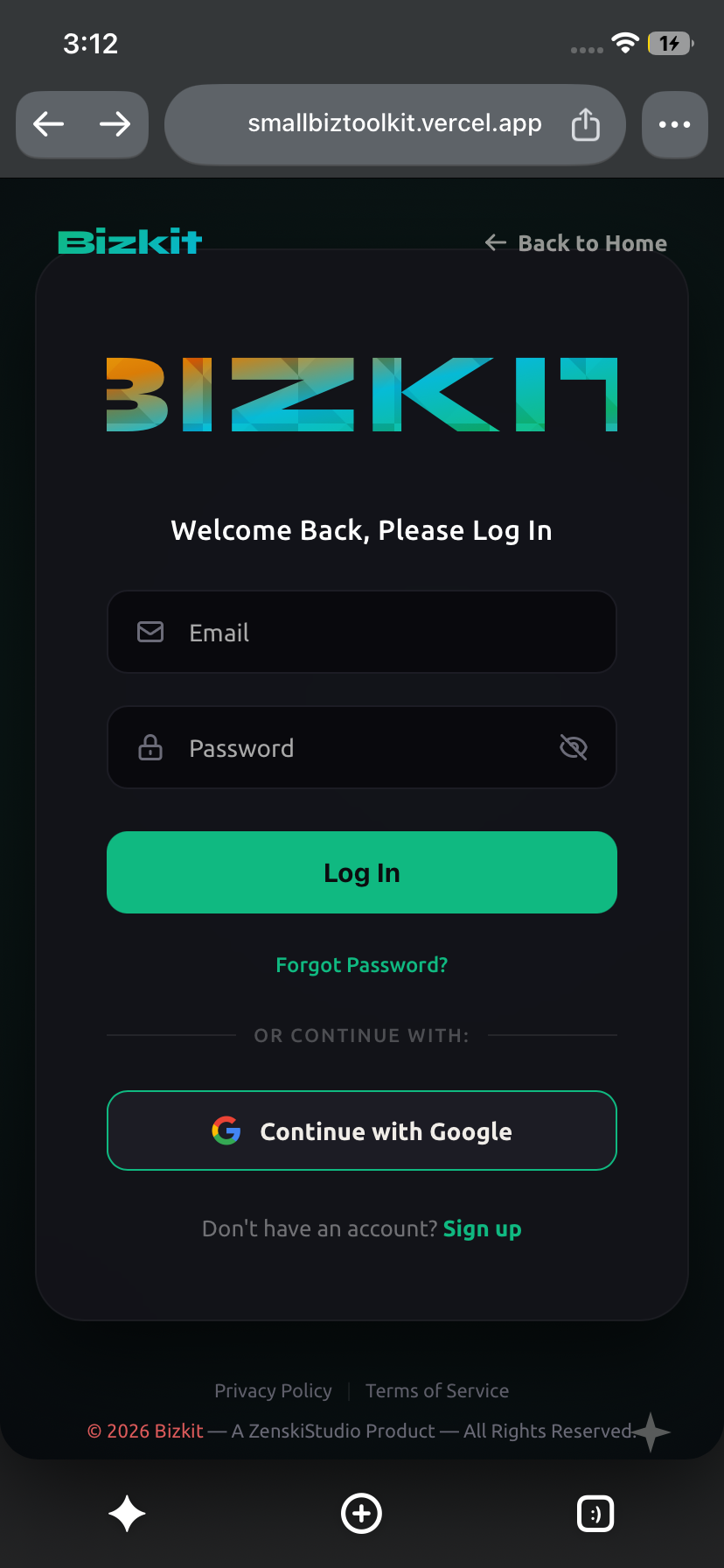
BizKit is an all-in-one digital business toolkit designed to help small business owners manage, organize, and grow their businesses from a single platform.
Rather than treating business management as a collection of disconnected tasks, BizKit brings essential tools such as business records, invoicing, customer management, marketing, productivity, and AI-assisted support into one simple and accessible experience.
The goal of BizKit is to make modern business technology accessible to small businesses that may not have the resources, technical knowledge, or budget to use multiple complicated business-management systems.
BizKit is more than a business management tool; it is designed as a digital growth partner for small businesses.
Live Project: https://smallbiztoolkit-l84z.vercel.app/
The Problem
Small business owners often have to manage many different aspects of their businesses simultaneously.
A typical business owner may need to:
- Track sales and business records
- Create and manage invoices
- Keep customer information organized
- Monitor business activity
- Promote products and services
- Communicate with customers
- Make financial and operational decisions
- Maintain records
- Learn how to use different digital tools
- Manage multiple applications and services
These responsibilities can become difficult when the business relies on spreadsheets, notebooks, messaging applications, separate invoicing tools, social-media platforms, and other disconnected services.
Many existing business-management platforms can also be too complicated, expensive, or designed primarily for larger organizations.
BizKit addresses this gap by bringing essential business tools together in a simpler, more approachable platform.
The Solution
BizKit provides small business owners with a centralized workspace where they can access tools that support both the day-to-day operation and long-term growth of their business.
Instead of requiring a business owner to learn and manage several different platforms, BizKit aims to provide a single environment for:
- Business management
- Record keeping
- Invoicing
- Customer management
- Marketing
- AI assistance
- Business organization
- Productivity
- Growth-oriented decision making
The platform is designed around the needs of the business owner rather than around complicated technical systems.
Vision
The long-term vision for BizKit is to become a digital operating system for small businesses.
BizKit aims to give entrepreneurs access to the same types of digital capabilities that larger companies use, while keeping those capabilities simple, affordable, and accessible.
The broader vision is:
Give every small business a digital growth partner.
Core Objectives
BizKit was built around several major objectives.
1. Simplify Business Management
Create one centralized platform where entrepreneurs can access important business-management tools without constantly switching between applications.
2. Improve Record Keeping
Help businesses maintain organized digital records instead of relying entirely on paper records, scattered spreadsheets, or informal notes.
3. Simplify Invoicing
Make it easier for businesses to create, manage, and organize invoices and keep track of transactions.
4. Improve Customer Management
Give business owners a structured way to organize customer information and maintain better relationships with their customers.
5. Make AI Accessible
Use artificial intelligence as a practical business assistant rather than presenting AI as a complicated technical feature.
AI can potentially help business owners with tasks such as generating ideas, writing marketing content, analyzing business information, and providing guidance.
6. Support Business Growth
BizKit is designed not only to help businesses operate but also to help them improve their visibility, organization, customer relationships, and decision-making.
Key Features
Business Dashboard
The dashboard serves as the central workspace for the business.
It can provide business owners with an overview of important information and activities, allowing them to quickly understand what is happening within their business.
A centralized dashboard reduces the need to search through multiple applications to find important information.
Business Records
BizKit provides tools for maintaining digital business records.
Instead of depending entirely on physical notebooks or scattered documents, business information can be organized digitally.
This can make it easier to:
- Find historical information
- Review business activity
- Maintain organized records
- Monitor transactions
- Make informed decisions
Reliable record keeping also creates a stronger foundation for future business analytics.
Invoicing
The invoicing system is designed to simplify one of the most common administrative tasks for small businesses.
Business owners can create and manage invoices while keeping transaction information organized.
A future expansion of the invoicing system could include:
- Invoice templates
- Customer information
- Automatic invoice numbering
- Payment status
- Invoice history
- PDF generation
- Digital sharing
- Payment reminders
This makes invoicing less dependent on manually creating documents.
Customer Management
Customer management allows business owners to keep important customer information organized.
Rather than storing customer details across different applications, BizKit can provide a centralized customer database.
This creates the foundation for features such as:
- Customer profiles
- Contact information
- Purchase history
- Customer notes
- Communication history
- Customer segmentation
- Follow-up reminders
Better customer organization can help businesses build stronger long-term relationships.
AI Business Assistant
One of BizKit's major differentiating features is the integration of artificial intelligence.
The AI component is intended to act as a digital business assistant.
Instead of simply adding an AI chatbot for novelty, BizKit can use AI to help business owners solve practical problems.
Potential applications include:
Business Advice
The assistant can help entrepreneurs think through business challenges and identify possible approaches.
Marketing Assistance
AI can help generate:
- Social-media ideas
- Promotional content
- Product descriptions
- Advertisements
- Marketing campaigns
- Captions
- Business announcements
Business Analysis
As BizKit accumulates structured business data, AI can potentially help identify trends and provide understandable insights.
For example, the system could help answer questions such as:
"Which products are performing best?"
or:
"What should I focus on improving this month?"
Productivity
The AI assistant can also help business owners organize tasks, summarize information, and plan activities.
The objective is to make AI useful to people who may not have previous experience working with AI tools.
Marketing Tools
Marketing is one of the areas where small businesses often need support.
BizKit is designed to make marketing assistance accessible alongside other business tools.
Possible marketing capabilities include:
- Campaign planning
- Social-media content generation
- Promotional ideas
- Product descriptions
- Customer communication
- Marketing copy
- Business announcements
- Content ideas
By connecting marketing with business information, BizKit can eventually provide more personalized recommendations rather than generic marketing suggestions.
Unified Business Experience
One of BizKit's central principles is reducing fragmentation.
Instead of having:
One application for invoices
Another for customers
Another for marketing
Another for AI
Another for records
BizKit brings these capabilities into one ecosystem.
This creates a simpler workflow:
Manage → Record → Understand → Market → Grow
The goal is to allow the business owner to spend less time managing tools and more time managing the actual business.
Target Users
BizKit is primarily designed for:
- Small business owners
- Entrepreneurs
- Freelancers
- Independent professionals
- Local businesses
- Online businesses
- Startups
- Service providers
- Small retail businesses
- Growing businesses transitioning from manual record keeping to digital systems
The platform is especially useful for businesses that are ready to adopt technology but do not want the complexity of enterprise-level software.
User Experience
BizKit follows a simplicity-first approach.
The interface should allow a business owner to understand the platform without requiring technical expertise.
The intended experience is:
- Open BizKit
- Understand the current state of the business
- Select the task that needs attention
- Complete the task
- Save the information
- Use the resulting data to make better decisions
This approach reduces unnecessary complexity and helps technology become part of the normal business workflow.
Technology
BizKit is deployed as a modern web application and is hosted through Vercel.
Deployment: Vercel
Application Type: Web application
The architecture can be extended with a backend and database infrastructure to support persistent business data, authentication, AI services, analytics, customer records, invoicing, and other business functionality.
The platform can also be designed to integrate with external services through APIs as the project grows.
Scalability
BizKit is designed with the possibility of expanding beyond a basic business-management application.
Future versions could introduce:
Payments
Integration with payment providers could allow businesses to track or receive payments directly through the platform.
Advanced Analytics
Business owners could receive dashboards showing:
- Revenue trends
- Sales performance
- Customer growth
- Product performance
- Business expenses
- Monthly comparisons
AI-Powered Insights
AI could analyze business data and automatically highlight important trends.
Automated Marketing
BizKit could eventually generate and schedule marketing campaigns based on a business's products, customers, and goals.
Inventory Management
Businesses selling physical products could track:
- Stock levels
- Product movement
- Low-stock alerts
- Suppliers
- Inventory value
Mobile Application
A mobile version could allow business owners to manage their businesses directly from their phones.
Integrations
BizKit could eventually connect with:
- Payment platforms
- Accounting systems
- Social-media platforms
- Email services
- Messaging platforms
- Cloud storage
- E-commerce platforms
This would transform BizKit from a standalone toolkit into a broader business ecosystem.
Security and Privacy
Because BizKit deals with business and potentially customer information, security and privacy should be treated as fundamental parts of the platform.
Important areas include:
- Secure authentication
- Access control
- Data encryption
- Secure API communication
- Protection of customer information
- Secure database storage
- Input validation
- Protection against unauthorized access
- Secure handling of AI requests
- Data backup and recovery
As the platform develops, privacy-by-design principles should be incorporated into the architecture rather than added later.
Business Impact
BizKit aims to reduce the technological barrier faced by small businesses.
A business owner should not need a technical team to benefit from modern technology.
By combining business management, AI, marketing, records, invoicing, and customer management, BizKit can help small businesses:
- Save time
- Stay organized
- Reduce manual work
- Improve customer relationships
- Make better decisions
- Improve their marketing
- Digitize business processes
- Understand their business data
- Prepare for future growth
The ultimate goal is not simply to digitize existing processes, but to give small businesses better tools for competing and growing in a digital economy.
Development Philosophy
BizKit is being developed around a simple principle:
Technology should adapt to the business owner, not force the business owner to adapt to technology.
Every feature should therefore answer a practical question:
Does this make running a small business easier, faster, clearer, or more effective?
This philosophy helps prevent the platform from becoming overloaded with unnecessary features.
Future Roadmap
Phase 1 — Foundation
- Core interface
- Business dashboard
- Basic records
- Customer management
- Invoicing
- Initial marketing tools
Phase 2 — Intelligence
- AI business assistant
- AI marketing generation
- Business insights
- Automated recommendations
- Smart search
Phase 3 — Automation
- Automated invoices
- Payment tracking
- Marketing automation
- Customer follow-ups
- Notifications
- Business reminders
Phase 4 — Ecosystem
- Payment integrations
- Accounting integrations
- Social-media integrations
- E-commerce integrations
- Mobile application
- Advanced analytics
- Third-party integrations
Phase 5 — Digital Growth Partner
The long-term goal is for BizKit to evolve from a collection of business tools into an intelligent business platform capable of understanding a company's operations and helping its owner make better decisions.
Conclusion
BizKit is designed to solve a simple but important problem: small businesses need better access to technology without the complexity that often comes with it.
By bringing business management, AI, marketing, record keeping, invoicing, and customer management together, BizKit creates a foundation for a more connected and accessible way of running a small business.
The project is ultimately about more than software.
It is about giving small business owners the digital tools, intelligence, and organization they need to operate confidently and grow.
BizKit — Your digital growth partner for small business.
Built With
- claude
- javascript
- next.js
- sql
- supabase
- vercel

Log in or sign up for Devpost to join the conversation.