A. The problem our project solves?
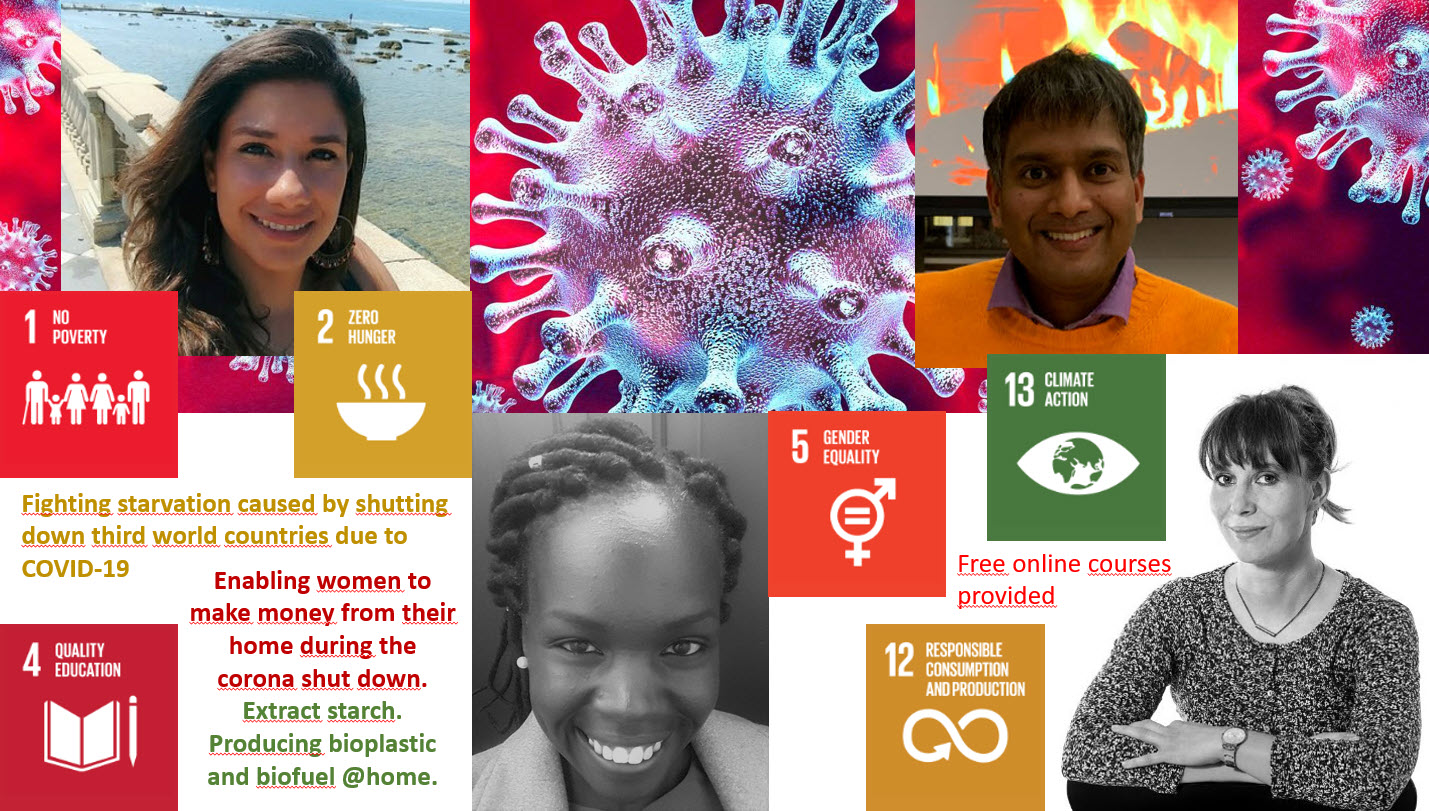
COVID19 has shut down everything, and many people lose their job. This is really serious in the 3rd world countries because no income means no food. In fact, the population in this part of the world fear starving more than they fear the Corona-virus itself. Here is an example from Zimbabwe
However, waste products from the production of cassava, coffee and coconut can be recycled to a new production of bioplastic and biofuel. We want to make people work from their own home with this kind of production. Because it will earn them a new income as self-employed, minimize the risk of infection and support bioproduction at the same time. As a part of the project, we hire female leaders to handle daily leadership. This is to prevent sexual harassment and support equality between genders.
B. The solution we bring to the table?
We have hired our first contact in Sri Lanka, who owns a house. The house has a good location according to infrastructure, and a small investment has made us able to start production very soon. Besides we are working to expand the idea to other 3rd world countries. According to the United Nations World Food Programme the consequences of COVID19 is a big threat to 3rd world countries because of the lack of safety-net systems:
“Safety-net systems are critical lifelines to help stem the negative economic and nutritional impacts of COVID-19. Many developing countries, however, lack safety-net systems to fill that void. In fact, less than 20 percent of people living in low-income countries have access to social protections of any kind, and even fewer have access to food-based safety nets.”
Source: United Nations World Food Programme
C. What we have done during the weekend?
We have done a lot of research on the products, production and possibilities of transport of the goods from our location. We have also expanded our network to other parts of the world than Sri Lanka to see if it is possible to work from Kenya and Uganda.
D. The solution’s impact on the crisis?
Our solution helps a population to work themselves out of the crisis, during local circumstances they would have a hard time handling without structural (and financial) help from someone with more resources to cope during an international crisis. We believe that self-employment will be a better help in the long term than immediate cashflow. As United Nations World Food Programme does:
“Out of 65 countries where recent adverse impacts of economic slowdowns and downturns on food security and nutrition have been strongest, 52 countries rely heavily on primary commodity exports and/or imports.”
Source: State of Food Security and Nutrition in the World report, 2019
The fact that the production can be done from our partners own homes makes it possible to keep the social distance, required by the government to minimize the risk of infection. In addition, the final products are goods that are used daily in most households. This will keep the communal economy running during crisis – and even after the crisis, as we got potential to expand production as markets open after lockdown.
Having different kinds of products, both in waste-production materials and final products also increases the market competition in the local market of the countries that we choose to work with.
E. The necessities in order to continue the project?
First of all – we need a timeline, budgets and test-cases.
At the moment we have looked into the costs, taxes, rules and certification of shipping in the possible locations. As long as we still have the COVID19-lockdown it is difficult to transport anything, but we want to be ready as soon as gates open again. Until that happens, we can start the training of our partners using our free online education platform.
We have to educate our partners on the chosen locations. At the moment have set up a “mock-page” with 2 online courses for production with cassava.
We also need to establish contracts with more partners in the business of selling our products in Denmark (B2B). So far, we have established one contact in Denmark who is very interested in our goods.
F. The value of your solution(s) after the crisis?
Building everything on self-employment for our partners in 3rd world countries as well as Denmark and ourselves, we believe in great value for our solution after the crisis.
Our business model has the potential to grow to more places in the world. With our business, we can create job security, financial independence and new skills to our partners in the 3rd world countries. We hope to experience involvement from both population and government and to reduce gender inequality by creating a network of women in agribusiness and increase income to themselves and their families affected by the COVID19-lockdown.
The project works well with United Nations Sustainable Development Goals:
• goal 1 no poverty
• goal 2 zero hunger
• goal 4 quality education
• goal 5 gender equality
• goal 12 responsible consumption and production
• goal 13 climate action
This means that our project is not just about employment, education, production, gender, climate or starvation. They are all connected, and even if COVID19 has made this extra clear to us, it will still be like that after the crisis. Or as United Nations Food Programme puts it:
“To ensure that structural transformation is pro-poor and inclusive requires integrating food security and nutrition concerns into poverty reduction efforts, while ensuring that reducing gender inequalities and social exclusion of population groups is either the means to, or outcome of, improved food security and nutrition.”
Source: State of Food Security and Nutrition in the World report, 2019
That is why we need to consider all the elements in our future work with the project.
Built With
- .net
- blazor
- cassava
- coconut
- governance


Log in or sign up for Devpost to join the conversation.