-
-
-
-
-
-
-
-
-
-
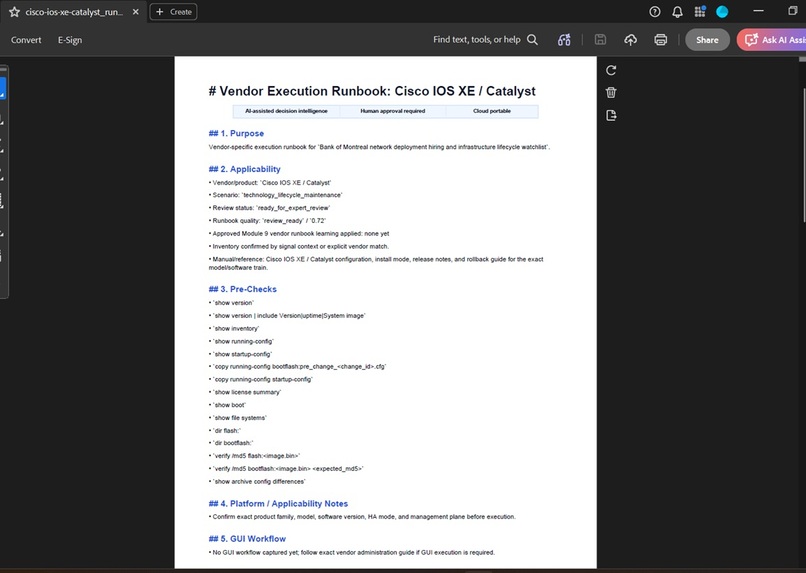
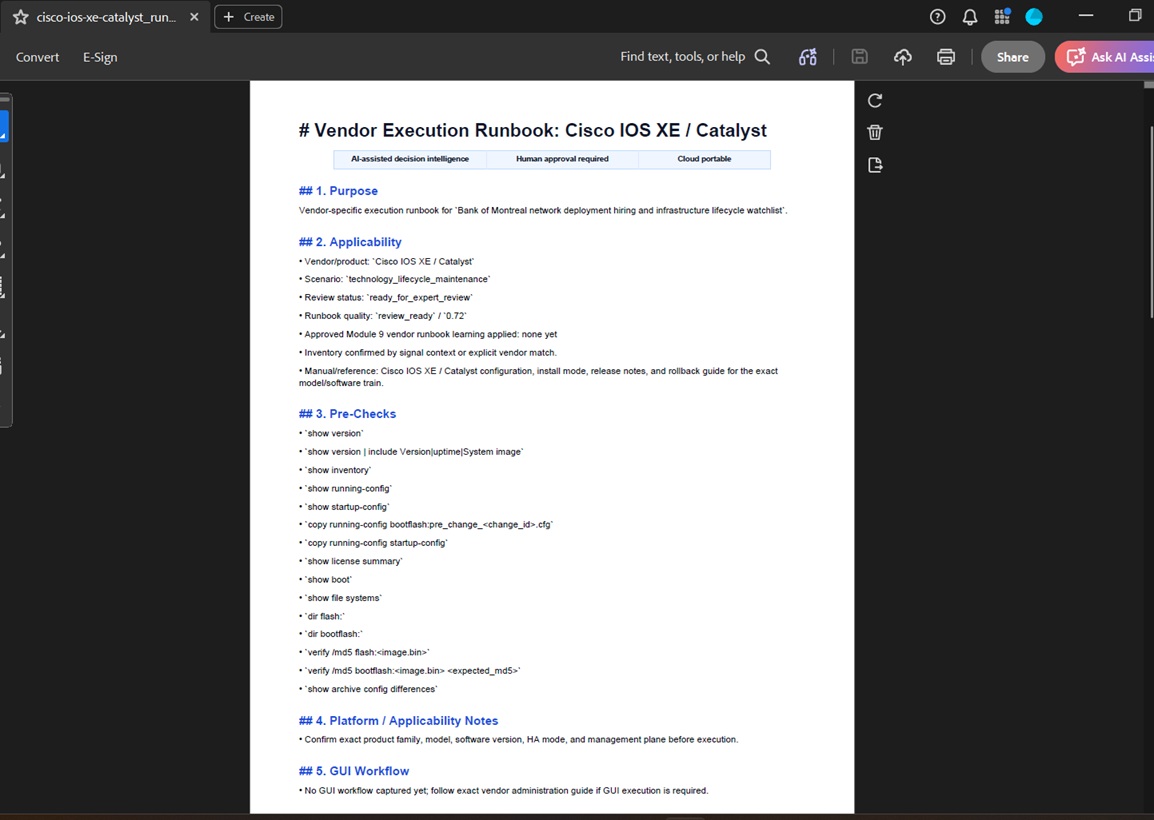
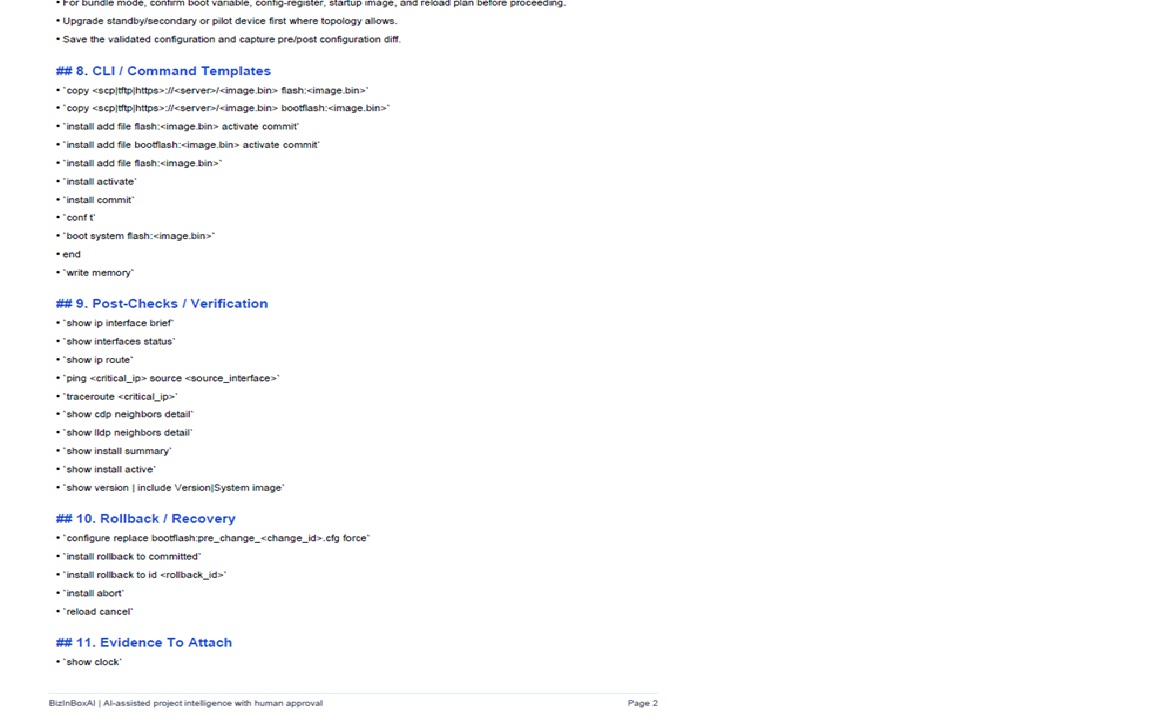
downloadable runbooks
-
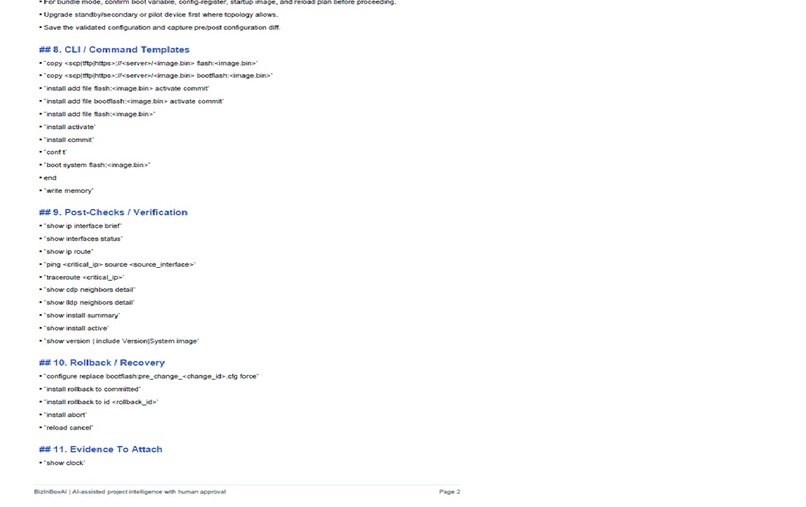
Clear rollback on the runbooks
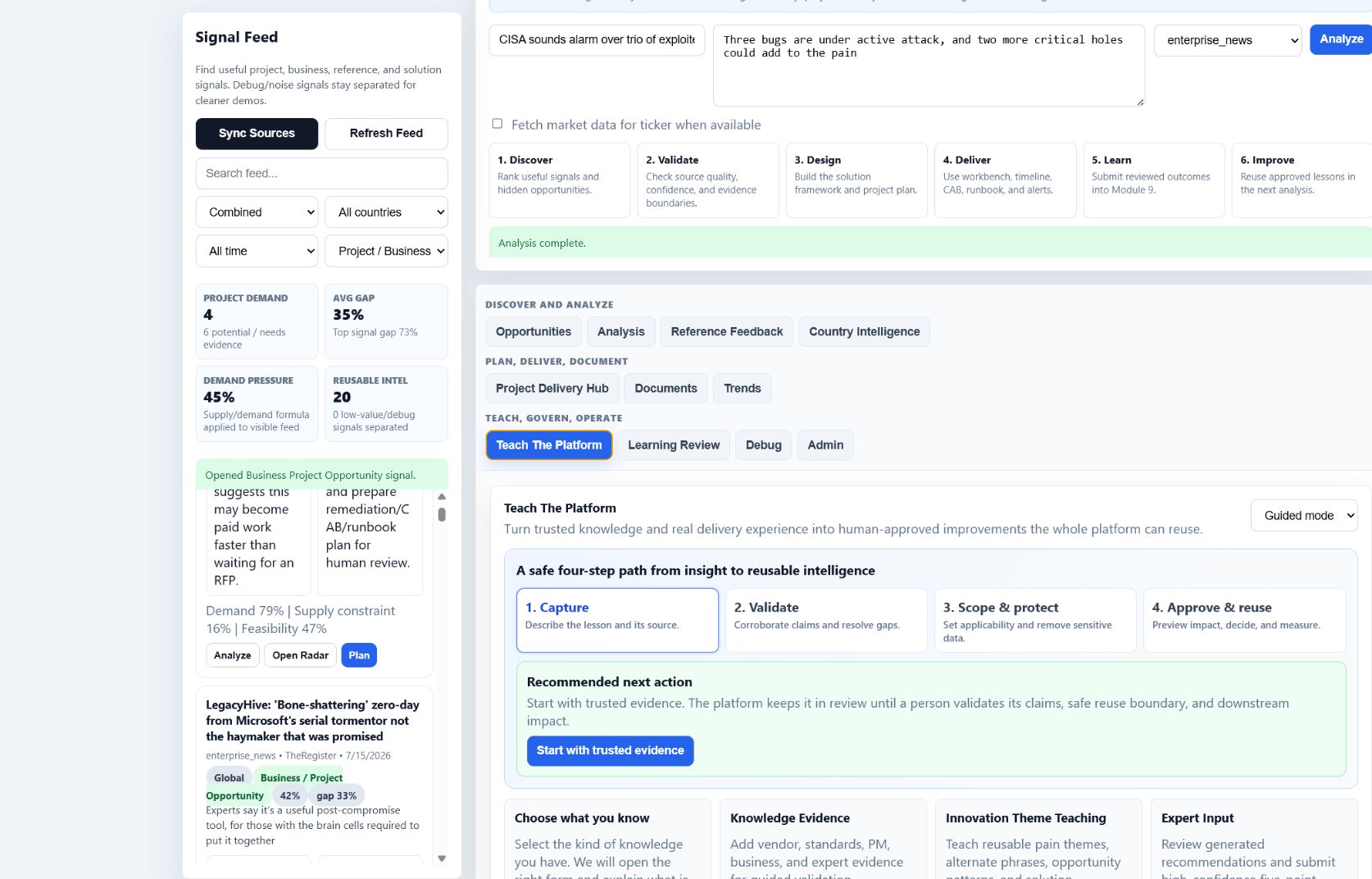
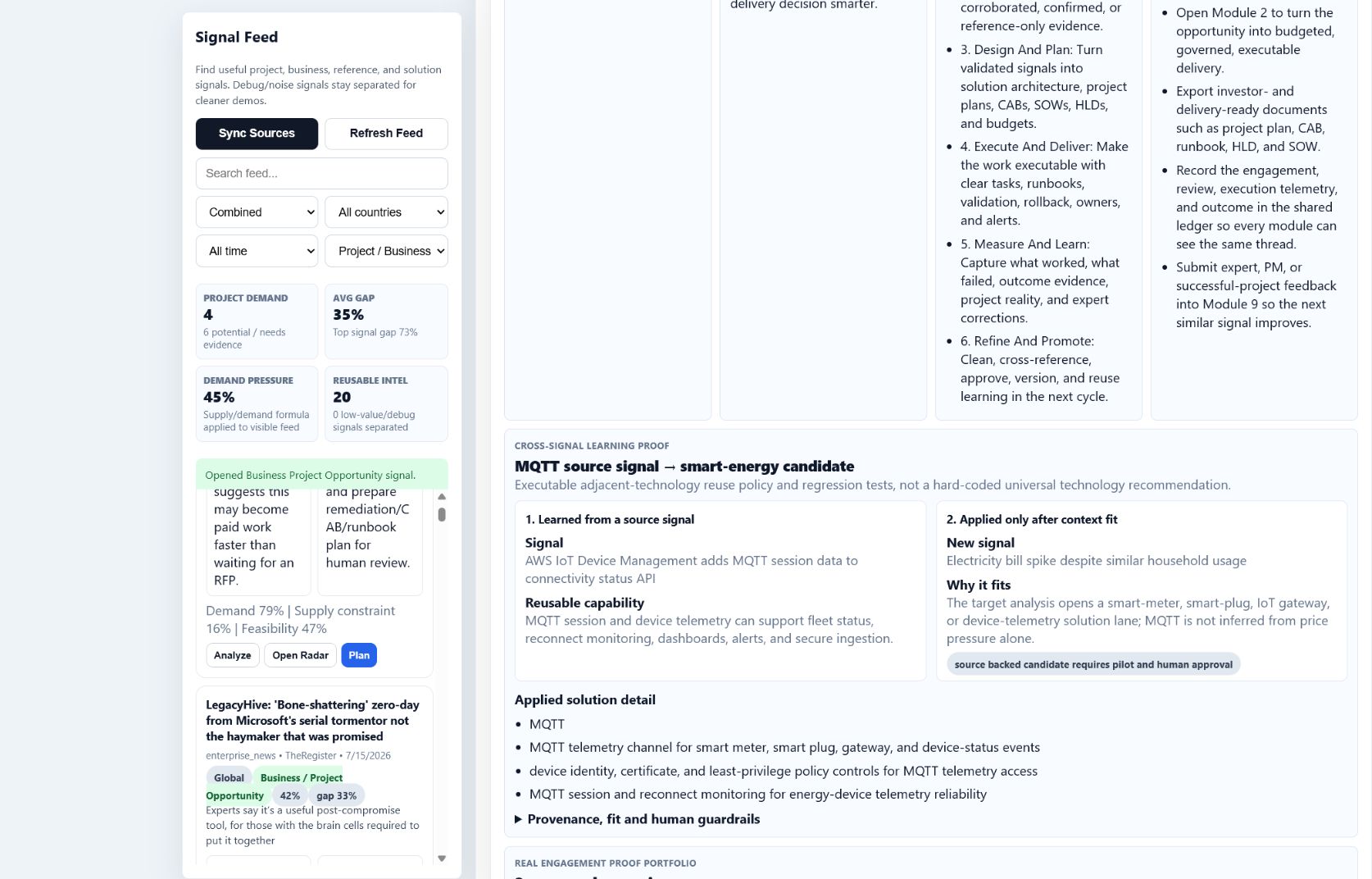
Judge quick start
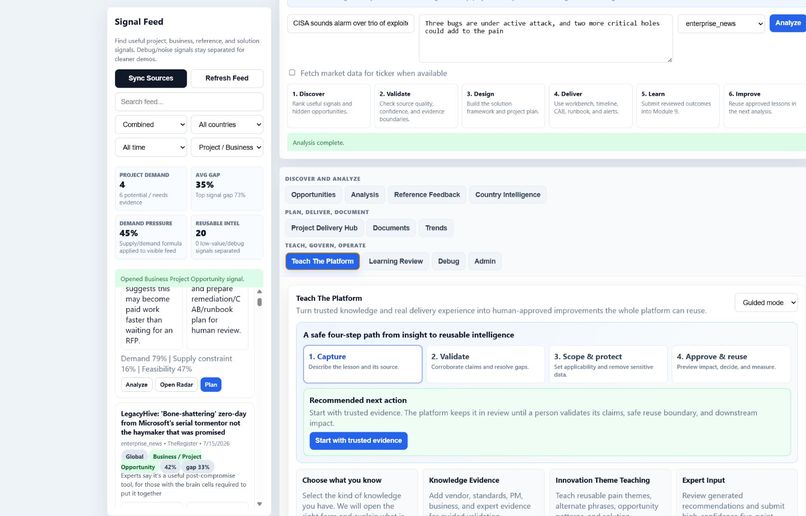
BizInBox turns weak business and technical signals into evidence-bounded opportunities, human-approved delivery plans and governed learning. In the 2:45 demo, a CISA SharePoint signal becomes a remediation and CAB-ready execution package, while MQTT knowledge transfers into smart energy only when context, evidence and human approval support it. The working judge path runs locally without an API key.
90-second proof path
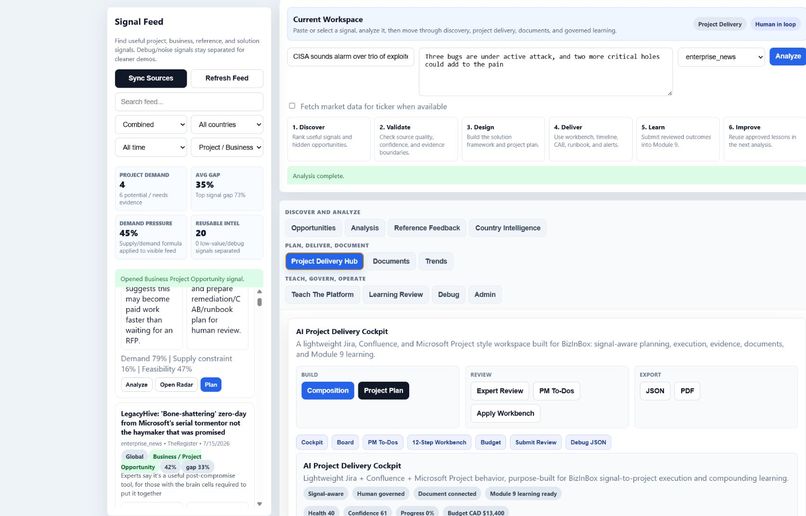
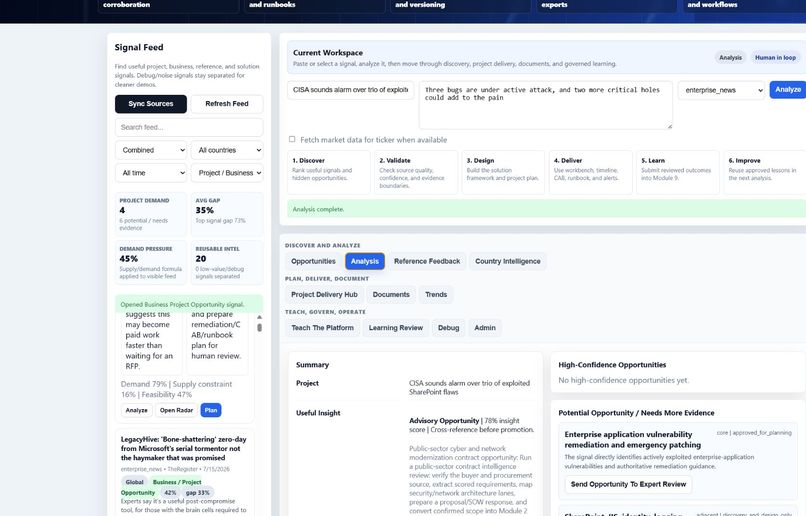
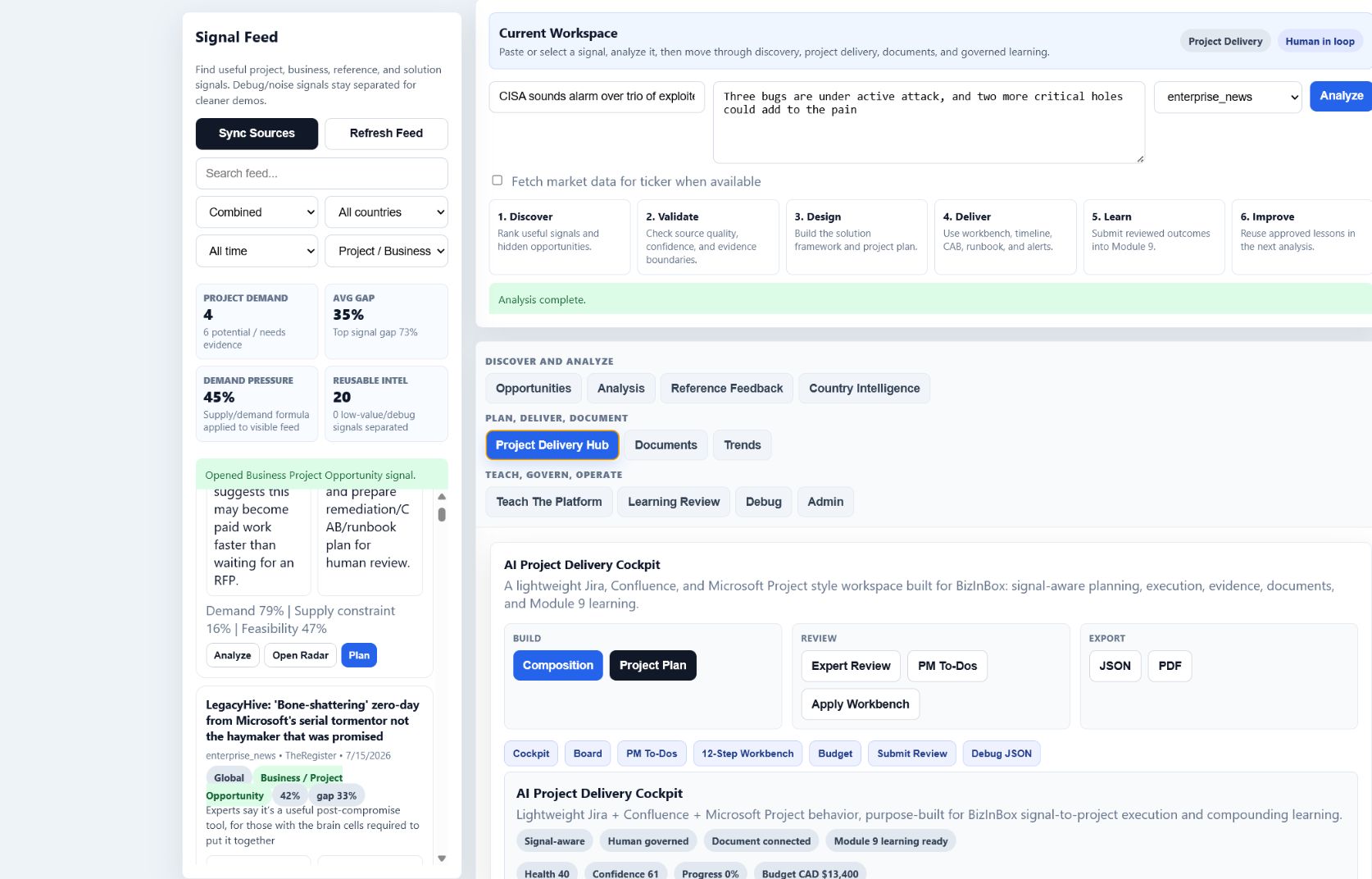
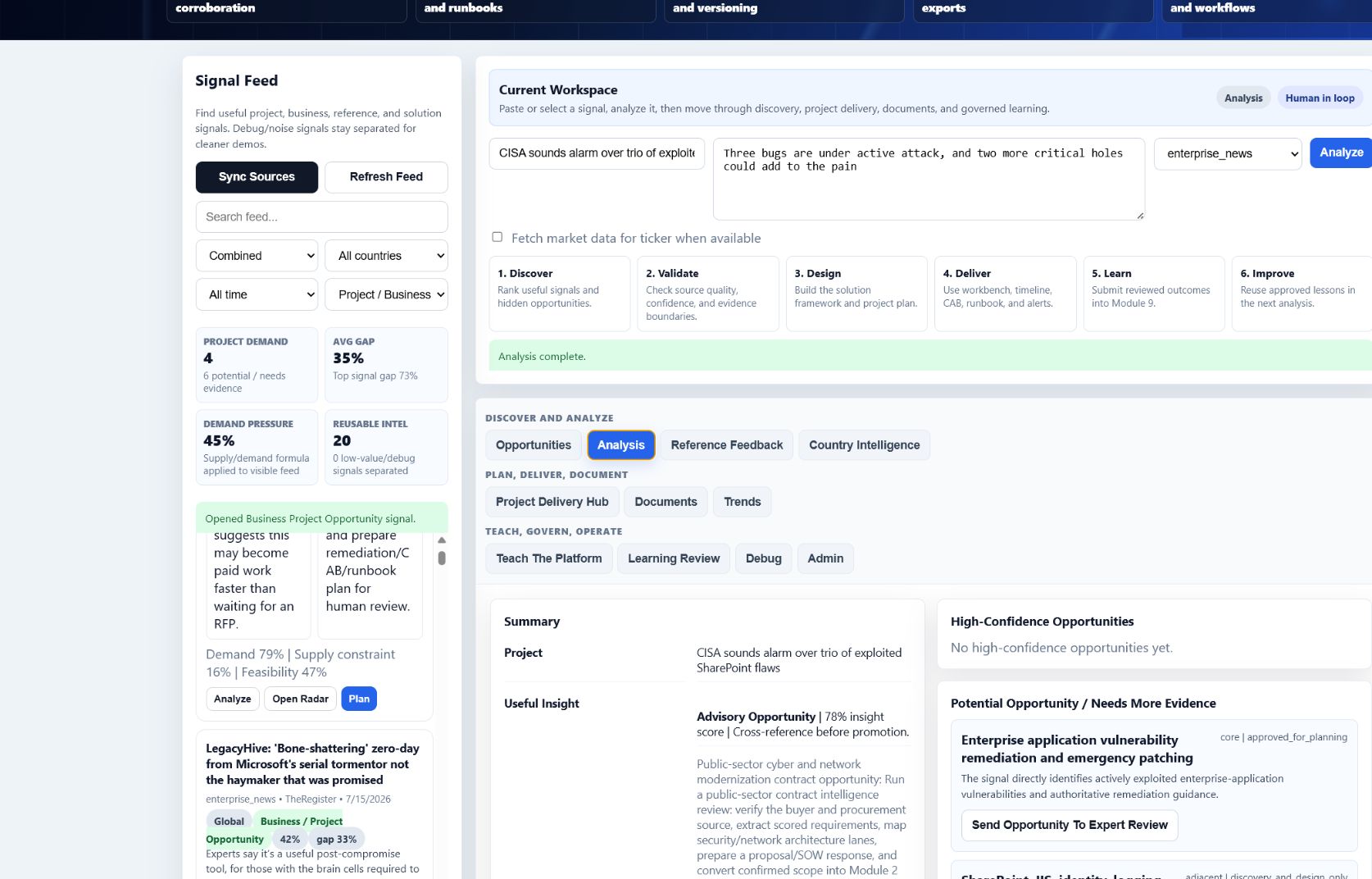
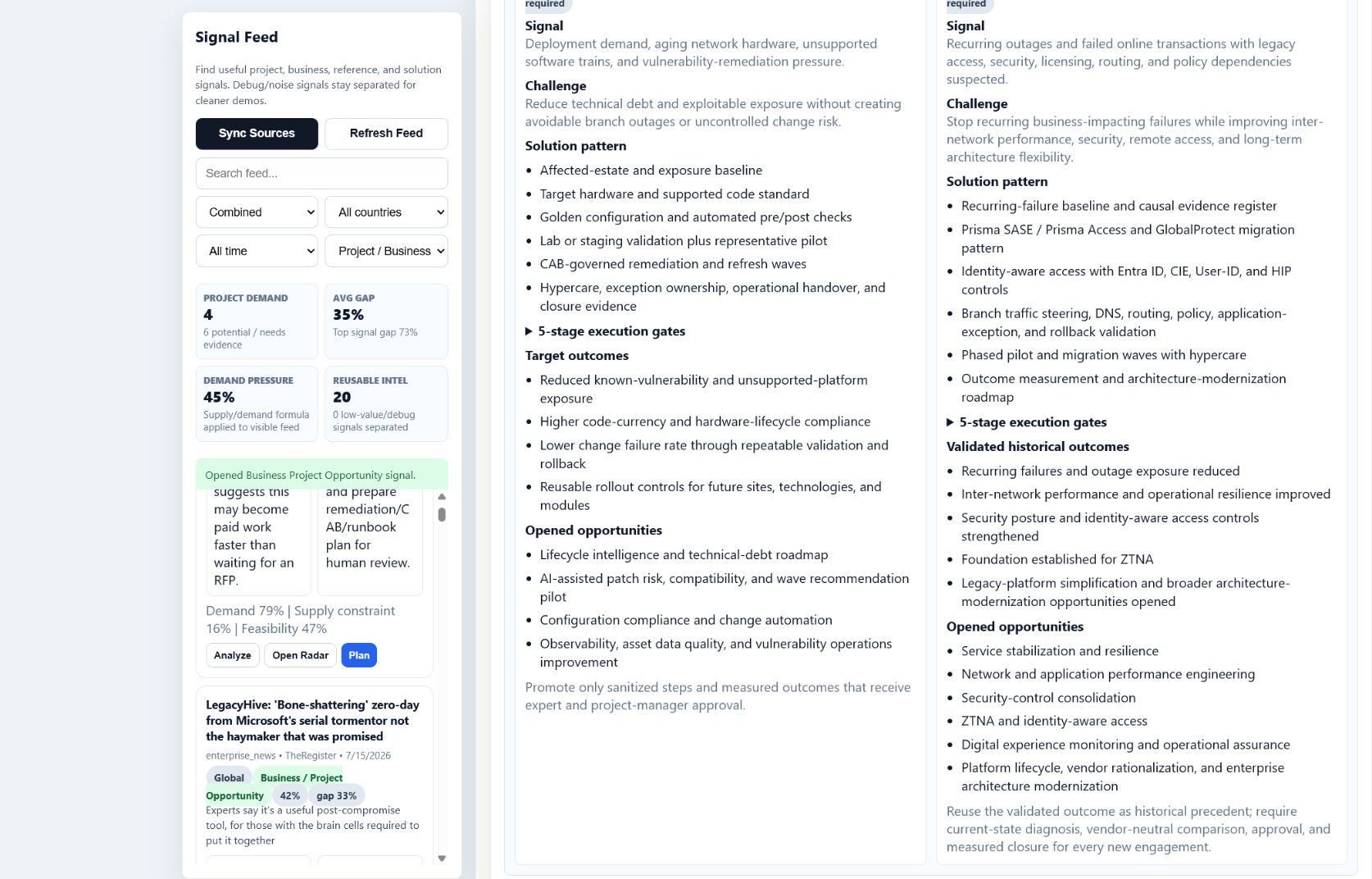
Analyze the CISA SharePoint signal and compare core remediation, adjacent hardening, conditional ZTNA and strategic cloud-modernization gates. Open the Project Delivery Hub and inspect owners, validation, rollback, acceptance evidence and all nine CAB field groups. Open Teach The Platform and Readiness to inspect sanitization, human approval, MQTT-to-energy transfer and the sanitized hardware/code-refresh and Prisma SASE precedents.
Evidence-gating note: a sparse signal may intentionally show “No high-confidence opportunities yet.” That is not a missing result. It means the evidence-backed remediation path remains reviewable without silently promoting uncorroborated transformation scope.
Inspiration
From hidden signals to smarter execution.
A single security advisory, outage, financial change, hiring pattern, complaint or procurement notice can hide a valuable project—or tempt a team into proposing a transformation before the evidence supports it. BizInBox was created to help consulting and enterprise delivery teams discover worthwhile opportunities sooner, turn approved opportunities into practical execution, and retain verified lessons so the next engagement starts smarter.
What it does
BizInBox is a human-governed opportunity-intelligence and delivery workspace. It connects one traceable lifecycle:
signal → evidence → causal hypotheses → opportunity tiers → human decision → delivery plan → execution outcome → approved learning → smarter next cycle
The working MVP:
classifies business and technical signals while routing weak evidence into research instead of presenting it as fact; corroborates source families, exposes evidence gaps, and separates observation from inference; generates competing causal hypotheses, counter-evidence and falsification tests; separates immediate, adjacent, conditional and strategic opportunities with explicit promotion gates; converts approved scope into phased work packages, risks, architecture guidance, CAB controls, rollback readiness, scenario-aware runbooks, adaptive implementation guidance and measurable acceptance evidence; captures expert corrections, provenance, applicability and sanitization through the Teach Platform, Learning review; and carries a versioned engagement identity across modules so only approved, context-matched learning can improve future work.
The system may recommend, compare and prepare. Humans remain responsible for project approval, production changes, procurement commitments and reusable-learning promotion.
End-to-end proof
The primary demo starts with “CISA sounds alarm over trio of exploited SharePoint flaws.” BizInBox does not jump straight to cloud migration or Zero Trust. It identifies the evidence-backed response first: exposure validation, compromise assessment, emergency patching and recovery readiness. It then preserves server hardening as adjacent discovery, ZTNA as conditional architecture work, and cloud migration as a strategic option requiring a separate business case.
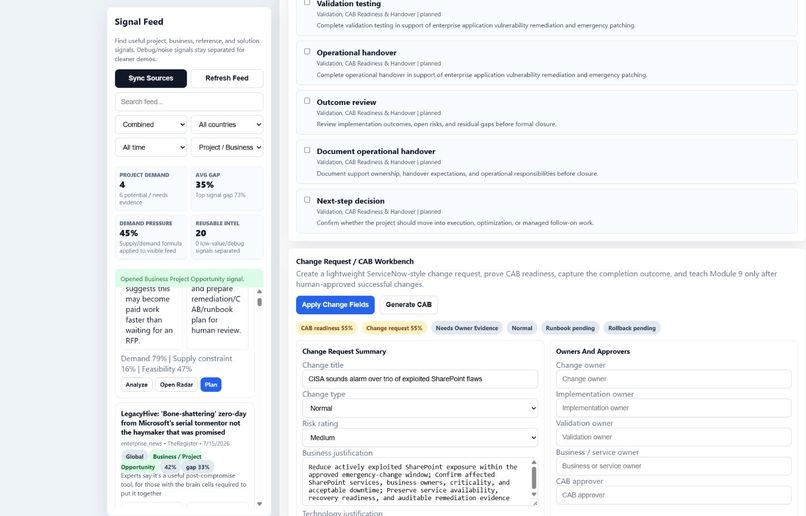
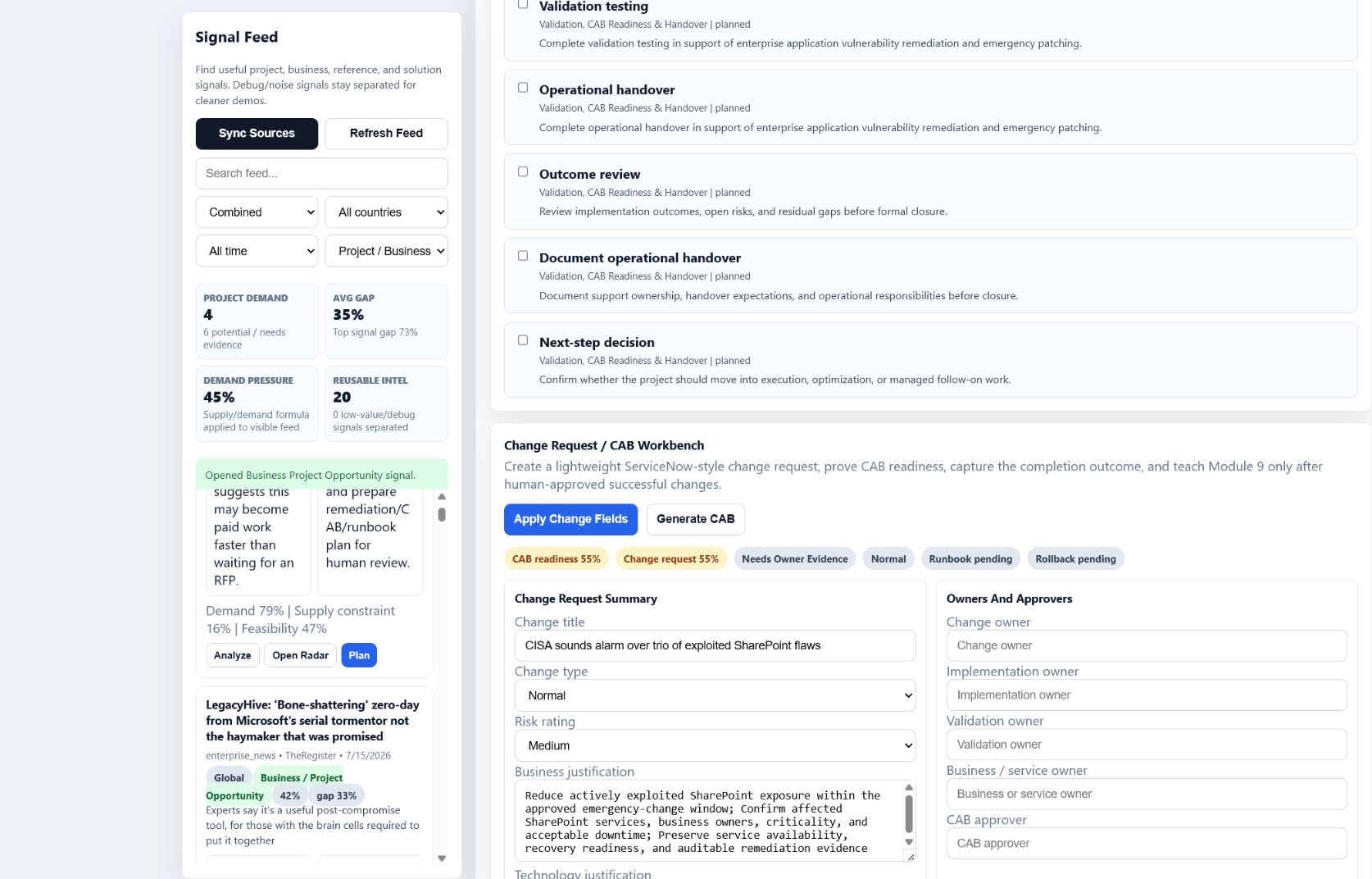
After human scope approval, the Project Delivery Hub produces a phased plan with owners, controls, validation evidence, rollback steps and acceptance gates. Its downloadable CAB record preserves all nine live CAB fields instead of losing operational detail between the screen and the artifact.
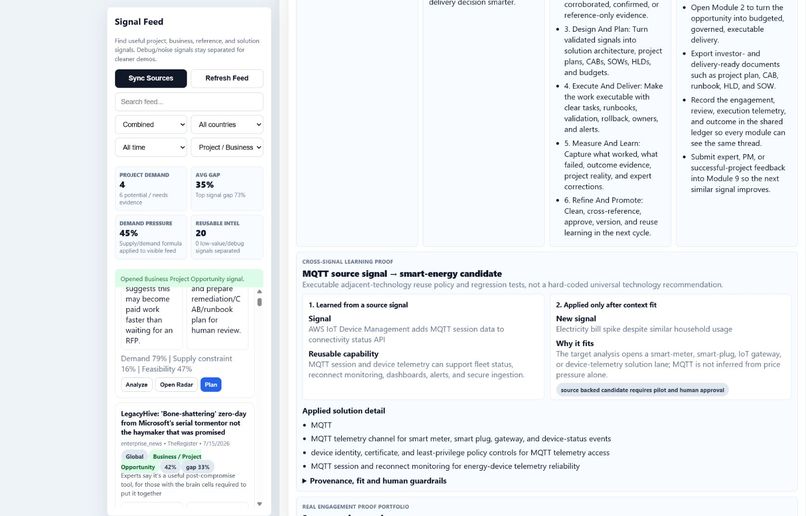
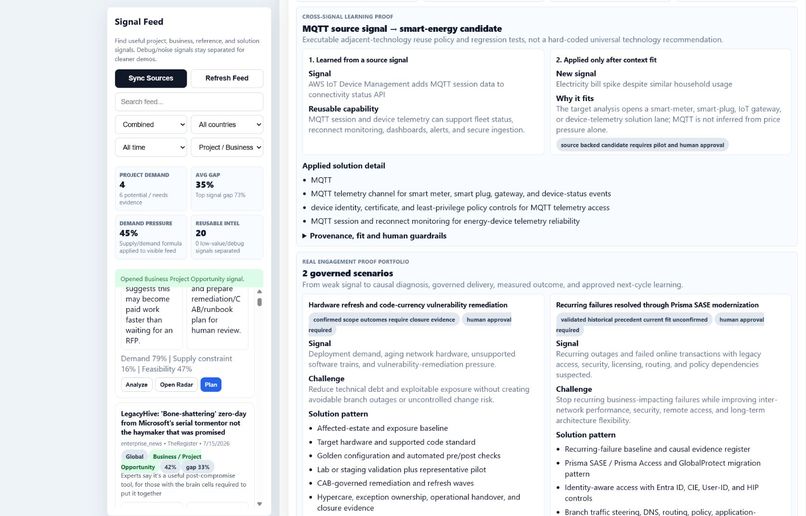
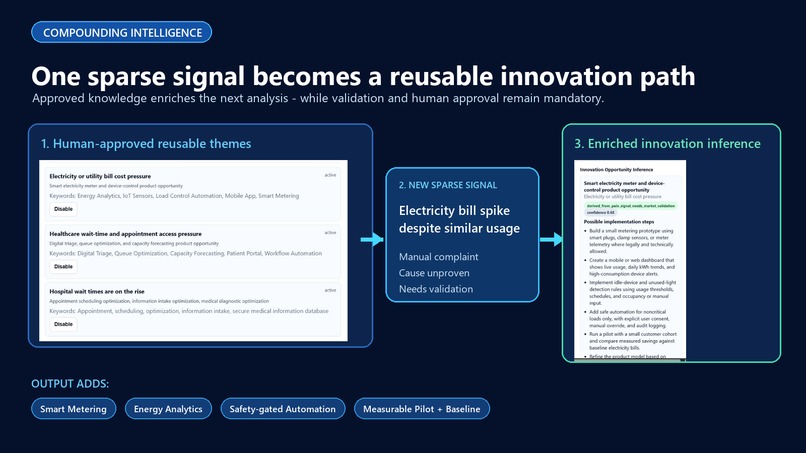
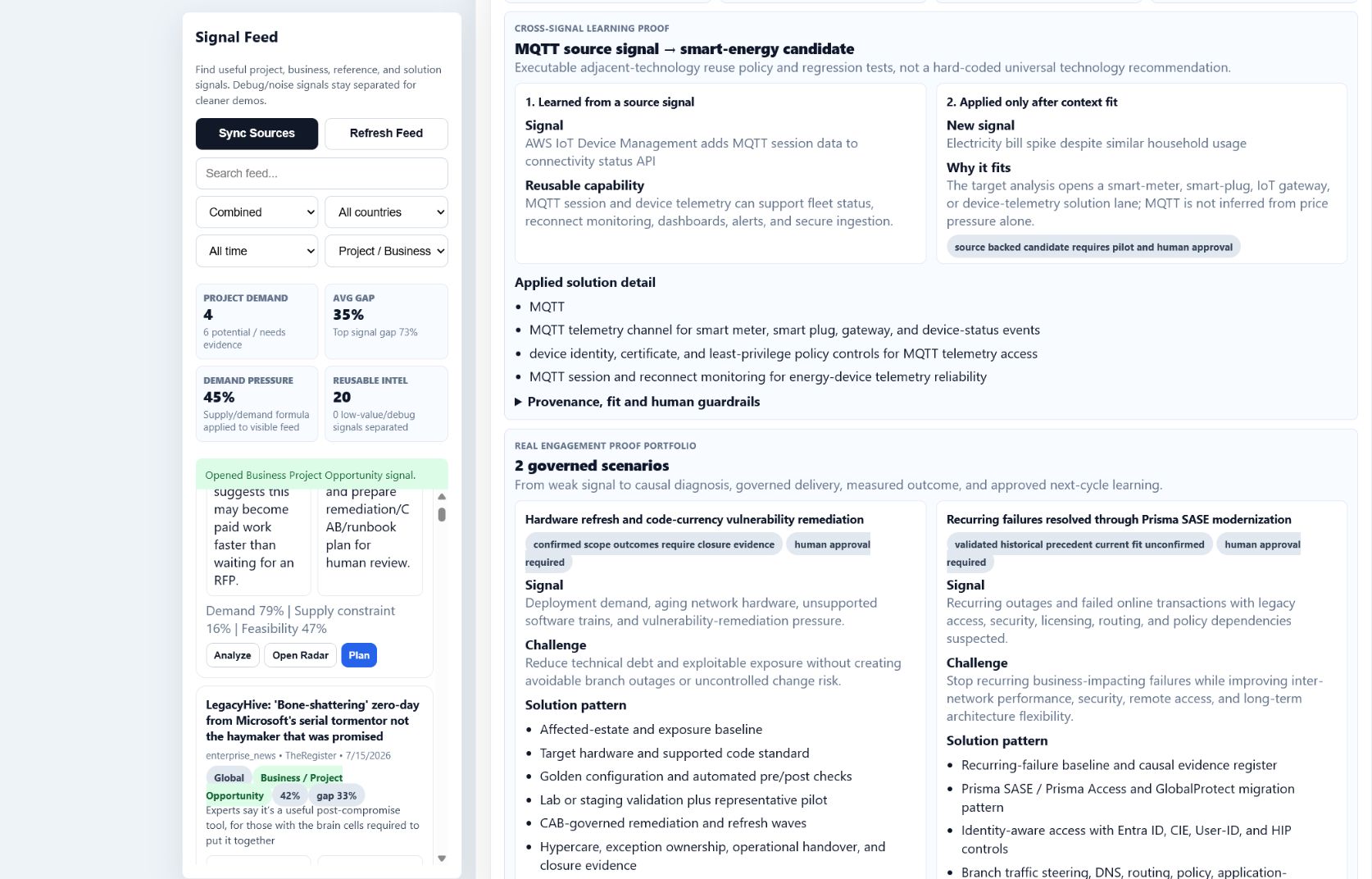
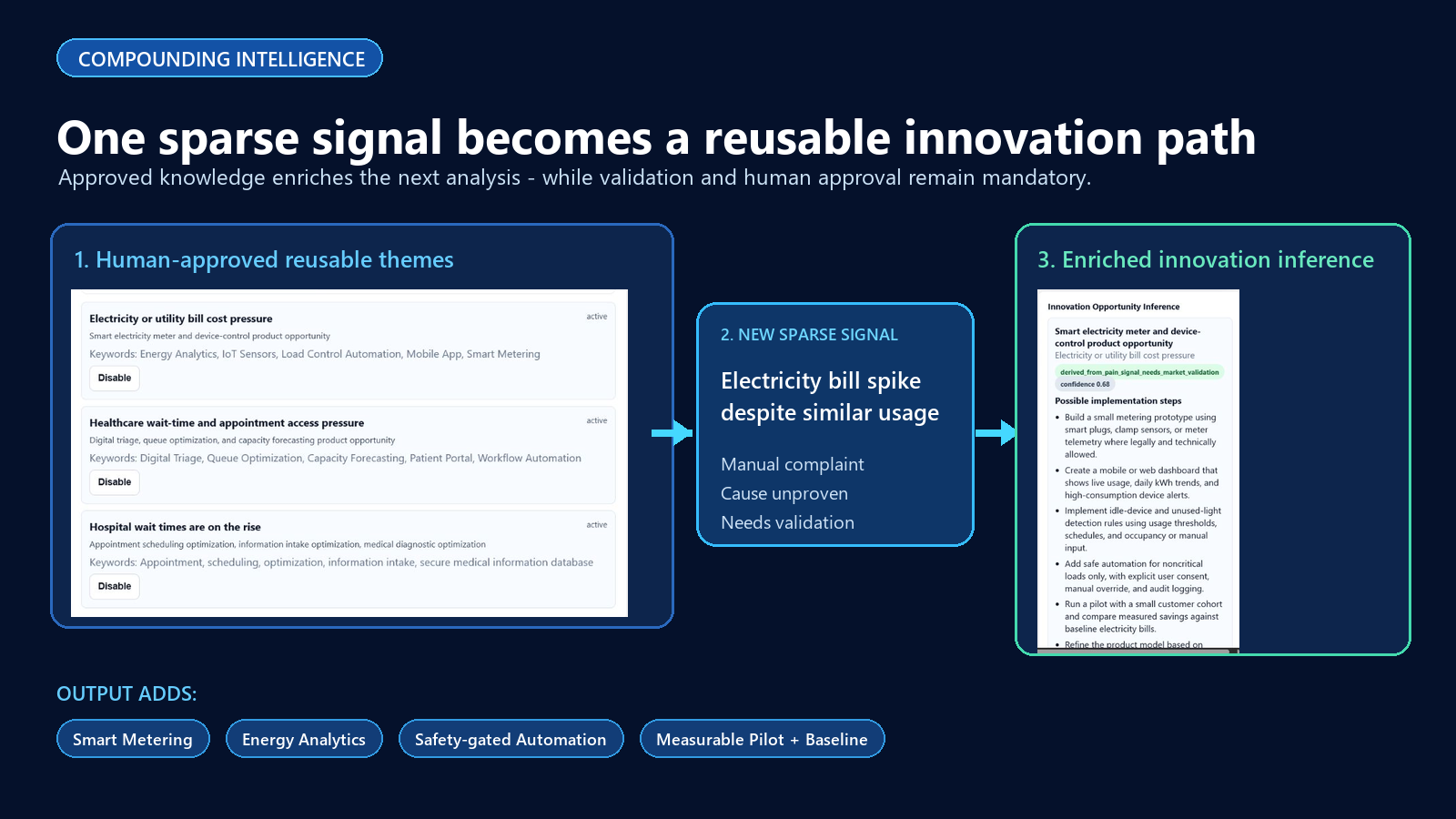
A cross-signal example demonstrates capability transfer rather than scenario memorization. BizInBox learns the source-backed MQTT session and device-telemetry pattern from an AWS IoT signal. When a later electricity-spike signal opens a smart-meter, smart-plug or IoT-gateway lane, MQTT can appear as a bounded candidate with telemetry reliability, device-identity and least-privilege controls. It is not presented as the cause of the price spike, it is not forced into a tariff-only case, and representative-device testing plus human approval remain required.
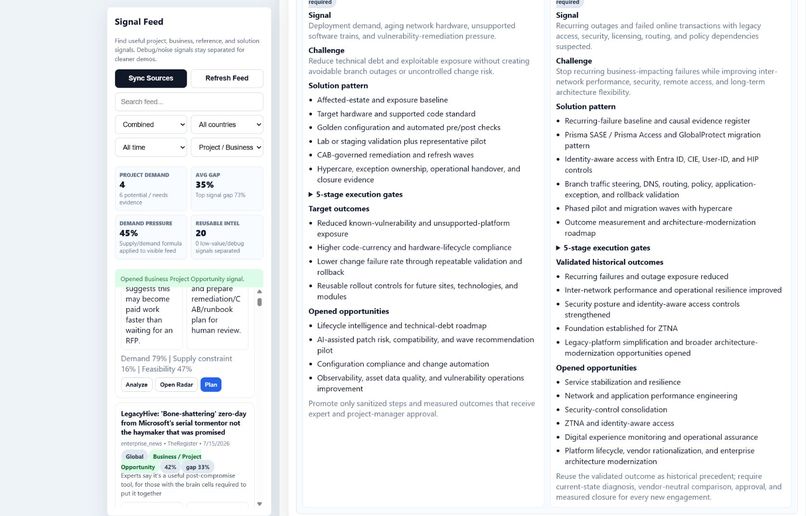
Two sanitized real-project proofs show how precedent compounds without becoming universal truth. A hardware and network-code refresh scenario connects lifecycle pressure to vulnerability remediation and gated execution. A completed Prisma SASE engagement reduced recurring outages, improved network performance and security posture, created a ZTNA foundation, and opened adjacent modernization opportunities. That validated outcome strengthens the next hypothesis; it does not prove current-customer fit.
Why it is different
BizInBox's unit of value is not a chatbot response. It is a reviewable decision package and execution thread: what was observed, what was inferred, what was approved, how it will be delivered, and what was learned.
Unified by design, compounding through every engagement.
Its differentiators are:
Evidence boundaries that retain source quality, corroboration and uncertainty. Opportunity boundaries that keep valuable adjacent ideas visible without silently expanding approved scope. Execution continuity from approved opportunity to delivery-ready work package. Governed compounding requiring provenance, sanitization, applicability, reviewer identity and rationale. Platform-wide continuity: signal analysis, corroboration, causal reasoning, opportunity discovery, human approvals, project delivery, CAB controls, execution outcomes and governed learning share one versioned engagement and evidence chain. Every current—and future—module contributes to and benefits from the same intelligence lifecycle, so knowledge, decisions and execution capability compound instead of resetting at each handoff. Future-module continuity through portable evidence, engagement, decision, execution and outcome contracts. Evolution-ready architecture adds advanced AI and enterprise tools through governed adapters, so new capabilities inherit the same evidence, security, approval, audit and learning controls without fragmenting the platform. Context-matched transfer that reuses capabilities across compatible scenarios while preserving fit tests and human gates. BASRO and KISSERS are compact internal design checks that keep decisions aligned to business intent, architecture, security, privacy, compliance, operations, simplicity, efficiency, resilience and scalability. They do not bypass evidence or human-approval gates.
How we built it
The MVP is a Python and Flask application with a responsive browser workbench, inspectable domain engines, portable JSON contracts, local audit stores, PDF and PowerPoint generation, and an optional OpenAI-backed Admin Assistant.
The modular path is:
source adapters → normalization and signal routing → corroboration and causal reasoning → opportunity policy → human gate → Project Delivery Hub → engagement/outcome ledger → governed learning registry → next-cycle reuse
The deterministic judge path requires no API key. Replaceable adapters allow a future database, queue, vector index, PM tool or model gateway and advanced AI to evolve without rewriting the lifecycle. When separately configured, the Admin Assistant uses the OpenAI Responses API and defaults to GPT-5.6, but remains bounded behind provider and human-approval interfaces.
How Codex and GPT-5.6 were used
Codex was an engineering collaborator, not a one-prompt generator. It helped inspect the package, reproduce incorrect outputs, trace cross-module behavior, implement reviewed fixes, close legacy approval bypasses, create portable contracts, write regression tests and verify live API behavior.
GPT-5.6 was used for the final end-to-end refinement across causal reasoning, domain accuracy, delivery controls, governed learning, capability transfer, responsive presentation, regression tests, smoke test and verification across the platform: scenario-aware causal reasoning, SharePoint and patch-management accuracy, Project Delivery Hub/CAB completeness, the governed Teach Platform, learning review refinement, MQTT-to-smart-energy capability transfer, real-project proof contracts, future-module continuity, responsive presentation and verification.
The participant supplied the product vision and real network, security and IT consulting experience; challenged weak outputs; reviewed domain accuracy; and retained final authority over scope and learning decisions.
Primary Codex feedback session: 019f7280-4065-7d72-a6d1-4f495fc12c36
Challenges and lessons
The hardest design problem was avoiding two opposite failures: treating every interesting clue as a confirmed transformation project, or being so conservative that commercially useful adjacent opportunities disappear. Source-family corroboration, competing hypotheses, counter-evidence, opportunity tiers and named gates address that tension.
The second challenge was safe learning. A raw comment—even a successful project—must not become universal truth. Reusable promotion therefore requires provenance, sanitization, structured applicability, reviewer identity, rationale and quality readiness.
We learned that enterprise users need more than confident recommendations. They need to know why a recommendation exists, what evidence is missing, what would disprove it, and who approved the next step. The strongest execution engine is not uncontrolled autonomy; it is a faster, continuously improving partnership between machine reasoning and accountable human judgment.
Accomplishments
Built a runnable workbench connecting discovery, causal reasoning, delivery planning and governed learning. Demonstrated context-bounded MQTT knowledge transfer into a compatible energy solution hypothesis. Added durable, idempotent human decision history and context-aware reuse. Collected 571 tests and passed a focused 86-test review covering governed learning, adjacent integrations and cloud/CAB scenario boundaries, plus 23-test and 17-test review suites. Verified live API behavior for blocked incomplete learning and fully governed approval. Aligned CAB artifacts with all nine live Project Delivery Hub fields. Generated synchronized accessibility captions from the same 18-scene timing contract as the narration so future video rebuilds cannot silently drift. Kept working MVP claims separate from roadmap and future model opportunities.
What's next
Initial buyers are boutique consultancies, MSPs and enterprise transformation, security and delivery teams. The first fixed-scope offer is a Signal-to-Decision Assessment followed by an evidence-backed Delivery and CAB Pack. Customers can then retain BizInBox as a governed intelligence-monitoring and delivery-acceleration service. Next steps are customer pilots with measurable time-to-decision, planning-rework, change-failure and realized-value metrics; production source connectors; multi-tenant identity and storage; deeper PM/procurement integrations; grounded retrieval; evaluation datasets; learned ranking; and carefully governed domain fine-tuning.
Customer information would never enter shared training automatically. Consent, usage rights, source licensing, tenant isolation, sanitization, holdout evaluation, drift monitoring, compliance acceptance and human approval remain explicit gates.
Built With
- codex
- css
- flask
- gpt-5.6
- html
- javascript
- openai-responses-api
- pytest
- python
- python-pptx
- reportlab

Log in or sign up for Devpost to join the conversation.