Inspiration
Starting an online business in Africa is still harder than it should be. Many small businesses rely on social media because building an e-commerce website requires technical skills, time, and money. Existing platforms often expect merchants to understand themes, hosting, product management, and website design before they can even make their first sale.
We asked a simple question:
What if building an online store was as easy as describing your business to an AI?
That idea became Bizgrid, this an AI-powered commerce platform that lets anyone create, customise, and launch a professional online store through natural conversation.
What it does
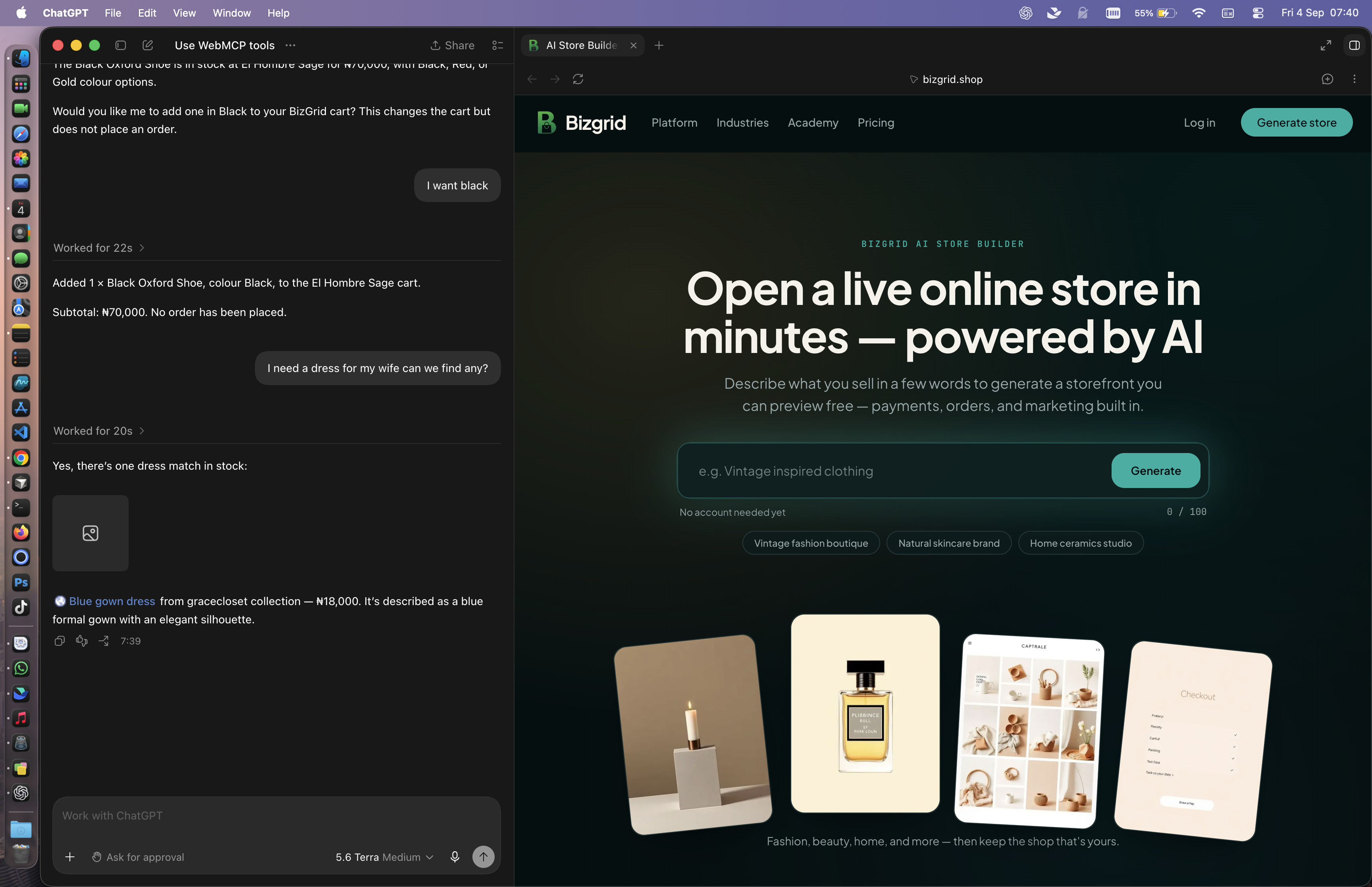
Bizgrid is an AI commerce platform for sellers and SME's. With WebMCP, any agent can search products across every live store on Bizgrid and add to the correct merchant’s cart ,without scraping the UI.
Why our use case is a strong fit for WebMCP
Bizgrid is an AI-first commerce platform for African sellers: dozens of independent merchants each run their own storefront, with their own catalog, inventory, prices, and Paystack checkout, all hosted on one platform. That shape many sellers, one marketplace is exactly where WebMCP shines, because commerce is fundamentally structured data. Stores, products, prices, stock levels, variant options, and carts all have well-defined schemas. WebMCP's tool model lets us expose that structure directly, instead of forcing an agent to reverse-engineer it.
Before WebMCP, an agent trying to shop on Bizgrid would have to scrape HTML fragile, slow, and blind to the rules that matter. It wouldn't reliably know whether a product is in stock, how many units can be purchased, what currency the merchant prices in, or which variant options are required. It certainly couldn't know that a "cart" on Bizgrid is scoped to a specific merchant, and that putting an item in the wrong cart means paying the wrong seller. Those are business-critical rules, not UI details. With WebMCP, we encode them once, as typed tool contracts: every tool response carries a store_slug, every add_to_cart validates stock, purchase limits, and variant options against the merchant's real data before writing. The agent can no longer guess wrong about who gets the money the platform itself enforces correctness.
There's also a natural symmetry in our product story: Bizgrid merchants already run their shops with an AI assistant on WhatsApp. WebMCP completes the loop on the buyer side. Merchants sell through an agent; now buyers shop through an agent, too with Bizgrid as the structured layer that connects them.
How it creates a better user experience
Imagine a shopper in Lagos who wants a vitamin C serum under ₦20,000. The old way: they'd discover Bizgrid stores one at a time, open each storefront in a new tab, search each shop's catalog separately, compare prices by hand, and repeat the whole ritual for every product. The new way: they open ChatGPT (or any WebMCP-capable browser) on the Bizgrid homepage and say one sentence: "Find me a vitamin C serum under ₦20,000."
The agent calls search_products with budget_max, gets back structured results from every published store at once — name, store, price, currency, stock status, and a direct product link and presents a ranked comparison. The shopper says "add the one from GlowSkin to my cart," and the agent calls add_to_cart with the correct store_slug, where the platform validates stock and variants and writes to that merchant's cart. The shopper then clicks one checkout link and pays normally with Paystack. What makes this a better experience, not just a different one: the human stays in the familiar, trusted flow the same storefront cart and checkout they already know while everything upstream (search, comparison, decision fatigue) becomes conversational. And because tools are typed, the agent quotes real prices in the right currency, never hallucinates a product, and never sends a shopper to a checkout that doesn't contain what they asked for. Discovery becomes instant; trust stays human.
What people and agents can do together that was difficult or impossible before
The genuinely new capability here is platform-wide shopping with a human-held checkout. Before WebMCP, an agent could only operate inside one website at a time, scraping one storefront's HTML. Cross-store comparison meant running one agent per tab, and adding to a cart meant custom per-merchant integrations that no small African seller could afford. There was no way for an agent to say "search all of Bizgrid" the marketplace existed in the URL structure, not in any machine-readable interface. WebMCP collapses that. A single tool layer registered on the platform homepage exposes every published store, every product, and every cart as first-class, callable operations. One agent can search across merchants, compare, negotiate the shopper's preferences, and fill the correct seller's cart then hand the same browser cart to a human for the final, money-moving step. That handoff is the heart of it: a division of labor that didn't exist before. The agent does what machines are good at exhaustive search, structured comparison, remembering constraints, enforcing rules. The human does what humans insist on reviewing, confirming, and paying with the checkout they trust. Agent discovers and carts; human reviews and pays. That collaboration was impossible with scraping, and it's exactly the human-agent partnership WebMCP exists to enable.
How we implemented WebMCP
We extended Bizgrid's Next.js frontend with a WebMCP tool layer, all client-side, no agent-specific integrations:
- Registration: src/lib/webmcp/bootstrap.ts polls for document.modelContext (up to 120 animation frames, so registration works even if the WebMCP runtime initializes after page load), registers all tools through registerTool, dispatches a toolchange event so agents re-discover them, dedupes via a single bootstrap promise (protecting against React Strict Mode double-invocations), and cleans up on pagehide. An app-wide provider (src/components/webmcp/platform-webmcp-provider.tsx) plus an instrumentation hook register the tools on every page, early.
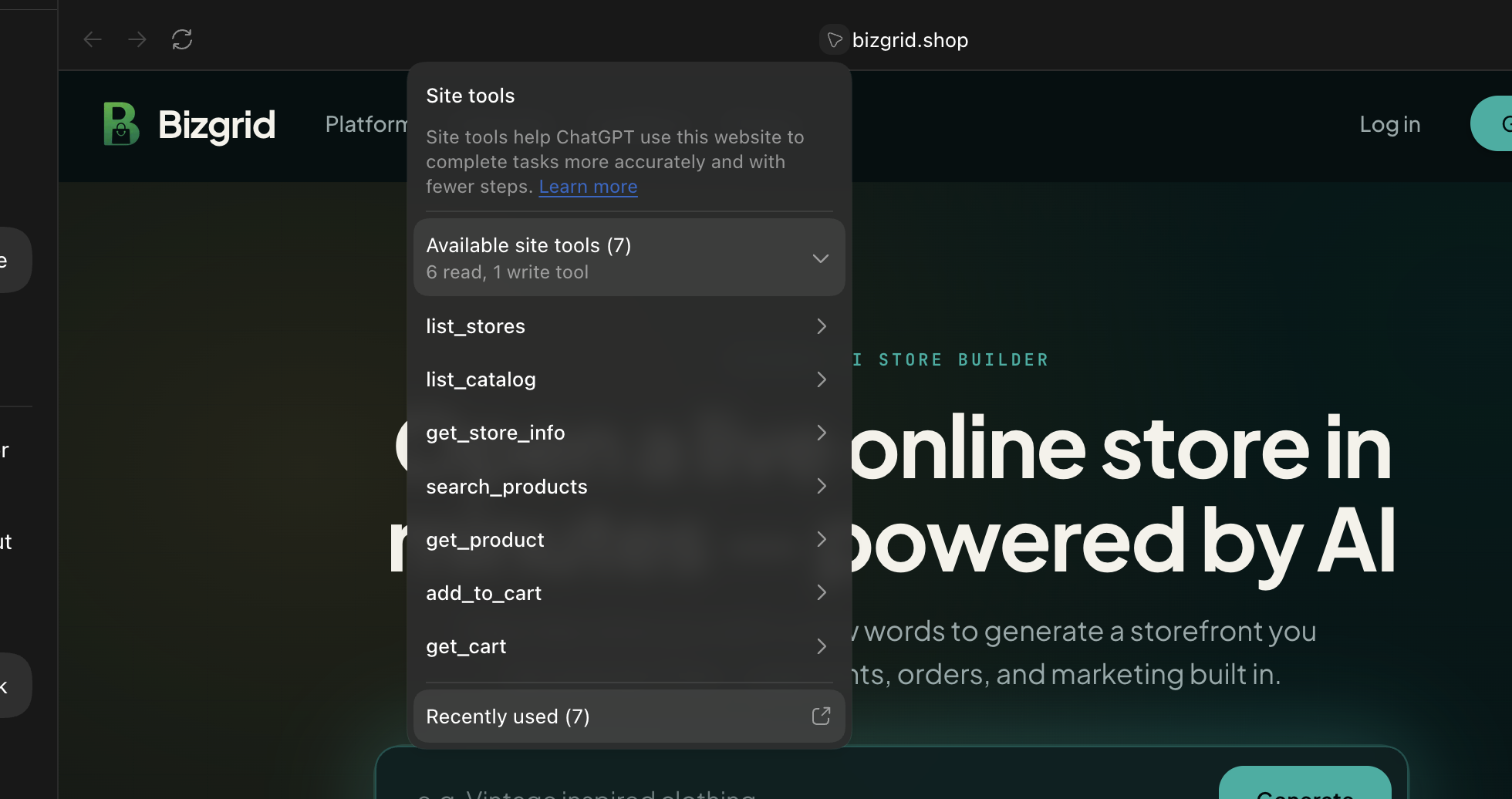
- The seven tools (src/lib/webmcp/platform-tools.ts) — list_stores, list_catalog, get_store_info, search_products, get_product, add_to_cart, get_cart — each with a JSON Schema inputSchema, descriptions written to guide agent tool selection (e.g., "prefer search_products when the shopper has a specific query"), and readOnlyHint annotations so agents can reason about side effects.
- Data layer — tools call Bizgrid's existing catalog APIs (store listing, full catalog with pagination, search with budget filters, per-product lookup), so agents get live, real prices and stock, never static HTML.
- Shared cart, shared checkout — add_to_cart writes to the same per-store localStorage cart keys the storefronts already use (src/lib/webmcp/platform-cart.ts), with validation of stock, purchase limits, and variant options (src/lib/webmcp/shared.ts). Every response includes cart_url and checkout_url, so the human opens the exact checkout the agent filled. Agents and humans share one cart and one trusted Paystack flow nothing is simulated or sandboxed.
- No server changes required because everything is structured client-side on top of existing APIs, the entire WebMCP surface ships with the normal frontend bundle, live at https://www.bizgrid.shop today.

Log in or sign up for Devpost to join the conversation.