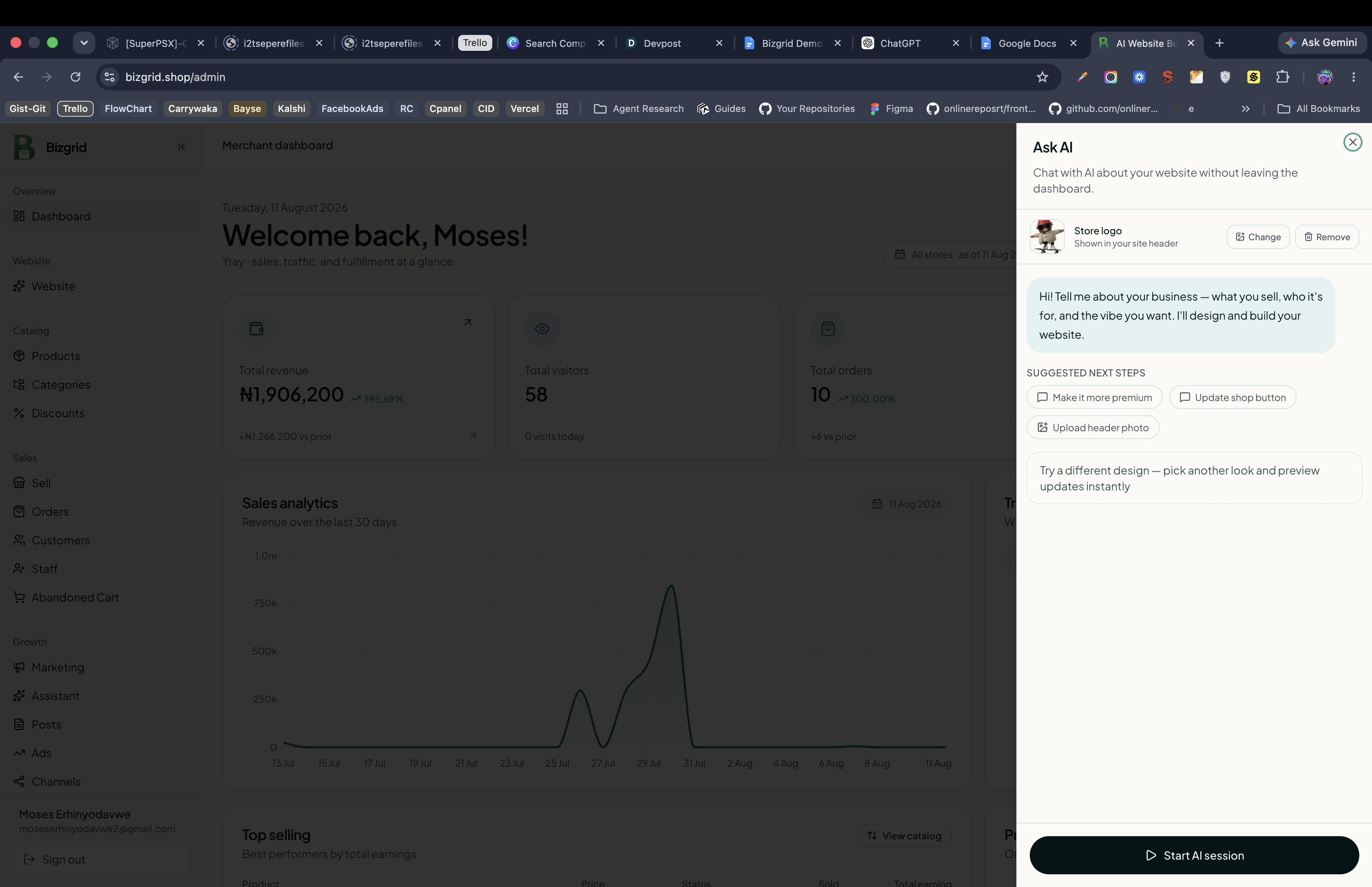
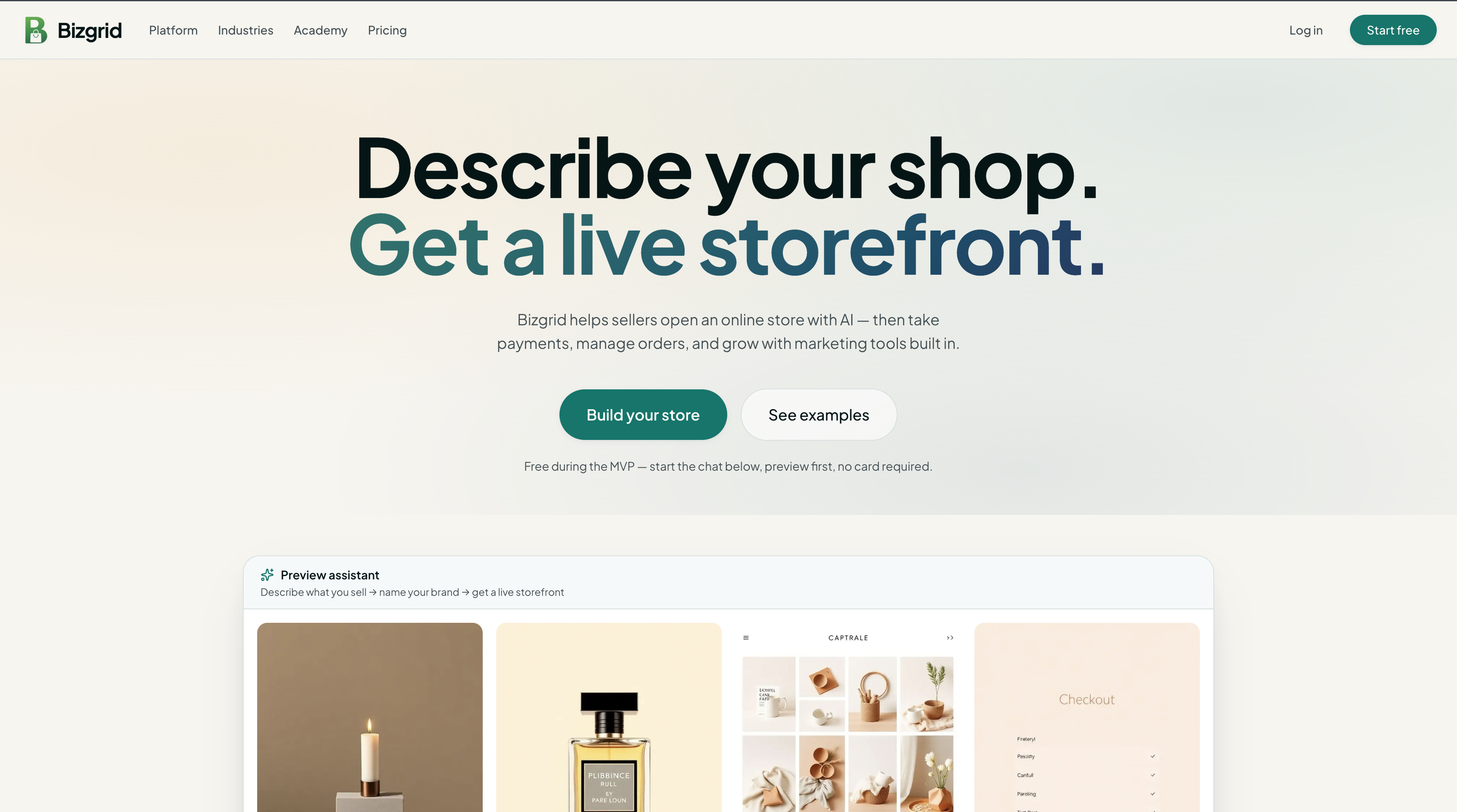
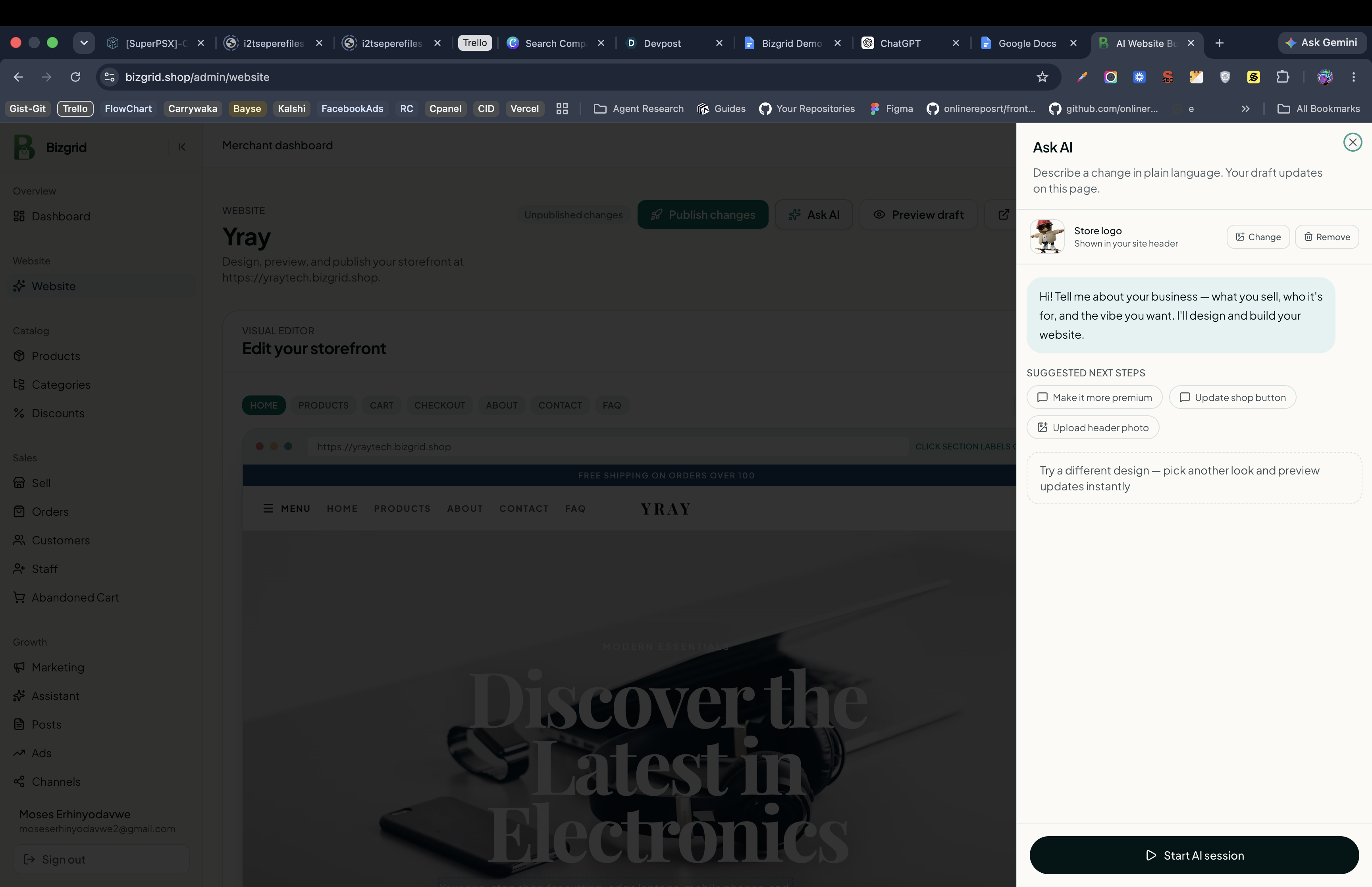
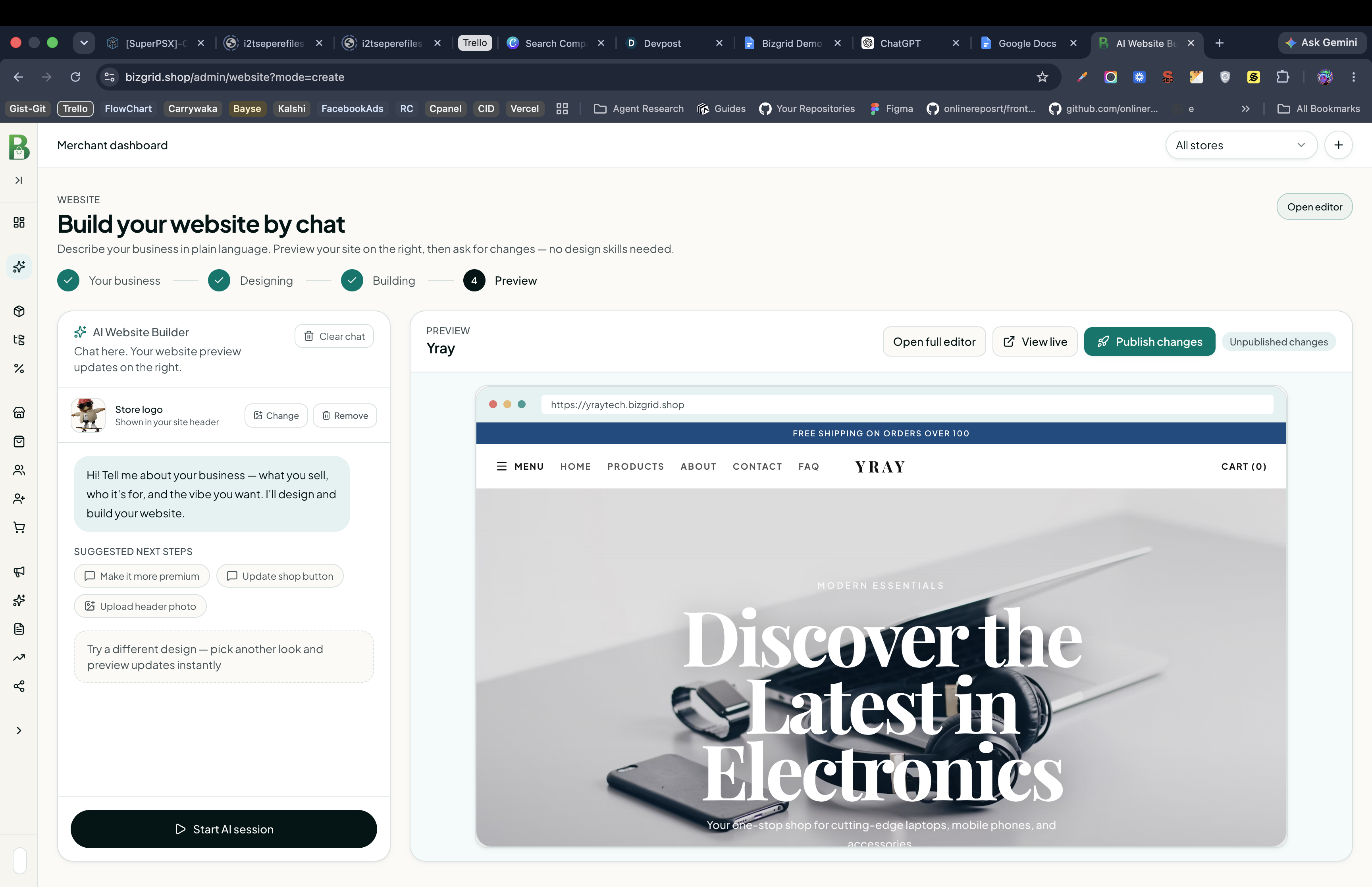
Bizgrid — Your AI Commerce Operator
What if selling one product didn't require six different jobs?
Imagine you have a dress to sell.
Not a fashion empire. Not a huge retail company. Just one dress.
You take a photo of it with your phone.
And suddenly, selling that dress online becomes a much bigger job.
You need a model.
You need professional-looking product photography.
You need a product page.
You need marketing content.
You need a video.
And when someone finally sees the dress, they ask the question a photograph can't really answer:
“What will this look like on me?”
Then they ask:
“What bag would go with it?”
For a large brand, there are people whose entire jobs are dedicated to answering each of those questions.
For a small business, one person is expected to do everything.
That is what inspired us to build Bizgrid.
We Don't Think Businesses Need More Software
Ecommerce has given businesses incredible tools.
But there is a strange problem.
The more software we give merchants, the more the merchant has to become the person connecting it all.
One tool for the store.
Another for design.
Another for marketing.
Another for analytics.
Another for content.
Another for customer engagement.
Another for visual experiences.
The tools are powerful.
The problem is the person operating them.
So we asked a different question:
What if the merchant didn't have to operate all of it?
What if they could simply say what they wanted?
“Add this product.”
“Prepare this for launch.”
“Create a campaign.”
“Show this to customers who are looking for something for a wedding.”
And instead of sending them to another dashboard, another menu, or another application, AI could understand the intent and do the work.
That became the idea behind Bizgrid.
The Shift
AI has changed what software can be.
For a long time, software waited for us to click the right button.
Now AI can understand what we're trying to accomplish.
That creates a different model:
Old model
Merchant → Dashboard → Menu → Tool → Action
Bizgrid
Merchant → Intent → AI → Action
We aren't trying to build another chatbot that answers questions about an ecommerce store.
We're building an AI Commerce Operator.
A system that understands the business, knows the capabilities available to it, and can coordinate them to accomplish a goal.
But We Started With One Product
We wanted to see what would happen if we stopped thinking about ecommerce as a collection of tools and instead followed one product through the entire journey.
So take that dress again.
It starts as a photograph.
Bizgrid can turn that product into richer visual content.
The merchant can publish it to their storefront.
The same product can become marketing content.
It can become a product-focused video.
A customer can discover it through the store.
Then comes the question:
“What would this look like on me?”
Bizgrid can invoke visual AI to create a virtual try-on experience.
Then:
“What bag goes with it?”
Bizgrid can use the merchant's catalog to recommend a complementary product.
The customer can explore that product too.
And eventually:
They buy.
What started as one photograph has travelled through:
Product → Content → Storefront → Marketing → Discovery → Try-On → Recommendation → Purchase
That was the moment the idea became bigger than product photography.
We Realized the Product Should Be the Source
Most commerce tools treat each activity separately.
Create the product.
Then recreate it for marketing.
Then recreate it for advertising.
Then recreate it for visual experiences.
Then recreate it for recommendations.
We wanted to reverse that.
Create the product once. Let the intelligence around it do the rest.
A product in Bizgrid isn't just an item sitting in a catalog.
It becomes the source for:
- Product imagery
- Storefront content
- Marketing
- Video
- Customer discovery
- Virtual try-on
- Recommendations
- Transactions
- Business insights
The product becomes the common thread connecting the merchant and the customer.
And Then There Was the Customer
We didn't want to make the merchant experience intelligent while leaving the customer to navigate a traditional store.
So we applied the same idea to shopping.
Instead of forcing customers to know exactly what they want, they can communicate their intent.
“I'm going to a wedding. I need something to wear.”
The AI can understand the request and work with the merchant's catalog.
The customer finds something.
“Try this on me.”
Visual AI helps them see it.
“What about this one?”
They compare.
“What goes with it?”
The store recommends.
The customer visualizes the combination.
And the journey continues toward purchase.
The experience becomes:
Tell us what you want.
See it.
Try it.
Explore it.
Buy it.
Why We Integrated YouCam
This is where visual AI became more than a feature.
Seeing a product can change whether someone is willing to buy it.
That's especially true for fashion and other visual categories.
So instead of making virtual try-on a separate destination, we integrated YouCam's visual AI capabilities into the commerce workflow.
Bizgrid can call visual capabilities when they help answer a question:
“What would this look like on me?”
“What would these shoes look like?”
“What would this bag look like with the outfit?”
Visual AI becomes something the commerce agent can invoke when it matters.
YouCam isn't the destination.
It's a capability inside the journey.
That distinction shaped how we built Bizgrid.
How We Built It
Underneath the experience is an agentic architecture.
At the top is the Bizgrid AI agent.
It receives the user's intent and determines what needs to happen.
Underneath it are the deterministic commerce systems responsible for the actual business:
- Products
- Inventory
- Stores
- Orders
- Customers
- Marketing
- Payments
- Analytics
Then there is the visual intelligence layer, which connects Bizgrid to YouCam capabilities.
The flow is:
Intent
↓
Bizgrid AI
↓
Business Context
↓
Capability Selection
↓
Commerce Services / Visual AI
↓
Action or Experience
This separation was important.
We learned that an AI system shouldn't simply be allowed to "do everything."
The AI should be responsible for reasoning and orchestration.
Critical business operations still need reliable, deterministic systems underneath them.
The AI decides what should happen.
The underlying systems make sure it happens correctly.
The Hard Part Wasn't Making AI Generate Something
That was one of our biggest lessons.
Generating an image is impressive.
Generating a video is impressive.
Virtual try-on is impressive.
But individually, these are just capabilities.
The real challenge was asking:
How do we make all of these capabilities behave like one product?
When should the AI call visual AI?
When should it query the merchant's catalog?
When should it recommend another product?
What information should the agent know?
What should it be allowed to change?
What should remain deterministic?
And how do we make the experience feel natural enough that the merchant doesn't even need to think about which technology is running underneath?
That became the real engineering problem.
What We Learned
Building Bizgrid taught us that AI becomes much more valuable when it has context and tools.
A generic AI can tell you how to create a campaign.
An AI commerce operator should understand your products and help create one.
A generic AI can explain virtual try-on.
An AI commerce operator should recognize when a customer needs it and invoke it.
A generic AI can recommend products.
An AI commerce operator should understand the merchant's actual catalog and make recommendations inside the shopping experience.
So our biggest lesson was:
AI shouldn't just answer questions about a business. It should help operate the business.
We also learned that the best AI experience may not look like AI at all.
The merchant doesn't need to know which model generated the image.
The customer doesn't need to know which API powered the try-on.
They simply need to say what they want and receive the right experience.
The intelligence should disappear into the workflow.
The Challenges
Our biggest challenge was finding the boundary between AI and traditional software.
AI is probabilistic.
Commerce often cannot be.
An AI can decide:
“This customer is probably looking for a wedding outfit.”
But the system underneath still needs to reliably know:
- Is the product in stock?
- What is the price?
- What variants exist?
- Was the order actually created?
- Was the payment completed?
That forced us to think carefully about the architecture.
Another challenge was connecting multiple visual AI capabilities into a coherent commerce experience.
The goal wasn't to build several impressive demos.
It was to make them feel like one continuous journey.
That distinction changed how we approached the product.
The Future We See
Today, a merchant might tell Bizgrid:
“Prepare this product for launch.”
Tomorrow, they could say:
“I have a new collection launching next month. Prepare everything.”
And instead of manually moving between applications, Bizgrid could understand the products, prepare visual assets, build the storefront experience, generate marketing content, identify opportunities, and bring the important decisions back to the merchant.
The merchant moves from:
Operating software
to
Supervising intelligence.
And on the customer side, shopping moves from:
Searching → Clicking → Filtering → Guessing
toward:
Intent → Conversation → Visualization → Confidence → Purchase
What We Are Really Building
When we started, we thought we were solving a problem around product content.
Then we thought we were building a better ecommerce platform.
But following that one dress through the journey changed our thinking.
We realized the bigger opportunity is to connect the entire commerce operation around intelligence.
The merchant.
The product.
The marketing.
The storefront.
The customer.
The visual experience.
The transaction.
The data.
All connected by one intelligence layer.
We don't believe the future of commerce is giving merchants more software to operate.
We believe it is giving them less software to operate.
Because the next generation of business software shouldn't just help you run your business.
It should help run the business with you.
One Product. One Intelligence Layer. An Entire Commerce Journey.
A photograph becomes a product.
A product becomes a storefront.
A storefront becomes an experience.
An experience becomes a conversation.
A conversation becomes visualization.
Visualization becomes confidence.
And confidence becomes a purchase.
That's the journey we're building.
Bizgrid
Your AI Commerce Operator.
Built With
- laravel
- nextjs
- youcam

Log in or sign up for Devpost to join the conversation.