
The Inspiration Behind BizDocs
BizDocs started in our garage.
We run VOXELO, a small 3D printing business where we handle everything ourselves, from designing and 3D modelling to printing, client communication, and day-to-day operations. As a team of three, our time matters. Designing requires focus, creativity, and mental energy, so spending additional time creating invoices, quotations, estimates, receipts, and other business documents quickly became an exhausting part of running the business.
We naturally looked for online tools that could make the process easier. Many of them appeared to offer exactly what we needed; simple, free document generation. But too often, after spending time entering all the information and preparing the document, we would reach the final step only to be asked to create an account, start a trial, or purchase a subscription before we could download the PDF.
That last-minute friction was frustrating.
We didn't want another complicated business platform. We simply wanted to enter the information, generate a professional document, download it, and get back to our actual work.
So we built one.
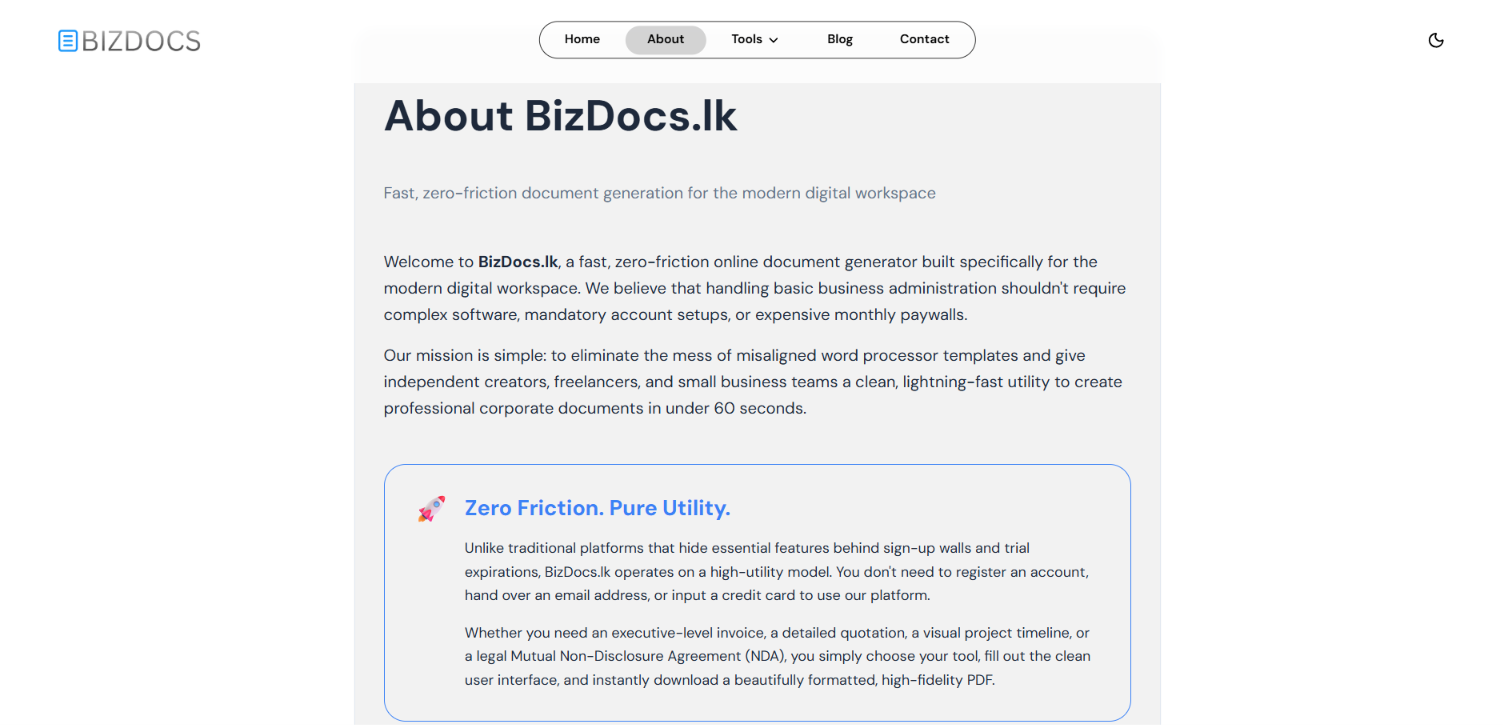
BizDocs was initially created purely for our own use at VOXELO, a zero-friction, fast, professional business document generation web app designed around the way we wished these tools worked. No unnecessary complexity. No wasting time. Just create the document you need and move on with your day.
As we continued using it, we realized that the problem wasn't unique to us. Freelancers, startups, small businesses, creators, and independent professionals around the world deal with the same repetitive administrative work every day.
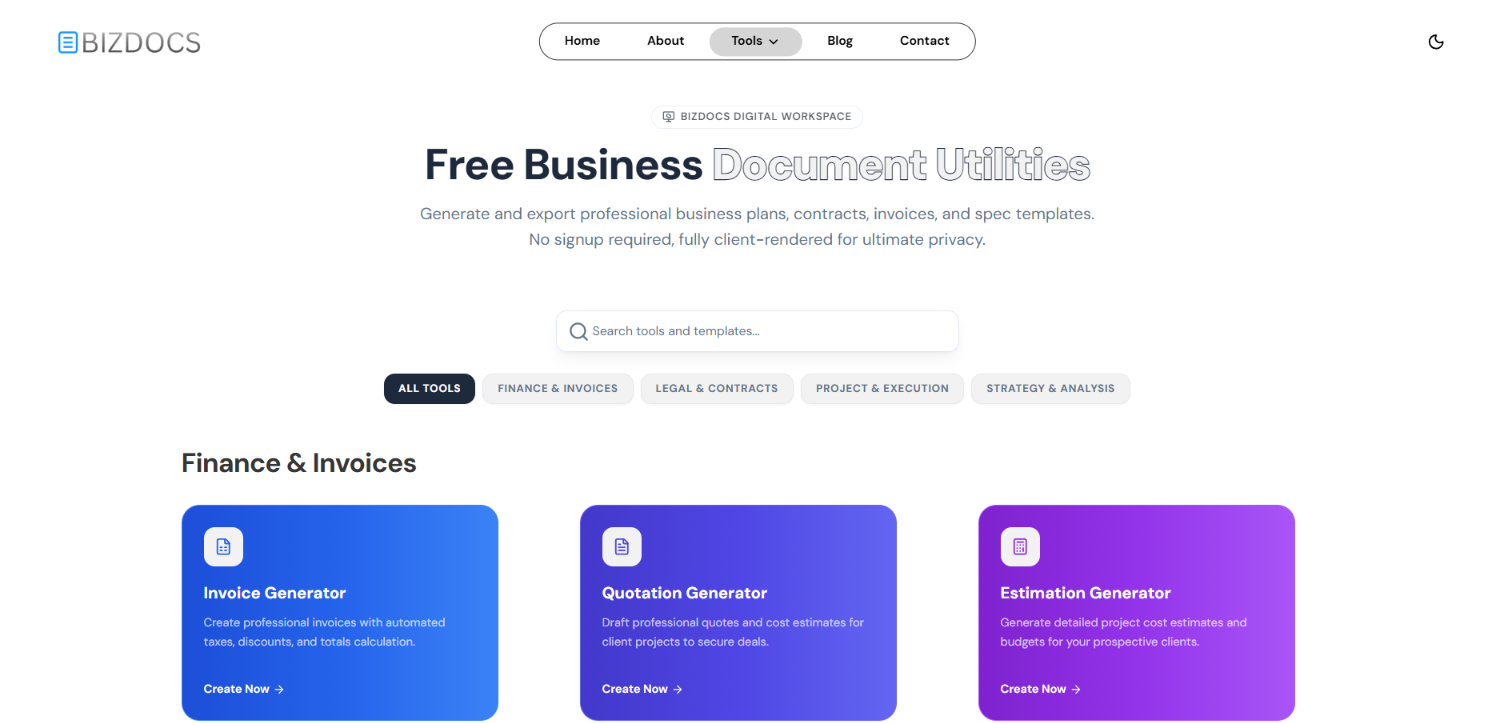
That's when we decided to turn our internal tool into something everyone could use. Today, BizDocs brings essential business document generation into one simple platform, including invoices, quotations, estimates, receipts, purchase orders, NDAs, service contracts, and project timelines.
What started as a small tool built in a garage to save ourselves a little time became our attempt to give that time back to every small business owner. Because running a business is already hard enough. Creating the paperwork shouldn't be.
What it does
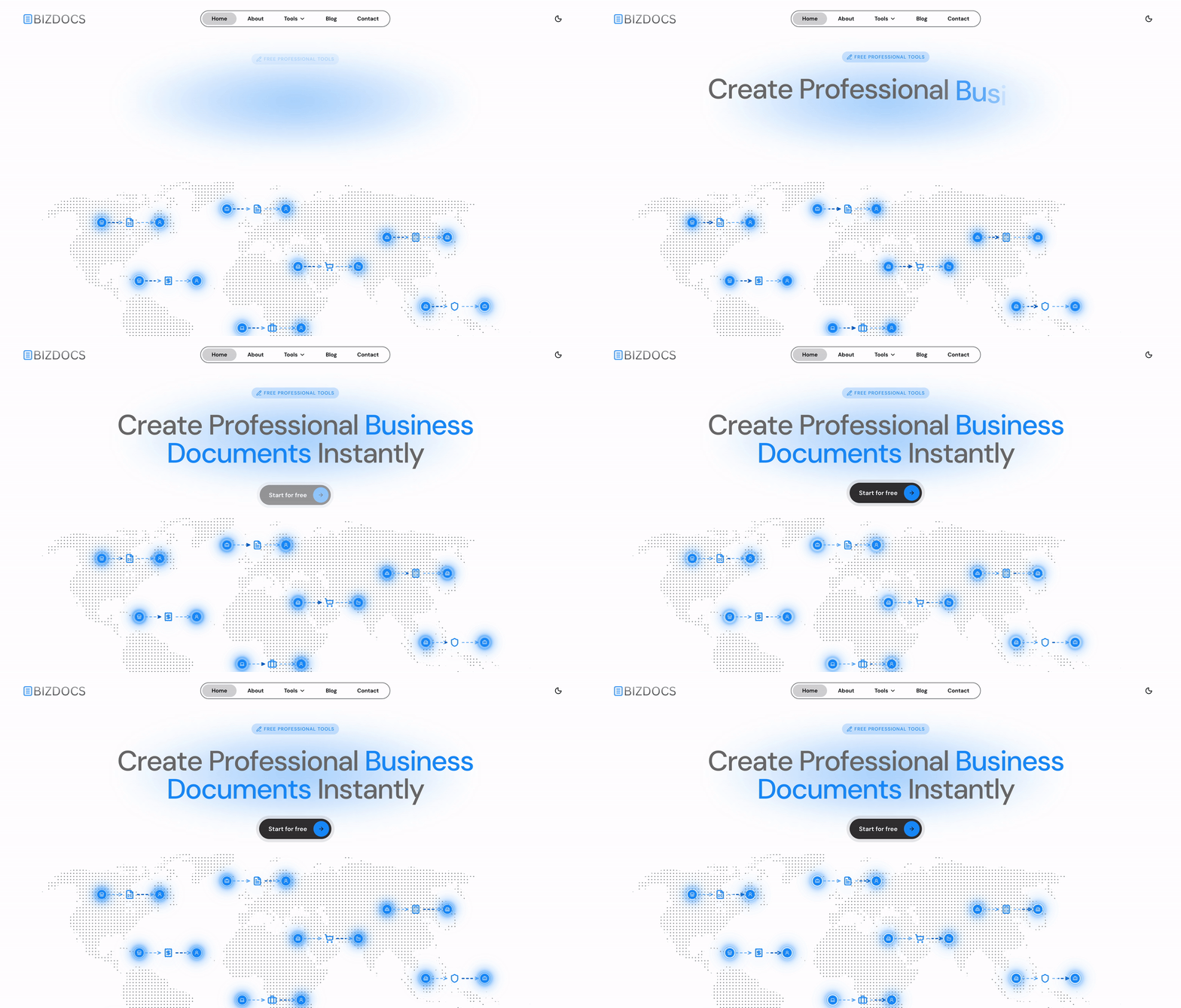
BizDocs.lk is a fast, zero-friction web application that lets users create professional business documents in seconds without signing up, subscribing, or installing software. Users simply select the document they need, enter the required information through a guided interface, and instantly generate a polished, ready-to-use PDF.
BizDocs currently supports a growing range of essential business documents, including:
- Invoices
- Quotations
- Estimates
- Receipts
- Purchase Orders
- Mutual Non-Disclosure Agreements (NDAs)
- Service Contracts
- Project Timelines
The platform handles the document structure, calculations, formatting, layout, and PDF generation automatically, removing the need to manually edit Word documents, spreadsheets, or reusable templates.
A typical workflow is simply:
Choose a document → Enter the details → Preview → Download
No account creation, email verification, credit card, or subscription is required. The result is a lightweight business utility that turns repetitive administrative work into a process that can be completed in under a minute, allowing freelancers, creators, developers, agencies, and small businesses to spend less time preparing paperwork and more time on their actual work.
How we built it
BizDocs began with an idea, but the first step was not writing code. It was turning that idea into something clear enough to build. We started with Gemini, using it as a brainstorming and ideation partner to organize our initial thoughts, explore the problem we were trying to solve, challenge assumptions, and shape the concept into a practical web application. We also used Gemini while exploring the product identity and naming direction, eventually arriving at the name BizDocs.
Once the concept became clearer, we moved into development using Google Antigravity. Antigravity helped us rapidly transform the initial idea into a working web application and establish much of the foundational product structure. Instead of spending weeks manually scaffolding every part of the application, we were able to move quickly from an idea to something we could actually interact with, test, and improve.
However, our goal was never simply to generate a prototype with AI and stop there. As BizDocs evolved, the requirements became significantly more complex. We needed reliable document-generation workflows, professional PDF outputs, responsive interfaces, calculations, validation, and more advanced application functionality. Development therefore became a collaborative engineering process involving Antigravity, Codex, AI coding agents, and our own hands-on development work.
We used AI agents extensively throughout the coding process to accelerate implementation, explore approaches, troubleshoot problems, refactor code, and develop new features. Antigravity played a major role in establishing and evolving the application, while Codex and other AI-assisted development workflows were especially valuable as we worked on more advanced features and backend functionality.
At the same time, we deliberately kept a human engineering layer throughout the project. Every generated solution still had to fit the architecture, user experience, privacy requirements, and quality standards we wanted for BizDocs. We reviewed implementations, made architectural decisions, tested workflows, corrected problems, refined interfaces, and redesigned features when an AI-generated solution was not good enough.
This became one of the most important principles behind the project:
AI helped us build faster, but we remained responsible for what we built. Rather than treating AI as a replacement for engineering, we treated it as a collection of highly capable collaborators. The AI agents could generate, reason, iterate, and accelerate development, while we provided the product vision, context, constraints, judgment, testing, and final engineering decisions.
That combination allowed us to move from a problem we experienced personally, to an idea brainstormed with Gemini, to a functional product built with AI-assisted development and finally to a polished web application designed for real people to use.
Challenges we ran into
Building BizDocs.lk was not simply about creating forms and exporting PDFs. The biggest challenge was preserving our core promise fast, zero-friction, privacy-first document generation while still delivering professional, flexible, and reliable results.
One of the hardest technical challenges was client-side PDF generation. Real business documents are dynamic: an invoice may contain two items or fifty, while contracts may span several pages. Because we wanted document processing to remain inside the browser, we had to handle text measurements, row heights, wrapping, spacing, page breaks, image placement, tables, and high-resolution rendering dynamically. The goal was not just to generate a PDF, but to produce one that a business could confidently send to a client.
Our privacy-first architecture created another major constraint. We wanted sensitive information such as client names, financial data, project details, and contract terms to remain on the user's device rather than being unnecessarily stored on external servers. This meant moving much of the document processing, draft handling, calculations, and rendering into the browser. Maintaining that privacy while ensuring good performance, especially on lower-powered mobile devices, required careful optimization.
We also faced a constant balance between simplicity and flexibility. BizDocs is designed around a simple workflow: choose a document, enter the details, generate, and download. However, complex documents such as service contracts, NDAs, Statements of Work, and strategic frameworks require more information. Every extra field improves customization but also creates more friction. We continuously refined forms, removed unnecessary inputs, introduced defaults, and designed guided workflows to keep the experience simple.
Another challenge was SEO and discoverability. BizDocs is primarily an interactive, client-heavy web application, which can provide limited indexable content for search engines. We addressed this by combining immediately accessible tools with structured supporting content and metadata, allowing search engines to understand each page without forcing users through unnecessary content before reaching the generator.
AI accelerated development significantly, but turning AI-generated code into production-quality software required substantial human engineering. We used Gemini for ideation, Google Antigravity for early development and application structure, and Codex and other AI-assisted workflows for implementation. However, generated code still required architectural review, testing, refactoring, privacy checks, performance optimization, and integration. AI increased our development speed, but human judgment remained responsible for the final product. As BizDocs expanded to support invoices, quotations, estimates, receipts, purchase orders, NDAs, contracts, timelines, and other business documents, maintainability and reusable architecture also became increasingly important.
These challenges ultimately shaped the product. BizDocs became an exercise in combining AI-powered development with human engineering judgment to create a fast, private, professional tool that removes administrative friction instead of adding more.
Accomplishments that we're proud of
One of our proudest accomplishments is that BizDocs.lk grew from a solution to our own operational problem into a production-ready platform that can help creators, freelancers, startups, and small businesses everywhere.
We are especially proud of maintaining a genuinely zero-friction experience. Users can choose a document, enter their information, generate it, and download the final PDF without creating an account, providing an email address, entering a credit card, or encountering a last-minute subscription paywall. This directly addresses the frustration that originally inspired us to create BizDocs.
We also successfully built a scalable suite of 8+ business-document utilities, spanning financial, operational, legal, and strategic use cases. Despite the differences between these documents, we designed reusable components and rendering systems that allow the platform to continue expanding without rebuilding everything from scratch.
Another milestone we are especially excited about is gaining our first 20–30 active users entirely through organic growth. We have achieved this without spending any money on paid advertising or marketing campaigns. These early users discovered and began using BizDocs through our own organic outreach and visibility efforts, giving us an encouraging signal that the problem we experienced ourselves is shared by others. For a product still at an early stage, seeing real people voluntarily use the platform has been one of the most meaningful forms of validation.
We are also proud of how effectively we used Google Gemini and AI-assisted engineering throughout the project. Gemini helped us transform our initial thoughts into a structured product concept, explore ideas, refine workflows, and make product decisions. Google Antigravity helped establish and rapidly evolve the application's foundation, while Codex and other AI-assisted workflows supported implementation, debugging, refactoring, and advanced functionality.
However, perhaps our most important accomplishment is that we did not stop at an AI-generated prototype. Every major implementation still required human architectural decisions, testing, security considerations, UX refinement, performance optimization, and engineering judgment. For a two-person team simultaneously operating another business from a garage, turning a personal frustration into a polished, publicly usable platform, and then seeing real users adopt it is something we are incredibly proud of.
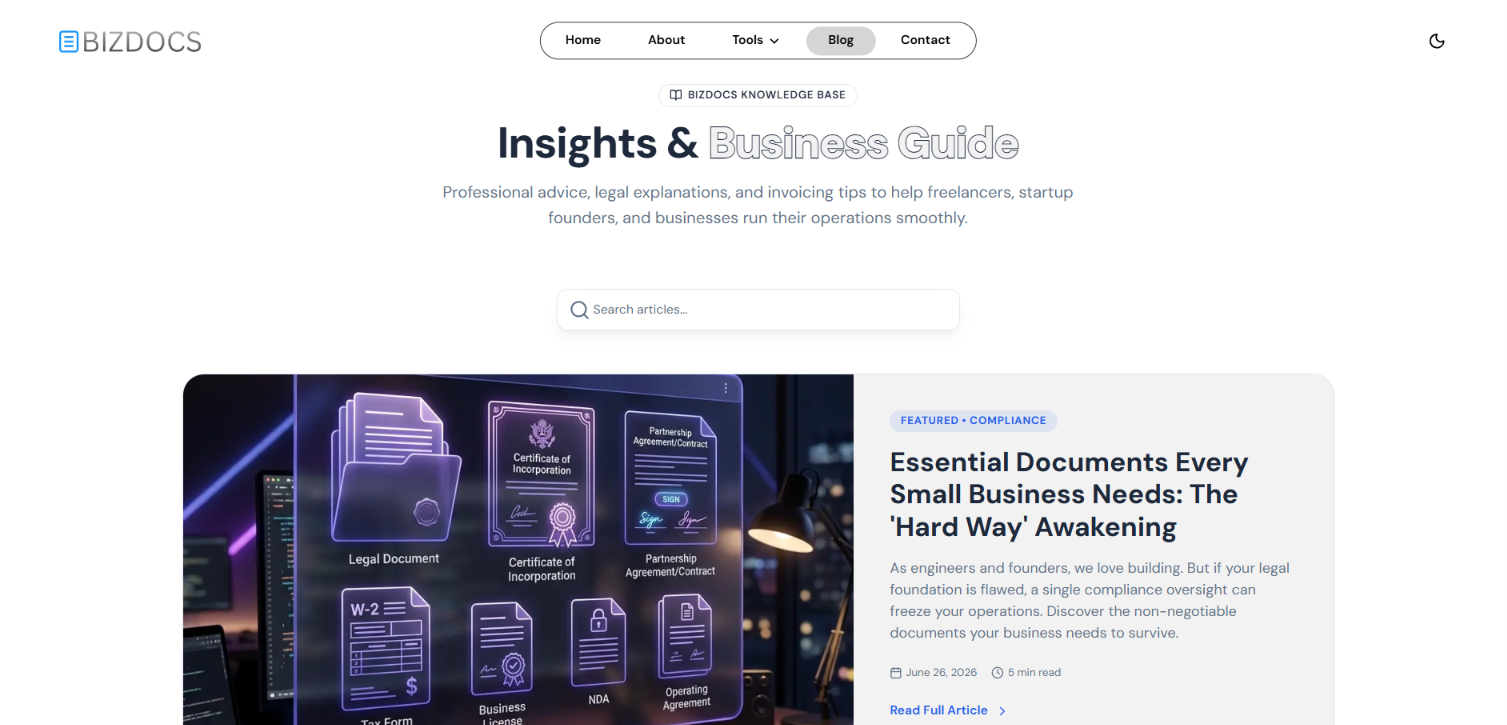
Beyond the product itself, we have also started creating educational blog content around business documentation, financial discipline, startup operations, and related practical topics. Our goal is not only to provide tools, but also to help founders, freelancers, and small business owners understand why proper documentation matters and how stronger financial and operational practices can contribute to healthier businesses.
This is helping BizDocs evolve from a document-generation utility into a broader knowledge and productivity platform for small businesses.
BizDocs demonstrates what becomes possible when real-world experience, human engineering judgment, AI-powered development, practical business education, and early organic user validation come together around a clear problem worth solving.
What we learned
Building BizDocs.lk taught us much more than how to develop a web application. It became a practical lesson in AI-assisted engineering, product thinking, marketing, entrepreneurship, and understanding real customer problems.
One of our biggest lessons was the importance of prompt engineering and communicating effectively with AI. Using Gemini, Antigravity, Codex, and other AI-assisted workflows showed us that the quality of an AI-generated solution depends heavily on the quality of the context, constraints, and instructions we provide. We learned to break complex problems into smaller tasks, provide relevant architectural context, challenge generated solutions, iterate on prompts, and treat AI as an engineering collaborator rather than simply a code generator. BizDocs also taught us how to use AI beyond software development. We used AI to brainstorm product ideas, refine messaging, create content, explore branding, plan marketing strategies, and improve how we communicate the value of the platform. This showed us that AI can support almost every stage of building a small digital business, not just programming.
Another major lesson was organic marketing. With no money spent on paid advertising, we began promoting BizDocs through content, social platforms, direct visibility, and educational material. Reaching our first 20–30 active users organically taught us that early traction does not always require a large marketing budget. Clear positioning, useful content, consistency, and solving a genuine problem can be powerful acquisition tools.
We also learned the importance of finding a less crowded opportunity in the market. Rather than trying to compete by building another large accounting or enterprise-management platform, we focused on a narrow frustration: people who simply want to create a professional business document quickly without accounts, subscriptions, complicated software, or last-minute download paywalls. This taught us to look for underserved spaces a blue-ocean opportunity where removing friction can itself become the differentiator.
Building our educational blog reinforced another lesson: a useful product can also educate its users. Helping small businesses understand documentation, financial discipline, contracts, startup operations, and professional practices allows BizDocs to provide value even before someone generates a document.
We also learned to validate through real usage rather than assumptions. BizDocs originated from a problem we personally experienced at VOXELO, but seeing other people independently use the platform gave us much stronger evidence that the problem extends beyond our own business.
Finally, we learned that building a product with limited resources forces better prioritization. As a two-person team simultaneously operating another business, we could not build everything. We had to decide what genuinely improved the user's experience and what could wait.
What began as an internal solution for our garage business ultimately taught us how AI, engineering, product strategy, content, and organic growth can come together to turn a small idea into a real product used by real people.
What's next for BizDocs
The next stage of BizDocs is about solving the friction that remains after document generation itself.
Today, BizDocs allows users to create and download professional business documents with zero friction. However, as businesses use the platform repeatedly, another problem becomes clear: entering the same company details, customer information, frequently sold products or services, prices, payment terms, and other recurring data again and again can become repetitive.
Our next goal is to eliminate that repetition.
We plan to introduce an optional account-based business workspace where users can securely store and manage their business information. This would allow returning users to save company profiles, customers, frequently used products and services, pricing, and other reusable information, then automatically reuse that data when generating future documents.
Also, we plan to introduce personal branding to documents where subscribed users can add branding to their documents just by choosing from designs and colours provided. We can't provide this to the free version users because it should be same for each user. But registered users with subscriptions can add personal branding to their documents instead of more plain/generic designs in the free version.
Beyond storage, we want BizDocs to evolve into a lightweight business data and analytics platform. By organizing the information generated through everyday business documents, users could gain useful insights into areas such as revenue, sales activity, commonly sold products or services, customer activity, quotations, expenses, and broader business performance.
Supporting persistent storage, database infrastructure, advanced analytics, and account-based features introduces ongoing infrastructure and operational costs. Because of this, we plan to introduce a subscription-based premium layer for businesses that want these advanced capabilities.
Importantly, this will not replace the zero-friction experience that defines BizDocs.
Our current instant document-generation tools will remain available for users who simply want to create a professional document without registering or subscribing. The premium workspace will instead be an optional extension for users who want BizDocs to remember their business, reduce repetitive data entry, manage information over time, and provide deeper operational insights.
Our vision is therefore to support two complementary experiences:
BizDocs Free: Instant, private, zero-friction document generation and download.
BizDocs Workspace: An optional subscription-based environment with persistent business data, reusable customer and product information, document history, database-backed management, and business analytics.
Ultimately, we want BizDocs to grow from a tool that helps businesses create documents faster into a platform that also helps them understand and manage the information behind those documents, while preserving the simplicity and accessibility that inspired BizDocs in the first place.
Built With
- css
- docker
- gin
- github
- golang
- goose
- javascript
- jspdf
- k8s
- lucide-react
- next.js
- pgx/v5
- pgxpool
- postgresql
- sqlc
- tailwind
- typescript
- vercel


Log in or sign up for Devpost to join the conversation.