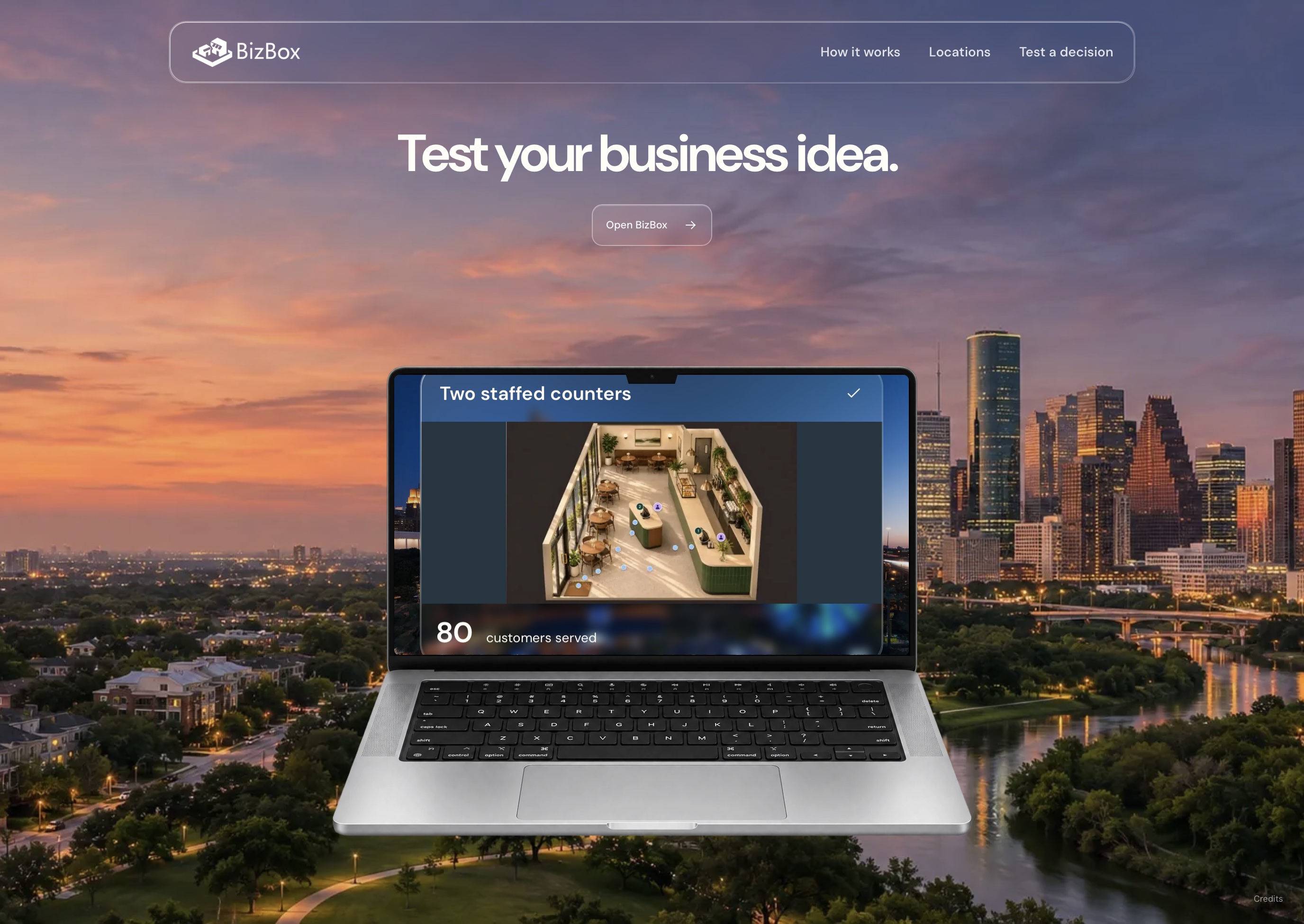
BizBox — Scout It. Simulate It. Scale It.
Inspiration
What if you could test your business before signing the lease?
Every year, entrepreneurs invest their savings into businesses without knowing whether they've chosen the right location, whether enough customers will show up, or whether their operations can handle demand.
A great business idea can fail because of a bad location. A promising storefront can become a financial burden because of unexpected costs. And a business with strong demand can still struggle because of inefficient operations.
The problem isn't a lack of data. It's that the data is fragmented, expensive to interpret, and disconnected from the decisions entrepreneurs actually need to make.
Large corporations hire real estate analysts, market researchers, and management consultants to evaluate these risks. Small business owners often rely on spreadsheets, online listings, and intuition.
We built BizBox to give entrepreneurs the decision-making power of an entire consulting team.
By combining CoStar commercial real estate intelligence, AI-powered customer modeling, and interactive business simulations, BizBox transforms the question from "Where should I open?" into "Where should I open, how should I operate, and what happens if my assumptions are wrong?"
Our mission is to make starting and growing a business less of a gamble and more of an informed investment.
What It Does
BizBox is an AI-powered business intelligence and simulation platform that helps entrepreneurs scout locations, test business strategies, and make smarter investment decisions before committing capital.
We built an end-to-end experience that takes entrepreneurs from an initial business idea to an evidence-backed, actionable plan.
1. Scout It — Find Opportunities That Fit Your Business
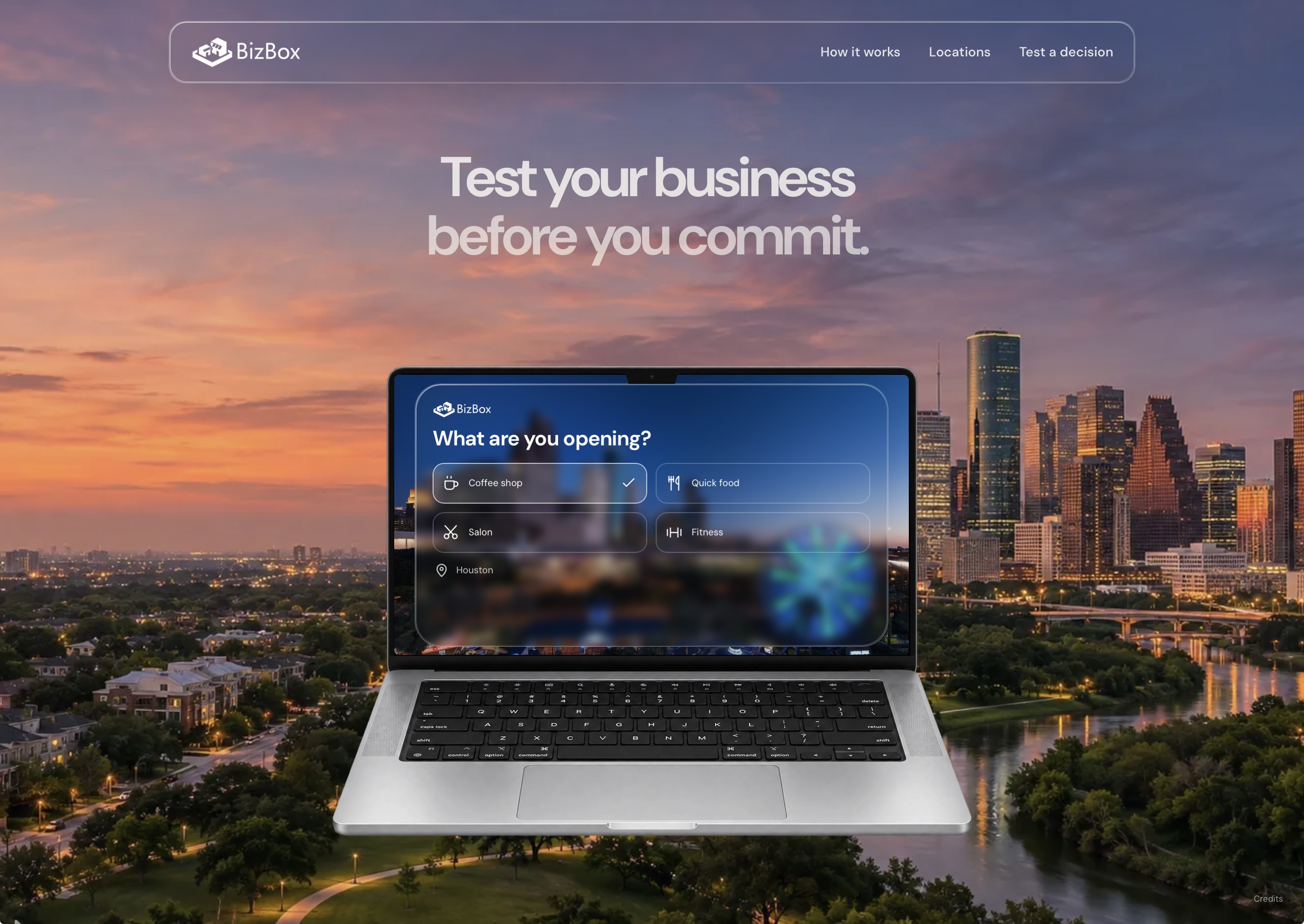
Tell BizBox what you want to build: a coffee shop, restaurant, salon, fitness studio, or another location-based business.
Our AI agent learns your budget, target customers, pricing, staffing, operating hours, and business goals.
Using CoStar commercial real estate data, BizBox identifies real candidate storefronts in Houston and Los Angeles and evaluates them against your specific business needs.
We enrich property intelligence with:
- Census ACS: Neighborhood demographics and population characteristics.
- LODES: Workplace employment and geographic job concentrations.
- Overture Maps: Nearby businesses and competitive context.
- CoStar: Commercial property characteristics and candidate spaces.
Instead of giving you a list of available spaces, BizBox helps answer a more valuable question:
Which properties make the most sense for the business you're actually trying to build?
2. Simulate It — See Your Business Before It Exists
Finding a promising storefront is just the beginning.
BizBox uses AI-simulated local customers to explore potential demand, customer preferences, and purchasing behavior.
These insights power an operational simulation that models how customers arrive, interact with the business, wait for service, and complete purchases.
Using Cesium, Vexcel 3D imagery, and Three.js, we bring those scenarios to life.
Entrepreneurs can:
- Explore an interactive 3D city environment.
- Visualize modeled customer journeys around potential storefronts.
- Watch customer-by-customer replays of daily operations.
- Identify service bottlenecks and capacity constraints.
- Examine modeled financial and operational performance.
Every simulated event connects to operational metrics, including customer throughput, service capacity, waiting times, and modeled financial outcomes.
You're not just looking at a property. You're testing what running a business there could look like.
3. Scale It — Optimize Before You Invest
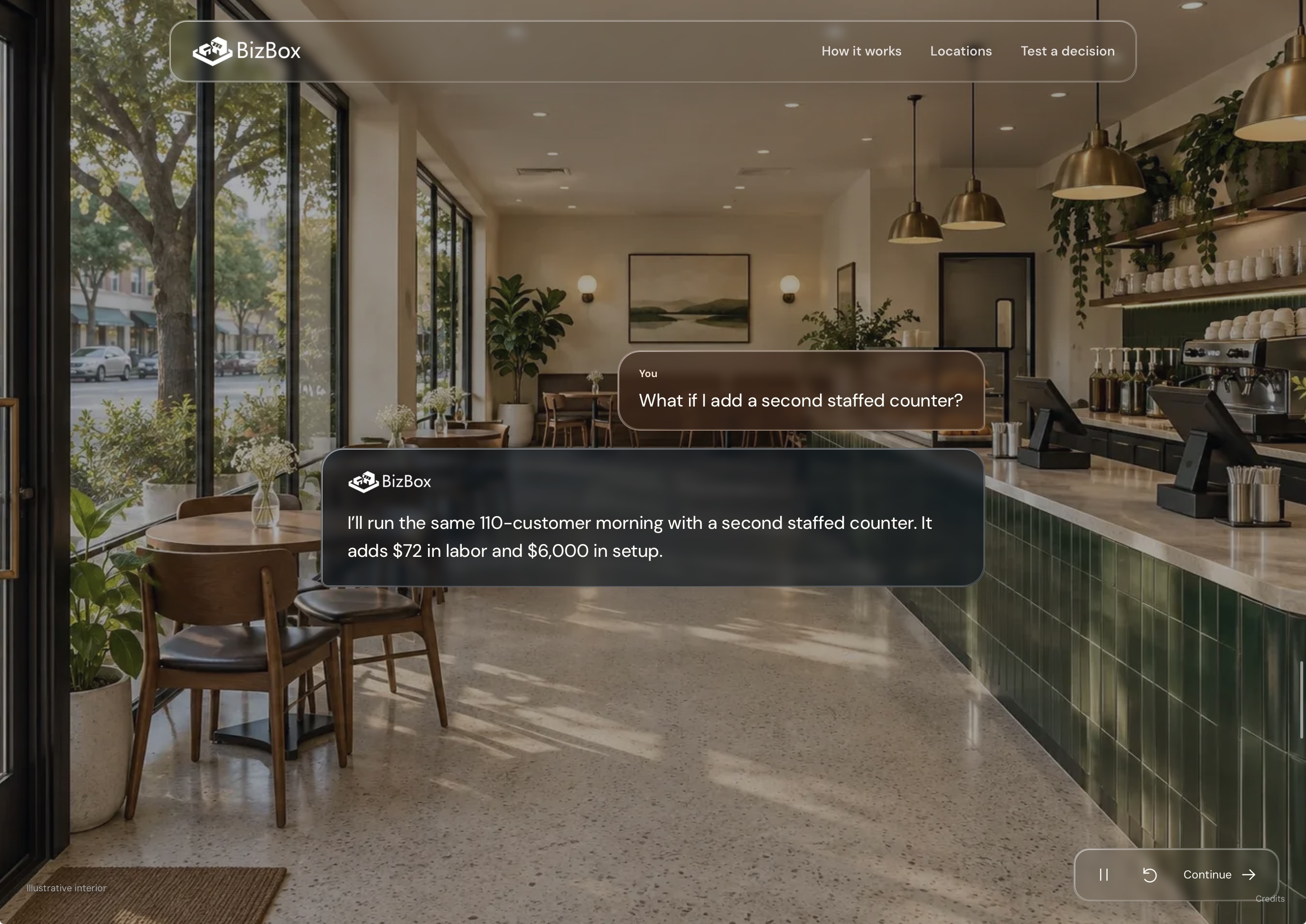
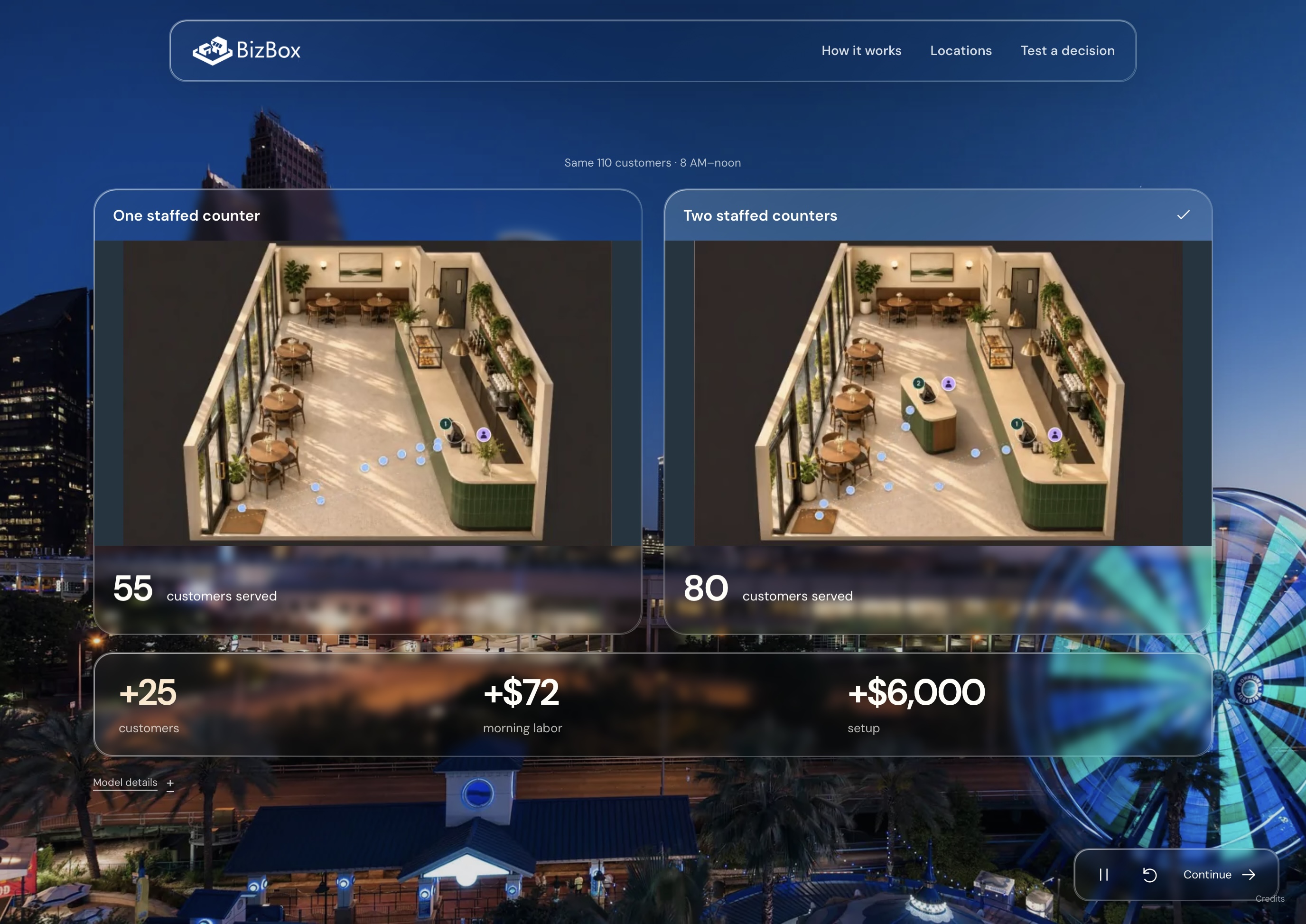
What if you hired another employee? Added a checkout counter? Changed your operating hours? Chose a different location?
BizBox lets entrepreneurs experiment with these decisions before making them in the real world.
Our AI consultant investigates opportunities, evaluates alternatives, and runs sensitivity analyses to reveal how changes affect modeled costs, capacity, and operating contribution.
For example, a location with strong potential demand might still perform poorly if limited service capacity causes customers to leave.
BizBox can test whether adding another service station improves the modeled outcome enough to justify its cost.
Entrepreneurs can compare scenarios, understand the tradeoffs, and see which assumptions could reverse a recommendation.
Finally, BizBox generates a ranked property comparison and printable location plan with supporting evidence, scenario results, and practical next steps.
From finding a storefront to designing a better operating strategy, BizBox helps entrepreneurs make the decision before making the investment.
How We Built It
We built BizBox as a full-stack application using Next.js, React, TypeScript, and Tailwind CSS, deployed on Vercel.
Our biggest technical challenge was connecting real-world property intelligence, agentic reasoning, customer behavior, financial modeling, and 3D visualization into one coherent system.
Commercial Real Estate and Market Intelligence
At the foundation of BizBox is CoStar's commercial property dataset, which provides real candidate retail spaces for our location analysis.
We combine this with:
- Census ACS for neighborhood demographics.
- LODES for workplace employment and job density.
- Overture Maps for nearby businesses and competitive context.
- Vexcel for 3D city imagery and spatial visualization.
Our data infrastructure uses PostgreSQL and PostGIS on Neon, with Drizzle ORM for type-safe database operations.
Our hosted dataset includes:
| Dataset | Records |
|---|---|
| CoStar properties | 3,339 |
| Commercial spaces | 3,955 |
| Tenancies | 11,179 |
| Census block groups | 12,816 |
| Workplace job blocks | 114,284 |
| Overture places | 137,469 |
This enables us to evaluate storefronts in the context of their surrounding markets rather than treating each property as an isolated listing.
Agentic AI and Business Intelligence
We built our agentic workflows using LangChain Deep Agents and OpenAI models.
Our system includes:
- AI Intake Agent: Translates an entrepreneur's goals into a structured business profile.
- Investigation Orchestrator: Researches properties, examines local markets, and evaluates business scenarios.
- AI Consultant: Explains tradeoffs, investigates operational changes, and supports financial decision-making.
Our investigation workflow uses seven structured, Zod-validated tools:
save_profile, search_sites, get_catchment, poll_customers, evaluate_sites, run_sensitivity, and get_site_run.
The investigation is checkpointed in Postgres, allowing the agent to preserve progress across serverless function calls.
We also built numerical grounding safeguards so the AI cannot simply invent financial figures or unsupported statistics.
The AI investigates and explains. Our underlying models calculate the results.
AI Customer Modeling and Deterministic Simulations
We use TypeSafe Jev to generate simulated customer responses informed by local market context.
These responses feed a demand model and a custom TypeScript simulation engine that models:
- Customer arrivals and purchasing opportunities.
- Service queues and waiting times.
- Staffing and service capacity.
- Operational bottlenecks.
- Modeled revenue, costs, and contribution.
Our simulation is deterministic and uses seeded randomness, meaning identical inputs produce reproducible results.
This makes comparisons between business scenarios more consistent and explainable.
Importantly, simulated customer behavior represents modeled assumptions, not observed customer transactions or guaranteed future demand.
Interactive 3D Visualization
We combined several visualization technologies:
- Cesium + Vexcel: Immersive 3D city environments.
- Three.js + React Three Fiber: Interactive storefront and customer simulations.
- MapLibre: Property discovery and geographic exploration.
- Recharts: Business performance and scenario comparisons.
Our objective was to make complex business analysis intuitive by allowing users to connect visual events to modeled outcomes.
Financial Intelligence
We integrated Capital One's Nessie sandbox into our AI consultant workflow to explore how available cash relates to modeled buildout and operating requirements.
Financial calculations are performed server-side, with explicit assumptions and limitations, rather than relying on AI-generated estimates.
Challenges We Faced
1. Bridging the Gap Between Property Data and Business Performance
Commercial real estate data can tell you a property's characteristics, but it cannot directly tell you whether a specific business will succeed there.
We needed to build a bridge between real-world property information, local market context, customer assumptions, and operational economics.
Our solution: Construct a connected modeling pipeline that evaluates each property as a business scenario rather than assigning an arbitrary attractiveness score.
2. Preventing AI From Inventing Business Metrics
Financial decisions require more than convincing AI-generated explanations.
Language models can produce plausible but unsupported revenue projections, cost estimates, and statistics.
Our solution: Structured tool outputs, Zod validation, numerical provenance tracking, and server-side financial calculations.
Every important number is grounded in a source, founder-provided information, or a calculated simulation result.
3. Scaling Hundreds of Customer Simulations
A two-property comparison can require hundreds of simulated customer responses.
Managing those requests introduced challenges involving latency, concurrency, and rate limits.
Our solution: Project-scoped caching, adaptive concurrency, and rate-limit backoff to make investigations more reliable.
4. Managing Large Real Estate and Geographic Datasets
Our initial database load exceeded Neon's storage limits.
Our solution: We removed unnecessary CoStar attachments and optimized database insertion batches, reducing storage requirements while preserving the data needed for analysis.
5. Making Complex 3D Environments Responsive
Combining city-scale 3D imagery with interactive customer simulations introduced substantial rendering and performance challenges.
Our solution: We optimized graphics settings, tile detail, rendering behavior, and offscreen processing to preserve responsiveness without changing the underlying simulation results.
6. Building Multiple Complex Systems Under Hackathon Constraints
BizBox required parallel development across data infrastructure, AI agents, simulation engines, and frontend experiences.
Our solution: We built a ticket-driven development orchestration system using Linear, where coding agents worked on assigned tasks, created pull requests, and coordinated through an orchestration workflow.
This helped us integrate multiple systems into a single product experience.
Accomplishments We're Proud Of
Our biggest accomplishment is creating an experience that goes beyond property discovery to support an actual business decision.
Business Idea → Real Commercial Properties → Market Intelligence → AI Customer Modeling → 3D Simulation → Operational Experiments → Actionable Business Plan
We're especially proud of:
- Integrating real CoStar commercial property data with public market intelligence.
- Building AI agents that investigate business-specific questions using structured tools.
- Developing reproducible customer and operations simulations.
- Creating an interactive 3D city and storefront experience.
- Supporting operational experiments and financial scenario comparisons.
- Implementing safeguards against unsupported AI-generated numbers.
- Producing evidence-backed comparisons rather than speculative revenue forecasts.
- Building our own ticket-driven agent orchestration workflow to coordinate development.
The most important achievement isn't the number of technologies we integrated.
It's that each component contributes to helping an entrepreneur make a better business decision.
What We Learned
Building BizBox taught us that the most valuable business intelligence doesn't just describe the world. It helps people evaluate what to do next.
Data Is Only Valuable When It Changes a Decision
Property data becomes far more powerful when connected to the specific economics and operating constraints of a business.
Knowing the characteristics of a storefront is useful. Understanding how those characteristics might affect customer demand, service capacity, and financial outcomes is far more actionable.
Simulations Should Expose Uncertainty, Not Hide It
A single projected revenue figure can create false confidence.
We learned to prioritize scenario comparisons, sensitivity analysis, and clearly labeled assumptions so entrepreneurs can understand the risks behind a decision.
Agentic AI Requires More Than a Chatbot
Building reliable agentic systems requires structured data, persistent state, validated actions, reproducible calculations, and the ability to revise recommendations when evidence changes.
The most valuable agents don't simply generate answers. They investigate questions, use tools, test alternatives, and explain the results.
Complex Technology Should Make Decisions Simpler
Our biggest product lesson was that technical sophistication only matters when it improves the user's ability to act.
The best business intelligence doesn't eliminate uncertainty. It makes uncertainty visible, measurable, and actionable.
What's Next
Our vision is to make BizBox an AI-powered decision platform for the entire small business lifecycle.
We plan to explore:
- Expanded property coverage: Supporting more cities and commercial markets.
- More business models: Extending our simulations to additional retail and service categories.
- Deeper spatial intelligence: Incorporating licensed Matterport interior information where permitted.
- Real operating data: Allowing established businesses to compare actual performance against modeled scenarios.
- Continuous optimization: Helping entrepreneurs revisit operational decisions as their businesses evolve.
Over time, BizBox could help entrepreneurs answer questions far beyond where to open:
Should I expand? Should I hire? Should I change my layout? Which investment will have the greatest impact?
Our long-term goal is to make sophisticated real estate intelligence, operational modeling, and business decision support accessible to entrepreneurs who have never had the resources to hire a dedicated consulting team.
Because entrepreneurs shouldn't have to bet their life savings on a decision they could have tested first.
Try BizBox
Live Demo: usebizbox.app
GitHub: BizBox Repository
BizBox — Scout It. Simulate It. Scale It.
Find the opportunity. Test the possibilities. Build with confidence.
Built With
- capital-one-nessie
- cesium
- costar
- deep-agents
- drizzle
- langchain
- maplibre
- neon
- next.js
- openai
- playwright
- postgis
- postgresql
- react
- react-three-fiber
- recharts
- tailwind-css
- three.js
- typesafe-jev
- typescript
- vercel
- vexcel
- vitest
- zod


