-
-
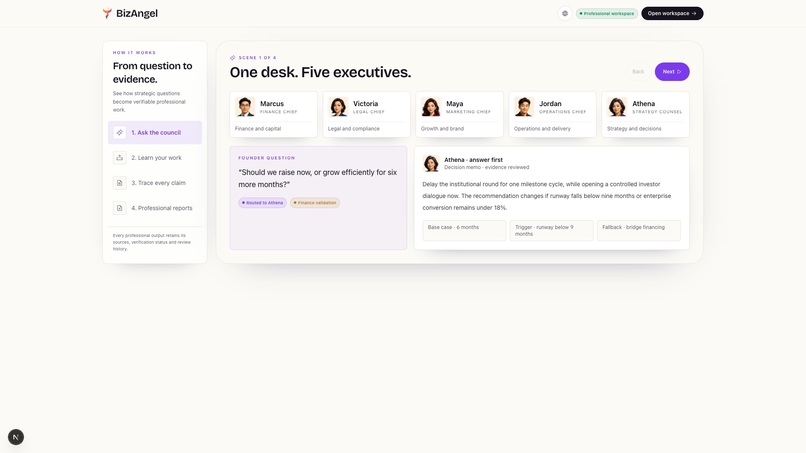
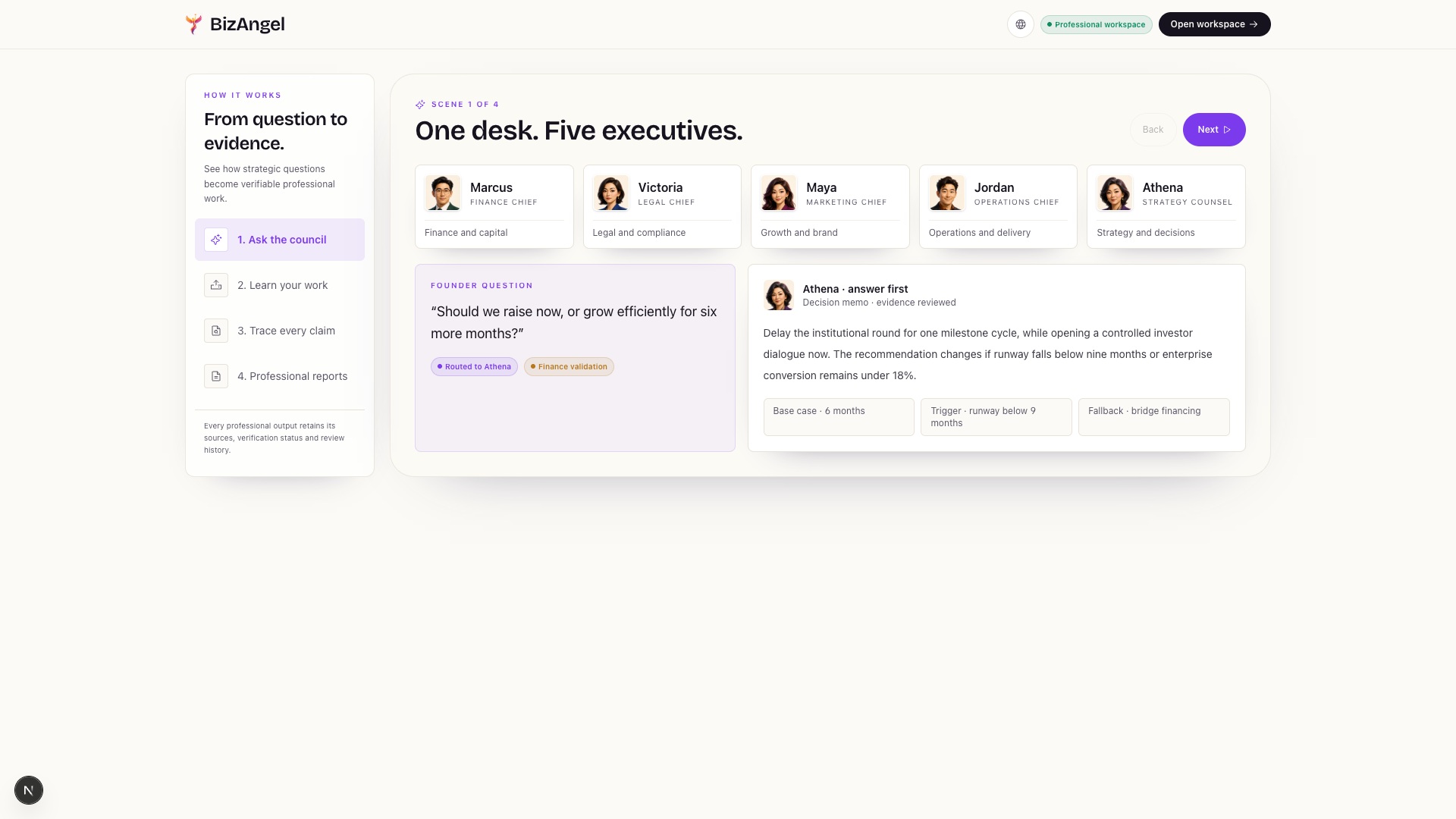
Five specialist AI executives behind one founder decision desk.
-
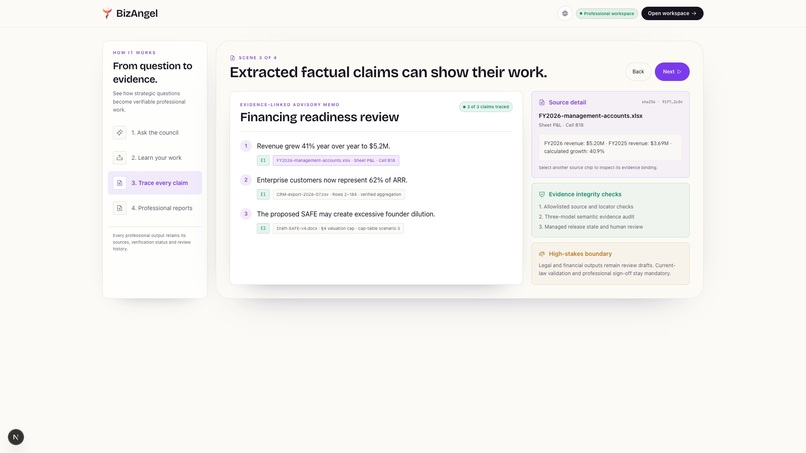
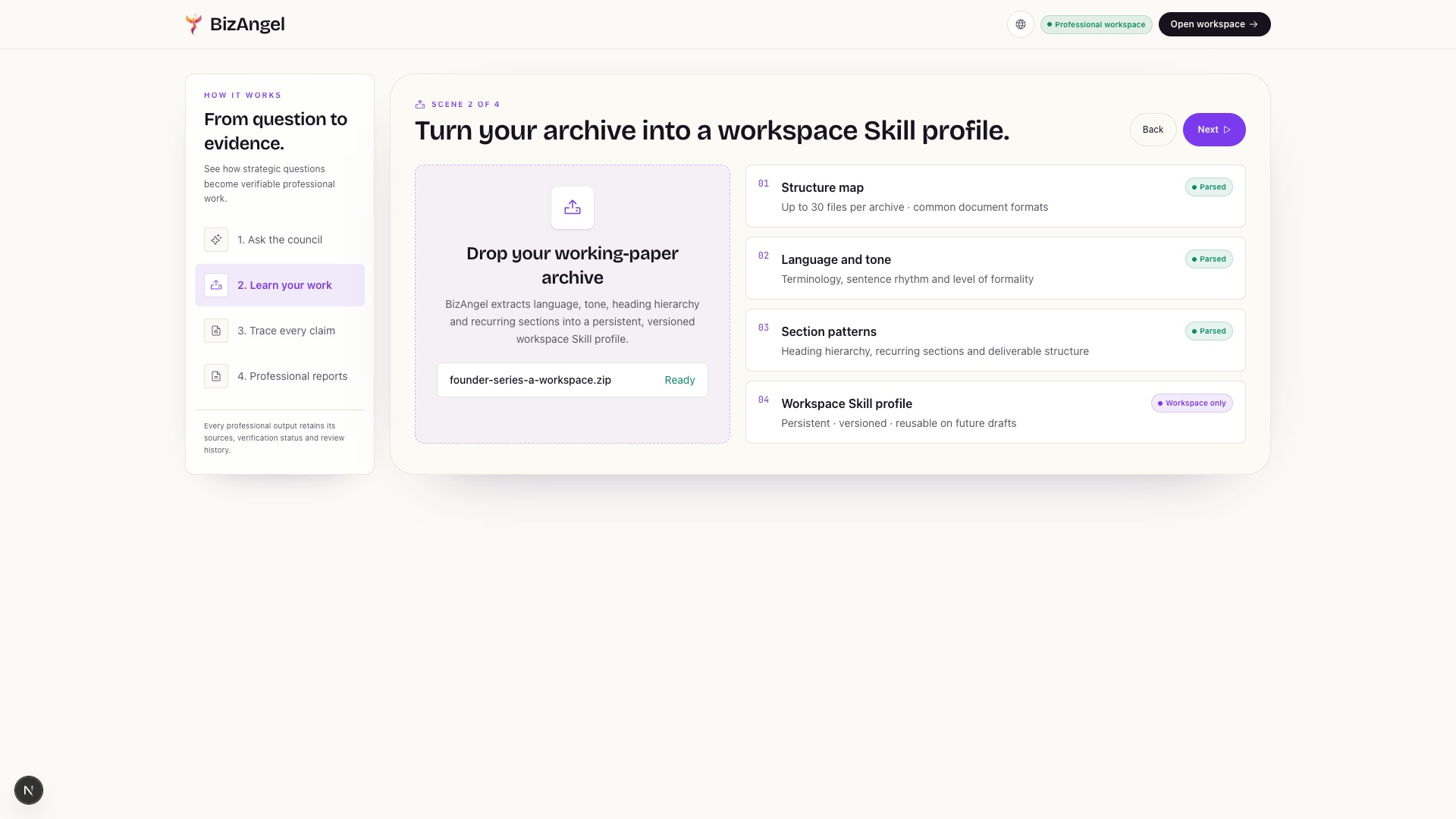
A working-paper archive becomes a persistent, workspace-scoped Skill profile.
-
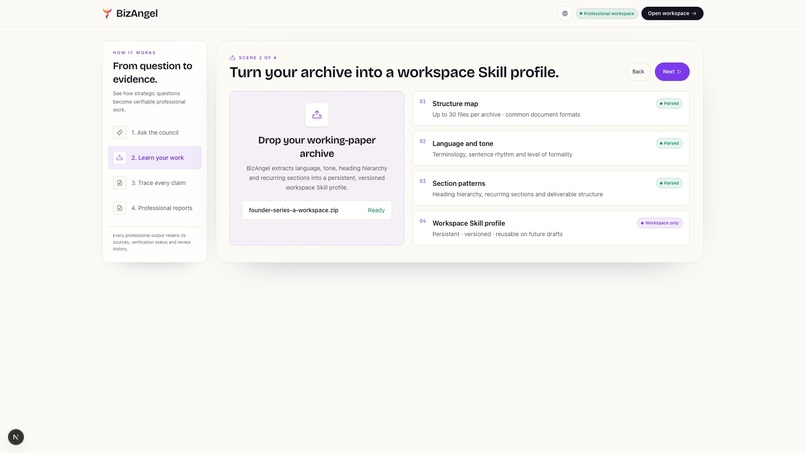
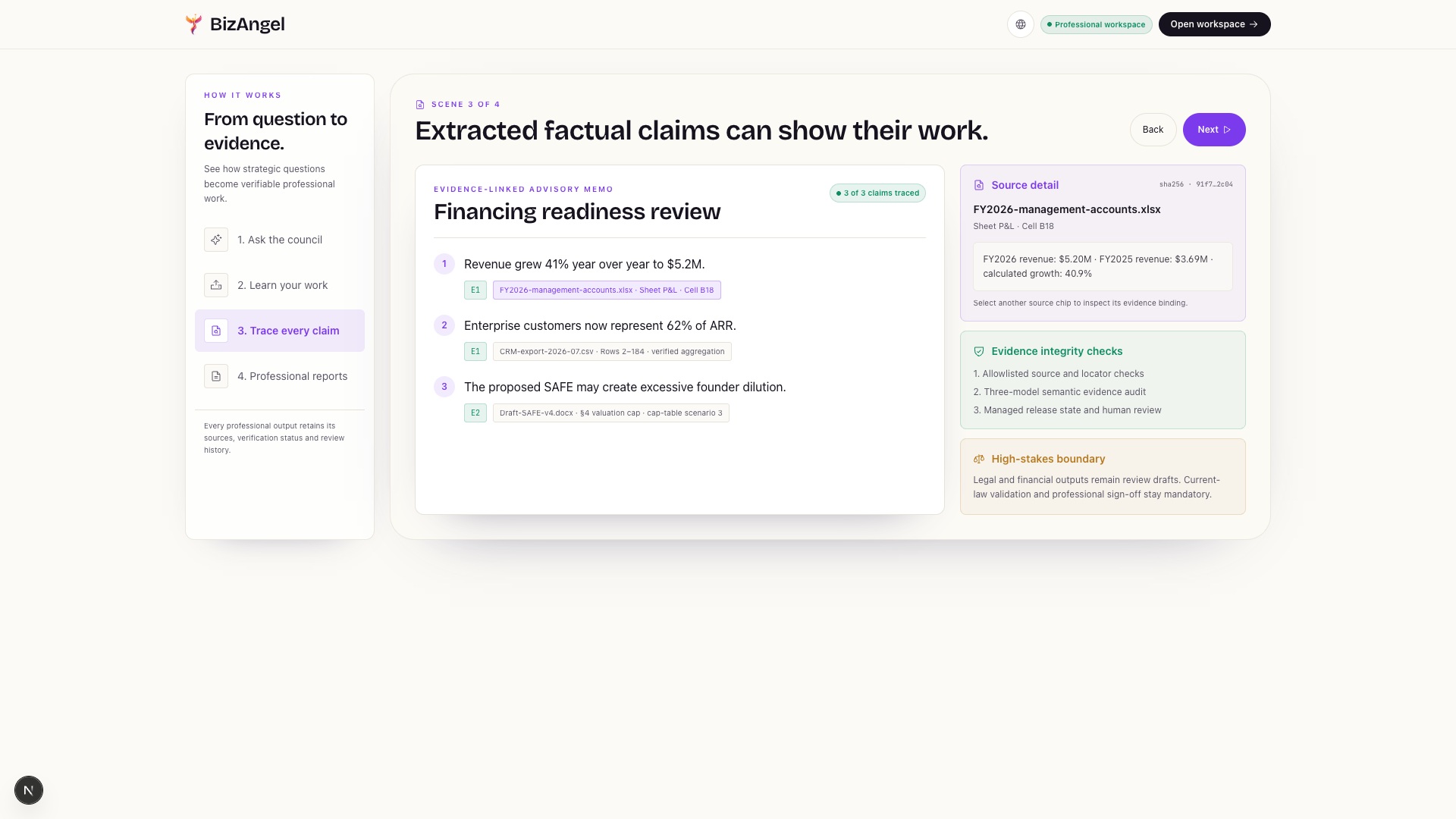
Extracted factual claims show their working-paper and source references.
-
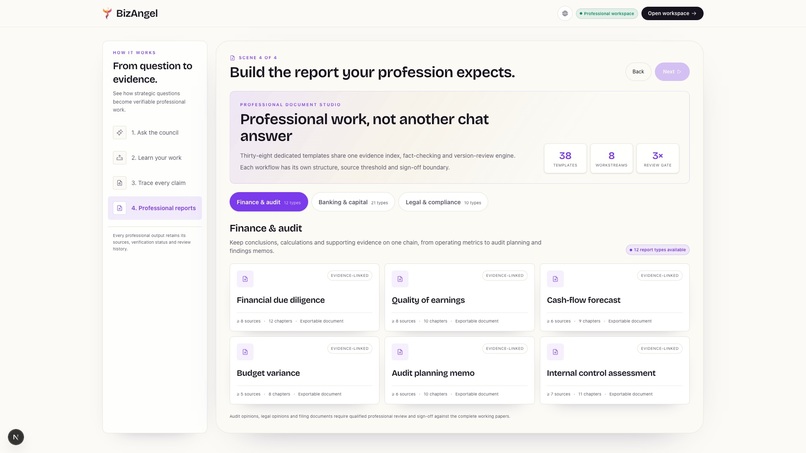
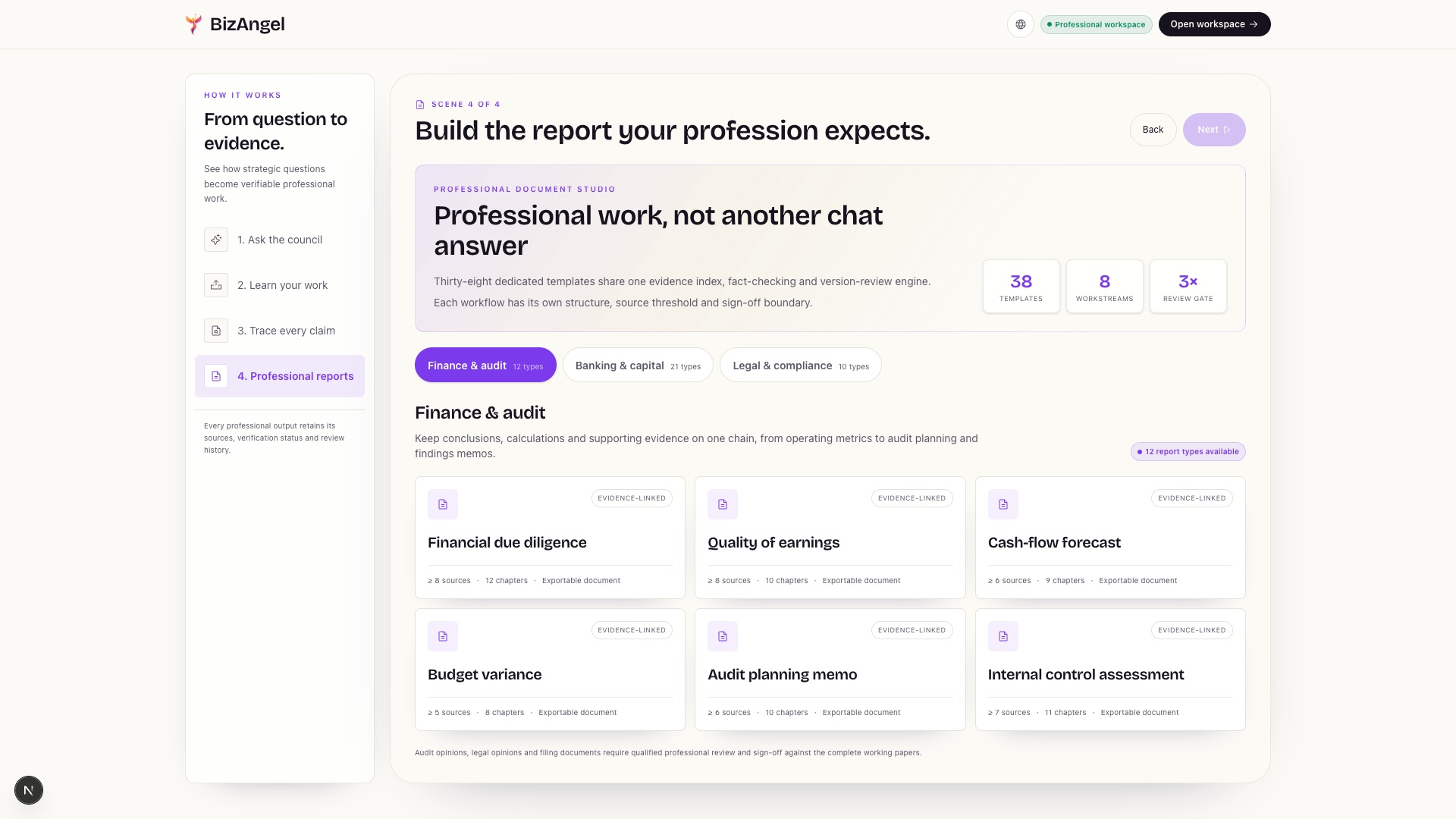
Thirty-nine professional review-draft workflows include finance, banking, legal, strategy consulting, and investment analysis.
Inspiration
AI now lets one founder build what once took an entire product team. But building a product is not the same as running a company.
Strategy, cash flow, contracts, operations, growth and fundraising arrive long before most founders can hire a full leadership team. At the same time, the professionals who support them — lawyers, bankers, consultants, finance teams and investors — spend enormous amounts of time researching, reconciling sources and drafting high-stakes documents.
BizAngel was built around one idea: one evidence-aware intelligence core can serve both sides. For a founder, it becomes an on-demand AI cofounder team. For professional and investment teams, it becomes a research-and-documents desk designed for reviewable work.
What it does
For founders: an AI cofounder team
BizAngel gives a founder five specialist AI executives:
- Athena, Strategy Counsel — tests the idea, assumptions, market position and fundraising story.
- Marcus, CFO — examines runway, scenario economics, financing consequences and financial reporting needs.
- Victoria, CLO — identifies contract, governance, compliance and jurisdiction risks.
- Jordan, COO — turns decisions into owners, milestones, dependencies and operating plans.
- Maya, CMO — develops positioning, content systems, growth experiments and market feedback loops.
A founder can ask one question at a single decision desk. BizAngel routes it to the relevant specialists, asks them to challenge one another and returns an answer-first brief with assumptions, evidence, risks, next actions, retreat paths and kill criteria.
During fundraising, the same workspace can support investor materials, diligence preparation, data-room organization, investor-question rehearsal and term analysis. The output is assistance for founder judgment, not automatic authority.
For professionals and investment teams: a research-and-documents desk
BizAngel also supports lawyers, bankers, consultants, finance teams and investors through a shared professional workflow engine.
The current document studio contains 39 review-draft workflows across legal, finance, banking, strategy consulting and investment-analysis work. Examples include contract and legal-opinion drafts, dispute filings, diligence reports, financial analysis, investment-committee memoranda, consulting reports and long-form offering-document workflows.
Investment teams can use multiple analysis lenses to examine a company, challenge assumptions and contradictions, draft harder diligence questions and assemble a reviewable investment-committee brief.
For a cross-border capital-markets example, a team preparing for a New York Stock Exchange process can combine working papers with public SEC EDGAR sources and build a Form S-1 or, for an eligible foreign private issuer, Form F-1 registration-statement review draft section by section. Material factual claims remain connected to their source records when evidence is available; regulated chapters and professional opinions remain subject to qualified human review and sign-off.
Private Skills and long-term workspace memory
Every professional team has its own method and house style. Users can upload a ZIP archive containing mixed working papers such as DOCX, PDF and XLSX files.
BizAngel extracts the archive's language, tone, heading structure, recurring sections and drafting patterns into a persistent, versioned, workspace-scoped Skill profile. That profile is private to the workspace and is not presented as an exportable public Skill.
This lets a team reuse its accumulated structure and style on a new matter while retaining the underlying working papers as the evidence boundary. The goal is to let institutional knowledge compound instead of disappearing at the end of each project.
Evidence and managed release states
Generation is only the first step. BizAngel separates fluent writing from release readiness.
Its trust layer combines:
- working-paper and web-source records;
- sentence-level references for extracted factual claims;
- allowlisted citation checks;
- semantic evidence review;
- number, date and consistency checks;
- visible review, blocked and release-ready states.
If support is missing, the system can flag the claim or prevent the deliverable from being treated as release-ready. BizAngel does not promise that an AI draft replaces a licensed lawyer, auditor, sponsor, investment committee or founder. It makes the draft easier to inspect, challenge and hand off.
How we built it
BizAngel is built with Next.js, React, TypeScript and Tailwind CSS. Supabase provides Postgres, authentication, row-level security and workspace records. Inngest coordinates durable multi-step document jobs. Evidence records, private Skill profiles and document state are persisted separately from the visible chat response.
The AI layer is deliberately multi-model, and GPT-5.6 holds the most safety-critical seat. Creation models are isolated from the independent review layer: the investment-committee Reviewer and the adversarial Challenger run on GPT-5.6, so the auditor is structurally separated from the model that produced the draft. This cross-model separation avoids shared model weights and reduces correlated blind spots.
A runtime guard compares underlying model identities. If the Reviewer resolves to the same model as the creator, it returns a non-passing degraded verdict instead of silently approving the memo; the Challenger likewise refuses to present a same-model result as an independent challenge.
The sentence-level evidence audit separately requires three independently requested models to unanimously support each factual claim. It records provider-reported actual models and fails closed if silent fallback causes supposedly independent auditors to collapse onto duplicate models.
An AUDIT_PROFILE switch trades cost for depth: the Reviewer and Challenger use GPT-5.6 Sol in the premium profile and GPT-5.6 Terra in the budget profile. Every model is reached through the OpenAI SDK via provider-aware adapters, with structured routing between specialist roles.
Long-form generation is treated as a workflow rather than one oversized prompt: plan sections, persist intermediate state, draft against jurisdiction and profession-specific templates, run integrity checks, preserve evidence references and export only with a visible readiness state.
During OpenAI Build Week, Codex drove the build itself: auditing the repository, building the executive interface, hardening private-Skill ingestion and evidence flows, extending the professional document workflows, writing the adversarial degradation tests, verifying the product in the browser and producing the Remotion demo. GPT-5.6, beyond powering the critical review layer, served as a reasoning partner for architecture, risk analysis and adversarial evaluation. Product scope, legal-risk boundaries and release decisions remained human decisions.
The public no-login judge sandbox uses clearly labelled sample data. Judges can run the instant local sample or an optional rate-limited GPT-5.6 Terra live review. The live review is isolated from private workspaces and cannot trigger payments, messages, user-workspace or business-record writes, tool calls or legal actions. Only operational model-usage metering is recorded.
Challenges we ran into
Making long documents inspectable
A prospectus, legal opinion or diligence report cannot safely be generated as one opaque response. We had to preserve intermediate section state, working-paper relationships and review gates across a durable job that may outlive a normal serverless request.
Preserving evidence through drafting and export
A source link is useful only if it remains connected to the claim it supports. We separated factual claims, professional analysis and disclosures, then carried evidence identifiers through the document workflow instead of flattening everything into final prose.
Learning style without leaking the archive
A private Skill must capture reusable structure and language without exposing a customer's documents or turning proprietary work into a downloadable public asset. Workspace scope, versioning and clear non-exportability became core product boundaries.
Staying powerful without pretending to be final
High-stakes work needs judgment. We designed BizAngel to produce professional review drafts, surface uncertainty and require the appropriate human sign-off rather than market generated text as autonomous legal, audit or investment authority.
Accomplishments that we're proud of
- A coherent five-person AI executive council with original character art and cross-functional routing.
- A public interactive tour that demonstrates the product without requiring an account.
- ZIP-to-private-Skill ingestion with persistent, versioned workspace profiles.
- Sentence-level evidence records for extracted factual claims and an exportable evidence ledger.
- A multi-pass hallucination, citation and consistency harness with managed release states.
- A cross-model adversarial review layer: GPT-5.6 serves as the independent investment-committee Reviewer and Challenger, with a runtime guard that refuses to pass any review whose auditor is not independent of the drafting model.
- 39 professional review-draft workflows across finance, banking, legal, strategy consulting and investment analysis.
- A long-form prospectus workflow with jurisdiction and professional-review gates.
- A verified engineering baseline: strict TypeScript, 1,285 passing tests and a clean production build.
- An under-three-minute Remotion product film with narration, subtitles and a visual system built from the live product.
What we learned
The best multi-agent interface is not the one with the most agents talking. It is the one that makes ownership, evidence, disagreement and hand-off visible.
We also learned that long-form professional generation is fundamentally a state-management and review problem. Larger context windows help, but they do not replace durable jobs, evidence records, version history or human approval.
What's next
Next we will expand retrieval evaluation across larger multilingual working-paper sets, add more jurisdiction-specific professional workflows, deepen team review and permission controls, and connect more verified professional data sources.
The product direction remains the same: give founders executive leverage, give professionals and investors reviewable intelligence, and never hide uncertainty behind confident prose.
Built With
- codex
- gpt-5.6
- inngest
- next-intl
- next.js
- node.js
- openai
- openrouter
- paddle
- playwright
- postgresql
- radix-ui
- react
- recharts
- redis
- remotion
- resend
- shadcn/ui
- supabase
- tailwind-css
- typescript
- upstash
- vercel
- vitest
- zustand


Log in or sign up for Devpost to join the conversation.