Inspiration
During large sporting events and concerts, customers often order food and beverages from their seats. Stadium staff typically rely on manual assignment and communication to fulfill these orders, leading to inefficient delivery routes, longer wait times, and inconsistent customer experiences. As attendance increases, coordinating thousands of deliveries across multiple seating sections becomes increasingly challenging.
Solution
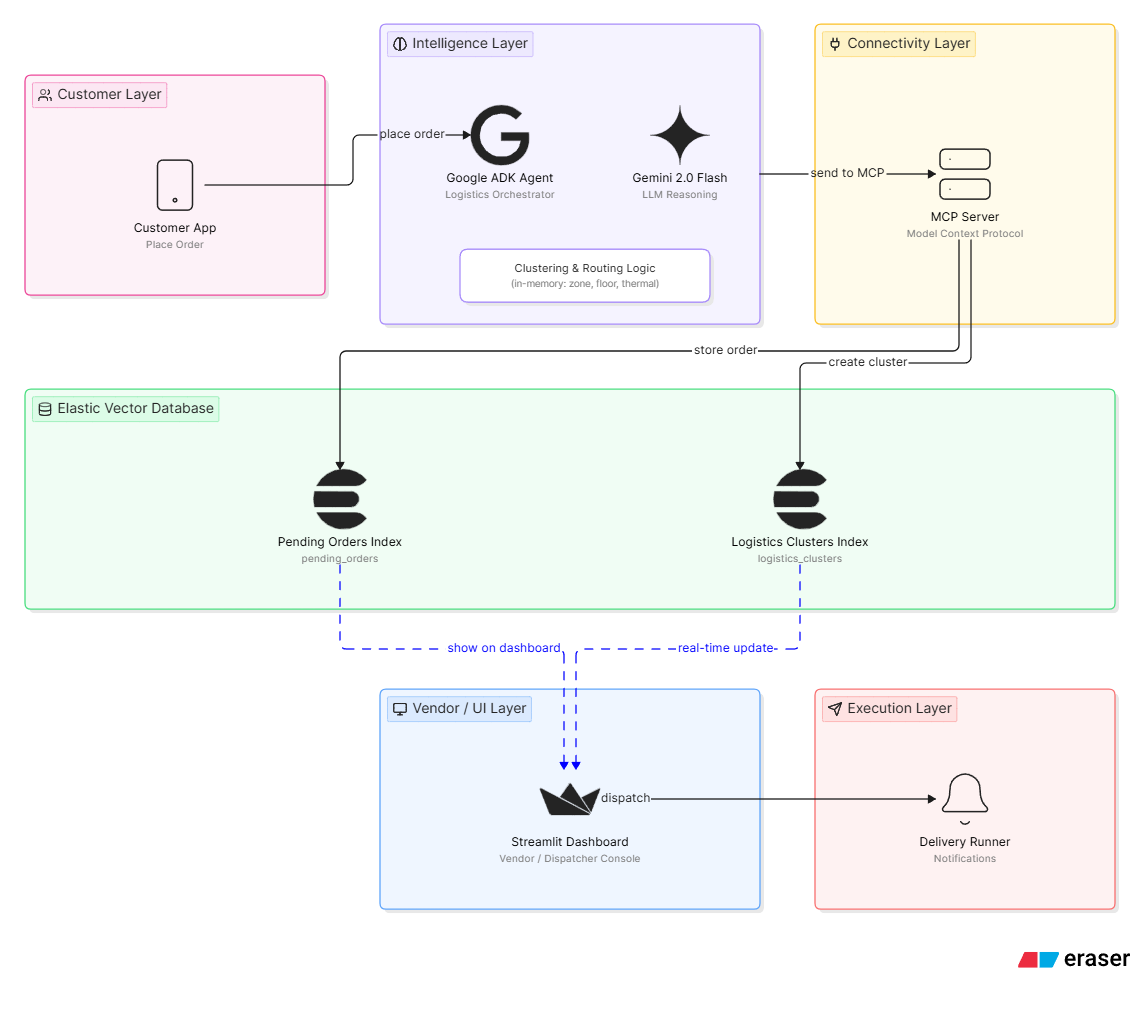
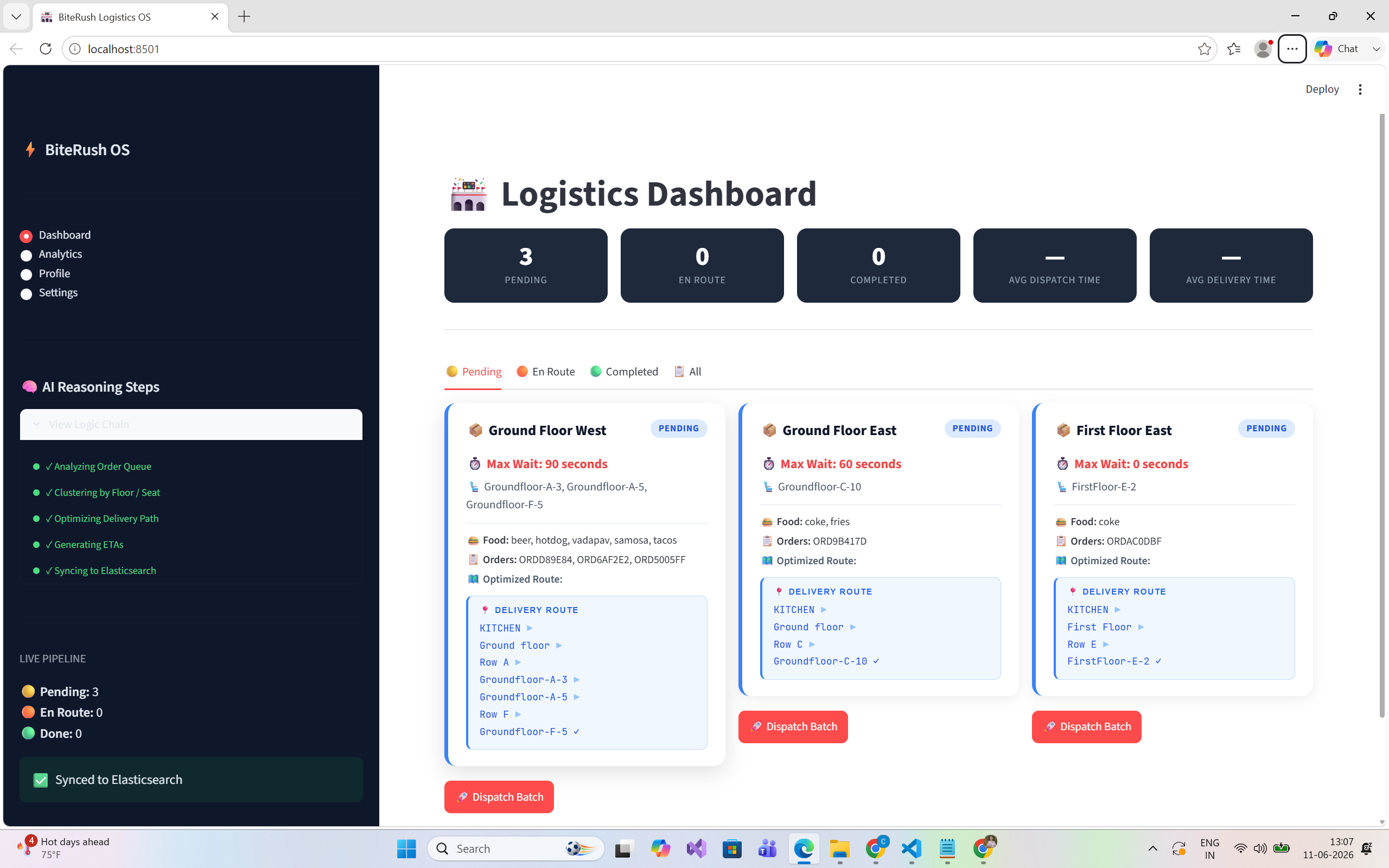
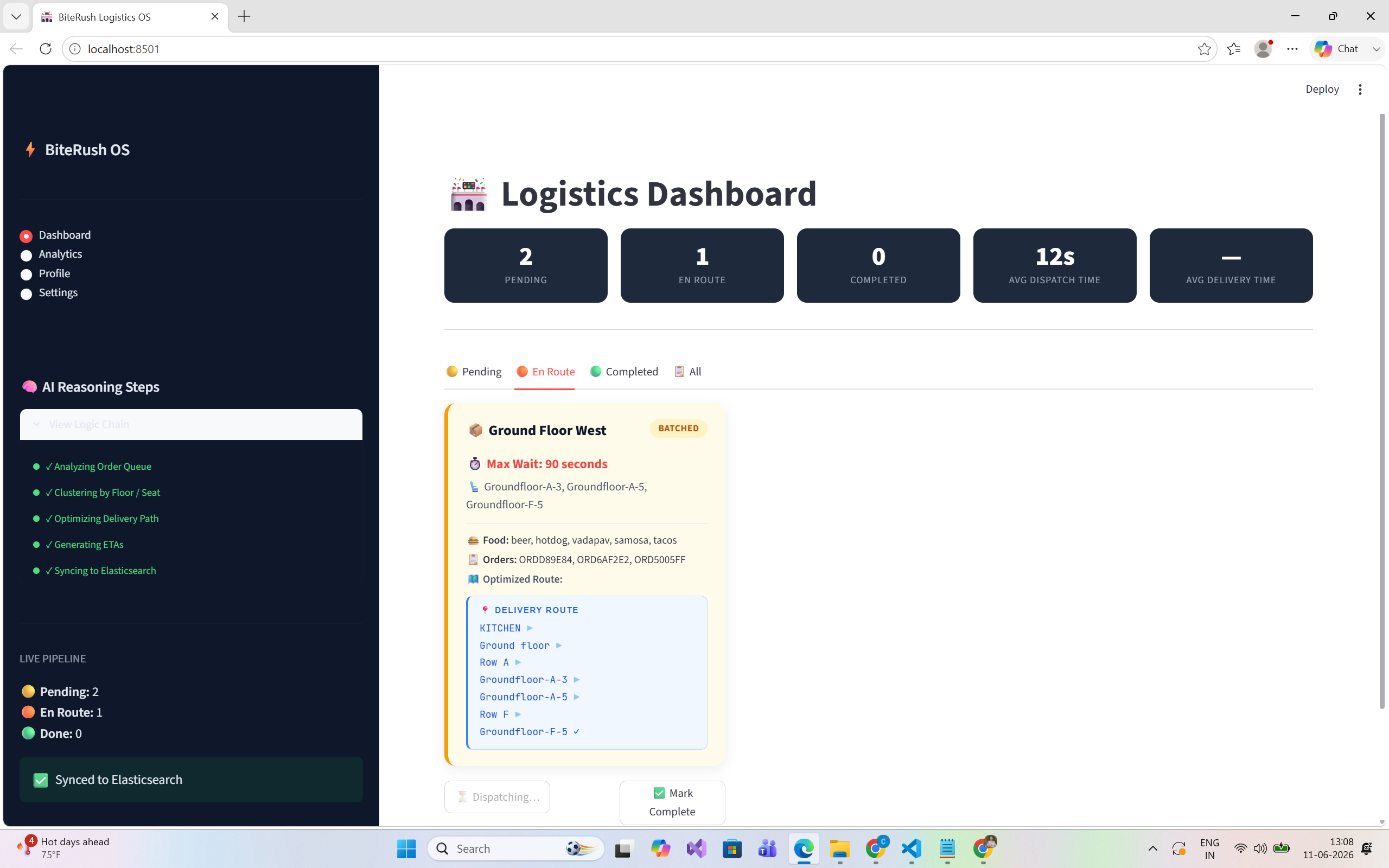
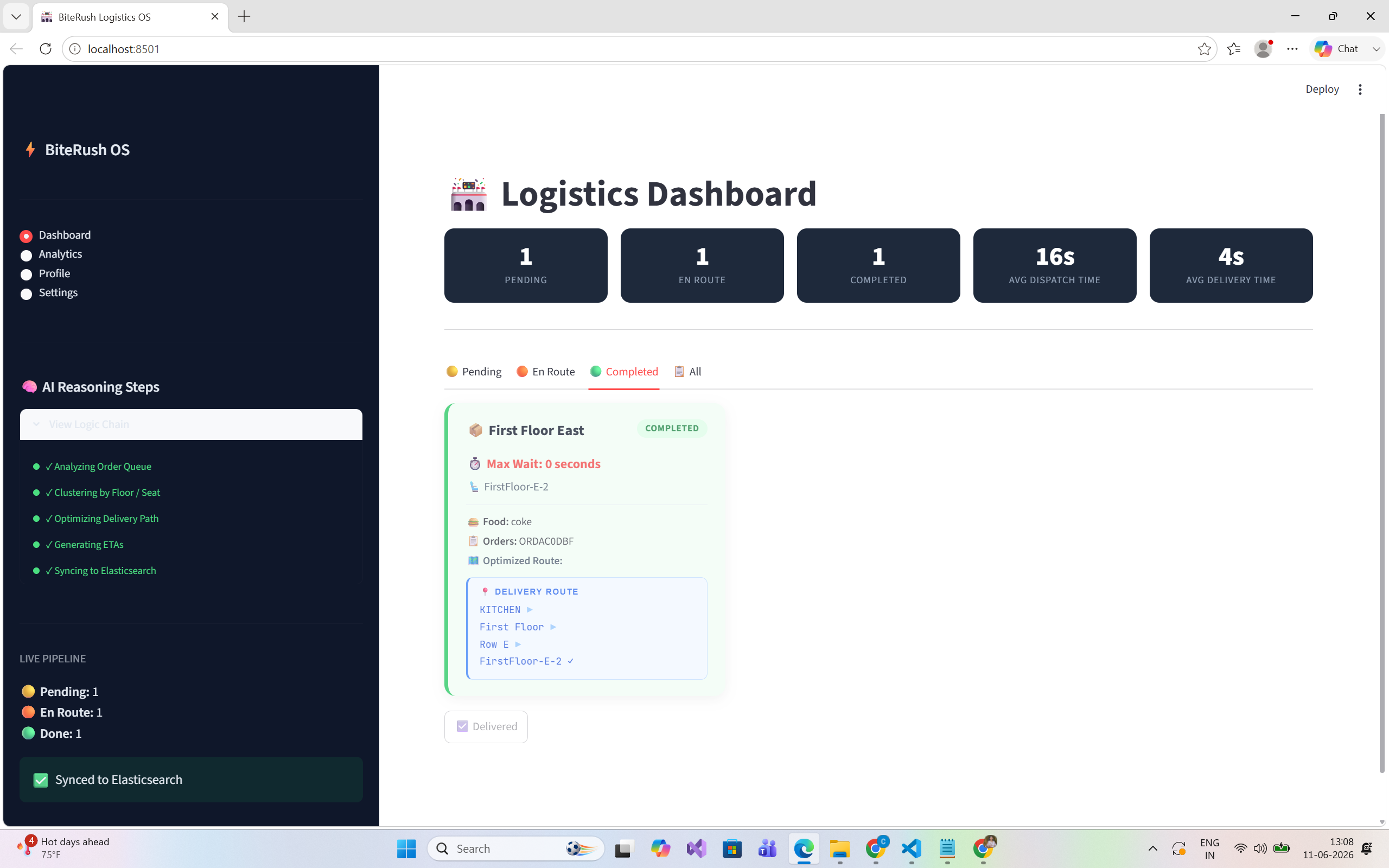
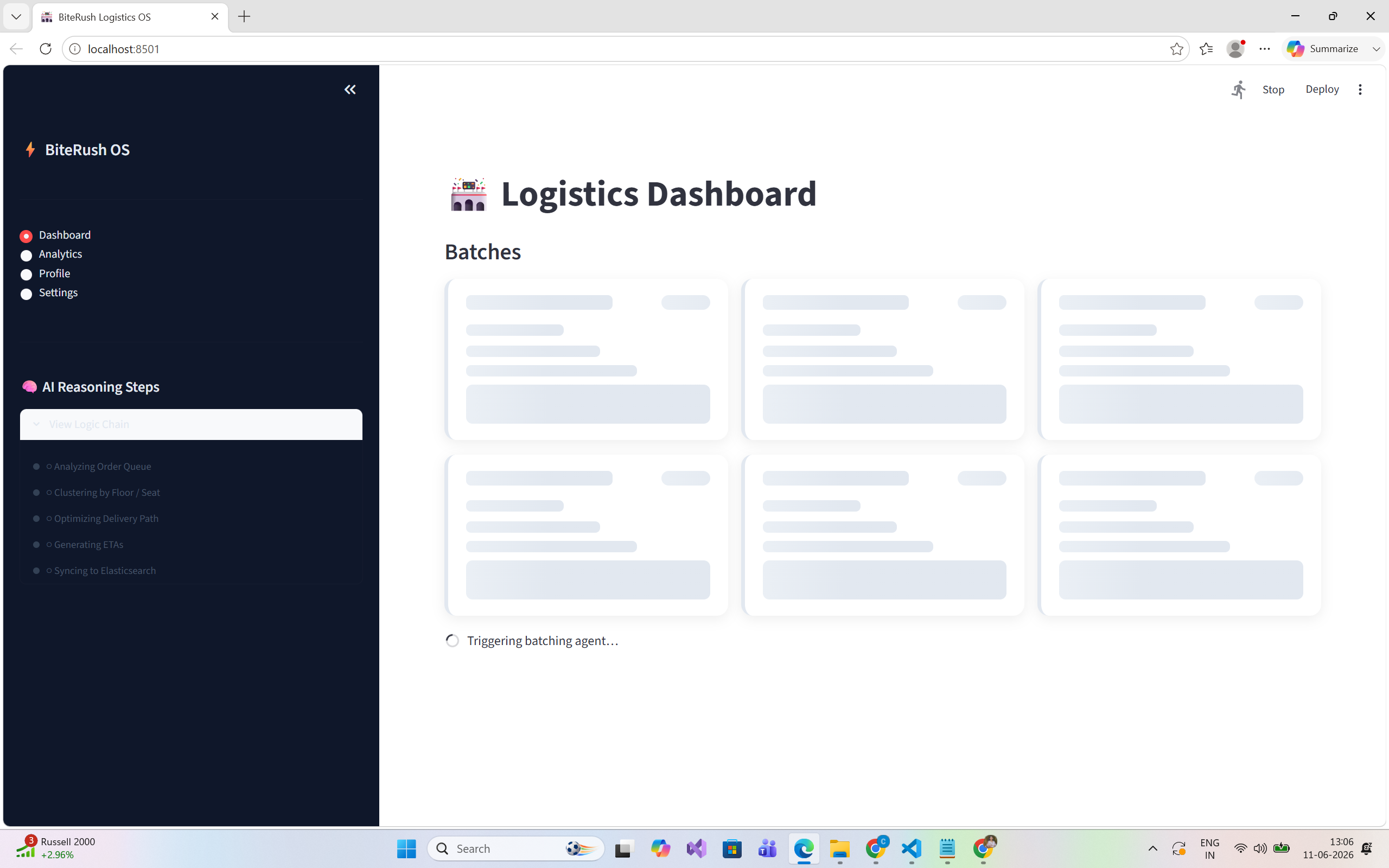
Developed a Stadium Food Delivery Optimization Platform that intelligently assigns customer orders to delivery staff and calculates the most efficient routes through the stadium. The platform provides real-time operational dashboards, enabling managers to monitor order status, delivery performance, and staff utilization during live events.
BiteRush is built on Google ADK, which handles agent orchestration, monitoring, and deployment for the autonomous orchestrator allowing it to reason over live operational data using Gemini 2.0 Flash with a clear, production-ready structure. For data access, BiteRush connects to Elastic through MCP tools, giving the orchestrator low-latency, real-time connectivity to query and update pending orders and delivery clusters as conditions change, and pushing live updates straight to the dispatcher dashboard.
How the System Works
Traditional systems wait for humans to make decisions BiteRush makes decisions autonomously.
Step 1: Order Ingestion
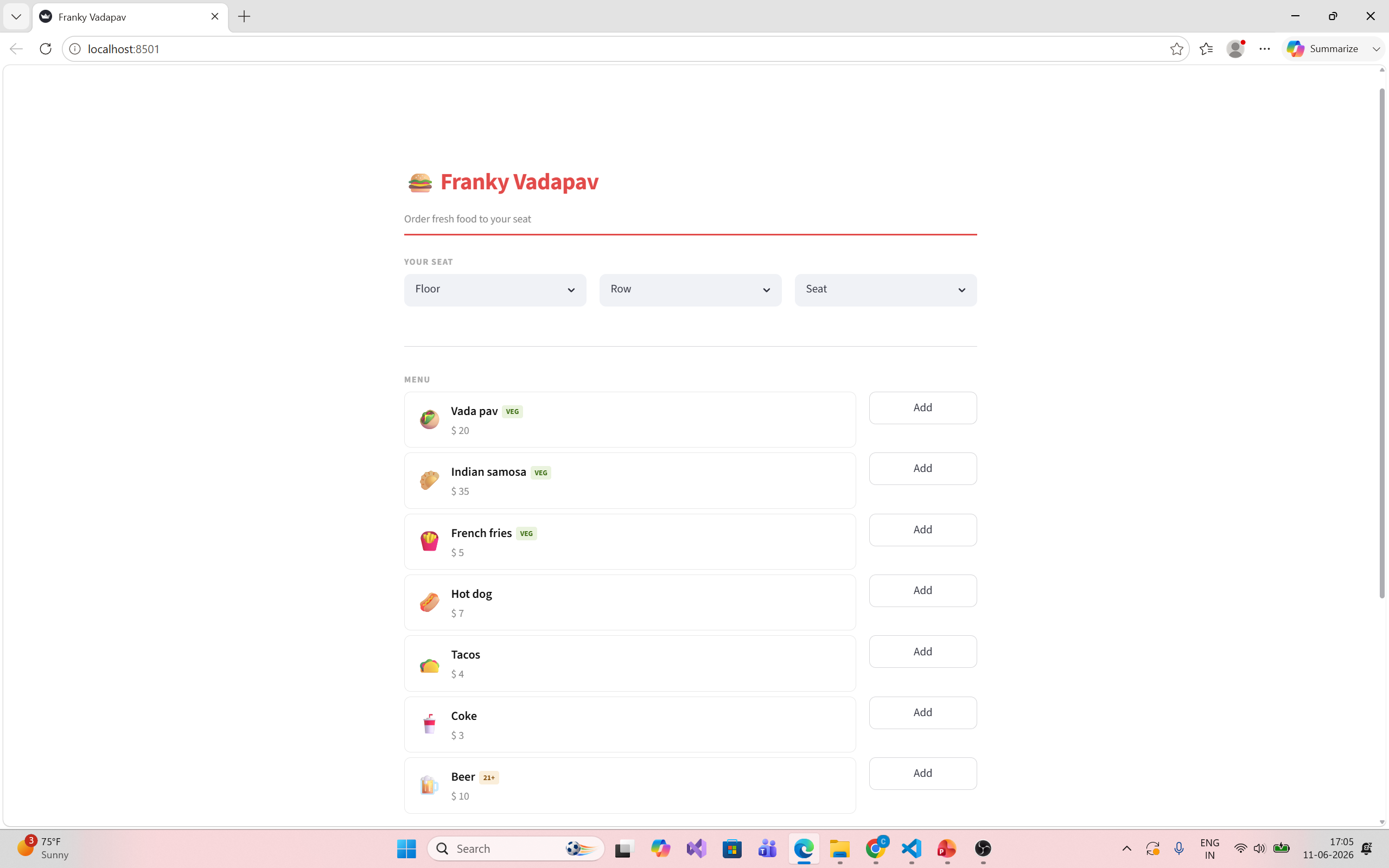
A fan places an order from their seat.
Step 2: Situational Awareness
The AI agent gathers live operational context:
- Staff availability
- Staff proximity
- Venue congestion
- Delivery queue length
- Current workload distribution
Step 3: Autonomous Assignment
The system identifies the optimal delivery associate based on efficiency, workload balancing, and estimated completion time.
Step 4: Intelligent Routing
Routes are dynamically generated using stadium topology, crowd movement patterns, elevator availability, and section accessibility.
Step 5: Continuous Optimization
As new orders arrive and conditions change, assignments are recalculated and optimized in real time.
Step 6: Command Center Visibility
Operations managers receive a live, system-wide view of venue performance, enabling rapid intervention when necessary.
Challenges
Our initial architecture used a multi-agent system where specialized agents handled assignment, routing, staffing, and operational analysis independently. While powerful, it introduced significant overhead requiring up to 24 network calls per workflow and high LLM token consumption, leading to ~2-minute latency, which is not suitable for real-time stadium operations.
To solve this, I redesigned the system into a single orchestrator agent with tool-based execution. Instead of inter-agent communication, the orchestrator directly invoked tools in one workflow. This reduced network calls from 24 → 1, and improved latency from ~2 minutes → 10–20 seconds, while also reducing token usage and improving reliability.
This taught me that effective agentic systems are not about more agents but about better orchestration under real-world constraints.
Accomplishments
- Reduced average delivery times through real-time AI routing and assignment
- Improved customer satisfaction via faster seat-side delivery experience
- Increased order fulfillment efficiency during peak demand periods
- Enhanced real-time operational visibility for stadium management teams
- Improved workforce allocation and utilization under high-load conditions
What I Learned
I learned how to balance AI intelligence with cost and latency constraints, designing systems that are not just powerful but production-efficient.
I learned to architect scalable, low-latency agentic systems where performance matters as much as capability under real-time load.
Most importantly, I learned to use AI as an intelligent decision-making system, not just a prompt engine focusing on orchestration, tools, and system design over raw prompting.
What’s Next for BiteRush: AI-Powered Stadium Commerce Platform
Due to time constraints, I was unable to fully implement a detailed stadium map visualization. The next step is to evolve the routing system into a spatial-aware navigation layer, enabling intuitive, map-based delivery guidance for staff.
I also plan to integrate camera and sensor data streams to make routing context-aware, allowing the system to factor in real-time crowd density, congestion hotspots, and movement surges when calculating optimal delivery paths.
This will transform BiteRush from static route optimization into a fully environment-aware, crowd-adaptive routing system.
Additionally, I initially implemented a single-vendor prototype in the customer module. The next step is to expand this UI (frontend) into a multi-vendor marketplace system, enabling multiple food and merchandise vendors within the same stadium ecosystem.
significantly improve scalability and real-world applicability for large venues.
The customer module is deployed in different link:- https://biterush-customer-module-production.up.railway.app/
Built With
- css3
- elastic
- google-adk
- google-cloud
- html5
- python
- railway
- streamlit


Log in or sign up for Devpost to join the conversation.