-
-
Start page
-
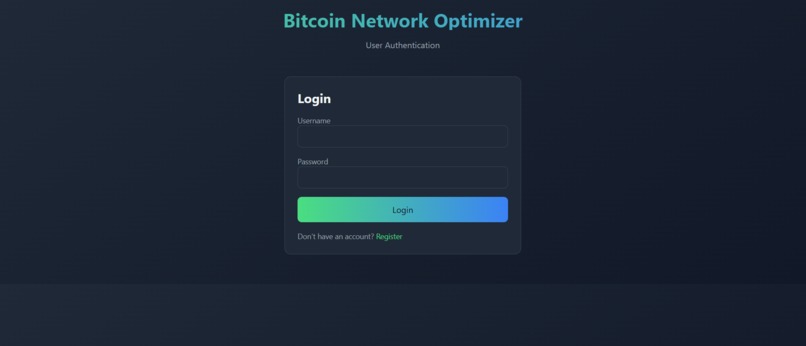
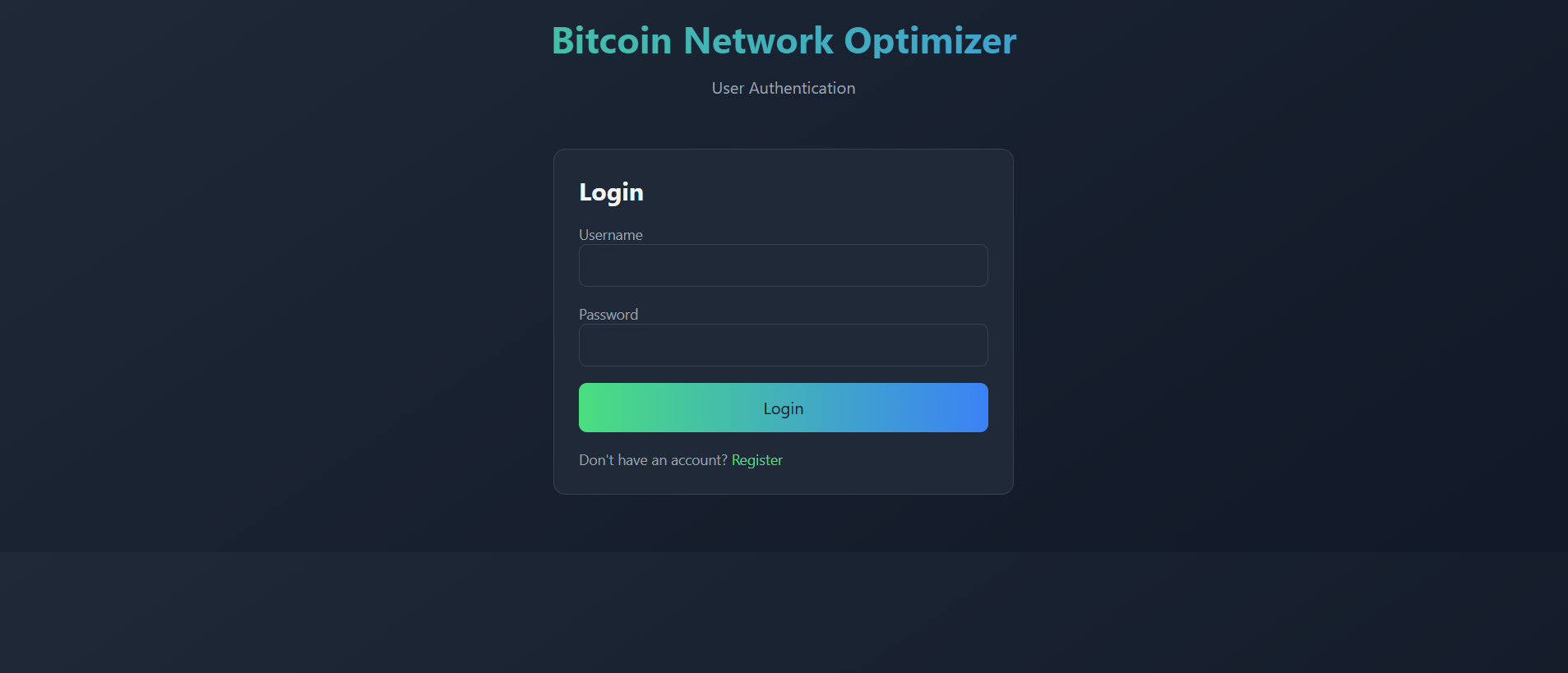
Login page
-
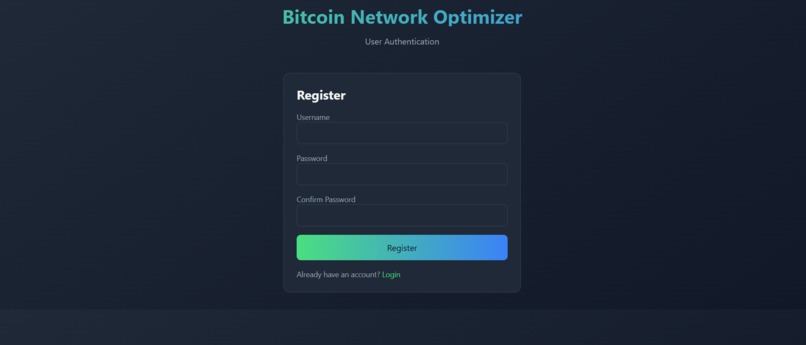
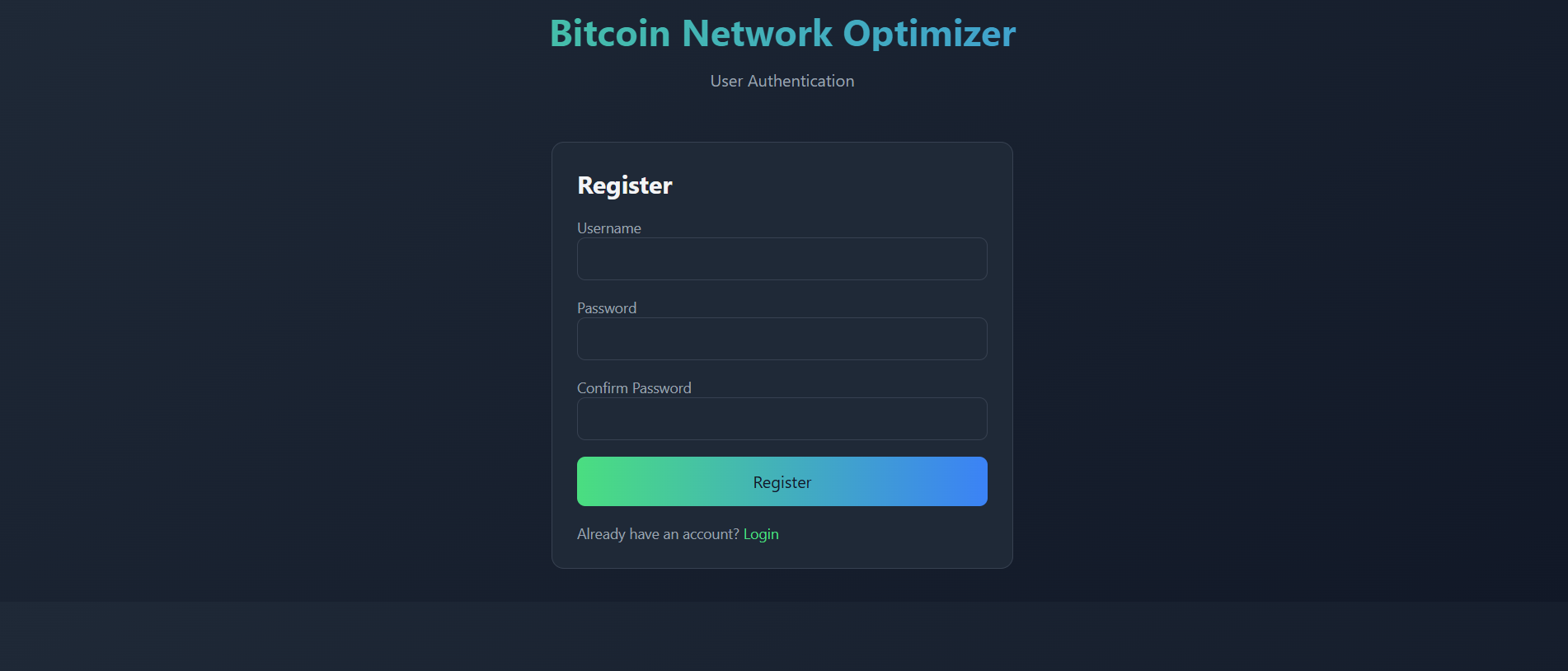
Register page
-
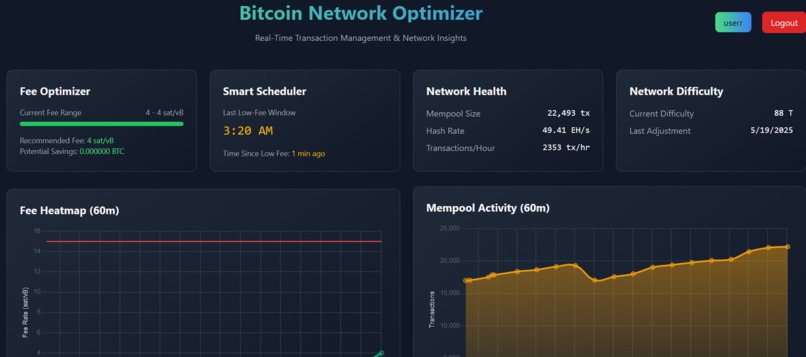
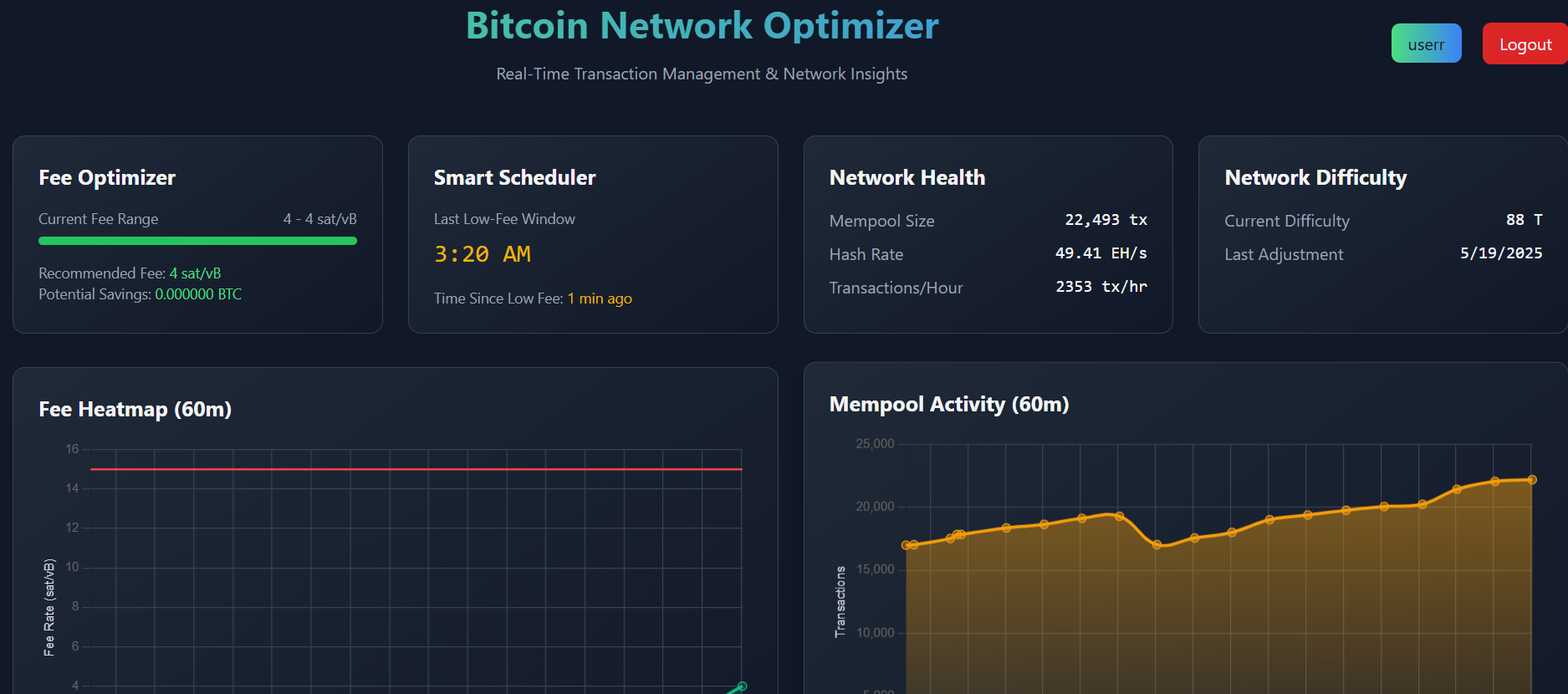
Dashboard starts
-
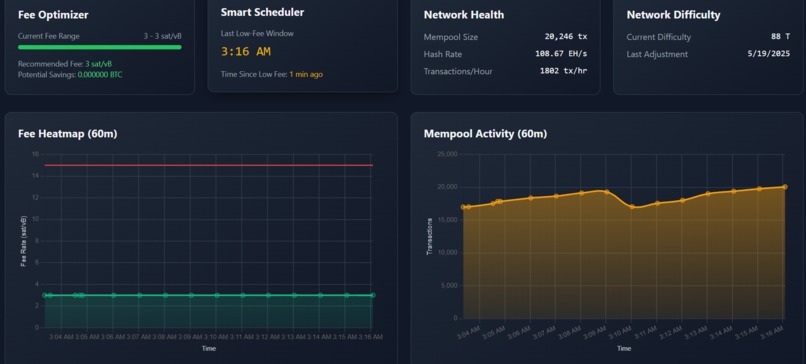
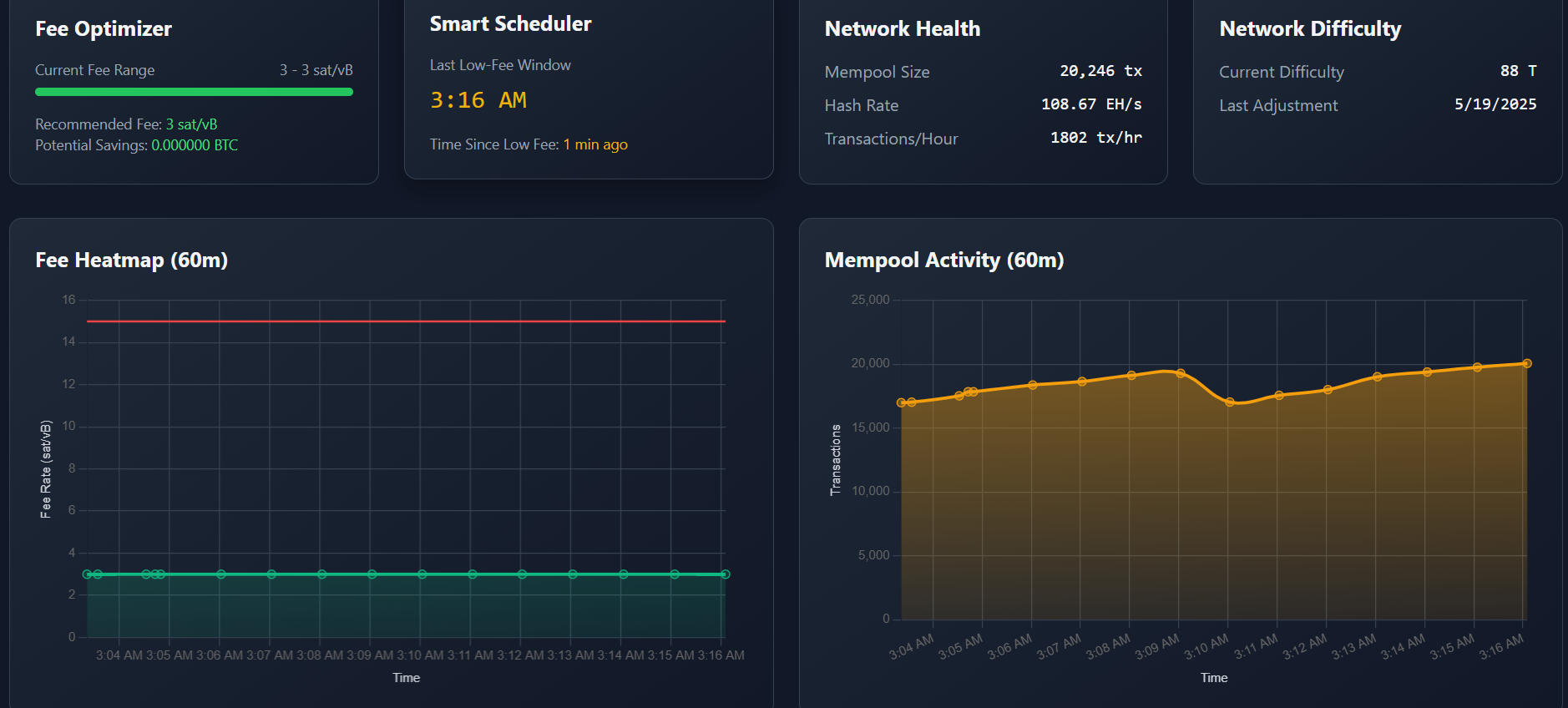
Fee Heatmap (60m) and Mempool Activity (60m)
-
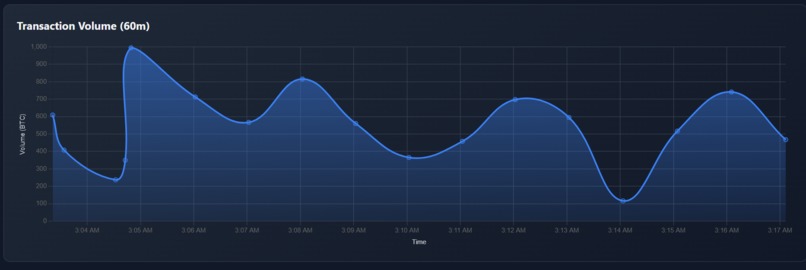
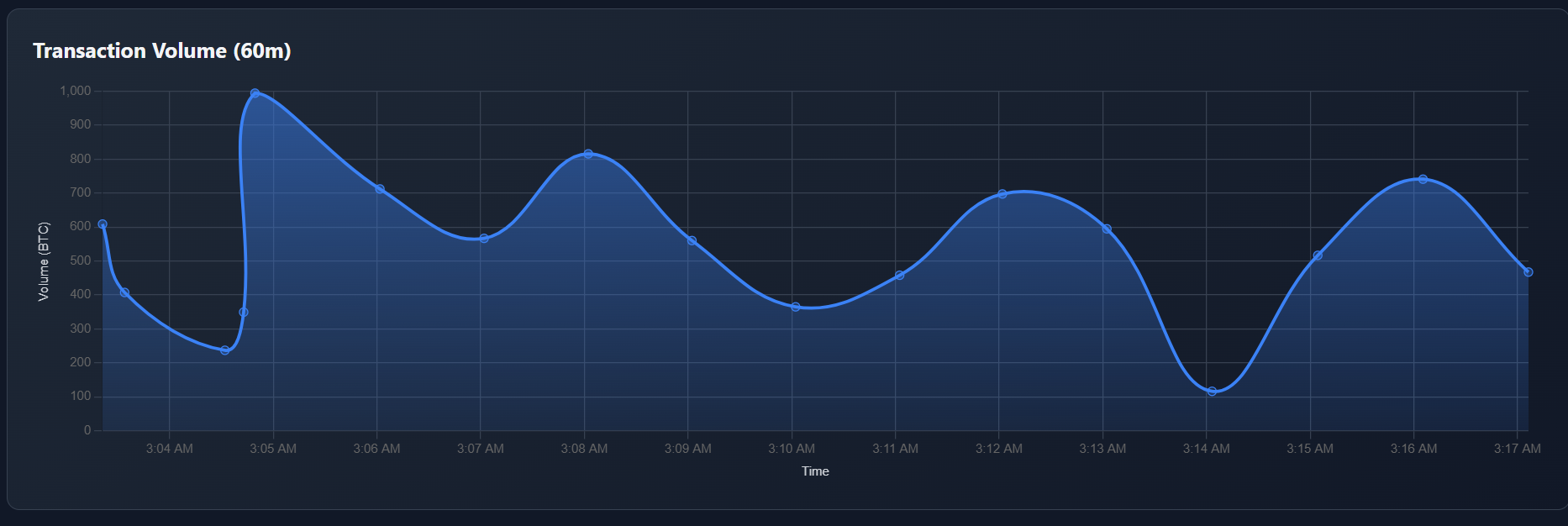
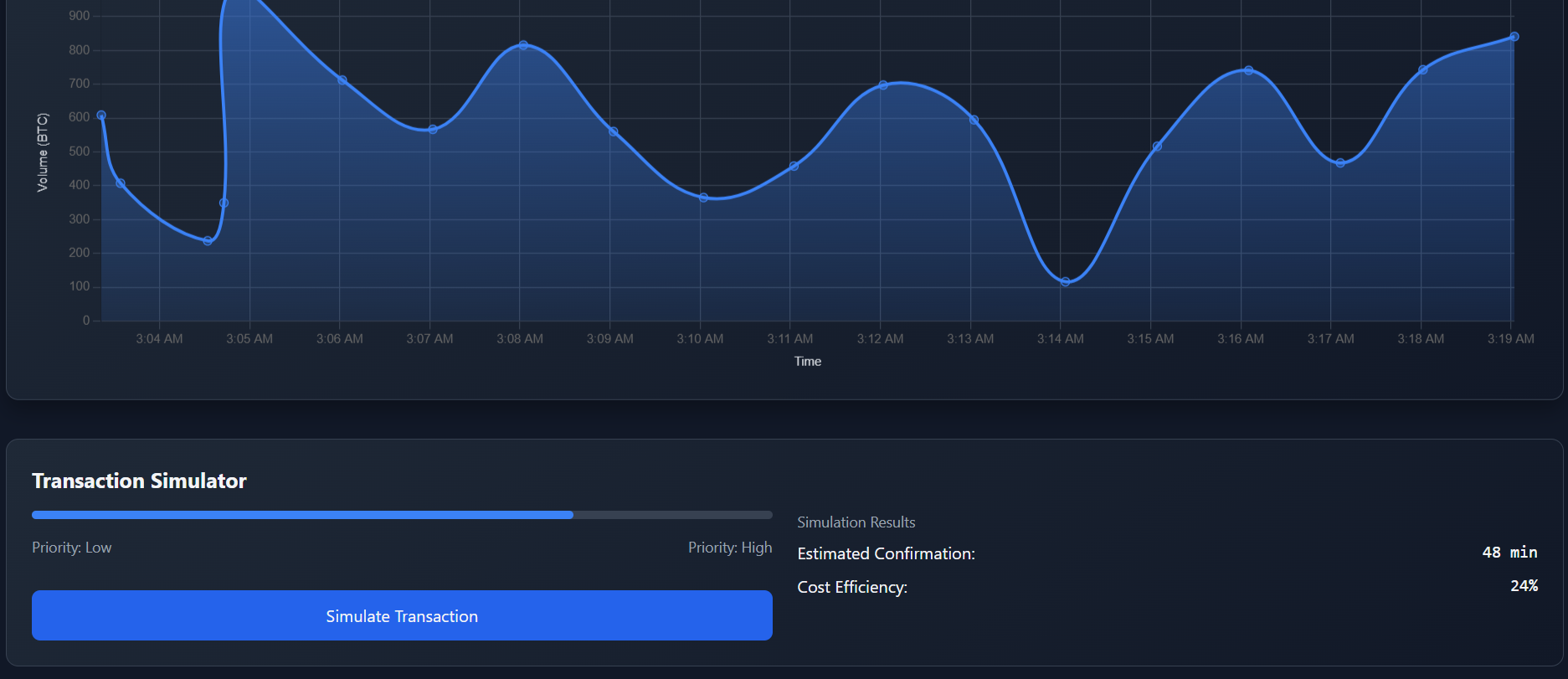
Transaction Volume
-
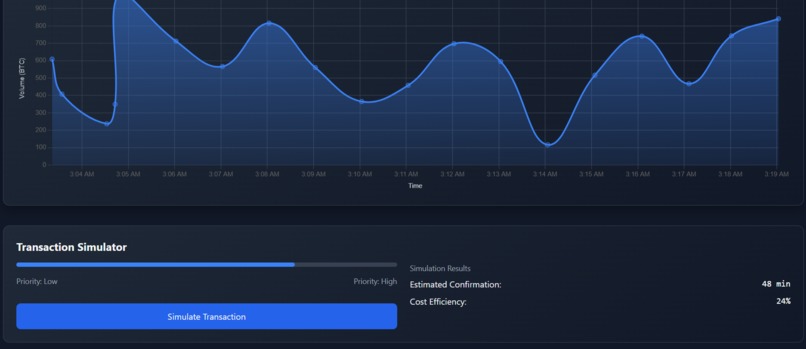
Transaction Simulator
-
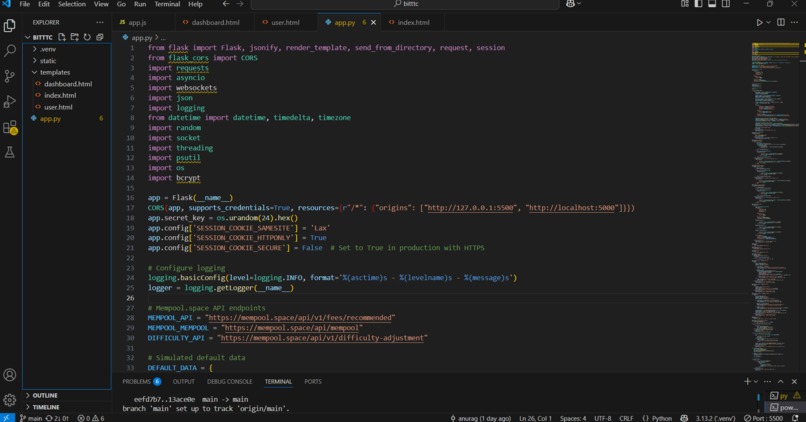
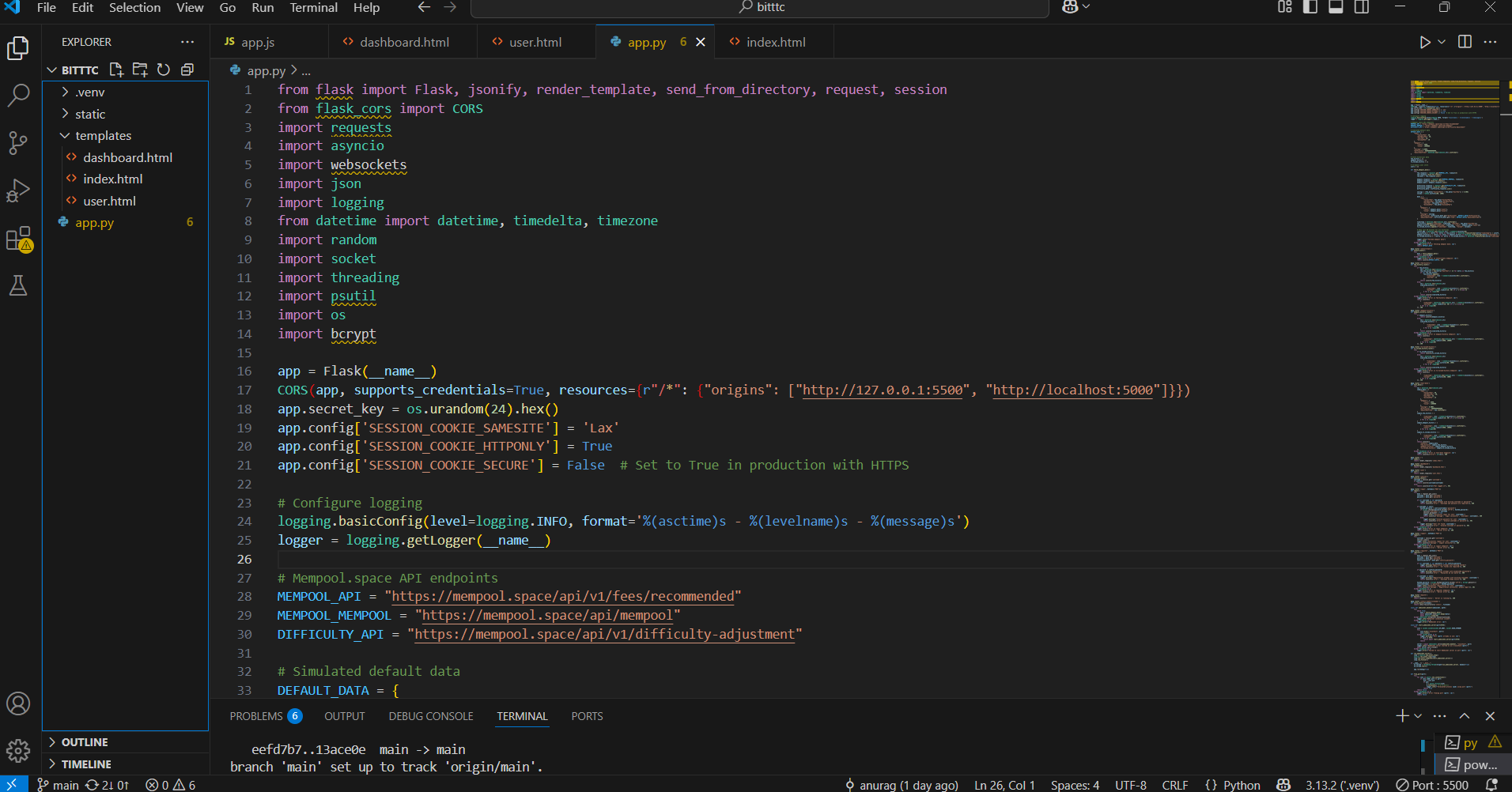
Code structures
Inspiration
As a Computer Science student passionate about blockchain, I was inspired by the challenges Bitcoin users face with high transaction fees and network congestion. Stories of users paying exorbitant fees during peak times motivated me to build a tool that democratizes access to Bitcoin network data. The Bitcoin 2025 Hackathon’s open-ended challenge to innovate for the Bitcoin ecosystem sparked the idea for the Bitcoin Network Optimizer Dashboard—a user-friendly web app to help traders, miners, and everyday users time transactions smarter, saving costs and enhancing Bitcoin’s usability.
What it does
The Bitcoin Network Optimizer Dashboard is a full-stack web application that visualizes real-time Bitcoin network data to optimize transaction timing. It fetches mempool size, transaction fees, and difficulty adjustments from the mempool.space API, displaying them in interactive Chart.js charts updated via WebSocket (ports 8765/8766). Users can:
- Register and log in securely with bcrypt-hashed passwords, greeted by “Welcome, [username]” on the dashboard.
- Analyze real-time data to identify low-fee windows (e.g., fee dips to 14 sats/vB) and avoid congestion.
- View responsive charts for mempool count, hourly fees, and transaction volume, styled with Tailwind CSS.
- Log out safely, clearing sessions.
By providing actionable insights, the dashboard empowers users to save on fees and make Bitcoin transactions more efficient, aligning with the hackathon’s mission to advance the Bitcoin ecosystem.
How we built it
Built solo during the hackathon (April 7–May 20, 2025), the project leverages a robust tech stack:
- Backend: Flask (Python) handles authentication, API requests, and session management. WebSocket servers (using
websocketslibrary) stream live data, with failover on ports 8765/8766 usingpsutilandsocket. The mempool.space API powers data fetching, whilebcryptensures secure password hashing. - Frontend: HTML, JavaScript, and Chart.js create dynamic charts. Tailwind CSS delivers a responsive, modern UI.
- Development: VS Code, Git, and Python 3.8+. Code is open-source on GitHub.
Key features include:
- Real-time updates every 60 seconds via WebSocket.
- Secure login with Flask sessions and
HttpOnlycookies. - Error logging for debugging (e.g.,
/loginendpoint). - Responsive design for desktop and mobile.
Challenges we ran into
Building a real-time Bitcoin tool wasn’t easy. Key challenges included:
- Server Error (HTTP 500): A
TypeErrorin the/loginendpoint (request.get_json()returningNone) caused login failures. I fixed it by validating JSON payloads and adding detailed logging (logger.info("Request JSON: {data}")) to pinpoint issues. - Dashboard 404: The
/dashboardroute failed due to a missingdashboard.html. I resolved it by creating the template intemplates/and addingtry/exceptforTemplateNotFound. - Session Persistence: Dynamic
app.secret_keybroke sessions on server restarts. Switching to a static key (your-static-secret-key-12345) ensured stability. - WebSocket Port Conflicts: Port 8765 was sometimes occupied. I implemented failover to 8766 using
psutilto free ports dynamically.
These hurdles tested my debugging skills but strengthened the project’s robustness, showcasing Routine Execution.
Accomplishments that we're proud of
I’m thrilled with what I achieved in the hackathon:
- Real-Time Innovation: Built a WebSocket-driven system for live Bitcoin data, a complex feature for a solo developer.
- Secure Authentication: Implemented bcrypt hashing and Flask sessions, ensuring user data safety.
- Polished UI: Delivered a responsive, Tailwind CSS-styled dashboard that’s both functional and visually appealing.
- Problem-Solving: Overcame critical bugs (500 errors, 404s) through rigorous debugging, making the app production-ready.
- Bitcoin Impact: Created a tool that directly improves transaction efficiency, contributing to Bitcoin’s adoption.
These accomplishments highlight Routine Difficulty and General Effect.
What we learned
This project was a deep dive into full-stack development and Bitcoin’s ecosystem:
- Technical Skills: Mastered Flask, WebSocket, and Chart.js. Learned to debug complex issues (e.g., JSON parsing, session management) and optimize WebSocket performance.
- Bitcoin Insights: Gained a deeper understanding of mempool dynamics, fee structures, and difficulty adjustments, reinforcing Bitcoin’s real-world challenges.
- Problem-Solving: Developed a systematic approach to debugging, using logs and network inspection to resolve errors.
- Hackathon Strategy: Learned to balance ambition with execution under tight deadlines, prioritizing user-focused features.
These lessons will fuel my future blockchain projects.
What's next for Bitcoin Network Optimizer Dashboard
The dashboard is just the beginning. Future plans include:
- Predictive Fee Models: Integrate machine learning to forecast fee trends, enhancing optimization.
- Lightning Network Support: Add data for off-chain transactions to support Bitcoin’s scalability.
- Mobile App: Develop a native app for iOS/Android using Flutter, broadening accessibility.
- Community Features: Enable users to share transaction timing tips, fostering a Bitcoin community.
- Deployment: Scale the app on cloud platforms (e.g., AWS) for global access.
These enhancements will amplify the dashboard’s impact, aligning with Bitcoin’s mission to be fast, affordable, and inclusive.
Built With
- bcrypt
- bcrypt-(password-hashing)
- chart.js
- chrome-devtools-(debugging)-**other**:-websocket-(real-time-data-streaming-on-ports-8765/8766)
- css
- css-**frameworks**:-flask-(python)
- difficulty-adjustments)-**platforms**:-git
- flask
- git
- github
- github-(version-control-and-hosting)-**tools**:-visual-studio-code-(ide)
- html
- javascript
- mempool.space
- psutil
- psutil-(system-utilities)
- python
- requests
- requests-(http-requests)-**apis**:-mempool.space-api-(mempool-size
- studio
- tailwind
- tailwind-css-**libraries**:-chart.js-(data-visualization)
- transaction-fees
- visual
- websockets
- websockets-(real-time-updates)


Log in or sign up for Devpost to join the conversation.