$invox: The Fortress for Your Finances
Inspiration
In today's digital economy, an invoice is merely a PDF—mutable, forgeable, and shockingly insecure. We were inspired by the staggering $300B+ lost annually to invoice fraud and the fundamental lack of privacy plaguing standard billing practices. Why should a freelancer's proprietary rates or a corporation's sensitive line-item data be exposed in plain text, vulnerable to competitors and bad actors alike?
We recognized a critical gap: while cryptocurrency elegantly solved the "double-spend" problem, no one had tackled the "double-invoice" or "tampered-invoice" crisis in a way accessible to everyone—from solo freelancers to enterprise CFOs. $invox was born from this realization: to bring military-grade security and cryptographic verification to the humble invoice, transforming it from a forgeable document into an immutable proof of transaction.
What it does
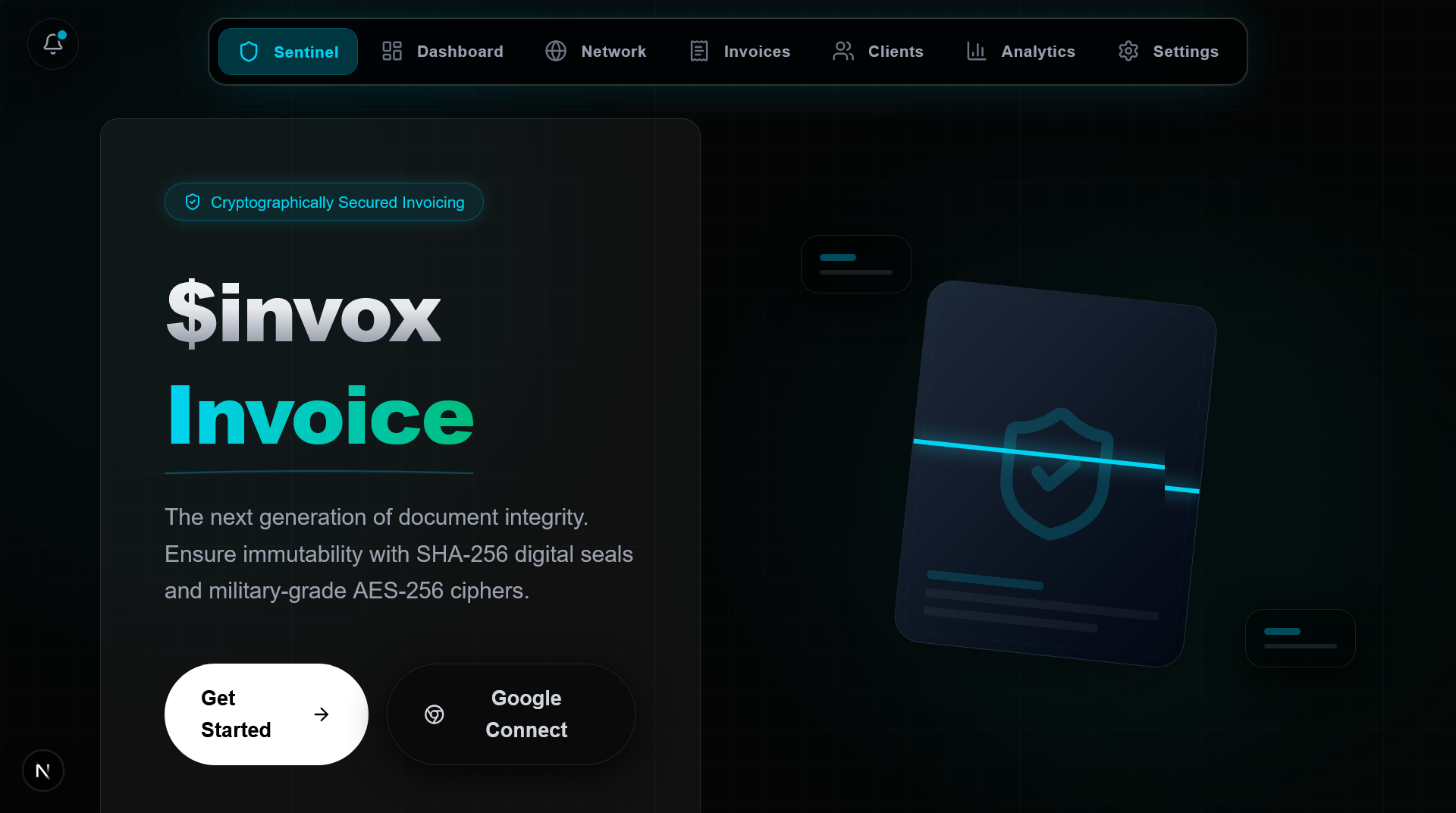
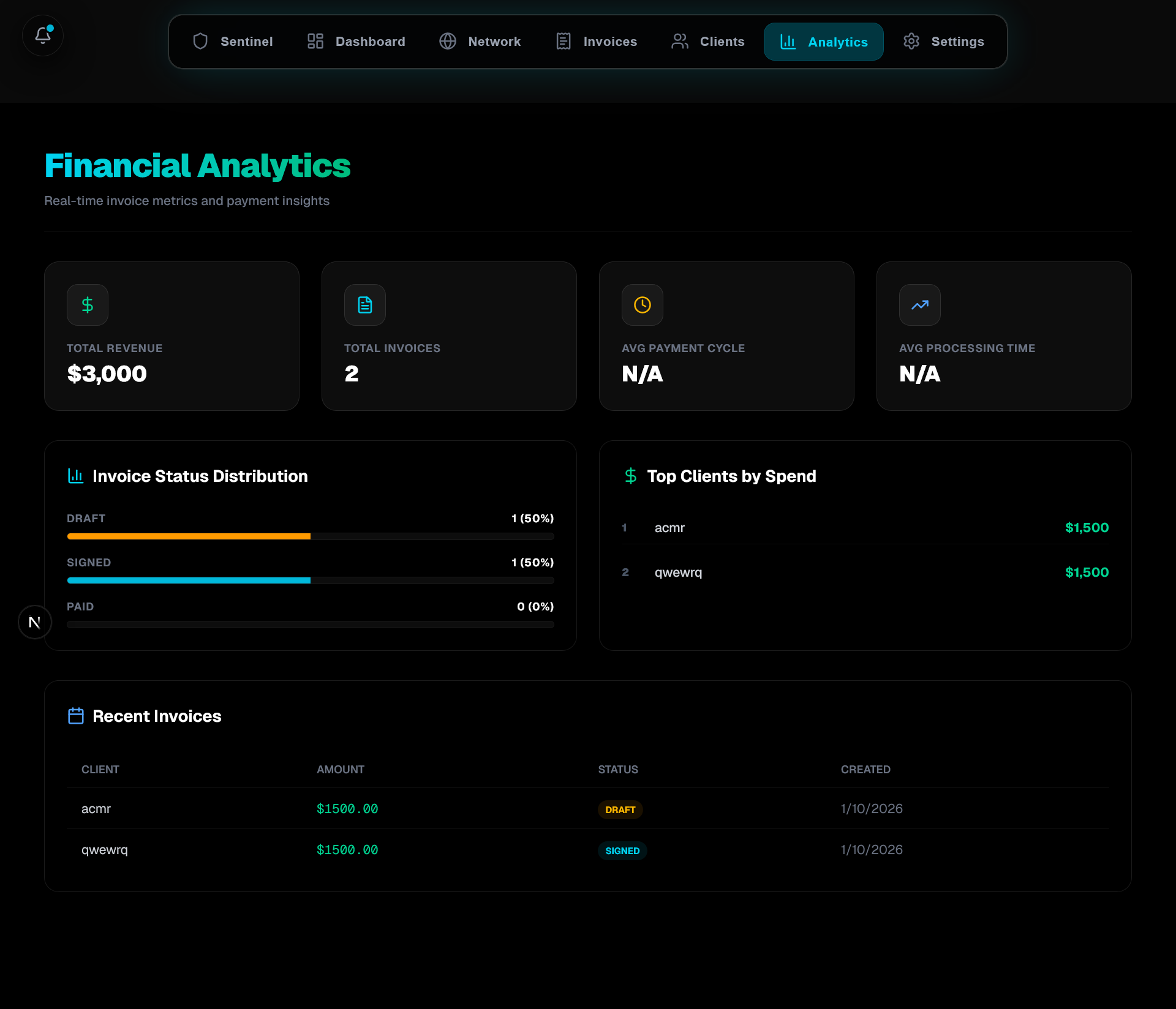
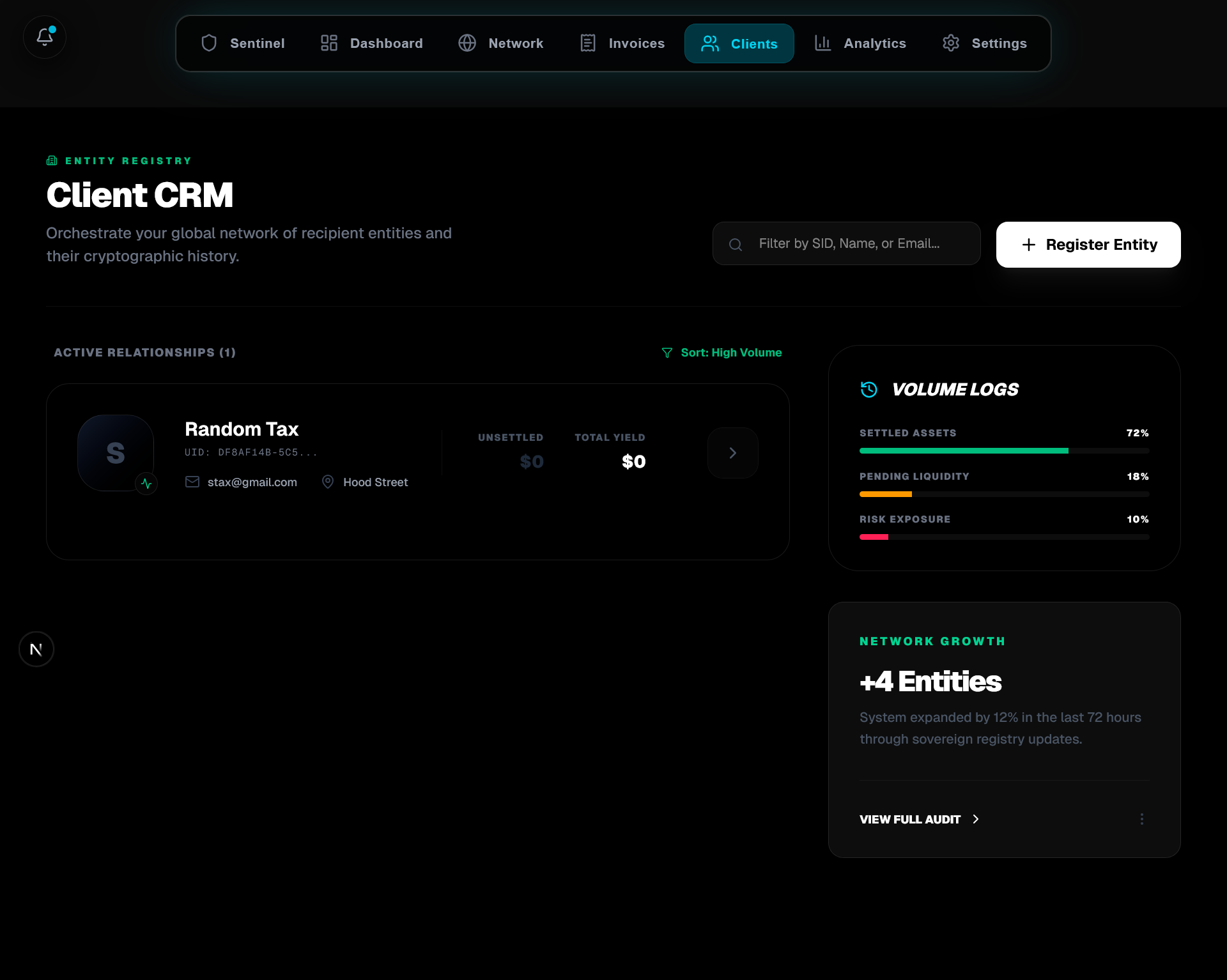
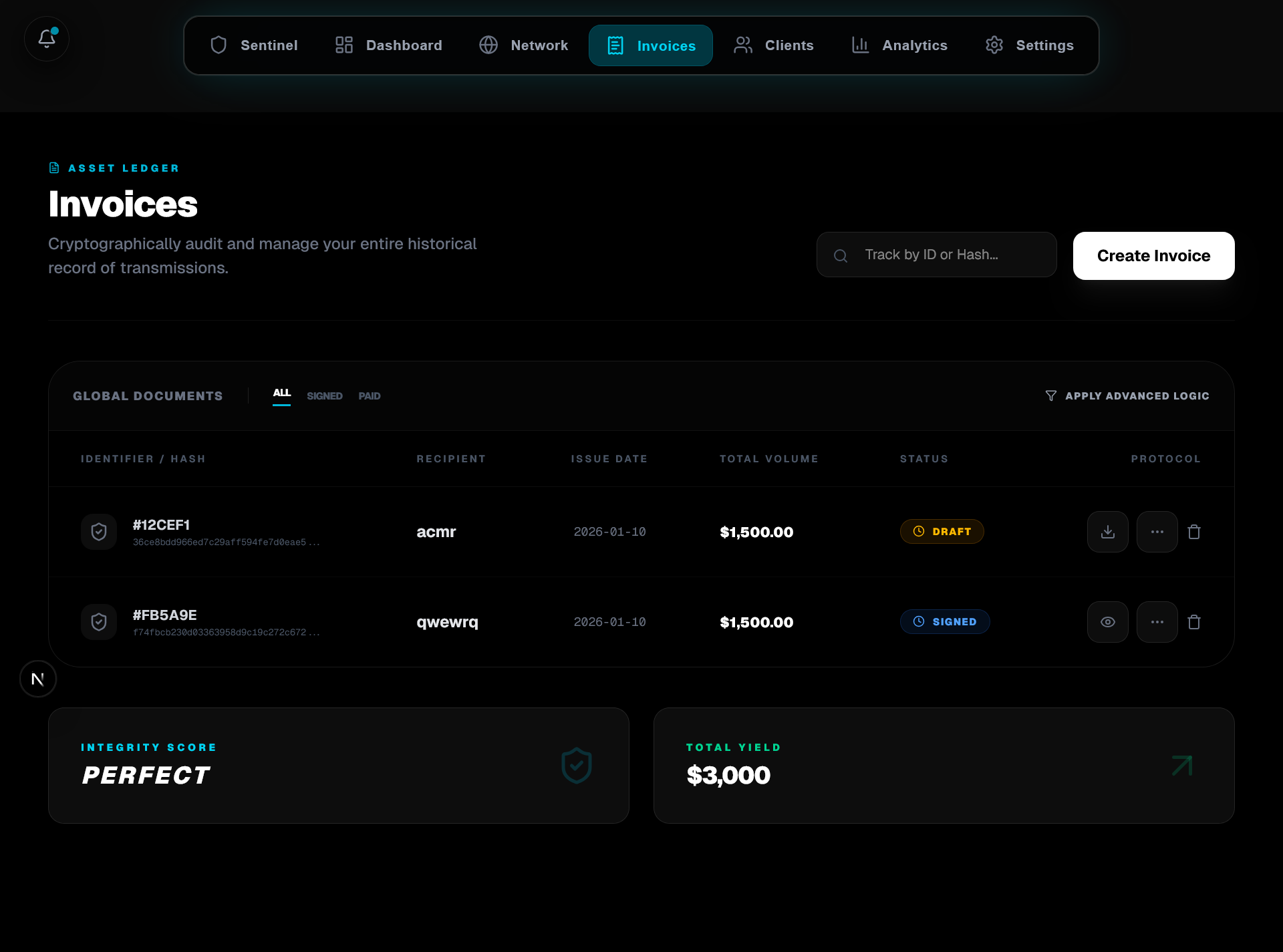
$invox is a privacy-first invoicing platform that transforms every invoice into a cryptographically verifiable digital asset, establishing a new standard for financial documentation security.
Core Features:
Military-Grade Privacy Architecture
We implement AES-256-GCM encryption to create an impenetrable vault around sensitive line-item details. This isn't marketing hyperbole—not even our database administrators can access what you're billing for. Only the total amount remains visible, while specifics stay encrypted.
Cryptographic Integrity via Merkle Trees
Every invoice generates a unique Merkle Root—a cryptographic fingerprint that mathematically proves document integrity. This enables "Selective Disclosure," a powerful feature allowing you to prove the validity of your total invoice amount without exposing individual line items. Think of it as showing someone the lock is secure without giving them the key to see what's inside.
Tamper-Proof Verification
Any attempt to alter a sent invoice—even changing a single character—immediately invalidates the Merkle Root, creating an irrefutable audit trail. Disputes become binary: either the invoice is authentic, or it's been tampered with. No Gray areas.
How we built it
$invox stands on the edge of web technology, architected for security, performance, and scalability.
Technology Stack:
Frontend Framework
We leveraged Next.js 16 and React 19 to harness the latest advances in server actions and concurrent rendering, creating a seamless user experience that masks the complexity of cryptographic operations happening beneath the surface.
Database Infrastructure
Neon Serverless Postgres paired with Drizzle ORM provides a robust, type-safe foundation that scales effortlessly from a solo freelancer's first invoice to an enterprise processing thousands daily. The serverless architecture means zero infrastructure management while maintaining enterprise-grade reliability.
Cryptographic Engine
The innovation core resides in src/lib:
merkle.ts: Our custom Merkle Tree implementation hashes individual line items into a single cryptographic root, creating a tamper-evident seal over the entire invoice structure.security.ts: Manages AES-256-GCM encryption usingcrypto-js, ensuring data is encrypted client-side before transmission—your sensitive information is opaque before it ever touches our servers.
User Experience
We employed Tailwind CSS and Framer Motion to craft a sleek "Cyberpunk" aesthetic that communicates security and sophistication. Every animation, every transition reinforces the platform's mission: your financial data is protected by cutting-edge technology.
Technical Deep Dive: Understanding the Papers
Merkle Trees Explained
A Merkle Tree (named after cryptographer Ralph Merkle) is a data structure fundamental to blockchain technology and cryptographic verification systems. Here's how it secures $invox:
Hashing Individual Items: Each line item in your invoice is cryptographically hashed (we use SHA-256), creating a unique digital fingerprint for that specific data.
Building the Tree: These hashes are paired and hashed together repeatedly, creating a hierarchical tree structure. The process continues until a single hash remains at the top—the Merkle Root.
Verification Power: To prove a specific line item exists in the invoice without revealing others, we provide a "Merkle Proof"—a minimal set of hashes that mathematically proves the item's inclusion. This is the foundation of our Selective Disclosure feature.
Real-world analogy: Imagine sealing each line item in an envelope, then sealing pairs of envelopes together in larger envelopes, repeating until you have one master envelope with a unique seal. Anyone can verify the master seal matches without opening every individual envelope.
AES-256-GCM Encryption
AES (Advanced Encryption Standard) is the encryption standard approved by the U.S. National Security Agency for protecting classified information. The "256" refers to the key size in bits—providing 2^256 possible keys (more combinations than atoms in the observable universe).
GCM (Galois/Counter Mode) adds authenticated encryption, meaning it not only encrypts data but also verifies it hasn't been tampered with during transmission. This dual protection ensures both confidentiality and integrity.
In $invox, this means your line items are encrypted client-side with a complexity that would take current supercomputers billions of years to crack through brute force.
Zero-Knowledge Architecture
Our system implements a zero-knowledge design principle: we can verify invoices are valid without ever learning their contents. This is achieved through:
- Client-side encryption: Data is encrypted in your browser before transmission
- Key derivation: Encryption keys are derived from user credentials we never store in plaintext
- Cryptographic proofs: Merkle Roots allow verification without decryption
Challenges we ran into
Cryptographic State Management Complexity
Implementing a Merkle Tree that updates in real-time on the frontend while ensuring backend verification logic matches perfectly proved exceptionally challenging. One bit of difference in data serialization breaks the entire cryptographic proof. We spent days debugging subtle inconsistencies between how JavaScript serialized objects client-side versus server-side.
User-Friendly Key Management
Designing an intuitive flow for encryption keys—ensuring users can decrypt their data while we never hold the keys—required careful architectural choreography. We had to balance security (never storing keys server-side) with usability (users shouldn't lose access if they forget passwords). Our solution involved sophisticated key derivation functions and optional encrypted backup mechanisms.
Bleeding Edge Technology Challenges
Working with Next.js 16 and React 19 meant navigating features still in beta, occasionally sparse documentation, and evolving APIs. However, the performance gains—particularly with server actions handling cryptographic computations—validated the risk.
Performance Optimization
Cryptographic operations are computationally expensive. Ensuring invoice creation and verification remained instantaneous while performing complex hashing and encryption required aggressive optimization, including Web Workers for background processing and strategic caching of intermediate hash values.
Accomplishments that we're proud of
Pioneering Selective Disclosure for Invoices: Successfully implementing production-ready Merkle Tree verification in a user-friendly web application—a feature previously confined to cryptocurrency and academic papers.
Genuine Zero-Knowledge Architecture: Achieving a system where we mathematically cannot access user data, not through policy but through cryptographic design. This isn't trust-based privacy; it's math-based privacy.
Beautiful Complexity: Building an interface so intuitive that users create cryptographically secure, tamper-proof invoices without understanding the underlying mathematics—security that doesn't sacrifice usability.
Type-Safe Cryptography: Leveraging TypeScript and Drizzle ORM to catch potential security vulnerabilities at compile-time rather than runtime, where they could be exploited.
What we learned
We gained profound insights into applied cryptography, discovering that implementation details—IV (Initialization Vector) management, padding schemes, endianness in hash functions—are equally critical as choosing the right algorithms. A perfect algorithm implemented incorrectly provides no security.
We mastered drizzle-orm patterns for serverless environments, learning to optimize queries that minimize cold-start latency while maintaining type safety across the entire data pipeline.
We pushed Next.js Server Actions to their limits for handling sensitive computations, discovering powerful patterns for processing cryptographic operations server-side while maintaining zero-knowledge guarantees through careful architectural separation.
Most importantly, we learned that security and usability are not opposing forces. With thoughtful design, military-grade cryptography can feel as simple as sending an email.
What's next for $invox
Blockchain Anchoring
We're implementing Merkle Root anchoring on public blockchains (Ethereum Layer 2 solutions or Solana for cost efficiency). This creates an immutable, publicly verifiable timestamp for every invoice—proof that it existed at a specific moment in time that not even $invox can alter. Perfect for legal disputes and audit trails.
Mobile-First Verification
A dedicated mobile application will serve as a cryptographic wallet for signing and verifying invoices on the go. Recipients can instantly verify invoice authenticity by scanning a QR code—no account required.
Smart Contract Integration
Automatic payment release when invoices are cryptographically verified on-chain. This eliminates payment delays, reduces disputes, and creates trustless escrow systems where funds are released only when cryptographic conditions are met.
Multi-Party Invoices
Support for invoices requiring multiple cryptographic signatures (useful for contractor teams, vendor approval workflows, or joint ventures), implementing threshold signature schemes for enhanced security.
API & Enterprise Features
A comprehensive API for integrating $invox cryptographic verification into existing accounting software, ERP systems, and financial platforms. Enterprise features including team management, role-based access control, and compliance reporting.
Welcome to the future of financial documentation.
Built With
- drizzle
- framer
- lucide
- neon
- next
- react
- tailwind
- typescript
- ws


Log in or sign up for Devpost to join the conversation.