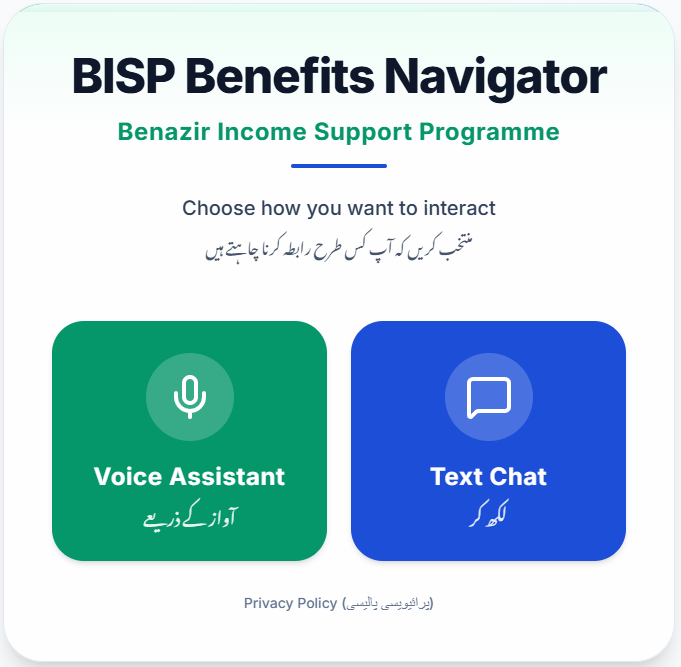
BISP Benefits Navigator is a voice-first AI pre-screener that helps low-literacy women in Pakistan check eligibility for 5 government support programs by speaking naturally in their own language , saving PKR 800 and a full day's wages before they ever join a queue.
Inspiration
In Pakistan, millions of women living below the poverty line are eligible for the Benazir Income Support Programme (BISP) but fail to access it due to a massive digital and literacy divide. Traditional web portals rely on complex dropdowns, legal jargon, and text-heavy forms. For a rural, illiterate woman, an online form is just as insurmountable as a closed door.
But the problem runs deeper than digital literacy. A woman in rural Sindh or KPK must spend her entire daily wage, sometimes PKR 500-800 on bus fare just to travel to a government Tehsil office, wait in a long crowded queue for hours, and often learn she doesn't qualify. She goes home having lost a full day's wages just to hear the word "no." She never needed to make that trip. She just had no way to know.
We were inspired to bridge this gap using AI - not by teaching these women how to use technology, but by teaching technology how to understand them. We wanted to build a system that feels exactly like a compassionate phone call, and answers the question every woman should be able to ask before she ever joins a queue: "Is it even worth going?"
What it does
BISP Benefits Navigator is an AI-powered, voice-first civic technology pre-screener. It allows low-literacy citizens to determine their eligibility for various social support programs simply by speaking in their native regional dialects (Urdu, Pashto, Punjabi, Sindhi, Balochi) or by typing, for those who prefer it.
The tool accepts both voice and text input. Voice-first for non-literate users, text chat for those who are comfortable typing. Crucially, the NLP layer handles imperfect input , a user who types "meri income 8000 hai family 6 log" or speaks in broken sentences or mixed languages gets the same quality result as a perfectly structured message. The system never fails a user for communicating imperfectly.
Dual-Language Isolation: We built a custom regex parser that strips English from the AI response before it reaches ElevenLabs. The screen shows both Urdu and English - so a judge, helper, or community worker can read along , but the audio speaks only Urdu. Fatima stays completely immersed in her language. The judge reads along in English.
By answering a 60-second voice prompt, our system saves a rural family up to PKR 800 in travel costs and prevents the loss of an entire day's wages , before she ever leaves home.
The 5 BISP Programs We Navigate
BISP is not one program - it is five. Each has completely different eligibility rules, different documents, and different stipend amounts. Most users don't know which one applies to them. Our AI breaks this complexity down through natural conversation , it identifies the user's situation first, routes them to the correct sub-program, and only then begins asking eligibility questions. No user is forced to understand the system before they can use it.
| Program | Who it's for | Benefit |
|---|---|---|
| Kafaalat | Low-income families with PMT score ≤ 32 (≤ 37 for Persons with Disabilities) | PKR 14,500 per quarter - unconditional cash transfer |
| Taleemi Wazaif | School-going children of Kafaalat beneficiaries (ages 4-22) | PKR 2,500-5,000 per quarter. Girls receive higher stipends. Girls completing primary school receive a one-time PKR 3,000 graduation bonus |
| Nashonuma | Pregnant and lactating women + children under 2 years old | PKR 2,500 for pregnant/lactating women; PKR 2,500 for male children under 2; PKR 3,000 for female children under 2 |
| Undergraduate Scholarship | University students from low-income Kafaalat families | 100% tuition coverage + PKR 4,000/month living stipend |
| Bachat (Savings Scheme) | Existing Kafaalat beneficiaries who save | Government matches 30% of the beneficiary's savings - incentivizing financial independence |
If a user doesn't qualify for BISP (PMT > 32), the system doesn't abandon them. It recommends:
- Sehat Sahulat Program - universal health coverage in KP, AJK, GB, and ICT (targeted coverage in Punjab, Sindh, Balochistan)
- Akhuwat Foundation - interest-free microfinance loans for household self-sufficiency and enterprise development
The recommendation is personalized: "Since your reported income of PKR 30,000 exceeds the BISP threshold, we recommend applying for an Akhuwat interest-free microfinance loan to support your household."
Most importantly: users check eligibility before standing in any queue. They only make the trip to the Tehsil office when they already know it is worth going.
The AI then guides them on the exact physical documents they need to bring, complete with a spoken script to recite to the official helpline:
"When you call 0800-26477, say: Mera naam [Name] hai, main BISP eligibility check karwana chahti hoon."
How we built it
We built a modern, serverless web application optimized for zero-latency voice processing.
| Layer | Technology | Why |
|---|---|---|
| Frontend | Next.js 16 + Tailwind CSS | Low-literacy dashboard, single glowing mic button, Jameel Noori Nastaleeq Urdu font |
| Speech-to-Text | Deepgram Nova-3 | detect_language=true — auto-detects Urdu, Pashto, Punjabi, Sindhi, Balochi |
| LLM / NLP | Gemini 2.5 Flash | Speed, native dialect understanding, grammar-tolerant entity extraction, strict program routing |
| Text-to-Speech | ElevenLabs eleven_multilingual_v2 |
Female voice — removes social barrier for rural women speaking about finances |
| Deployment | Docker + Google Cloud Run | Auto-scaling, HTTPS, survives hackathon traffic |
The key architectural decision: The LLM is completely banned from doing eligibility math. All PMT calculations run through a deterministic TypeScript rules engine (bisp-rules-engine.ts) using hardcoded 2026 BISP guidelines stored in bisp-data.json. The LLM handles language - the engine handles math. This eliminates hallucination risk on the most critical output.
Challenges we ran into
🔴 Routing Complexity - 5 Programs, One Conversation
BISP's 5 sub-programs have completely different eligibility rules. Early versions of our AI immediately asked income questions without confirming which program the user needed - leading to wrong eligibility checks. We solved this with strict routing: the system prompt forbids the AI from invoking the check_eligibility tool until it has explicitly confirmed the target program. The backend agent-tools.ts rejects any tool call missing this confirmation and forces the AI to apologize and ask the missing question first.
🔴 The Hackathon Killer (API Rate Limiting)
Relying on free-tier APIs meant our app would inevitably crash during live judging. We engineered a bulletproof API Quota Shuffling system. If the server catches a 429 Too Many Requests or 503 error, it silently rotates through an array of 11 backup API keys and seamlessly re-submits the payload - without ever dropping the user's connection.
🟡 The Translation Latency Trap Our initial pipeline required multiple API hops: Speech → STT → Google Translate → LLM → Google Translate → TTS. Traditional translators also destroyed cultural nuance. We removed the translation layer entirely and used Gemini 2.5 Flash natively, slashing latency by 40% and preserving regional dialects.
🟡 The "Bidi" (Bidirectional) Text Bug
Mixing Right-to-Left (Urdu/Pashto) and Left-to-Right (English) text in one block caused browsers to invert punctuation (e.g., ?Help instead of Help?). Fixed by splitting the transcript by line and applying dir="auto" to each individual line's div - forcing line-by-line directionality evaluation.
🟡 LLM Math Hallucinations
The LLM confidently hallucinated PMT scores. We enforced a strict "No Math Allowed" prompt constraint and built a deterministic backend Rules Engine (bisp-rules-engine.ts) using Gemini's Tool Calling to pass demographic data to a rock-solid math engine the LLM cannot override.
🟢 Initial Load Quota Burn
The ElevenLabs welcome audio was being regenerated on every page load, burning quota instantly. We wrote an offline Node script (generate-welcome.mjs) to pre-compute the audio at build time. The landing page plays a static welcome.mp3 - completely bypassing the API on initial load.
🟢 Mobile UI Overlap
On cheap Android devices, the "Voice Assistant" title collided with absolute-positioned buttons. Fixed with dynamic padding and responsive text scaling (md:text-3xl) - our primary target hardware is a basic Android phone.
Accomplishments that we're proud of
- [x] 5-Program Routing Engine - AI confirms the correct BISP sub-program before asking a single eligibility question. A pregnant woman gets routed to Nashonuma. A mother with school children gets Taleemi Wazaif. No user navigates the system alone.
- [x] Dual-Language Isolation Architecture - AI outputs regional language first, English in
<english>tags. Backend regex strips English before ElevenLabs. Voice speaks only regional language; UI displays both. Rural user hears her language. Judge reads along in English. - [x] Grammar-tolerant NLP - A user who says "meri income 8000 hai family 6 log" gets the same result as a perfectly structured sentence. The system never rejects a user for communicating imperfectly.
- [x] Two-layer UI - Large green/red card for the low-literacy user (no reading required). Estimated PMT Score breakdown card for the judge/reviewer (full mathematical transparency).
- [x] Zero hallucination on eligibility - Proven by architectural separation of LLM (language) and rules engine (math). The LLM physically cannot generate an eligibility number.
- [x] Responsible AI built in - Spoken disclaimer via ElevenLabs, "may qualify" framing hardcoded, Privacy Policy page disclosing all third-party processors, Help Modal handing off to human officials.
- [x] Self-healing backend - 11 API keys in rotation across Gemini, Deepgram, and ElevenLabs. No crash possible from rate limiting during live judging.
What we learned
We learned that when designing for the next billion users, traditional UI/UX rules go out the window. A hamburger menu or a text input field is a barrier. We learned the immense value of native LLM language comprehension over legacy translation wrappers, and how to architect resilient, self-healing backends that survive heavy traffic.
We also learned that responsible AI for vulnerable users is not a checkbox - it is a design constraint that changes every decision. The spoken disclaimer, the "may qualify" framing, the deterministic engine, the female voice - none of these were afterthoughts. Each one exists because our user cannot afford to be misled.
What's next for BISP Benefits Navigator
We want to integrate directly with WhatsApp's Voice Note API. Since WhatsApp is the most ubiquitous app in Pakistan (even among illiterate populations), a user could simply send a voice note to a WhatsApp business number and receive a voice note back - removing the need for a web browser entirely.
Beyond that:
- [ ] Integration with official BISP NSER data via government API partnership
- [ ] Expanding coverage of all 5 BISP programs with deeper eligibility logic
- [ ] Offline mode for areas with no internet connectivity
- [ ] Community worker dashboard for case managers serving multiple families at once
Built With
- deepgram-api
- docker
- elevenlabs-api
- gemini-2.5-flash
- google-cloud-run
- next.js
- node.js
- react
- tailwind.css
- typescript


Log in or sign up for Devpost to join the conversation.