Inspiration
Bipolar Mood Companion was inspired by a personal and practical problem: mood-tracking apps are good at collecting information, but they often leave users to interpret everything themselves.
For someone living with bipolar disorder, changes in sleep, mood, energy, medication adherence, and symptoms can be meaningful. However, these signals are easy to miss when they are spread across individual daily entries.
We wanted to build something that went beyond another mood diary—a supportive companion that helps users recognise patterns, reflect on changes, and prepare for more informed conversations with healthcare professionals.
What it does
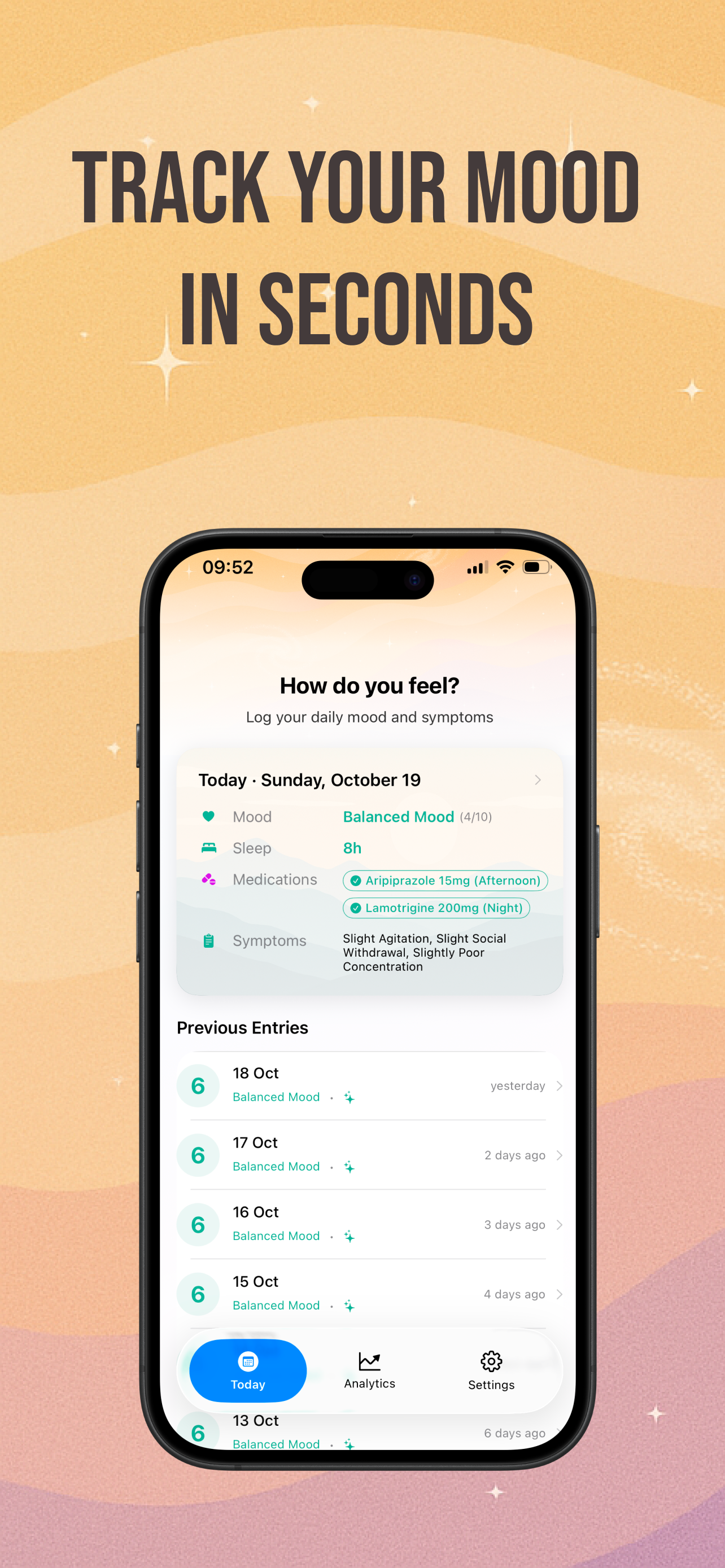
Bipolar Mood Companion helps users track their:
- Mood and energy
- Sleep duration and quality
- Medication adherence
- Depressive and elevated-mood symptoms
- Notes about important events or changes
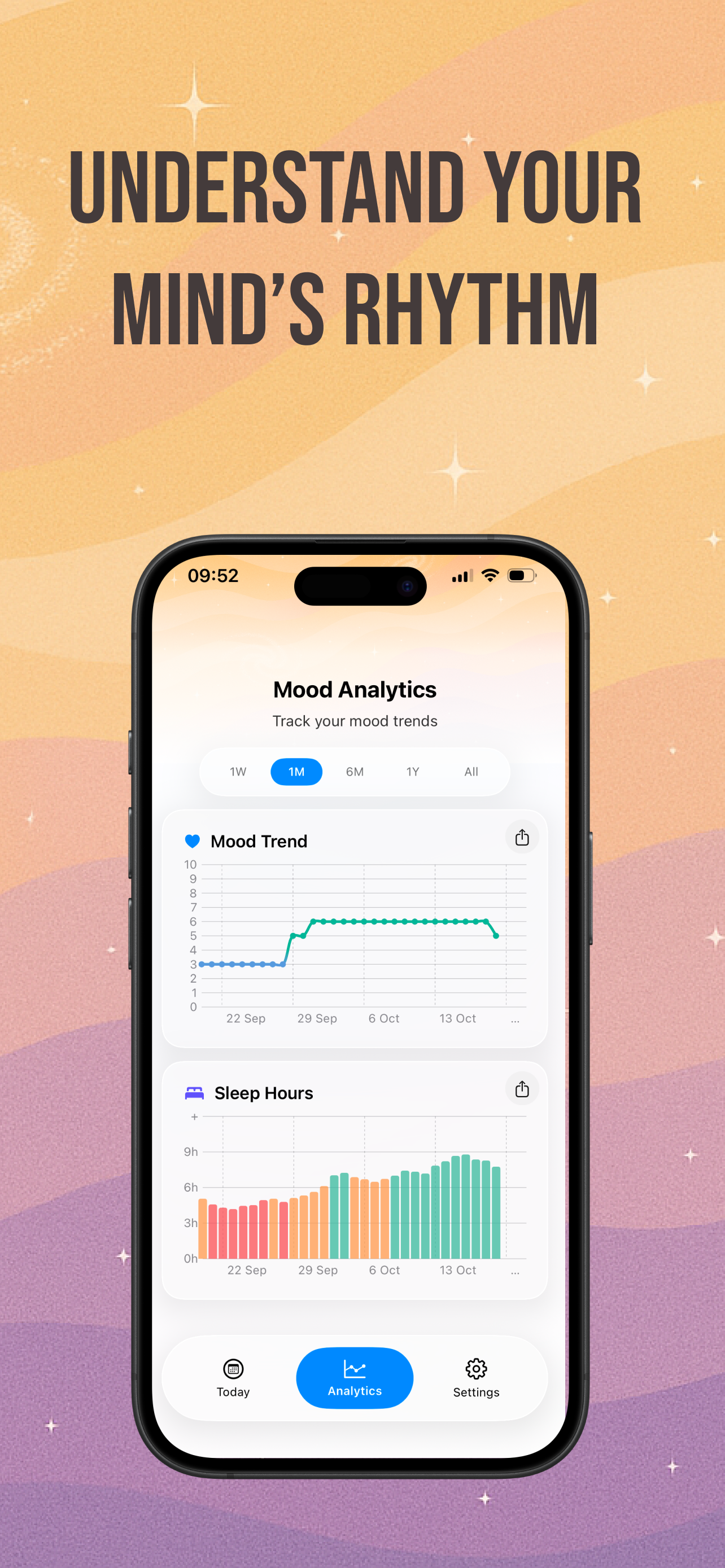
The app turns this information into visual trends, summaries, and personalised AI-generated insights grounded in the user’s own data.
For example, it can highlight that sleep has decreased while energy has increased, identify a gradual change from the user’s normal baseline, or generate a clear summary that can be shared with a clinician.
The app is designed to support self-awareness—not to diagnose conditions or replace professional medical care.
How we built it
We built Bipolar Mood Companion as a native iOS application with a simple daily check-in at the centre of the experience.
Each check-in is stored as structured data, including mood, sleep, energy, medication adherence, and selected symptoms. The app analyses recent values alongside the user’s historical baseline to identify meaningful changes and trends.
Instead of sending unstructured information directly to an AI model, we first prepare a concise summary of the relevant data. The model is then instructed to generate an insight that:
- References specific evidence from the user’s entries
- Clearly communicates uncertainty
- Avoids diagnoses and unsupported medical claims
- Suggests practical, low-risk next steps
We focused heavily on making the daily interaction quick and approachable. Users can record the most important information in a few moments, while more detailed symptom tracking remains optional.
Challenges we ran into
The biggest challenge was balancing usefulness with safety.
AI-generated mental-health advice can easily sound too confident. We had to make sure that observations were not presented as diagnoses or predictions. For example, the app should not claim that reduced sleep means someone is entering a manic episode. It can instead explain that sleep has been below the user’s normal level and encourage them to continue monitoring the change.
Another challenge was avoiding generic insights. Early recommendations sometimes sounded like advice that could be shown to anyone. We improved them by requiring each insight to be connected to specific trends or changes in the user’s data.
We also had to balance detail with usability. Asking too many questions would make daily tracking exhausting, while asking too few would limit the value of the insights. We therefore prioritised a small set of high-value signals and made additional details optional.
Accomplishments that we're proud of
We are proud that Bipolar Mood Companion turns passive tracking into something more actionable.
Rather than showing users only charts and numbers, the app explains what may have changed and why that change could be worth noticing. Every personalised insight is grounded in the user’s actual data instead of being generated from a generic mental-health prompt.
We are also proud of the product’s calm and non-judgemental experience. The app is designed to support consistency without using guilt, streak pressure, or alarming language.
Most importantly, we created a working foundation for a tool that can help users understand themselves better while respecting the boundaries between self-management, AI assistance, and professional healthcare.
What we learned
We learned that the quality of an AI feature depends less on how much text the model can generate and more on the context and constraints provided to it.
The most important work happens before generation: selecting meaningful signals, comparing them with a personal baseline, removing irrelevant information, and preventing unsupported conclusions.
We also learned that personal baselines are more valuable than universal thresholds. The same mood, sleep, or energy score can have a different meaning for each person. Understanding how an individual is changing relative to their usual patterns is often more useful than comparing them with a generic definition of “normal.”
Finally, we learned that responsible mental-health technology requires restraint. Sometimes the right outcome is not to generate an insight at all. The system should only surface a recommendation when there is enough evidence for it to be genuinely useful.
What's next for Bipolar Mood Companion
Our next step is to improve the quality and personalisation of the insights as more data becomes available.
We plan to add:
- Earlier detection of meaningful changes in sleep, mood, and energy
- Custom warning signs and personal stability plans
- Weekly and monthly reports for users and clinicians
- Better explanations of which data points contributed to each insight
- Privacy-preserving data export and sharing
- Optional reminders for medication and daily check-ins
- Integrations with Apple Health and wearable sleep data
In the longer term, we want Bipolar Mood Companion to become a trusted bridge between everyday self-reflection and clinical care—helping people recognise changes sooner, communicate them more clearly, and feel more in control of their mental health.


Log in or sign up for Devpost to join the conversation.