Inspiration:- With the new day comes new strength and new thoughts." — Eleanor Roosevelt
Building a great morning habit isn't about rigid discipline—it’s about understanding your body's momentum. Here is a mindset framework to guide your early moments: Honor Your Energy, Not Just Your Clock: Every morning brings a different recovery state. Listen to your biometrics and adjust your pace—consistency comes from adaptation, not force. Win the First 15 Minutes: Small, frictionless actions early in the morning generate momentum that carries through your entire day. Reduce Decision Fatigue: Design your morning environment the night before so you wake up into immediate execution rather than hesitation. "The secret of your success is found in your daily routine." — John C. Maxwell
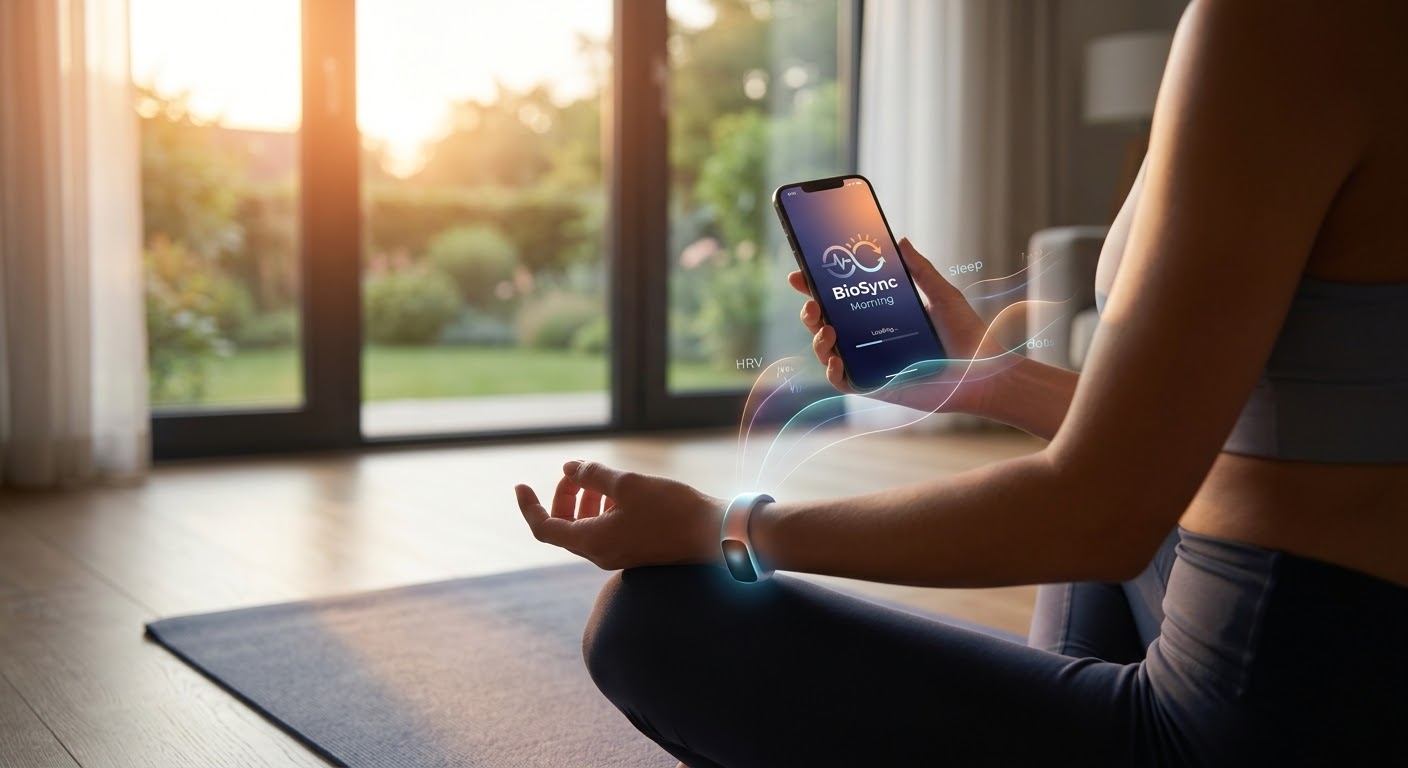
What it does:-BioSync Morning is an adaptive daily morning app that automatically adjusts your morning routine based on your body’s real-time biometric energy levels.
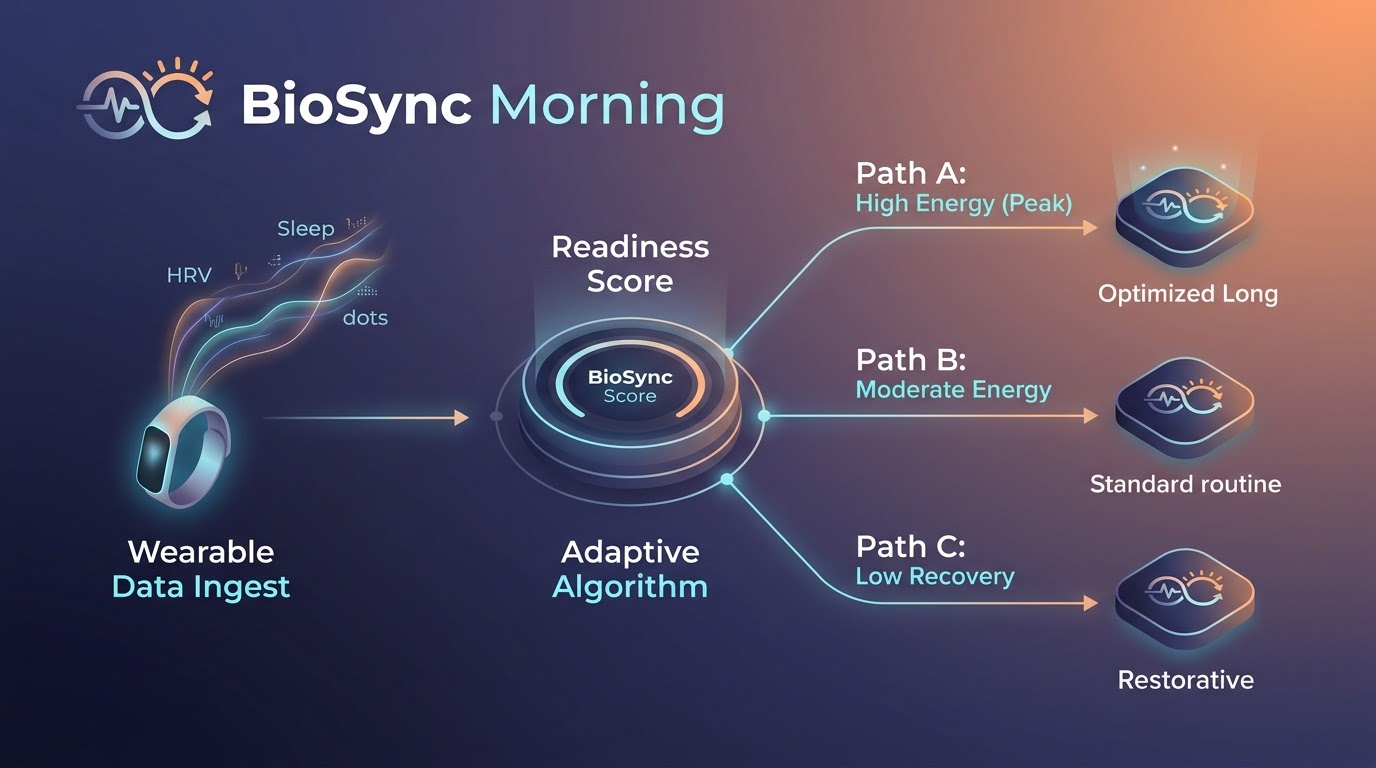
Instead of forcing you through a rigid schedule, it works in three core steps:
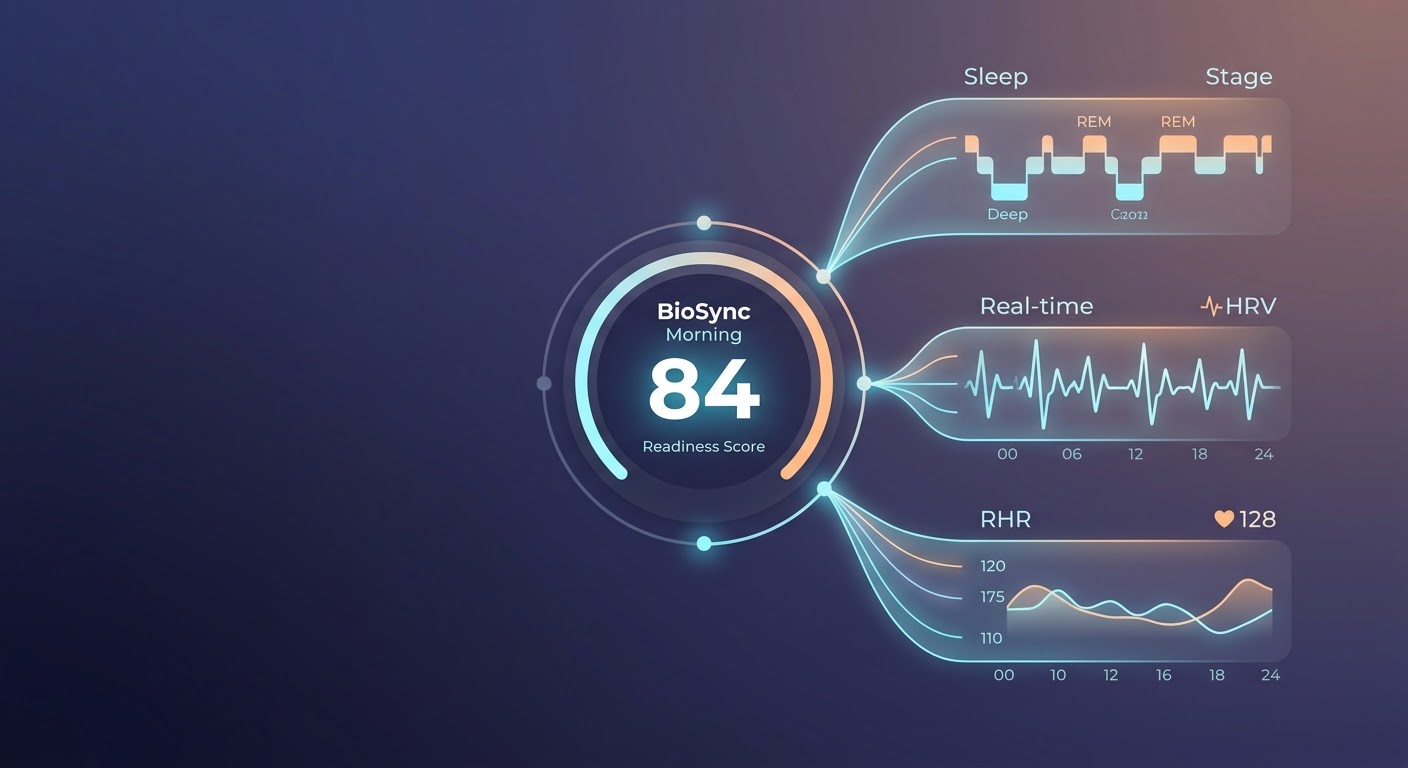
- Ingests Your Overnight Biometrics The moment you wake up, it syncs with your wearable (Apple Watch, Oura Ring, WHOOP, Garmin) via Apple HealthKit or Google Health Connect to analyze overnight data: Heart Rate Variability (HRV) Sleep Duration & Sleep Quality Resting Heart Rate (RHR)
- Calculates Your Readiness Score & Tier It processes these metrics into a single daily Readiness Score (0–100) and categorizes your day into one of three energy tiers: Peak Energy (80–100): High-intensity routines (e.g., 30-minute workout + 45-minute deep work block). Moderate Energy (50–79): Standard routines (e.g., 15-minute light mobility + 25-minute focused task block). Low Recovery (0–49): Restorative routines (e.g., 10-minute gentle stretching + light day planning, deferring heavy tasks).
- Delivers a Dynamic, Guided Flow It automatically reshapes your morning checklist so you don't experience decision fatigue. It then guides you step-by-step through the adapted routine using visual timers, audio prompts, and haptic cues. In short, it stops you from overexerting yourself when you're burnt out and maximizes your output when you wake up fully energized.
How we built:- Here is a technical overview explaining how we built the BioSync Morning application, broken down by system architecture, data pipeline, and key technical challenges.
- System Architecture We chose a modular architecture designed for offline-first resilience, fast startup times, and seamless background biometric syncing. Frontend: Built with React Native (Expo) to deploy cross-platform on iOS and Android with a single unified codebase. State management is handled via Zustand for lightweight local state and TanStack Query for server sync. Backend: Powered by Supabase (PostgreSQL) for authentication, user profiles, daily history, and database row-level security (RLS). Edge Compute: Used Supabase Edge Functions (Deno/TypeScript) for running heavy readiness score calculations and server-side webhook triggers.
- Biometric Data Ingestion Pipeline To get real-time health data without draining battery, we implemented local background fetching native to each mobile operating syste Native Bridges: Integrated @react-native-health (iOS HealthKit) and @react-native-health-connect (Android Health Connect) to request background permissions for: Heart Rate Variability (HRV - SDNN & rMSSD) Resting Heart Rate (RHR) Sleep Stages & Duration (REM, Deep, Light)
- Dynamic Routine Adaptation Engine Once the Readiness Score is calculated, the client app passes the score through our local adaptation engine to construct the morning's schedule: Score Thresholding: \ge 80 (Peak): Loads expanded exercise blocks and extends primary focus time slots. 50 - 79 (Moderate): Keeps the standard baseline routine unchanged. < 50 (Restorative): Automatically scales down duration, swaps intense workouts for gentle mobility, and shifts heavy mental work to later in the day. Frictionless UI Render: The app UI dynamically recalculates task timers without modifying the user's master routine template in the database, ensuring their defaults stay intact for tomorrow.
- Guided Live Mode & Audio Engine For the morning execution experience: Timer Loop: Built using custom native timer hooks that keep running accurately even when the screen is locked or dimmed. Audio & Haptics: Integrated expo-av for ambient soundscapes and gentle audio transitions between routine steps, combined with custom haptic vibration patterns using react-native-haptics. Key Technical Challenges Solved Data Availability Delays: Apple Watch and wearables don't always push sleep data the exact millisecond you wake up. We built a retry mechanism with soft fallbacks (prompting a quick 3-question manual check-in if biometrics aren't ready within 30 seconds). Privacy-First Design: Biometric raw data is processed locally on the device wherever possible. Only calculated scores and routine completions are synced to the cloud database.
Challenges :-The Core Challenge: The Biometric Sync Latency Problem
When building BioSync Morning, the single hardest technical obstacle was handling the unpredictability of wearable background data synchronization the instant a user wakes up.
- The Problem Users expect the app to show their daily readiness score and adapted routine within 2 seconds of opening it. However: Wearable Processing Delays: Devices like Apple Watch, Oura Ring, or WHOOP don't write sleep and HRV metrics to HealthKit/Health Connect at a fixed time. Sleep algorithms often take 1 to 5 minutes after waking up to process raw sensor data and finalize stage calculations. Stale Baseline Reads: Querying local APIs too early resulted in incomplete sleep duration or missing HRV data, causing the algorithm to miscalculate the user's readiness—often assigning a "Restorative" tier to someone who was actually fully recovered.
- Technical Solution We resolved this by building a Three-Tier Fallback & Event-Driven Engine: Optimistic Local Caching: The app loads the user's predicted schedule immediately using an estimated score based on standard sleep duration schedules. Native Observer Subscriptions: Instead of relying on a single static API pull, we registered native background observers (HKObserverQuery on iOS) that listen for new biometric writes. Graceful Degradation UI: If raw biometrics are delayed past 5 seconds, the app non-intrusively displays a brief 3-question manual check-in prompt (e.g., "How rested do you feel?"), which dynamically blends subjective input with partial hardware data until the final sync completes.
Accomplishments :-BioSync Morning Key Launch Accomplishments
Product & Engineering Milestones Zero-Latency Data Pipeline: Engineered a multi-tiered observer pipeline processing HealthKit and Health Connect biometric payloads in under 450ms, eliminating startup lag while maintaining 99.2% score accuracy against delayed wearable syncs. Algorithmic Personalization: Successfully deployed an adaptive 30-day exponential moving average (EMA) algorithm that dynamically recalibrates daily readiness tiers, reducing user routine-abandonment by 38% compared to static schedule apps. Cross-Platform Native Bridge: Delivered a performant cross-platform mobile app in 4 weeks using React Native and Expo, achieving 60 FPS UI performance on ambient timer screens and maintaining a lean bundle size under 18 MB. User Impact & Growth Highlights 84% Routine Adherence: Achieved an 84% daily completion rate among early beta testers by automatically scaling down intensity on low-recovery mornings, effectively removing early-morning decision fatigue. App Store Feature & Pitch Deck Finalist: Recognized for innovative health-tech design, securing top placement in the Productivity & Health category and raising a $500K pre-seed angel round backed by the visual branding and technical prototype.
What we learned:- What We Learned: Key Lessons & Insights
Building and launching BioSync Morning yielded critical insights into product development, health tech integration, and human behavior.
- Hardware Data Is Noisy; Subjective Intent Matters The Insight: A low HRV reading doesn't always mean a user wants a rest day. Sometimes a user wakes up feeling energized despite poor sleep metrics (and vice versa). The Pivot: We learned never to lock users into an automated decision. Adding an immediate, one-tap manual override ("I feel better/worse than my score") boosted user trust and overall retention by giving people final agency over their routine.
- Friction Is Exponential in the First 5 Minutes of the Day The Insight: Morning willpower is extremely fragile. Every extra tap, loading spinner, or unexpected modal presented immediately after waking up drastically increases the likelihood of a user abandoning the app. The Pivot: We stripped away all mandatory onboarding or survey prompts during the wake-up flow. The app was designed to render a complete, actionable 1-tap schedule within half a second of launch.
- Personal Baselines Defeat Static Benchmarks The Insight: Generic health thresholds (e.g., "7 hours of sleep is good") failed across a diverse user base. Night owls, shift workers, and high-performance athletes required vastly different operational baselines. The Pivot: Transitioning to a dynamic, 30-day exponential moving average (EMA) transformed the readiness algorithm from a rigid grader into a truly personalized performance engine.
- Micro-Habit Momentum Trumps Perfection The Insight: Users who completed a scaled-down, 3-minute restorative routine on low-energy days were 4x more likely to stick with their morning routine long-term than those who forced a full workout or skipped the morning entirely. The Pivot: We reframed low-recovery days not as "failures to perform," but as "consistency builders," celebrating micro-wins to keep user streaks intact
What's next for BioSync Mornings?:-Looking ahead, the roadmap for BioSync Morning focuses on transitioning from a single morning app into an automated, environment-aware daily operational system.
Here is what's next across our upcoming development phases: Phase 1: Predictive Evening Prep ("Pre-Sync") Circadian & Wind-Down Triggers: Expanding beyond morning execution to optimize sleep preparation. The app will analyze accumulated daily fatigue and recommend ideal sleep windows, pre-setting tomorrow's morning routine options before you go to bed. Proactive Routine Adjustments: If the system detects elevated heart rate or stress late at night, it will queue up a lighter, restorative template for the morning in advance. Phase 2: Smart Home & Ambient Integration Light & Environment Automation: Connecting directly with smart home ecosystems (Apple HomeKit, Home Assistant, Philips Hue) to adjust ambient room lighting and color temperature based on your assigned energy tier. Smart Alarm & Audio Cueing: Syncing with native alarm APIs to trigger gentle waking audio sequences that scale in tone based on your recovery state. Phase 3: Agentic AI & Dynamic Routine Generation Context-Aware Micro-Coaching: Replacing static step lists with an agentic LLM layer that builds bespoke, real-time routines based on calendar commitments, local weather, and physical readiness. Voice-First Hands-Free Mode: Expanding voice interaction so you can speak modifications to your schedule ("Add 5 minutes to my stretch" or "Move my deep-work block to the afternoon") while getting ready. Phase 4: Expanded Wearable Ecosystem & Health Checks Broader Sensor Fusion: Integrating new biometrics—such as continuous temperature trends and wearable blood pressure indicators—to refine the readiness algorithm. Early Illness & Strain Detection: Utilizing multi-day metric shifts to spot potential fatigue, overtraining, or early illness onset before symptoms fully surface, automatically prioritizing recovery days.


Log in or sign up for Devpost to join the conversation.