
Inspiration
When localized infectious disease cases surface - such as the meningitis cases reported in Essex - the primary bottleneck in public health isn't a lack of medical expertise; it is the time lost between detecting a risk threshold and deploying physical supplies. Public health networks like the NHS often rely on fragmented reporting chains and reactive stock distribution.
What it does
We built BioSecure to solve this operational delay. Our goal was to create an automated platform capable of evaluating regional risk scores continuously and initiating immediate, coordinated containment actions before localized outbreaks escalate into regional crises.
How we built it
The platform is designed around a decoupled, real-time architecture.
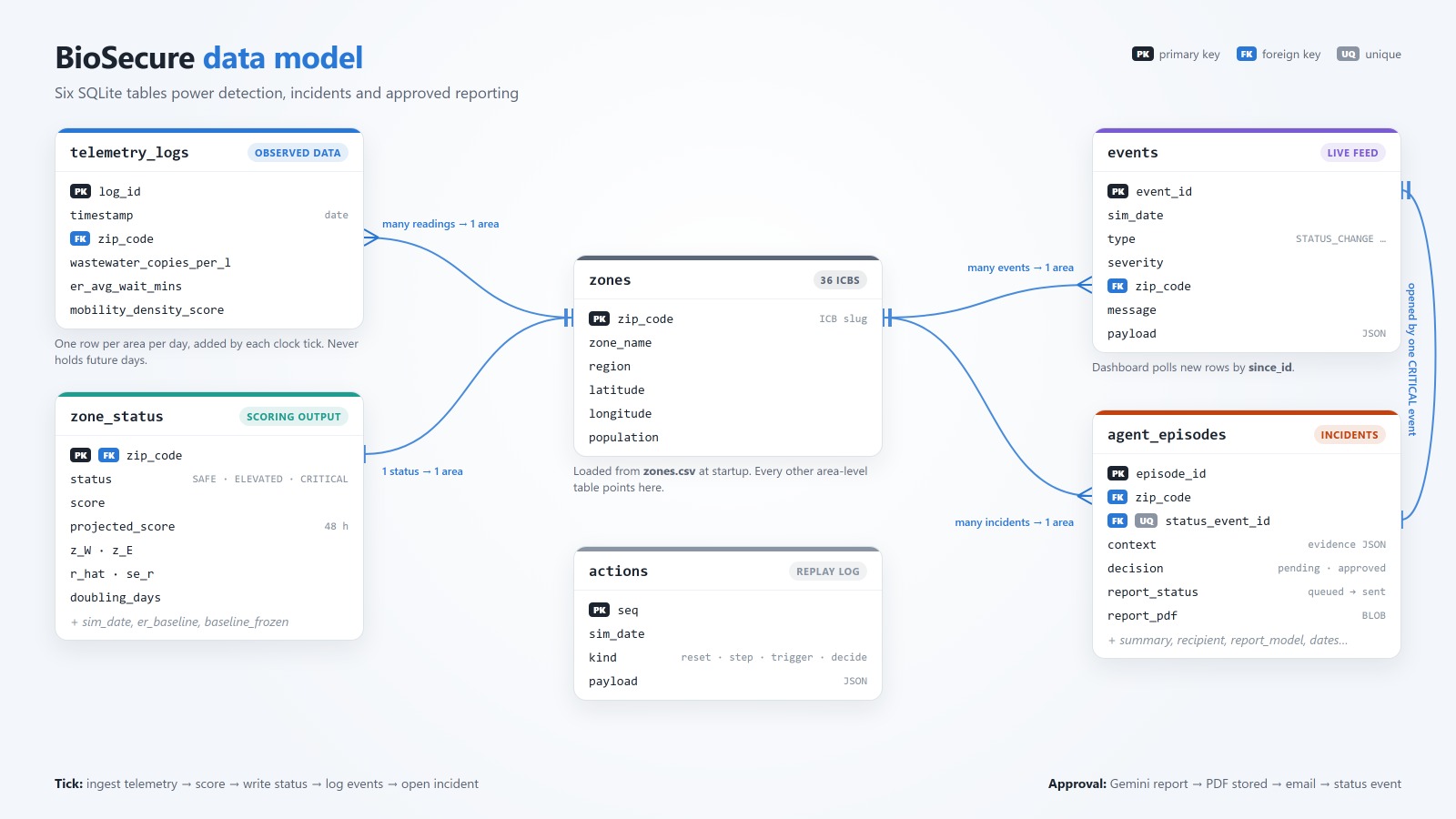
Backend & Simulation Engine: Powered by FastAPI (Python 3.13) to manage state updates, spatial risk tracking across NHS Integrated Care Board (ICB) regions, and 48-hour forecasting.
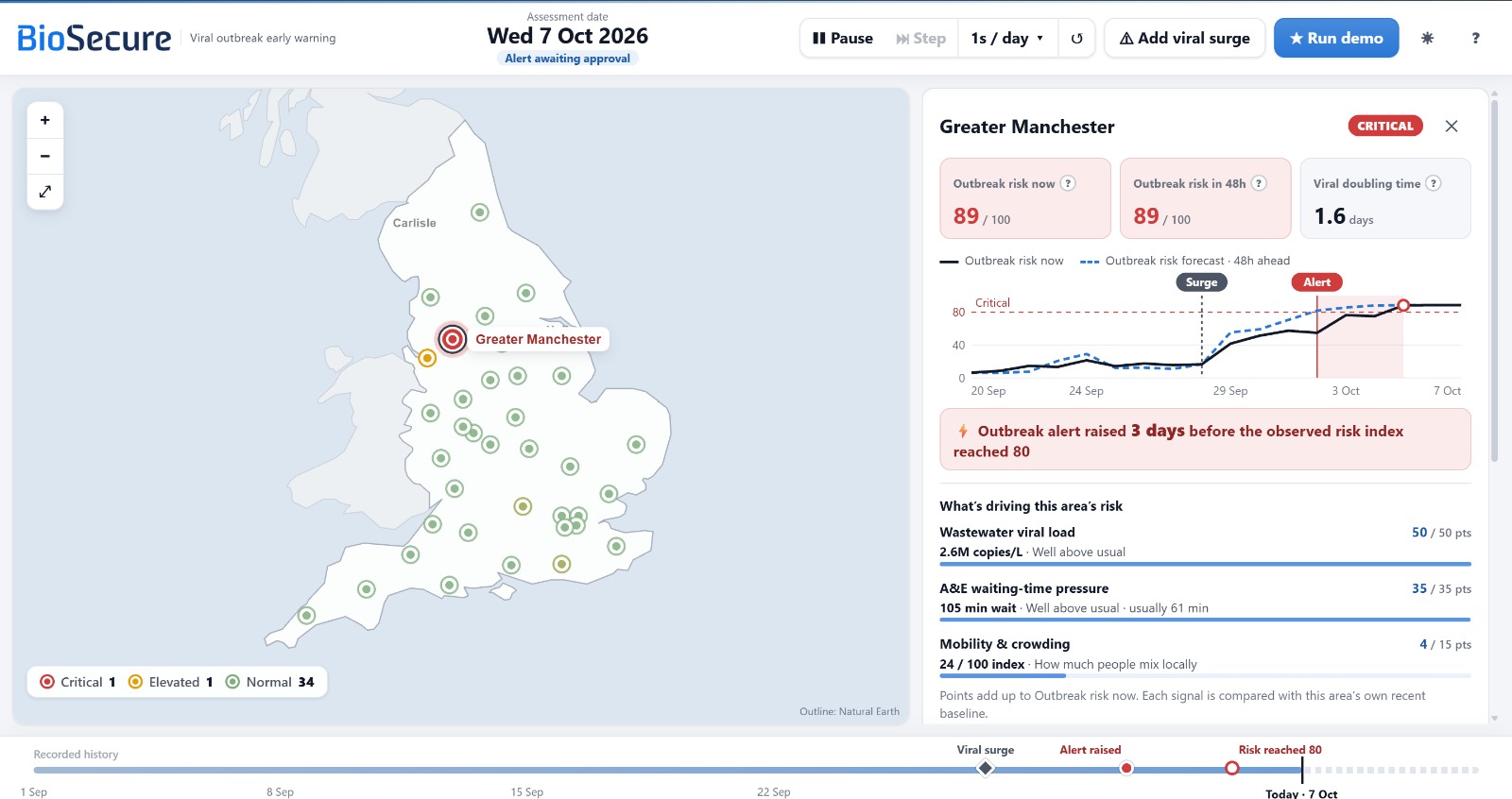
Automated Action Pipeline: When an NHS region breaches its predefined risk threshold, the engine triggers an automated containment workflow. It generates structured PDF incident briefings using reportlab and real-time system alerts.
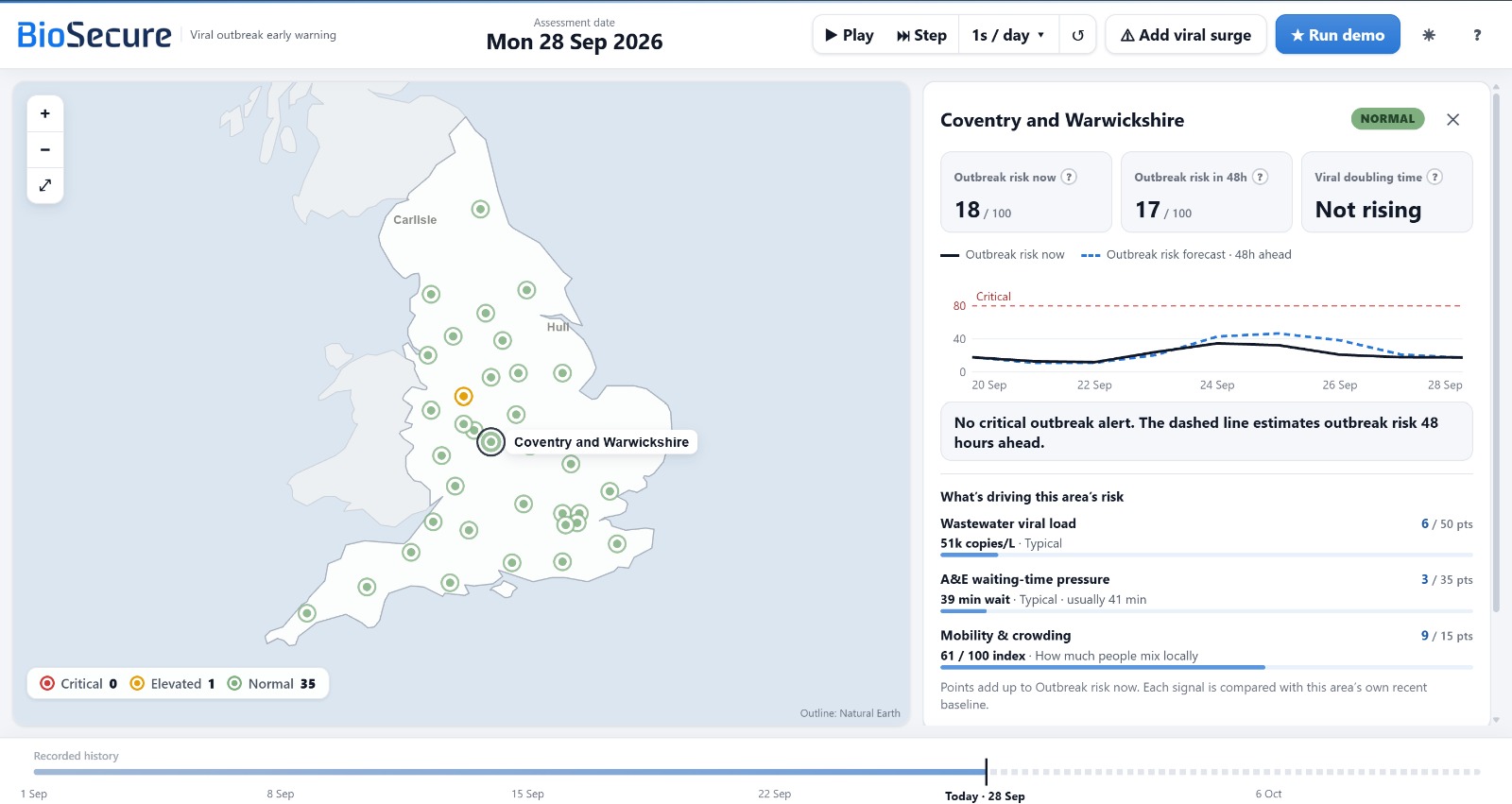
Frontend Dashboard: Built with React and Vite, presenting an interactive map of NHS regions with live indicators (Normal, Elevated and Critical), real-time status feeds, and manual simulation controls.
Risk & Rebalancing Model: To determine when an area transitions to a critical state, we compute a regional risk score for a given region at a given time.
Challenges we ran into
Connecting the Stack in Real Time: Getting the Python event loop to talk smoothly to our React dashboard meant communicating with background tasks, Vite proxying, and WebSocket reconnections so the map updated instantly without dropping state.
Environment & Import Headaches: Running Python 3.13 threw multiple errors when importing modules across root and subfolders, and getting dependencies like 'reportlab' wired up under hackathon time pressure meant fine-tuning our execution setup quickly.
Finding the Right Trigger Balance: Calibration was tricky. We had to tune the risk math so it triggers early enough to actually stop an outbreak, but not so aggressively that it constantly returns false positives.
Accomplishments that we're proud of
Integrated Gemini API Intelligence: Successfully leveraged the Gemini API to instantly generate plain-language, executive-level situation summaries of critical incidents.
Mathematical Risk & Rebalancing Engine: Formulated and implemented a spatial dynamic risk model that balances infection acceleration against geographic spillover to determine viral outbreak risk.
End-to-End Automation: Built a fully working, closed-loop pipeline - from real-time risk evaluation and Gemini-driven briefing generation to automated PDF report compilation (reportlab) and interactive frontend mapping
What we learned
Combining AI with Deterministic Math: We learned that LLMs like Gemini work best when paired with solid mathematical modeling - using the risk formula for precise triggers and Gemini for rapid, context-aware briefing generation.
Prediction Requires Action: Algorithmic forecasting is only as valuable as the automated workflows it triggers. Connecting live risk scores directly to automated briefing generation is what transforms raw data into a life-saving response.
System Integration Is Vital: Building a real-time biosecurity tool isn't just about writing clean algorithms - it requires seamless execution between Python event loops, AI API calls, background tasks, and Vite/React WebSocket connections.
What's next for BioSecure
Multi-Factor ML Predictive Models: Upgrade from mathematical thresholds to machine learning models (e.g., XGBoost, LSTM time-series forecasting) trained on multi-factor inputs - including weather patterns, population density, regional transit mobility, school term calendars, and historical epidemiological trends.


Log in or sign up for Devpost to join the conversation.