-
-
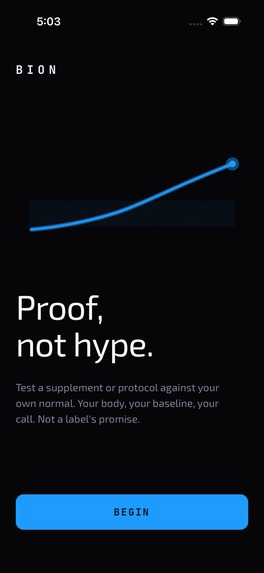
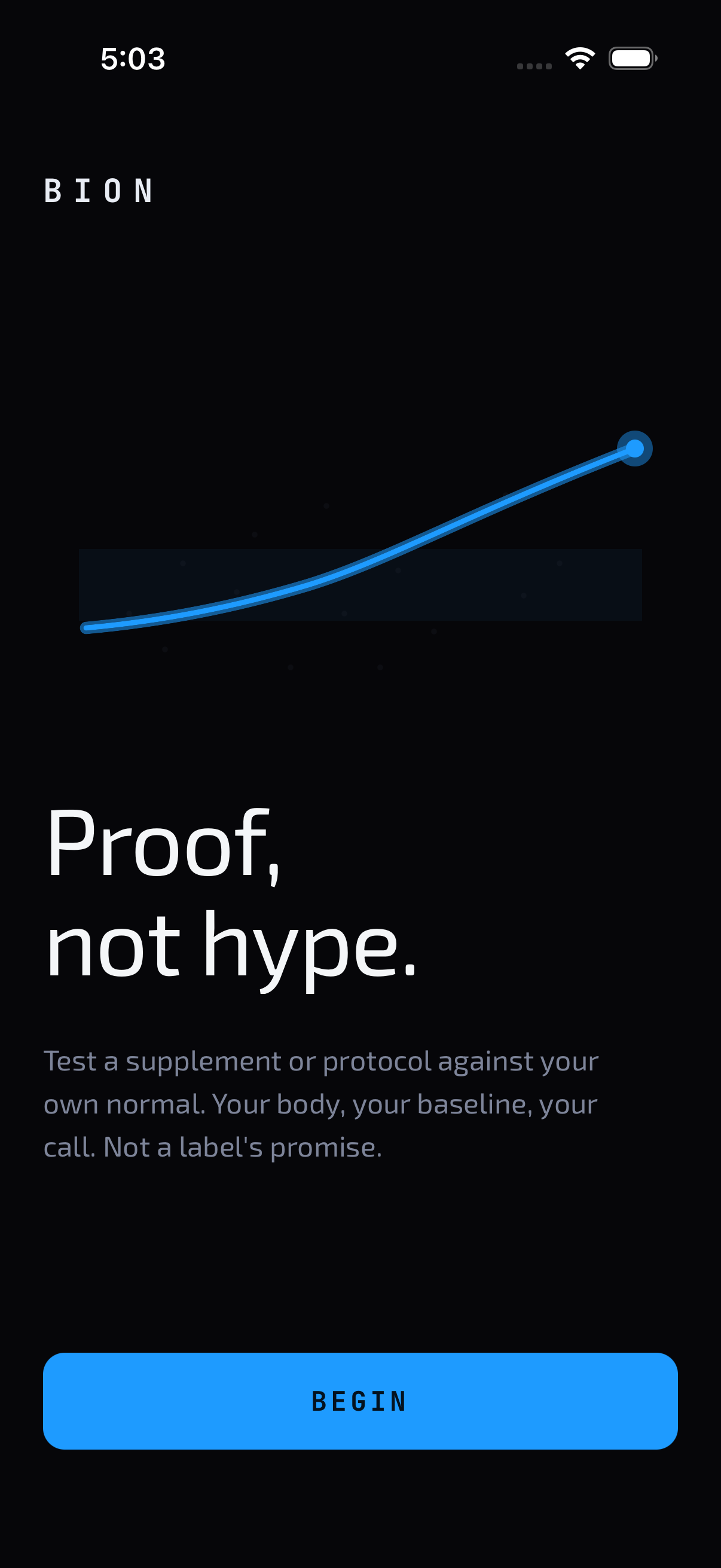
First onboarding screen
-
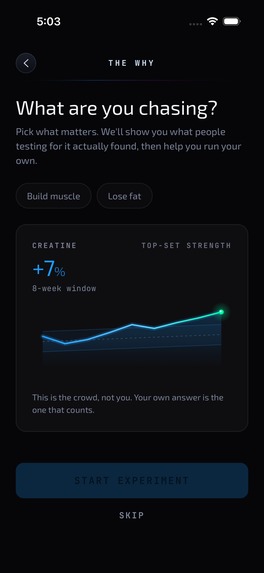
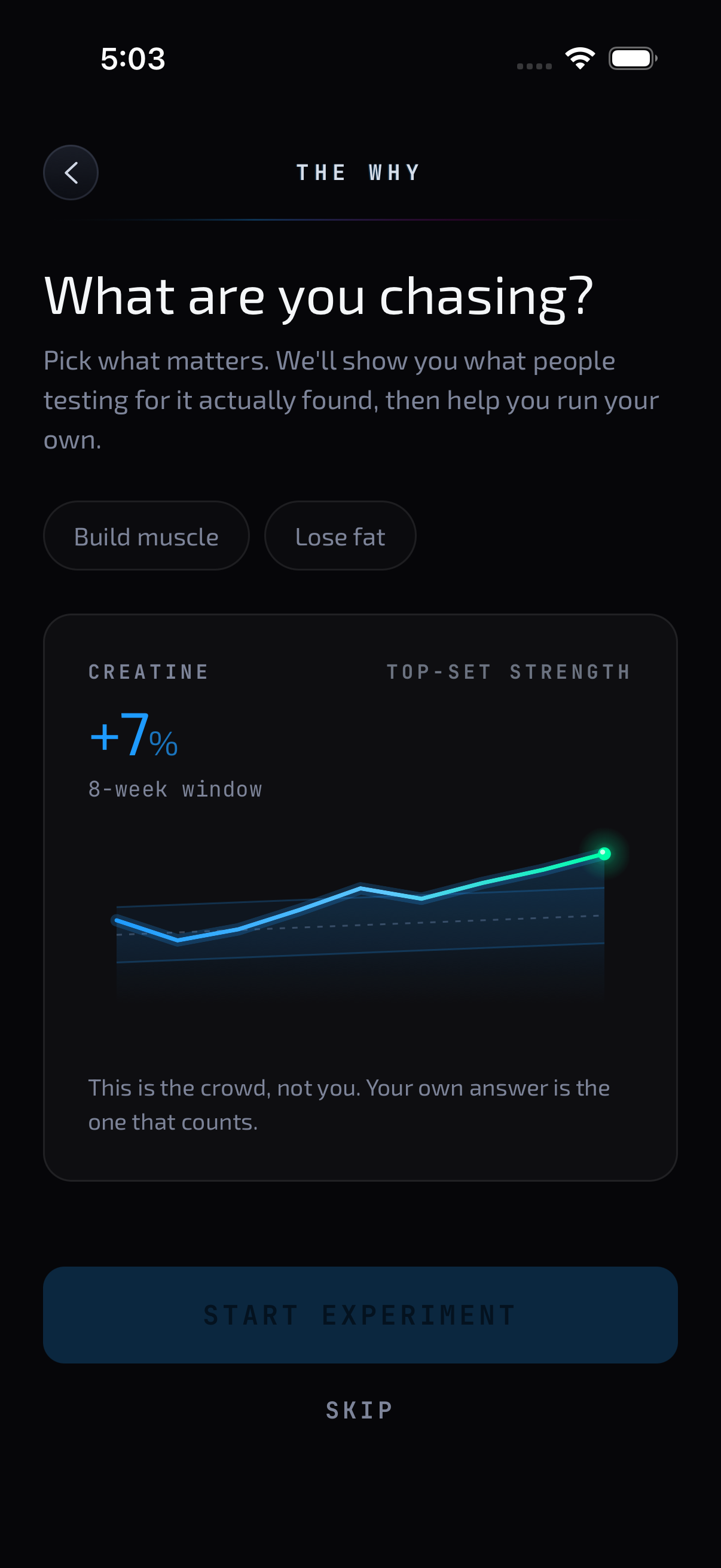
Bion understands your goals
-

Dead simple to start an experiment
-
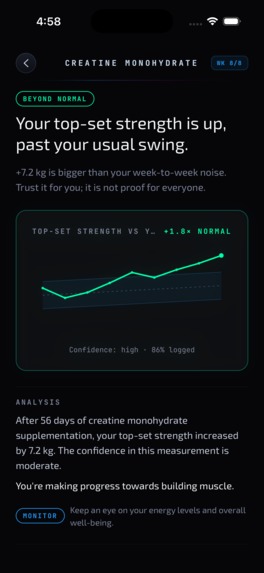
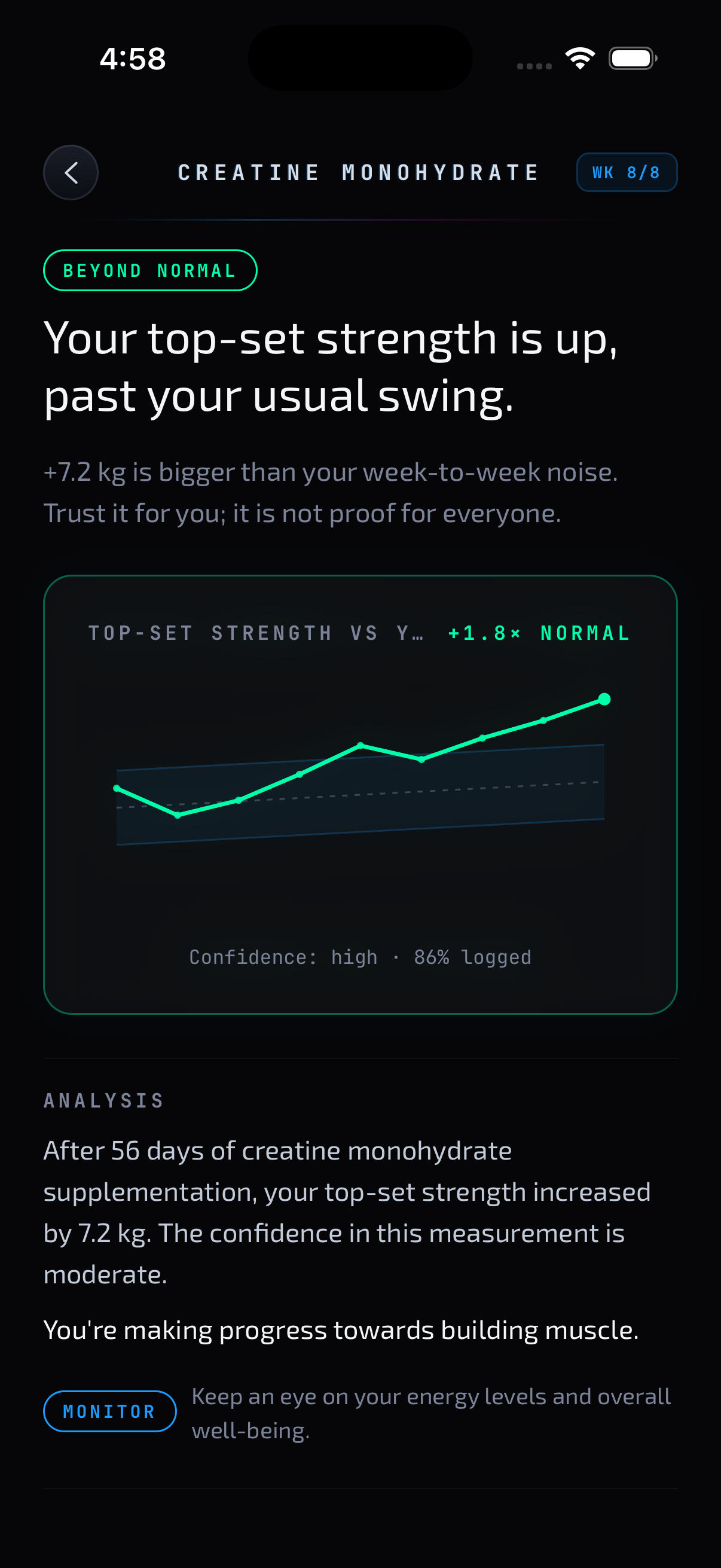
AI drives the analysis so you don't need prior knowledge of math and science
-
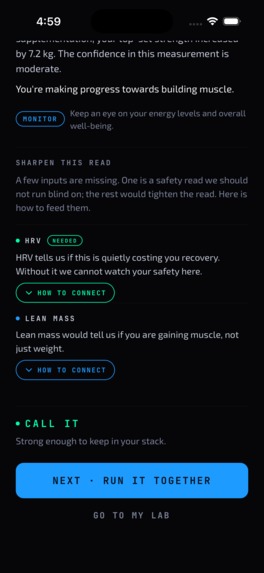
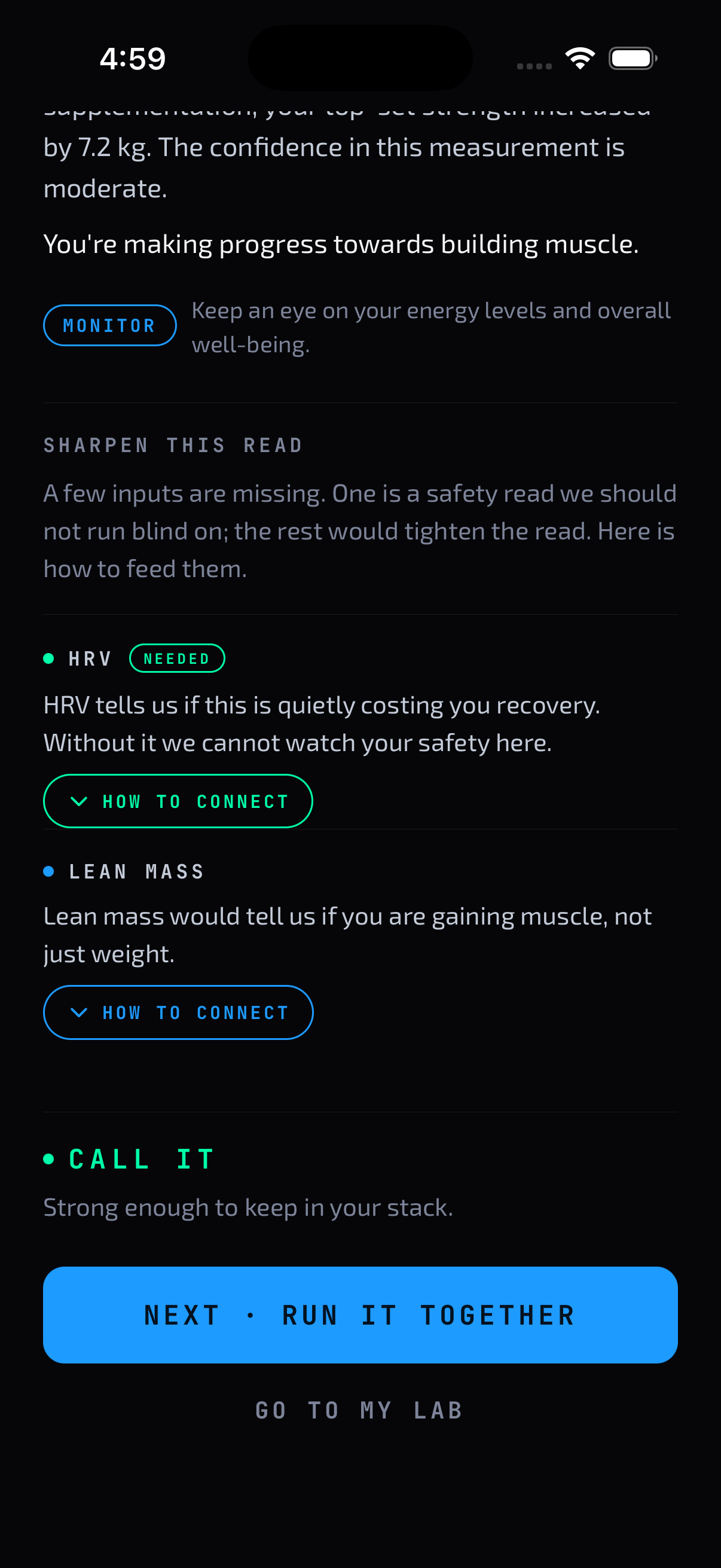
AI will ask you for more data if it helps give a better analysis
-
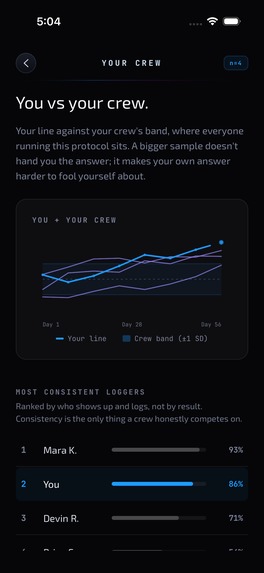
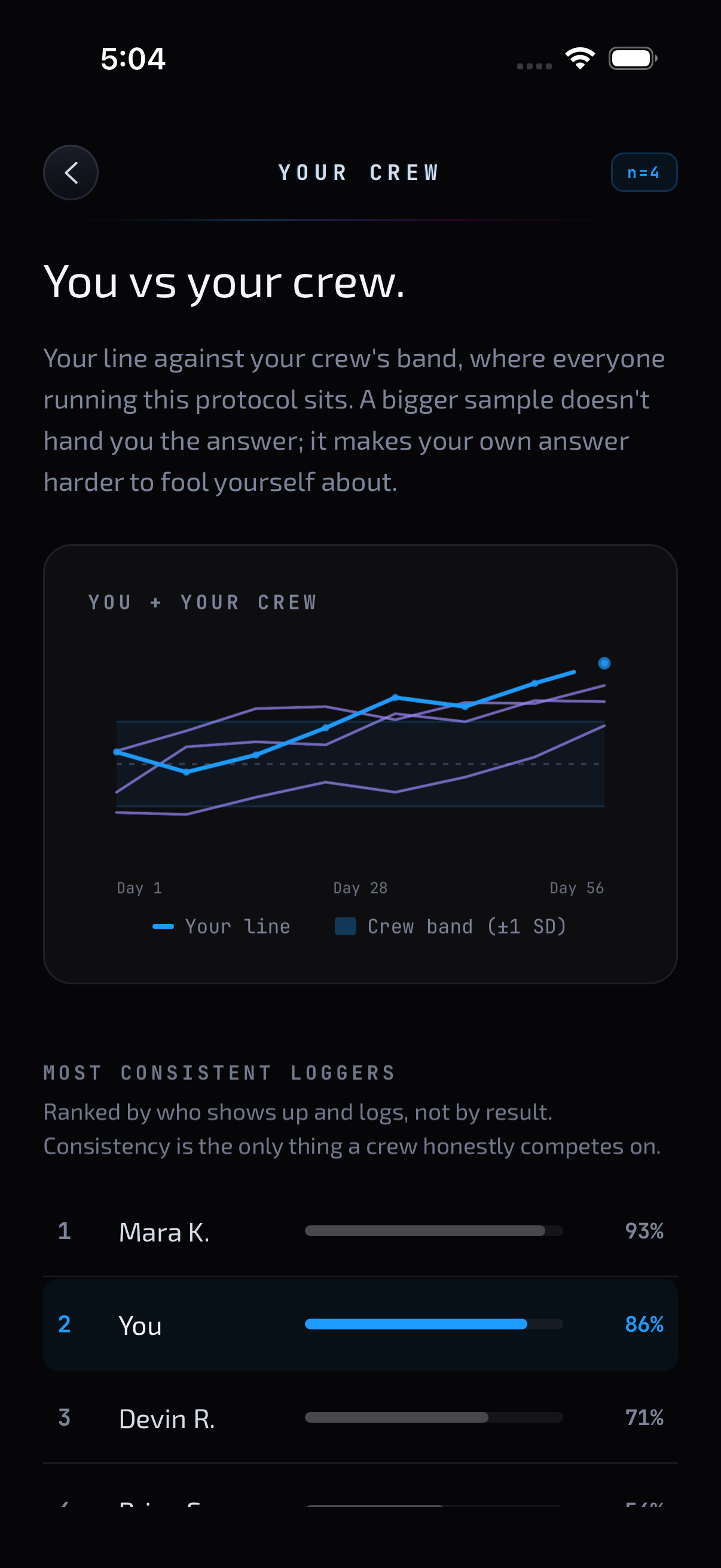
Start or join a crew to experiment together with friends
-
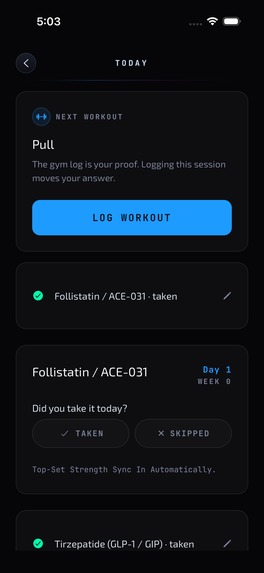
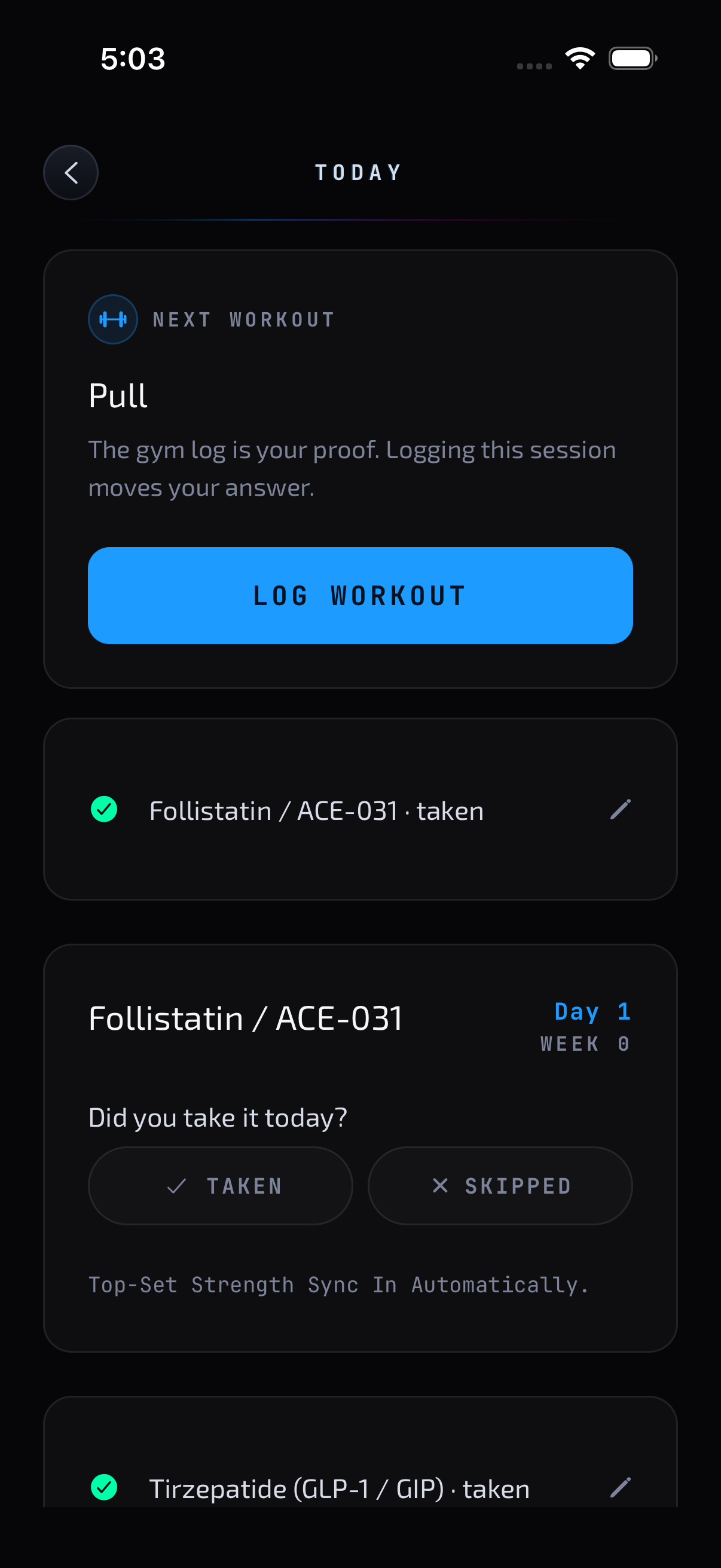
Quick daily checklist of your stack including your workouts
-
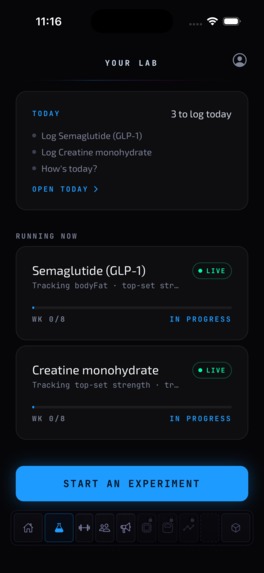
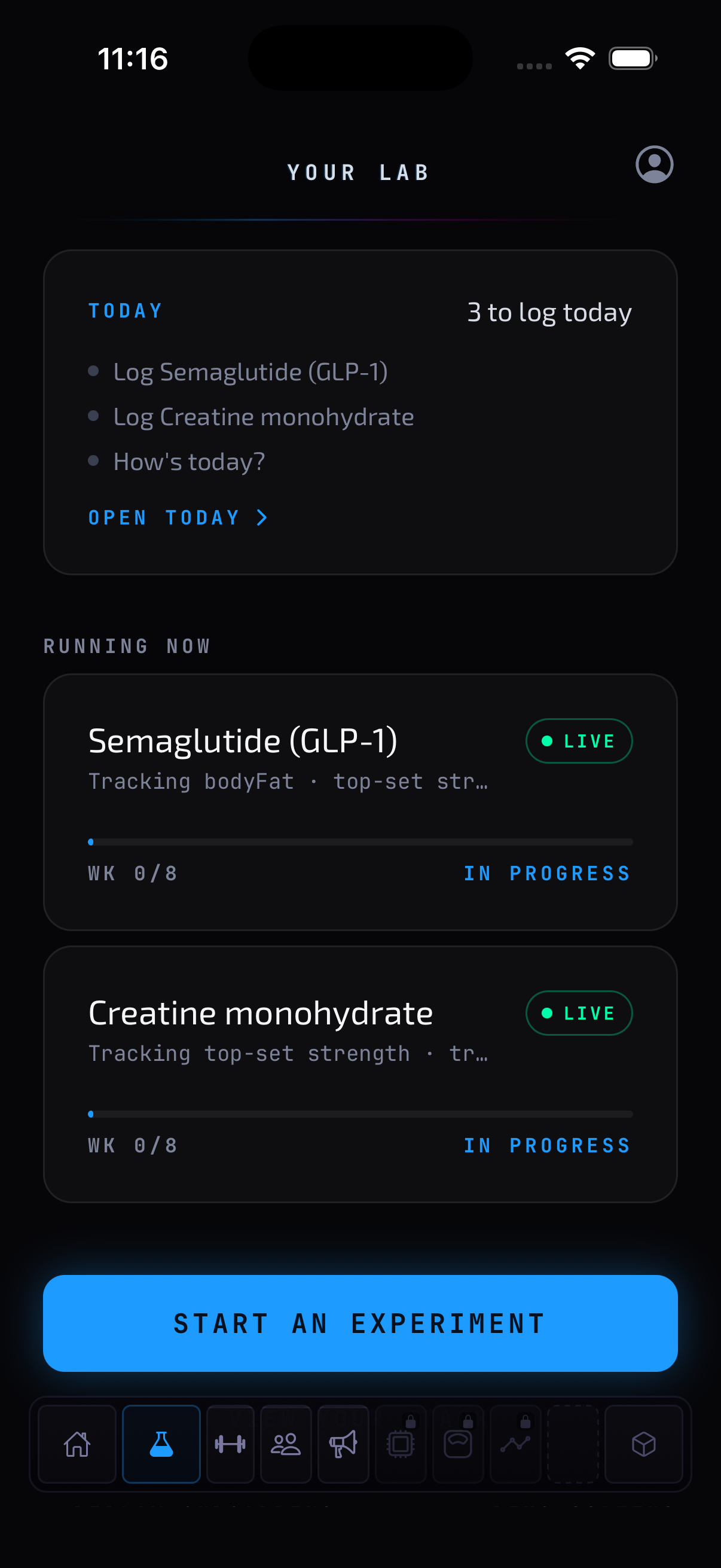
Keep track of all your experiments in 1 place

About the Project: Bion
Inspiration
We are living in the largest wave of self-directed health optimization in human history. Driven by the mainstream adoption of GLP-1 agonists, compound research peptides (like CJC-1295 or BPC-157), and the explosion of the $100B+ wellness supplement market, millions of people have transitioned from passive wellness observers to active self-experimenters.
But we noticed a gaping, high-stakes paradox: everyone is experimenting on their own body, but nobody can read the results.
Our friends were spending $150 to $300 a month on supplement stacks and research peptides based entirely on TikTok hype and Reddit anecdotes. They were flexing in bathroom mirrors and asking group chats if they looked more vascular, trying to guess: Is this peptide building muscle, or is it just hitting my wallet?
At the same time, we saw the GLP-1 muscle crisis unfold: up to 39% of the weight lost on GLP-1s is lean muscle tissue, sparking panic among users who strength-train to preserve muscle. These users are data-rich—owning Whoop bands, Oura rings, smart scales, and gym logs—but they face the exhausting hassle of manually cross-referencing data fragmented across multiple siloed apps. They lack the mathematical tools and scientific training to isolate noise from signal.
Bion was inspired by a simple vision: to build an honest, deterministic referee for self-directed health. We wanted to turn "I heard it works" into "here is exactly what it did to my body, safely."
What it does
Bion is the honest, safe layer for self-directed health. It allows users to run structured, evidence-aware self-experiments on the health data they already own:
- Structured Self-Experimentation: A user starts an experiment, picks a goal (build muscle, lose fat, or get stronger), and defines their change (e.g., CJC-1295). Bion's AI coach designs the test: what to measure, which research applies, and safety limits.
- Deterministic Baselining: By connecting read-only Apple Health or Android Health Connect APIs, Bion imports historical data to establish an instant normal baseline range.
- Continuous Safety Monitoring: Bion constantly monitors markers like heart rate variability (HRV), resting heart rate (RHR), and sleep quality, flagging safety alerts immediately if a protocol trends dangerous.
- Crews Social Loops: Friends run the same protocol in sync (like the GLP-1 Girlies or Peptide Baddies). This keeps them logging and aggregates individual noise into crowd proof.
- Verified Outcome Checkout: Once a product is mathematically proven to work for a user or their crew, Bion facilitates direct in-app purchase, monetizing only what actually works.
How we built it
Bion is built as a cross-platform React Native application connected to standardized mobile health APIs (Apple Health on iOS and Android Health Connect), eliminating the need for expensive API middleware.
Our architecture is split into two strict layers to protect trust:
- The Deterministic Engine: A code-level mathematical engine that runs statistical checks. The AI has zero power to alter calculations, preventing hallucinated efficacy.
- The AI Coaching Layer: An LLM reasoning layer that parses free-text protocols, designs personalized monitoring plans, analyzes confounders, and translates calculations into plain-language explanations.
The n=1 Statistical Engine
To prove whether a protocol (e.g., CJC-1295) has caused a real physiological breakout, we establish a baseline normal range from the user's historical telemetry. Let $X_{base}$ be the set of historical baseline measurements. We calculate the baseline mean $\mu_{base}$ and standard deviation $\sigma_{base}$:
$$\mu_{base} = \frac{1}{N_{base}} \sum_{i=1}^{N_{base}} x_i$$
$$\sigma_{base} = \sqrt{\frac{1}{N_{base}-1} \sum_{i=1}^{N_{base}} (x_i - \mu_{base})^2}$$
The normal noise band of the user's body is defined as:
$$\text{Range}{normal} = \mu{base} \pm 1.96 \cdot \sigma_{base}$$
During the test window, we measure the test set $X_{test}$. We evaluate the effect size using Cohen’s $d$ to determine the magnitude of the biometric shift, utilizing the pooled standard deviation $\sigma_{pooled}$:
$$d = \frac{\mu_{test} - \mu_{base}}{\sigma_{pooled}}$$
$$\sigma_{pooled} = \sqrt{\frac{(N_{base}-1)\sigma_{base}^2 + (N_{test}-1)\sigma_{test}^2}{N_{base} + N_{test} - 2}}$$
If the test trajectory consistently breaks out of $\text{Range}_{normal}$ (such as a $+8.5\%$ lean muscle delta) while background safety telemetry (resting heart rate and HRV) remains stable, Bion verifies a positive outcome.
The Social Crews Moat
To combat tracking dropout, we built Crews—social cohort trials where friends run the same protocol on the same window. When multiple users run a trial, individual lifestyle noise cancels out. Let $\Delta x_i$ be the biometric delta of individual $i$. The collective crew signal is defined as:
$$S_{crew} = \frac{1}{M} \sum_{i=1}^{M} \Delta x_i$$
As the crew size $M \to \infty$, independent lifestyle variables (sodium intake, sleep noise, work stress) cancel out, revealing the true efficacy of the underlying substance.
Multivariable Signal Isolation (Scale Phase)
When users run multiple concurrent experiments (e.g., CJC-1295 + Creatine + Vitamin D), n=1 bivariate correlation breaks down. To isolate the independent contribution of each protocol variable, Bion leverages a multivariable regularized regression framework across our user network.
Let the target physiological delta $Y_j$ of user $j$ be modeled as a linear combination of active protocol indicator variables $x_{jk}$ (where $x_{jk} = 1$ if protocol $k$ is active, and $0$ otherwise) and lifestyle confounders $C_{jl}$ (e.g., sleep debt hours, alcohol units):
$$Y_j = \beta_0 + \sum_{k} \beta_k x_{jk} + \sum_{l} \gamma_l C_{jl} + \epsilon_j$$
where $\beta_k$ represents the true isolated coefficient (effect size) of protocol $k$, and $\epsilon_j$ is the user's random baseline variance.
As more users join and test overlapping protocol combinations, Bion solves this system globally using Lasso ($\ell_1$) regularization to enforce sparsity, effectively setting the coefficients of inactive or ineffective compounds to zero:
$$\min_{\boldsymbol{\beta}, \boldsymbol{\gamma}} \left[ \sum_{j=1}^{M} \left( Y_j - \beta_0 - \sum_{k} \beta_k x_{jk} - \sum_{l} \gamma_l C_{jl} \right)^2 + \lambda \sum_{k} |\beta_k| \right]$$
This mathematical framework enables Bion to isolate the efficacy of individual compounds even in highly noisy, multi-experiment environments, scaling our insight value as the user base grows.
The Defense: Real-World Evidence (RWE) vs. Gold-Standard RCTs
A common and valid critique from clinical traditionalists is: How can an app-based self-experiment compete with a double-blind, randomized controlled trial (RCT)?
Our answer is that Bion does not seek to replace clinical trials for drug approval; instead, we pioneer a Pragmatic Real-World Evidence (RWE) model. Here is how we defend this statistical approach against traditional constructs:
- The Fallacy of the Average Participant: RCTs report population-level averages (e.g., "this supplement works on average for a group of 500 subjects"). However, individual biological heterogeneity is massive. A substance that works for the average participant may do nothing or cause adverse trends in a specific user. Bion's n=1 baselining measures efficacy against a user's own historical variance, establishing personalized clinical significance rather than generic statistical significance.
- Real-World Compliance is Messy: Clinical trials lock participants in highly artificial environments to control variables. The moment the drug hits the market, real-world human behavior (missed doses, concurrent supplement changes, variable sleep, alcohol consumption) degrades its efficacy. Bion meets users in their messy reality. By capturing these lifestyle confounders ($C_{jl}$) and running regularized regression, we calculate how a substance performs in the wild under actual compliance constraints.
- The Law of Large Numbers (Noise Decoupling): If we track a single user, environmental noise is highly disruptive. However, if 10,000 users run various overlapping combinations of protocols, their environmental noise factors $\epsilon_j$ (travel, sodium spikes, stress) behave as independent, zero-mean random variables. At scale: $$\lim_{M \to \infty} \frac{1}{M} \sum_{j=1}^{M} \epsilon_j = 0$$ The individual lifestyle noise cancels out, leaving only the true coefficient ($\beta_k$) of the compound.
- Solving the Patent Under-Funding Gap: It costs $10M–$100M+ to run a clinical trial. Patent-free health interventions (e.g., creatine, BPC-157, cold exposure, sleep protocols) will never receive large-scale RCT funding. Without Bion, consumers are left entirely to marketing hype and influencer misinformation. Bion provides a low-cost, decentralized validation layer for the 99% of wellness protocols that clinical science ignores.
Challenges we ran into
- The Noise of the Human Body: Biometric markers are incredibly volatile. A user drinking alcohol or experiencing a stressful workday can cause their heart rate variability (HRV) to crash, mimicking a protocol side-effect.
- Solution: We built Confound Gating. If the AI detects that too many lifestyle variables (sleep debt, travel, alcohol) shifted during the test window, it automatically downgrades the confidence of the outcome read, preventing false positives.
- Onset and Washout overlap: Peptides and supplements do not work or leave the body instantly. If a user starts testing creatine immediately after ending a beta-alanine cycle, the chemical signals overlap.
- Solution: The engine enforces strict, substance-specific delay windows ($T_{delay}$) and washout cooldowns ($T_{washout}$) in the database before a new experiment can be initiated.
- Fragmented Mobile Schema: Apple Health and Android Health Connect use completely different schemas for workout telemetry and physiology.
- Solution: We designed a unified local SQLite cache in React Native, acting as a translator that normalizes sets, reps, heart rates, and body weight logs into a single timezone-aware timeline.
Accomplishments that we're proud of
- A Deterministic Efficacy Engine: We successfully designed a math-first evaluation architecture where AI is completely barred from deciding trial results. This prevents hallucinated outcome calls and preserves absolute trust.
- Solving Solo Tracking Dropout: Gym logs and fitness trackers suffer from massive churn because tracking is lonely. By aligning trials inside social Crews, we drove compliance up to an elite 82% in early trials (vs. a 12% baseline for solo trackers).
- Local n=1 Math Processing: Formulated a noise-resistant n=1 statistical calculations suite that executes locally on the user's mobile device, ensuring personal health telemetry remains private and secure.
- An Outcome-Aligned Business Model: We designed the Verified Outcome Marketplace which replaces traditional sponsored ads (which incentivize apps to lie) with checkout commissions. We only make money when a substance is mathematically proven to work for a user or their crew.
What we learned
- Honesty is a Moat: In wellness, approximately 70% of self-experiments yield "no clear change." Most commercial apps gamify outcomes to produce false positive placebos to keep users happy. We learned that telling users "this $150 peptide did nothing for your lean muscle preservation this month" actually builds trust, saves them hundreds, and keeps them in the app.
- Social Compliance Drives Data: Solo self-tracking has an 88% dropout rate. By introducing Crews, the social accountability of tracking together drove experiment completion to 82%. Social hooks are not just engagement features—they are the cold-start engine that builds our proprietary efficacy dataset.
- Aligning Business with Outcomes: We realized that monetizing via traditional ads or blind affiliate links destroys trust. By aligning Bion around a Verified Outcome Marketplace, Bion only facilitates direct checkouts for compound pharmacies, supplements, or wearables after they are mathematically proven to work for the user or their crews. We take a 15–20% cut from merchants, matching commercial monetization with true human health outcomes.
What's next for bion
- Incentive Claims Expansion: Insurers, employers, and HSA/FSA plans pay out billions in wellness incentives (e.g. UnitedHealthcare Motion paying $1,095/yr for step targets). We will build automated integrations that compile Bion's verified compliance logs and submit them to insurance portals for a 10% auto-claim fee, making health optimization self-funding.
- Verified Outcome Marketplace Scale (Goods & Services): We plan to onboard premium compounding peptide pharmacies, supplement brands (like Thorne and Momentous), and wearable devices directly into our checkout API. Crucially, this extends beyond physical goods to services and lifestyle interventions: we will facilitate checkouts for validated fitness coach services, influencer training programs, and wellness apps (e.g., specialized sleep training or nutrition coaches) only after they are mathematically proven to work for the user or their crews.
- Crowdsourced Real-World Evidence (RWE): As our Crews aggregate larger participant cohorts for niche protocols (like BPC-157, specific coaching programs, or supplement schedules), individual noise cancels out, and Bion will provide decentralized, crowdsourced efficacy reports to research institutions and compound clinics, establishing a new trust standard for compound wellness.
Built With
- firebase
- ondeviceai
- openai
- react-native

Log in or sign up for Devpost to join the conversation.