-
-
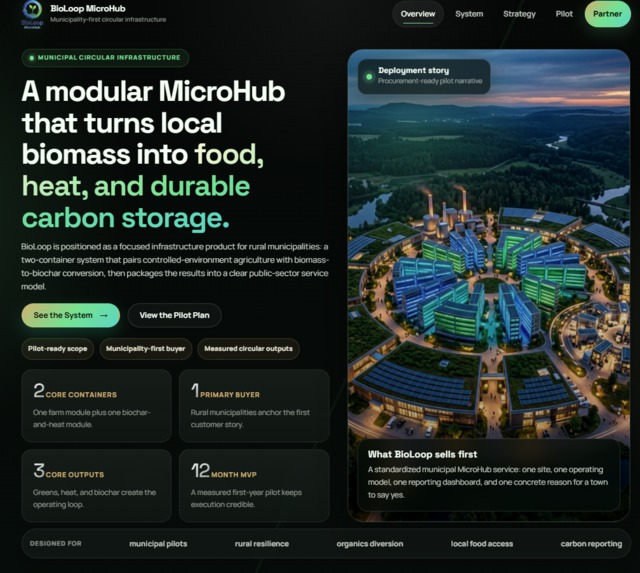
Website Photos
-
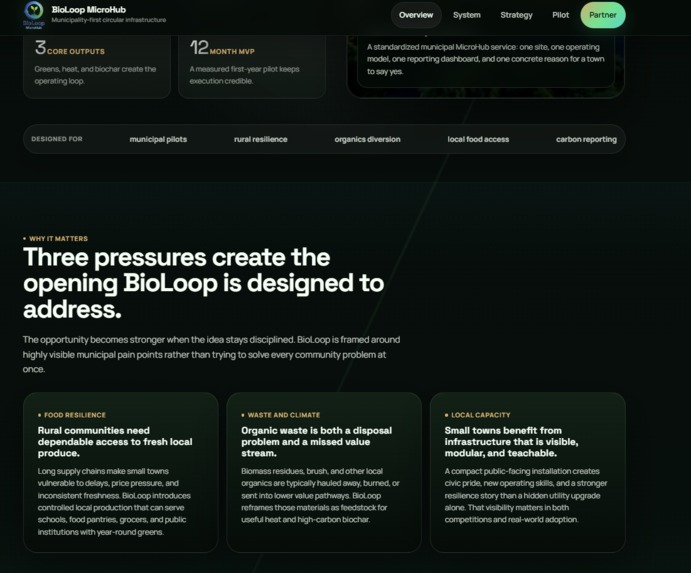
Website Photos
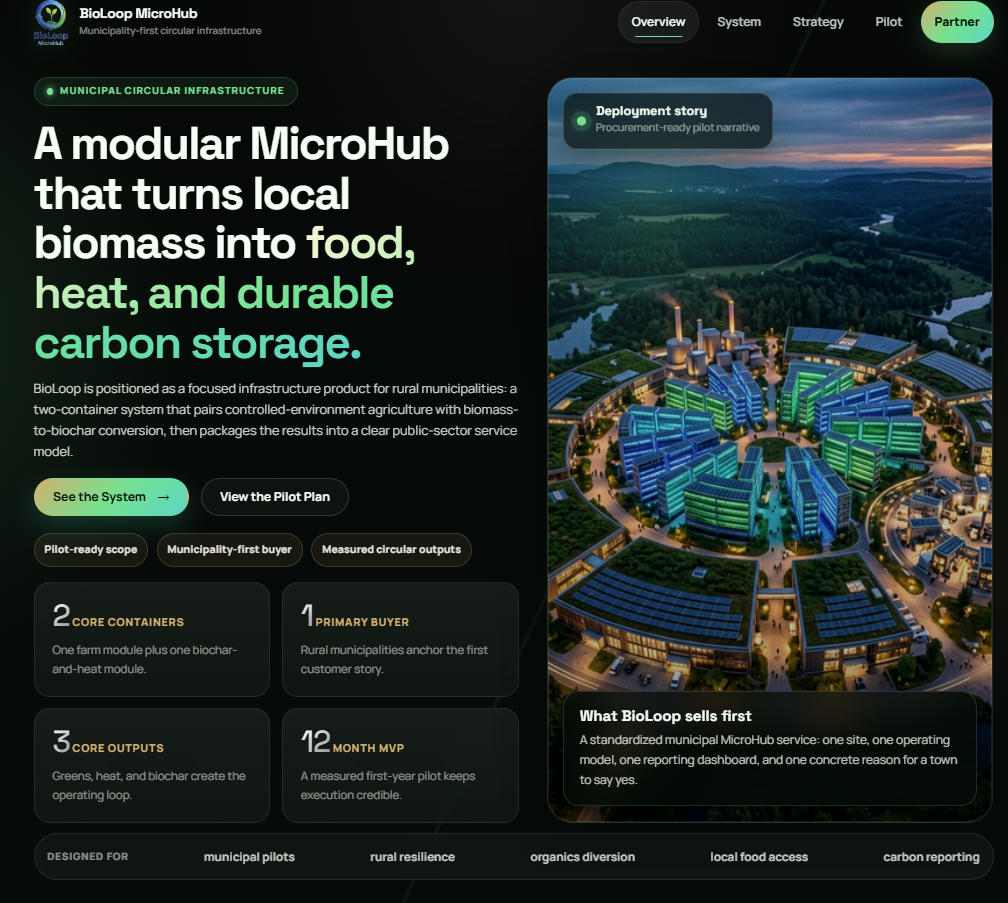
Inspiration
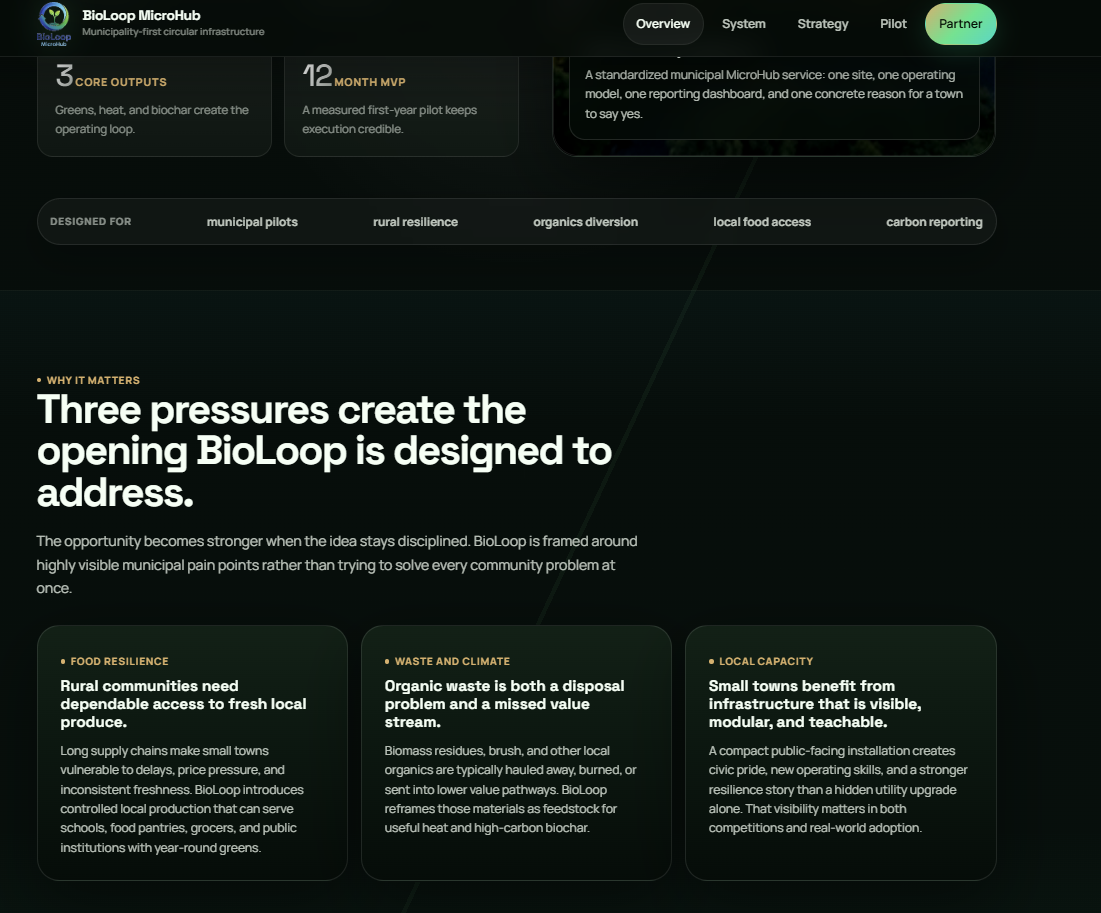
The inception of BioLoop stems from identifying a prevalent systems-level issue in rural communities. All three major components related to food, waste, and energy are treated independently as separate problems, when in actuality they are highly interrelated. For example, on average, fresh produce travels about 1,500 miles to reach rural towns; at the same time, many biomass waste materials within the community, including tree trimmings or agricultural waste, often lack a sustainable outlet for disposal if they are not burned or sent to a landfill.
In addition, the abundance of existing solutions is not the problem; rather, it is the fragmentation between them. For instance, community garden programs can build engagement and acceptance; however, most communities do not have the capacity for large-scale production to meet overall population needs. Vertical farms can produce sufficient amounts of food, but they are generally considered too costly for most areas to implement. Waste-to-energy systems convert municipal solid waste into usable energy; however, they often lack integration and do not provide direct access to local residents.
As such, we felt the design of BioLoop should reflect all three components, as our goal was to develop a system that connects food, waste, and energy into one continuous, self-sustaining, closed-loop system without forcing trade-offs. Additionally, we have always believed that these systems need to operate not solely from a technical perspective but also with consideration for their impact on communities, including real access to food and the creation of economic opportunities for residents. Therefore, we believe infrastructure must be designed not only to operate efficiently, but also to be visibly, dependably, and meaningfully integrated into the daily lives of the communities it serves over time.
What it does
BioLoop is an integrated, modular, and containerized system that converts biomass into food, energy, and other useful products through a continuous, closed-loop process. The MicroHub has two primary components. The first is a vertical hydroponic farm that produces fresh greens year-round, using significantly less water than traditional farming due to its efficiency. The second is a biomass-to-biochar and heat processing unit that converts organic waste into usable energy and stable carbon. Together, these components form a closed loop: local input creates local output, where waste is turned into energy that provides the power needed for additional production, ultimately generating food for the community. In addition to producing multiple outputs from the same resource, BioLoop creates value through fresh produce as food, usable heating as energy, and biochar as carbon, all of which can generate income and support sustainable communities. With this system, operations continue and become increasingly efficient as it utilizes local resources. This also helps develop a community’s capacity for self-sufficiency and reduces reliance on external supply chains.
How we built it
A single clear innovation is the foundation for BioLoop: a modular, replicable, two-container MicroHub based on established technologies. Rather than creating entirely new systems, we integrated existing technologies and brought them together as one unified whole. Container-based hydroponic farms are available with known labor and production outputs, as are small-scale biochar and heat systems with defined performance specifications. While developing each component in isolation was relatively straightforward, developing the interaction between those components was the true challenge. We designed our system so that the outputs from one process enhance the outputs of another, thereby ensuring a stable and consistent resource loop. The overall system is not an array of separate technologies, but a coordinated system ready for municipal use and deployment.
Challenges we ran into
A major difficulty was choosing the right scope. Initially, the concept became more extensive, involving many alternative service businesses and industries. However, we found that added complexity and detail reduced clarity, particularly in a competitive environment where focus and feasibility are critical.
Another major difficulty was developing a feedback loop that would actually be sustainable and capable of continuous improvement. Without the right structure, feedback loops can often lead to unproductive behavior. Therefore, we had to ensure that each part of the system contributed value to the loop without introducing additional failure points or dependencies on every component performing perfectly.
In addition, we had to consider real-world constraints, including cost, permitting, and ease of operation. The system not only needs to work in theory, but also be something that a small town can realistically implement and maintain.
Accomplishments that we're proud of
We take great pride in transforming a wide-ranging system into a simple and well-defined integrated system. BioLoop is not merely a concept; it is a fully developed model ready for municipal implementation, with a defined target audience, an established deployment strategy, and measurable results. In addition, we are proud to have developed true integration. While there are many alternatives for addressing food, waste, or energy, BioLoop integrates all three into a single system with multiple measurable outputs, while remaining compact and scalable.
What we learned
We learned that the size and scope of an idea do not determine its strength; what matters is how well it meets a clear need. Once we focused BioLoop on one main innovation, it narrowed its scope and made it easier to understand and implement. We also learned that when developing systems at the community level, a different mental framework is required. It is not just about efficiency or production levels, but about being reliable, usable, and trustworthy. A system will only matter to people if they are able to use it consistently in their daily lives.
What's next for BioLoop Microhubs
BioLoop is bringing its concept to life by advancing a pilot program and deploying the MicroHub in a rural municipality, measuring its performance through data collection, and using real-world insights to refine and improve the operational system. The next step is transforming the MicroHub into a modular, repeatable model that can be deployed across additional communities, towns, and school districts that would benefit from locally circular infrastructure. Ultimately, we want BioLoop to be a simple yet impactful system that continuously converts local raw materials into real-world benefits, not just efficient, but reliable; not just sustainable, but regenerative.
Built With
- cad
- fastapi
- firebase
- javascript
- node.js
- python
- simulation
- vercel

Log in or sign up for Devpost to join the conversation.