-
-
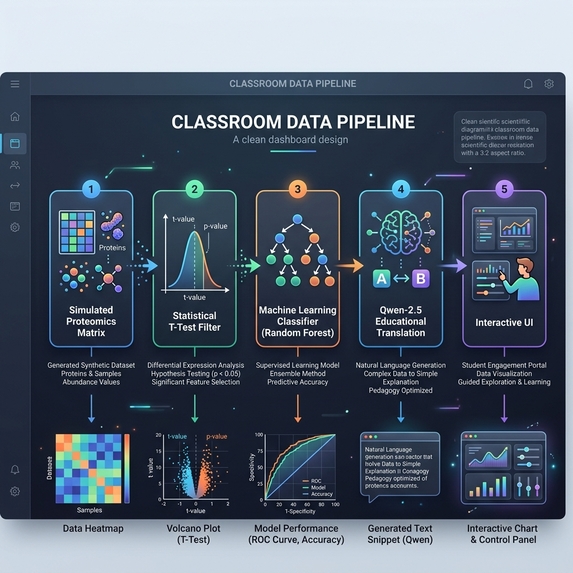
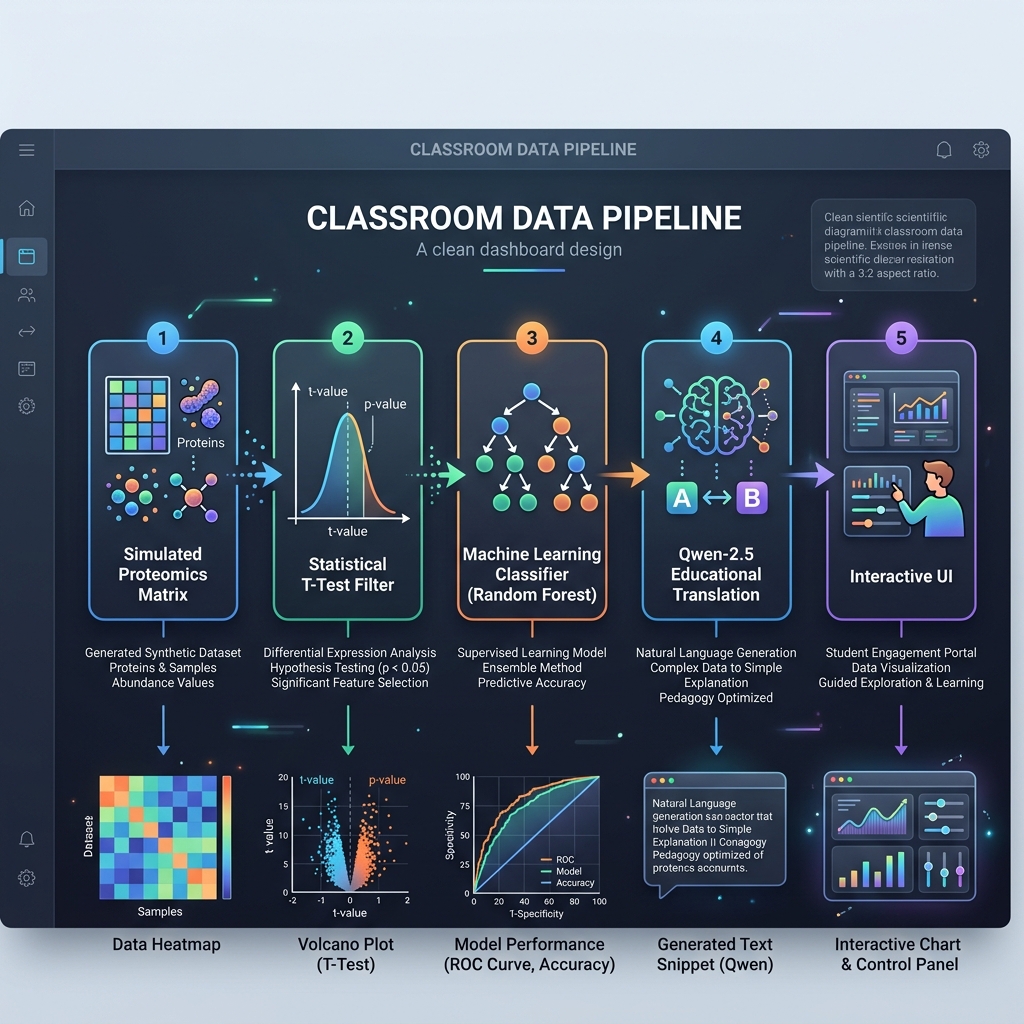
Classroom data pipeline showing simulated proteomics, statistical filters, classifier training, and Qwen tutor translation.
-

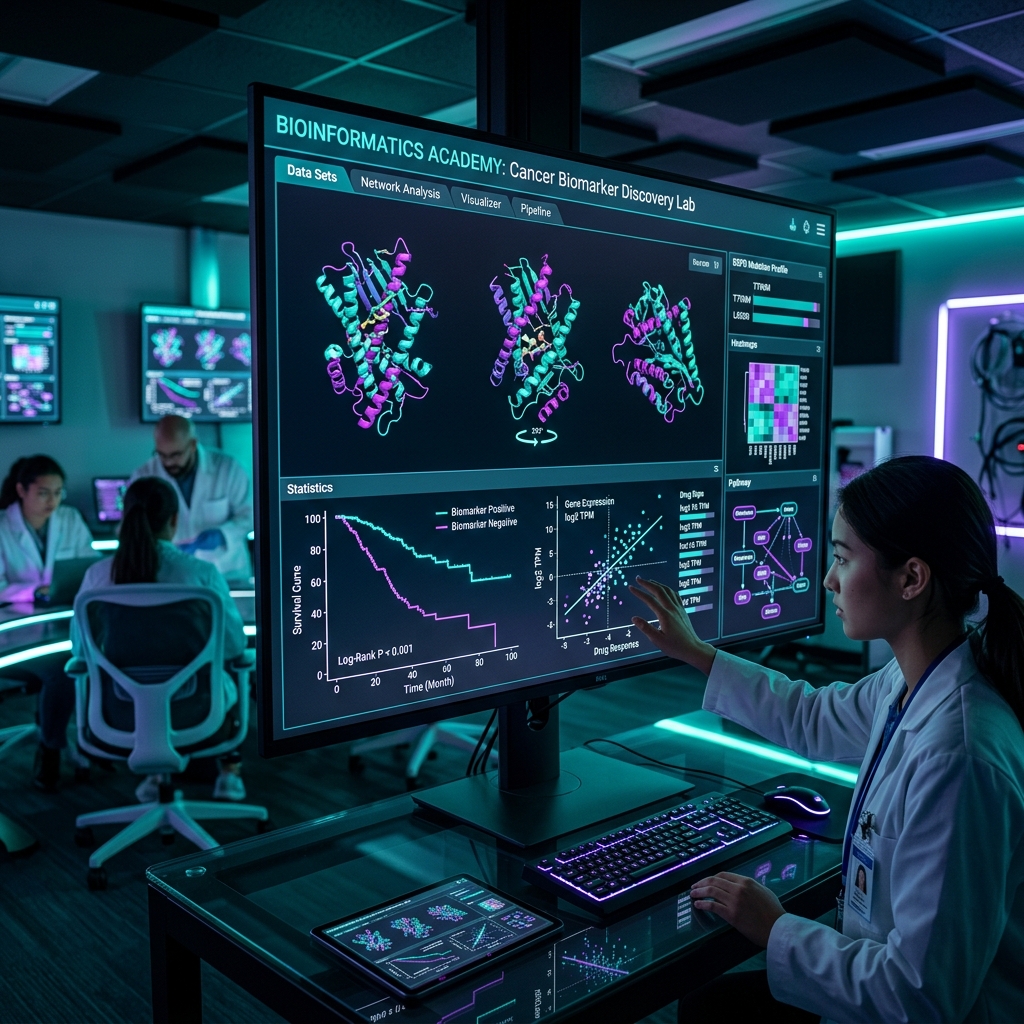
Interactive Bioinformatics Academy dashboard built in Gradio for real-time biomarker discovery and ML experimentation.
-
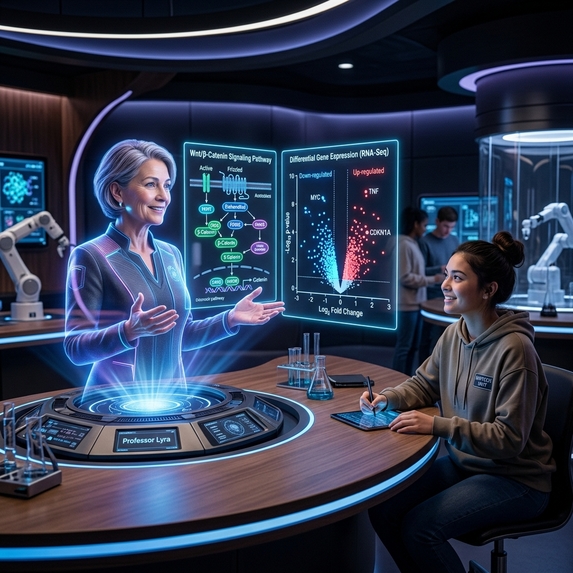
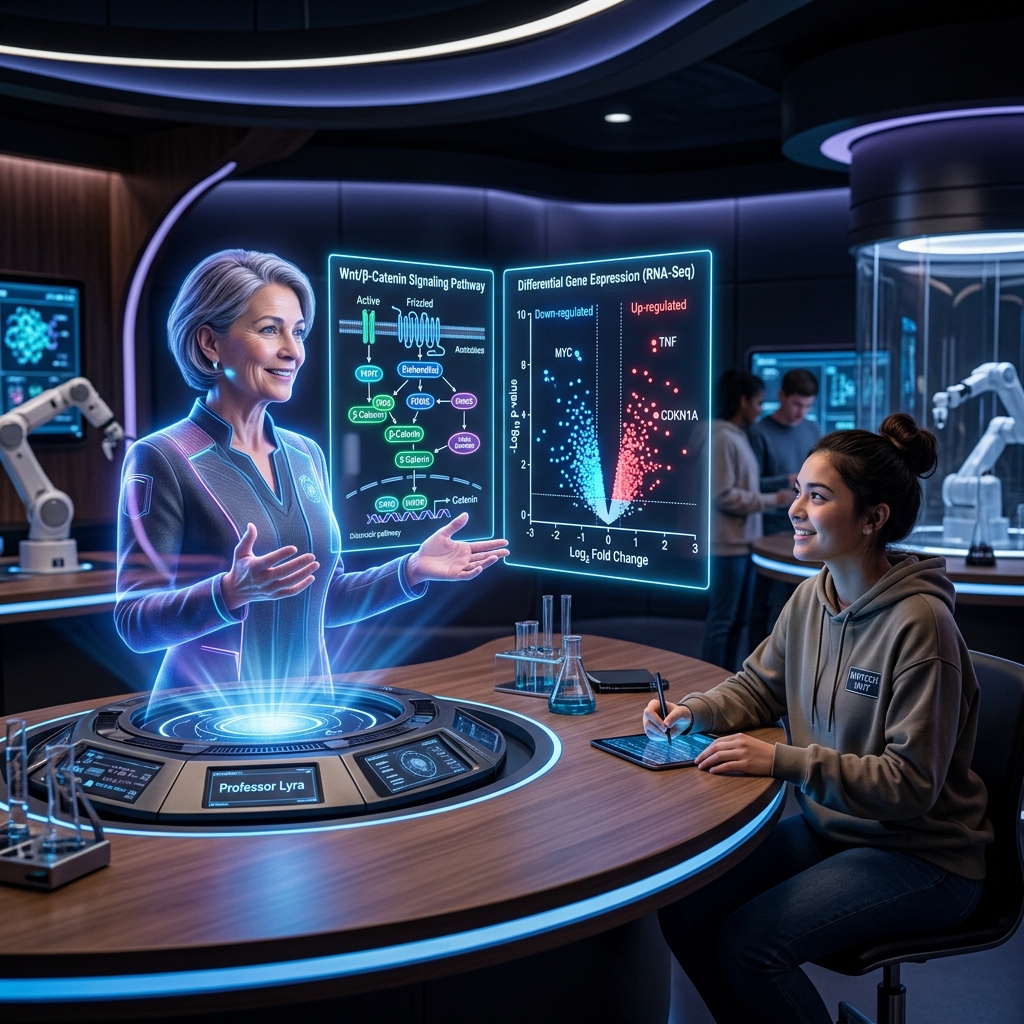
Conceptual design of Professor Qwen, a virtual AI tutor providing personalized molecular biology lessons to students.
Inspiration
Computational biology and machine learning are transforming modern oncology, yet these fields remain highly gatekept. Students and aspiring bioinformaticians often struggle to understand the bridge between raw statistical values, machine learning classification metrics, and their actual clinical meaning.
We built Bioinformatics Academy: Cancer Biomarker Discovery Lab to democratise access to computational oncology. By allowing students to interactively tune statistical and machine learning parameters, visualise data, and learn from an AI-powered biology tutor in real-time, this dashboard makes complex big data analysis accessible and engaging.
How We Built It
The application runs entirely on a CPU-based Google Colab instance, leveraging the following pipeline:
- Proteomics Data Simulator: We modelled expression profiles of 100 patients across 50 proteins. To mimic breast cancer biology, we simulated upregulated oncogenes (e.g.,
ERBB2,AKT1), downregulated tumour suppressors (e.g.,TP53,BRCA1), and neutral housekeeping proteins. - Differential Expression Engine: For each protein, we conduct an independent two-sample t-test to evaluate the difference between tumour (group 1) and normal (group 2) samples:
$$ t = \frac{\bar{X}_1 - \bar{X}_2}{\sqrt{\frac{s_1^2}{N_1} + \frac{s_2^2}{N_2}}} $$
Proteins with a p-value satisfying \( p < \alpha \) (where \( \alpha \) is the user-defined threshold) and an absolute Log2 Fold Change (LFC) exceeding the user threshold are flagged as significant. The results are displayed on a real-time volcano plot.
- Machine Learning Classifier: We split the dataset into training and test sets and trained a classifier to predict whether a tissue sample is normal or a tumour. Below is a snippet of the Random Forest training callback:
# Train the classifier to identify tumour vs. normal samples.
model = RandomForestClassifier(n_estimators=100, random_state=42)
model.fit(X_train, y_train)
importances = model.feature_importances_
Built With
- bioinformatics
- biomarkers
- cancer-research
- google-colab
- gradio
- huggingface-api
- llm
- machine-learning
- matplotlib
- numpy
- pandas
- python
- qwen-2.5
- scikit-learn
- scipy
- seaborn
- statistics

Log in or sign up for Devpost to join the conversation.