-
-
Process
-
Kiln design
-
Benefits
-
Logo
Biochar: From Smoke to Soil
Inspiration
Every November we open our windows in Delhi and we cannot see the sky. The AQI hits 500. Schools shut. People stay indoors. And the conversation always goes the same way: blame the farmers.
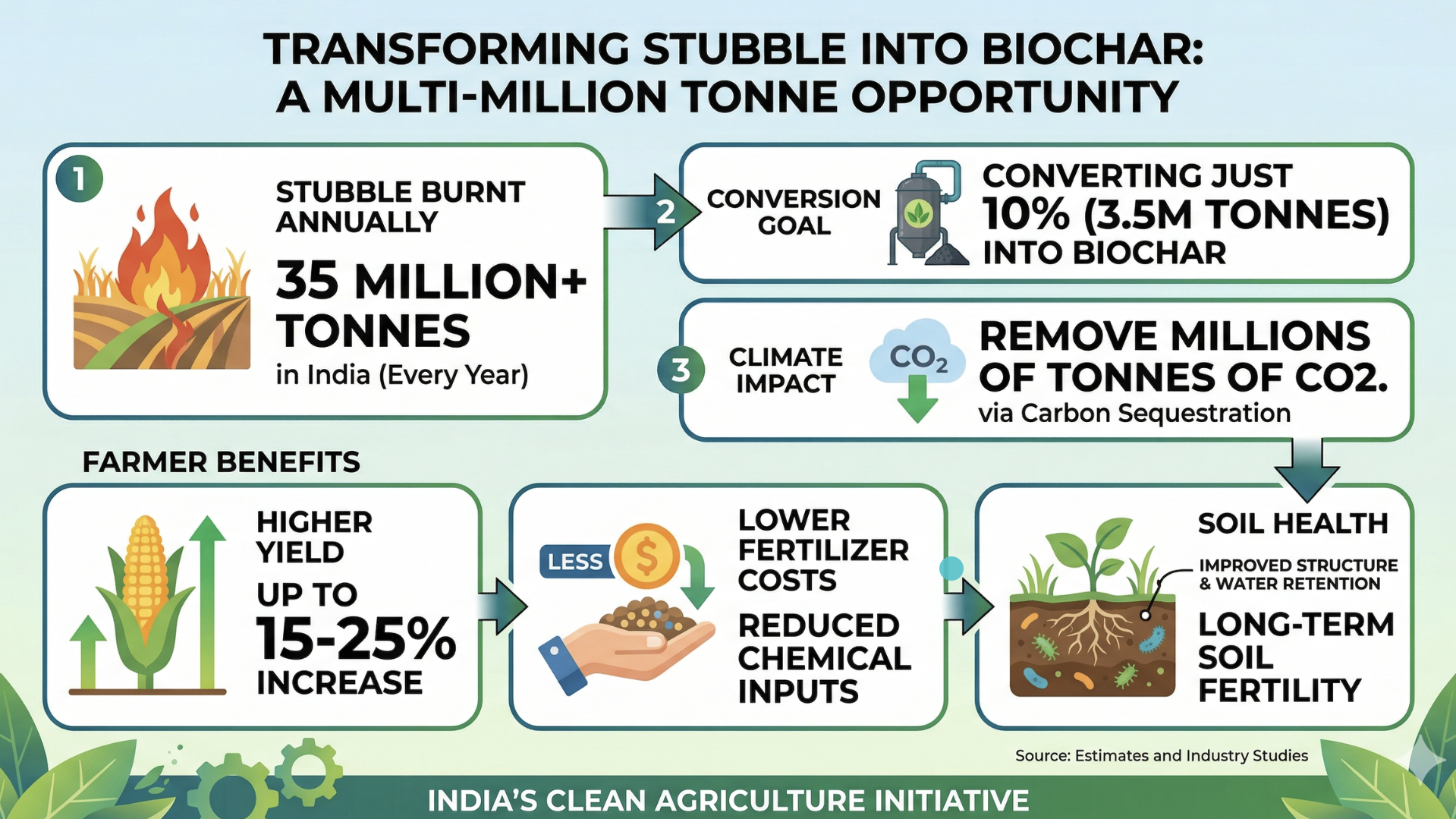
We wanted to actually understand why farmers burn their fields instead of just accepting that narrative. What we found was that they are not being careless. They are trapped. They have a 2 to 3 week window to clear 35 million tonnes of paddy stubble before wheat planting season begins. Machines cost Rs 6000 or more per acre. Most smallholder farmers simply cannot afford that. So they light a match because it is the only option that fits their timeline and their budget.
The thing that really got us was that the government's response to this is to fine them. Fining people for doing the only thing they can afford to do is not a solution. It is just blame with a price tag.
We started digging into what an actual alternative would look like and that is when we found biochar. And then we found terra preta, the 2000 year old Amazonian dark earth that is still fertile today because of biochar that was applied two thousand years ago. That is when we knew this was worth building a real proposal around.
What it does
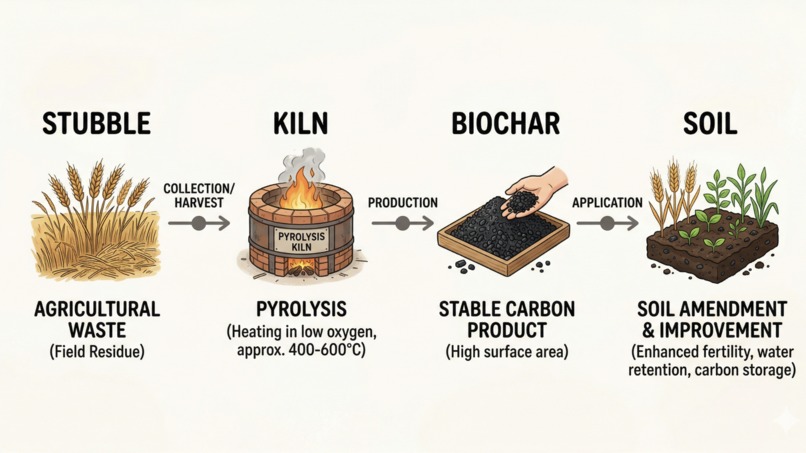
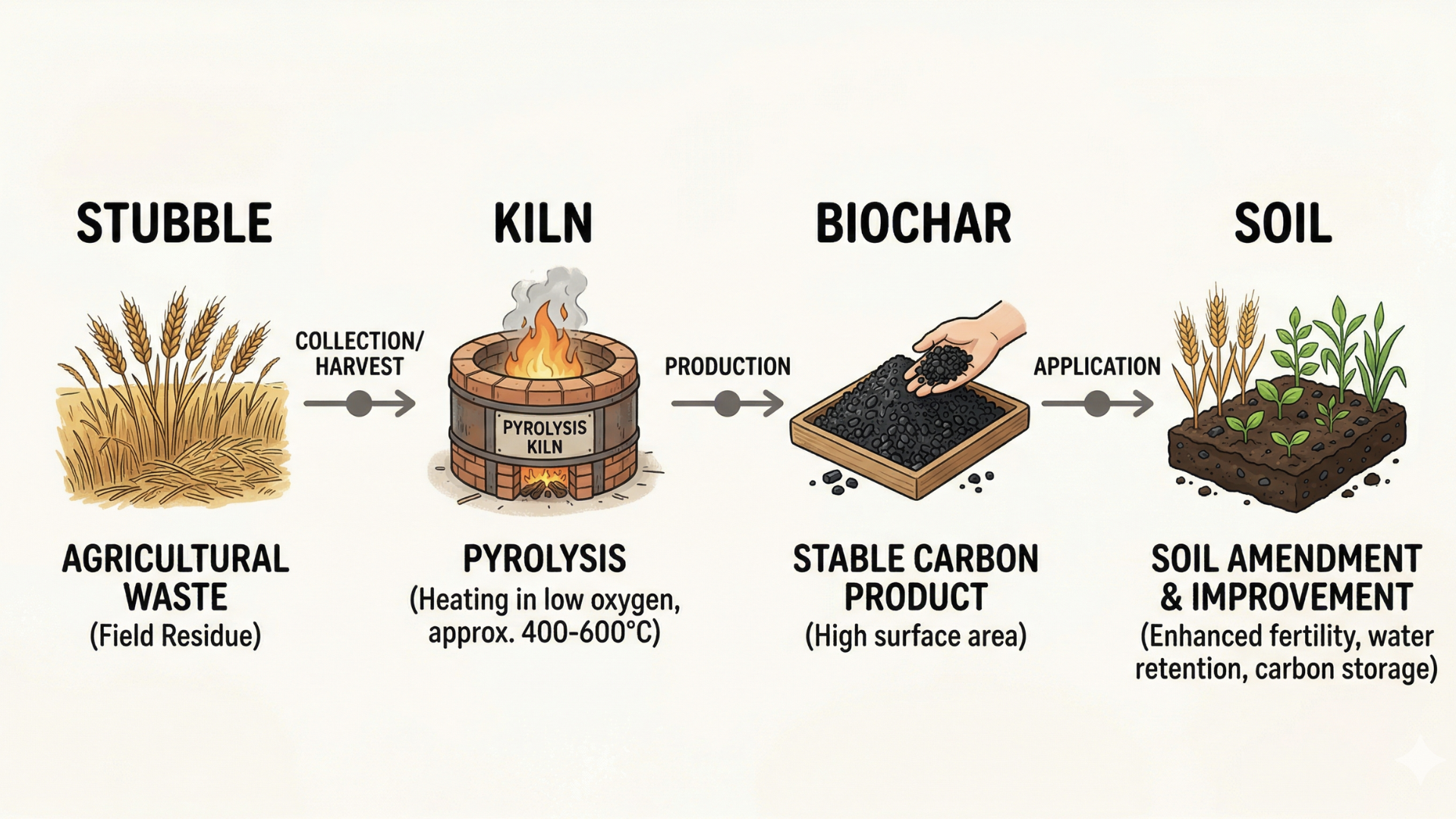
Biochar is what you get when you heat organic material like paddy stubble in a low oxygen environment instead of burning it openly. The process is called pyrolysis. Instead of carbon escaping as CO2, it gets locked into a stable porous structure that can persist in soil for hundreds to thousands of years.
Our proposal takes that science and builds a farmer first system around it in three phases.
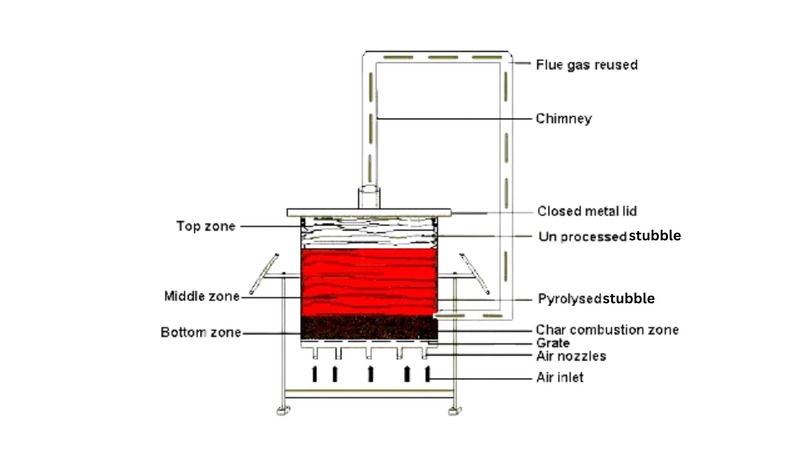
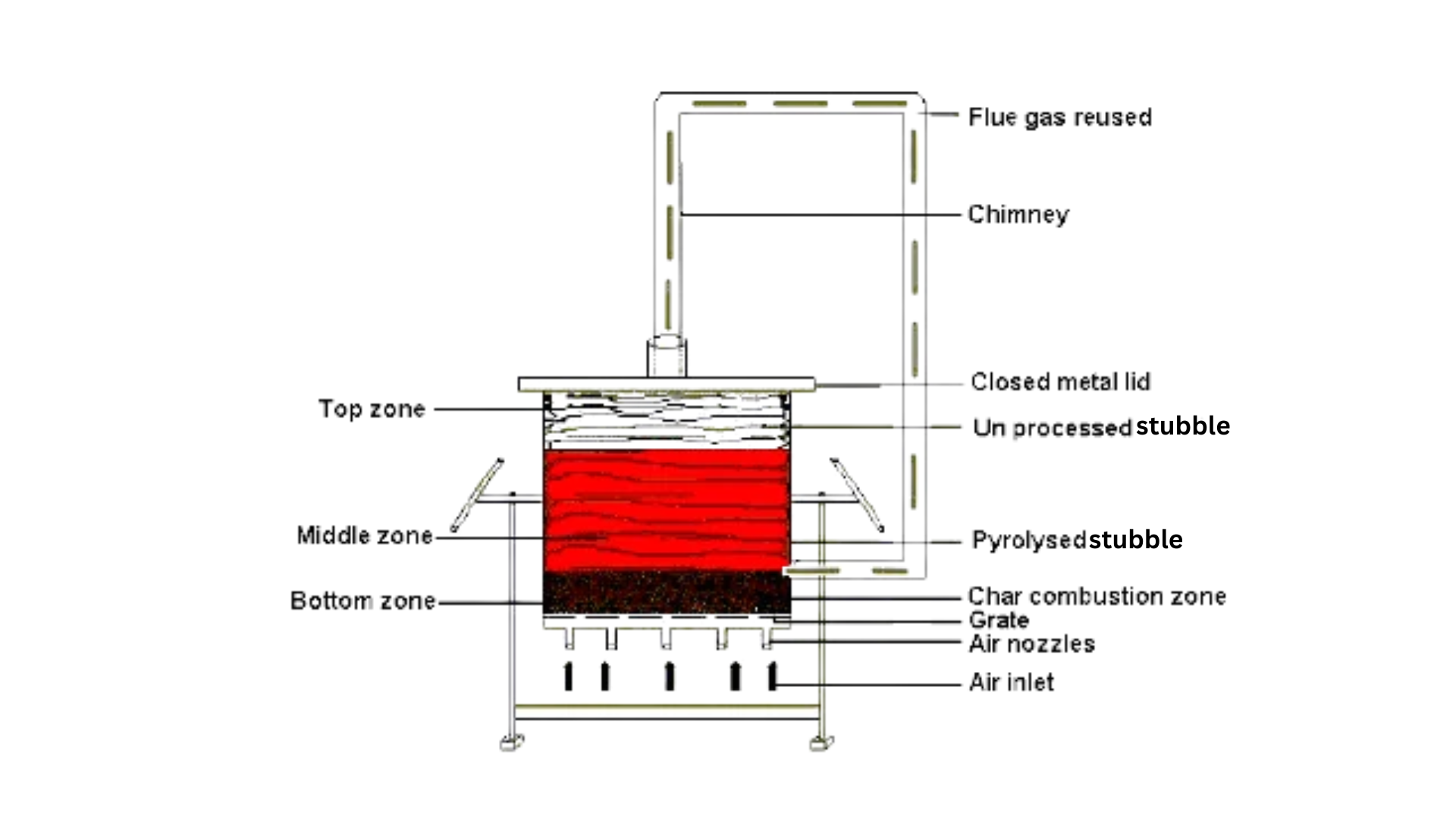
The first phase is the cooperative kiln. Groups of 10 to 20 farmers share a single flame cap kiln that costs around Rs 2500 to build from scrap metal by a local welder. During the October to November stubble window they pool their waste and convert it to biochar together. No external dependency. No corporate middleman.
The second phase is a farmer to farmer demonstration network. Early adopters open their fields so neighbouring farmers can see the results across multiple seasons before committing. Behaviour change that comes from a neighbour whose crop is visibly better is far more reliable than a government notice.
The third phase is carbon credit access. At cooperative scale, biochar production becomes large enough to meet the aggregation requirements for international carbon credit certification under standards like Gold Standard or Verra. This creates a long term revenue stream on top of the yield and soil benefits.
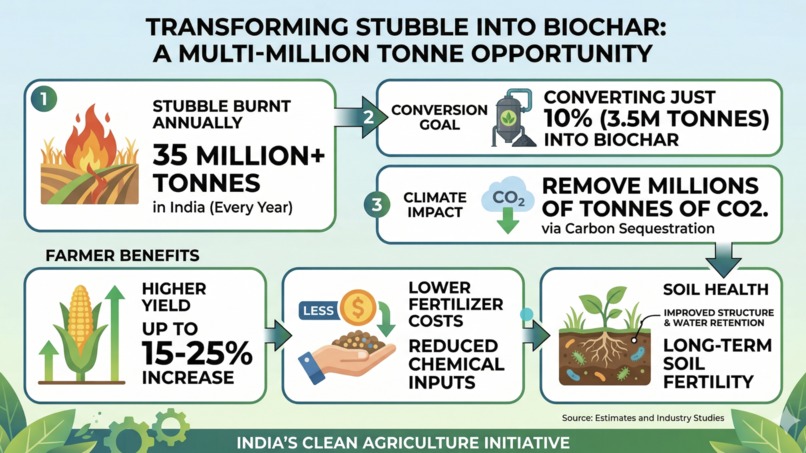
The benefits to the farmer are immediate and direct. Water retention in soil improves by 15 to 30 percent. Fertilizer costs drop because nutrients bind to biochar instead of washing away. Yield improves by 15 to 25 percent within two to three seasons. The climate benefit of locking away millions of tonnes of CO2 happens automatically as a result.
How we built it
This was a research and design project rather than a software build. We spent the hackathon going deep on the problem from multiple angles.
We started by mapping the actual economics of stubble burning from the farmer's perspective including the cost of machines, the timeline pressure, and the financial reality of smallholder farming in Punjab and Haryana. We wanted to make sure we understood why existing solutions like the Happy Seeder have had limited adoption before proposing something new.
We then researched the science of biochar and pyrolysis, the terra preta precedent, and the existing field trial data from Indian dryland farming contexts. We looked at organisations already working in adjacent spaces like Kheti Virasat Mission and research from Punjab Agricultural University to understand what a credible pilot partner ecosystem looks like.
From there we designed the three phase implementation model, the cooperative ownership structure, and the pilot plan for Ludhiana district. We also mapped the carbon credit pathway and identified the aggregation problem as the key barrier to access for smallholder farmers.
The deliverables we produced are the proposal framework, a presentation deck, and a short video script that walks through the problem and solution.
Challenges we ran into
The biggest challenge was making sure the farmer's incentive was genuinely self interested and not asking them to do something for the planet at a cost to themselves. A lot of climate solutions in agriculture make that mistake. We kept asking ourselves: why would a farmer with debt and a tight planting window actually do this? The answer had to be that their own situation improves, not just the environment. Getting the economic case tight enough to be credible took a lot of back and forth.
The second challenge was the behaviour change problem. Biochar improves soil over seasons, not overnight. You cannot show a farmer the benefit in week one. We had to design around that reality with the demonstration farm model rather than pretending the adoption barrier does not exist.
The third challenge was the carbon credit pathway. The economics at cooperative scale make sense but the verification and aggregation process for smallholder farmers is genuinely complicated and we did not want to overclaim on that. We positioned it as a Phase 3 goal rather than a Phase 1 promise.
Accomplishments that we are proud of
We are proud that the core incentive structure is honest. The farmer who adopts biochar wins on their own terms first. Better soil, lower fertilizer costs, higher yield. The carbon sequestration is real and significant but it is a byproduct of something the farmer would want to do anyway. That alignment is rare in climate solutions and we think it is the reason this one has a real shot at adoption.
We are also proud of how the systems story holds together. Stubble that currently produces toxic air becomes soil carbon that improves water retention during drought years while also reducing fertilizer runoff into Punjab's already depleted groundwater. Every climate theme in the hackathon connects through this one intervention without us having to force it.
And honestly we are proud of the research quality. We went into this knowing almost nothing about pyrolysis or agricultural carbon markets and we came out with a proposal we actually believe in.
What we learned
We learned that the most important question in climate solutions is not "does the technology work" but "why would the person who needs to adopt it actually do so." The technology here is not new. Biochar is well understood. Terra preta is thousands of years old. What has been missing is a deployment model that makes it worth it for the individual farmer, not just for the climate.
We also learned that the stubble burning problem is way more connected than we realised going in. It links to soil degradation, groundwater depletion, farmer debt, rural employment, urban air quality, and public health. Pulling on one thread pulls on all of them. That is what made it such a rich problem to work on.
And we learned that equity is not something you bolt on to a proposal after designing it. It has to be the starting point. Who controls the kiln, who owns the biochar, who gets the carbon credit revenue, who benefits from better soil, these are design decisions not afterthoughts.
What's next for BioChar
The pilot would involve building two flame cap kilns with local welders, running the first biochar production batch from the November stubble window, applying it to pilot fields, and tracking soil moisture, fertilizer use, and yield through the next wheat season.
If the pilot shows the yield and soil improvements the existing research predicts, the goal is to document it in a format that neighbouring farmers can actually see and understand, not a research paper but a field walk. Farmer to farmer trust is the distribution channel.
Longer term, once the cooperative model is running at enough scale, the plan is to work with a carbon credit aggregator to get the first batch of Indian smallholder biochar credits verified under an international standard. That would be a first and would open up a revenue stream that makes the whole system financially self sustaining without ongoing subsidy.
The smoke was never the enemy. The system was. And systems can be redesigned.
Built With
- canva
- clipchamp


Log in or sign up for Devpost to join the conversation.