-
BioBuntu
Inspiration
Bioinformatics workflows are often fragmented across multiple tools, command-line scripts, and complex environments. Many researchers struggle with managing pipelines, organizing data, and switching between different interfaces. BioBuntu was inspired by the need for a unified platform that simplifies genomic analysis while remaining powerful enough for real research workflows. The goal was to bring together automation, usability, and flexibility into a single ecosystem.
What it does
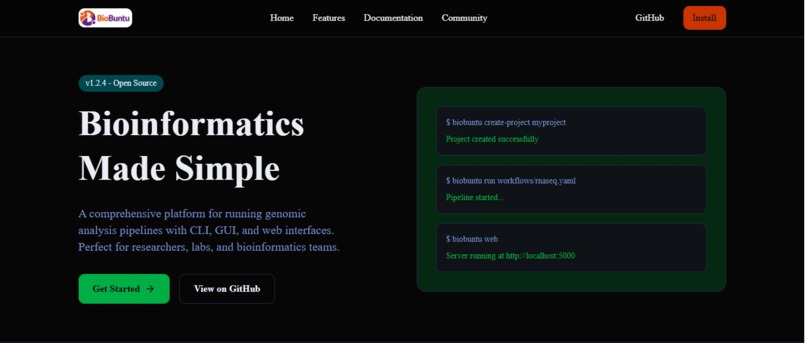
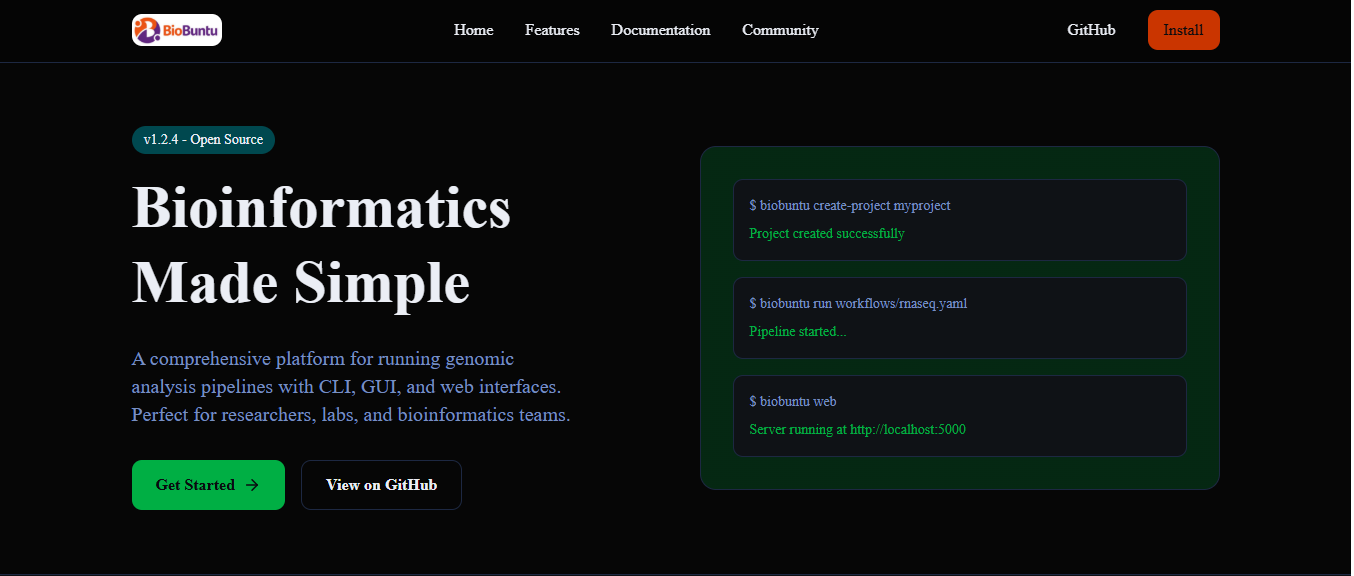
BioBuntu is a comprehensive bioinformatics platform that allows users to run genomic analysis pipelines through multiple interfaces, including CLI, GUI, and a web dashboard. It enables researchers to create and manage projects, execute complex workflows, and monitor results efficiently.
The platform supports workflows such as RNA-seq, variant calling, metagenomics, and quality control. It integrates widely used bioinformatics tools and provides features like parallel execution, workflow validation, and remote job execution. BioBuntu also organizes project data into structured directories, making it easier to manage large-scale biological datasets.
How I built it
BioBuntu is developed using Python and designed as a modular system that supports multiple interaction layers. The core system handles pipeline orchestration, dependency management, and execution logic. I built a command-line interface using Click to provide powerful scripting capabilities, along with a desktop GUI and a web dashboard for accessibility.
The platform integrates external bioinformatics tools such as FastQC, BWA, GATK, HISAT2, and Samtools through custom wrappers. I implemented workflow configuration using structured YAML files, allowing flexible and reproducible pipeline definitions.
Additionally, I developed API endpoints for remote execution and job tracking, enabling distributed analysis. The system is packaged for multiple environments, including pip, Debian packages, and Conda, ensuring ease of installation and deployment.
Challenges I ran into
Designing a system that supports both simplicity and advanced functionality was a major challenge. Managing dependencies between pipeline steps while allowing parallel execution required careful architectural planning. Integrating multiple bioinformatics tools with consistent interfaces also required handling differences in input formats and parameters.
Another challenge was building and maintaining multiple interfaces, including CLI, GUI, and web, while keeping them synchronized with the core system. Ensuring reliability in long-running genomic workflows and handling errors gracefully was also critical.
Accomplishments that I'm proud of
I successfully built a full bioinformatics platform that supports real-world genomic workflows across multiple interfaces. The system provides structured project management, automated pipelines, and integration with industry-standard tools. It is packaged and distributed across multiple platforms, making it accessible to a wide range of users.
The ability to run workflows locally or remotely with job tracking and API support makes BioBuntu more than just a tool; it is a scalable solution for labs and research teams.
What I learned
This project helped me develop a deep understanding of workflow orchestration, pipeline design, and bioinformatics tools. I gained experience in building multi-interface systems and designing scalable architectures. It also strengthened my skills in Python development, API design, and system packaging.
I also learned how to balance usability and flexibility, ensuring that both beginners and advanced users can benefit from the platform.
What's next for BioBuntu
The next step is to enhance BioBuntu with more advanced pipeline templates, improved visualization of results, and better integration with cloud-based infrastructure. Future development includes adding support for distributed computing, real-time collaboration features for research teams, and expanding the plugin system for custom workflows.
There is also potential to integrate machine learning modules for automated data analysis and to evolve BioBuntu into a complete bioinformatics operating environment tailored for modern research needs.
Mubashir Ali - Aspiring Bioinformatics & Data Science Professional | Bridging Biology & Data | Researcher | Genomics, Machine Learning, AI | Founder @TynexAI and @Code with Bismillah | Schema.org expert
Built With
- biopython
- python

Log in or sign up for Devpost to join the conversation.