-
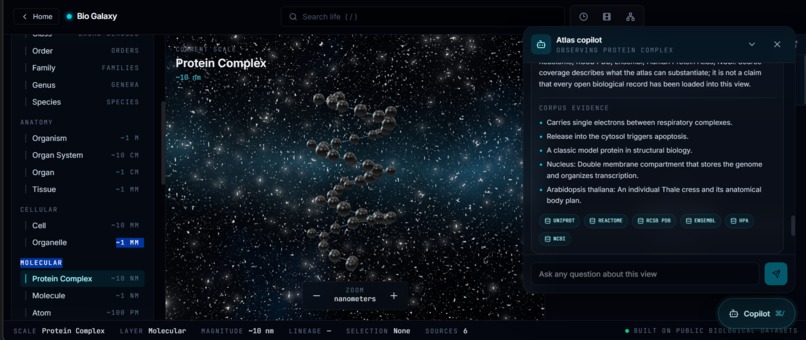
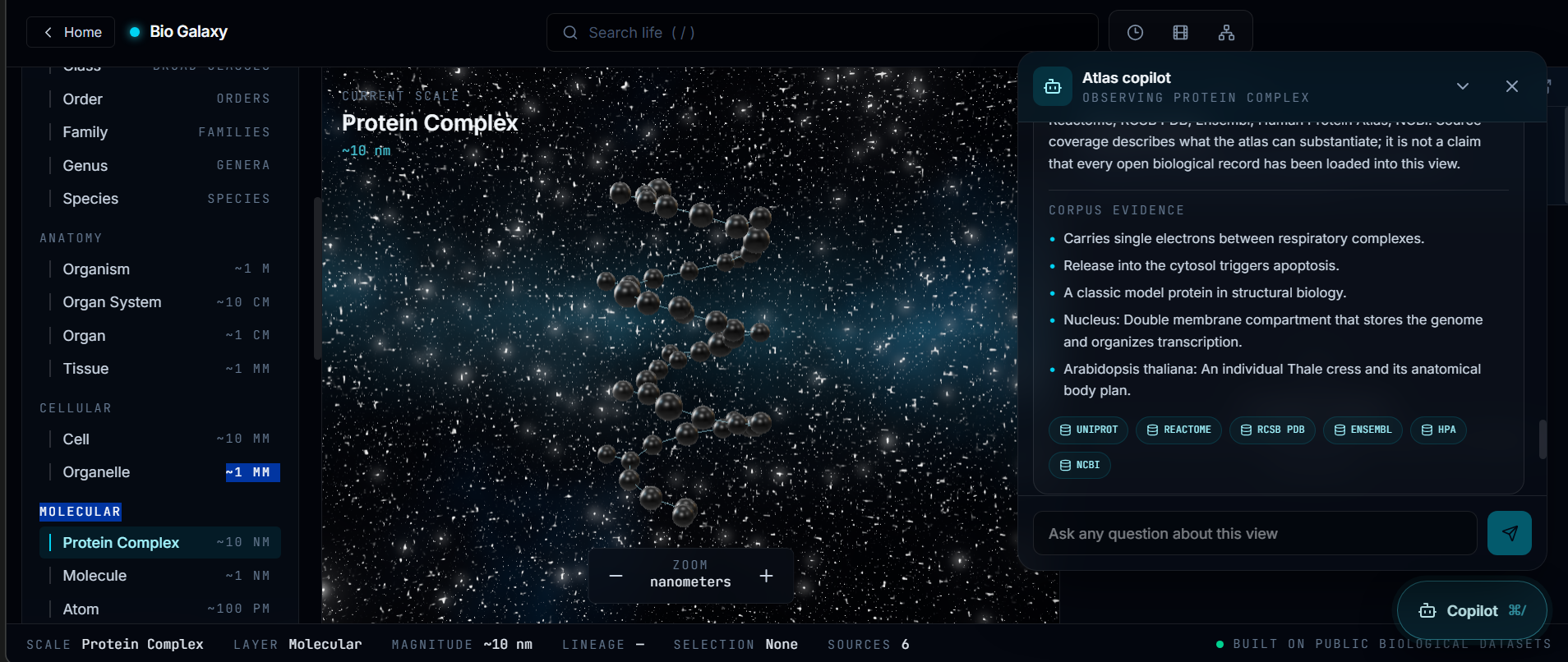
Protein Complex View
-
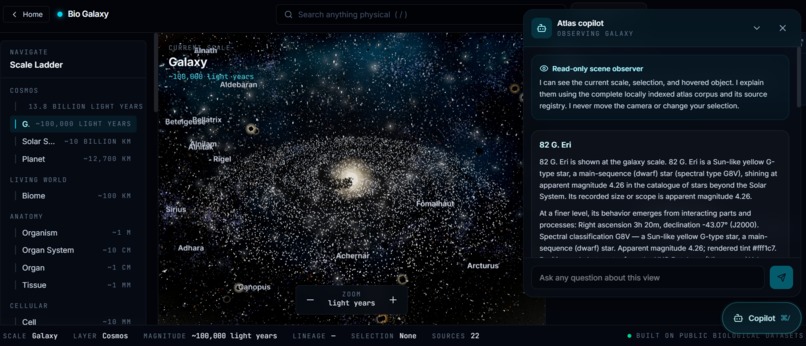
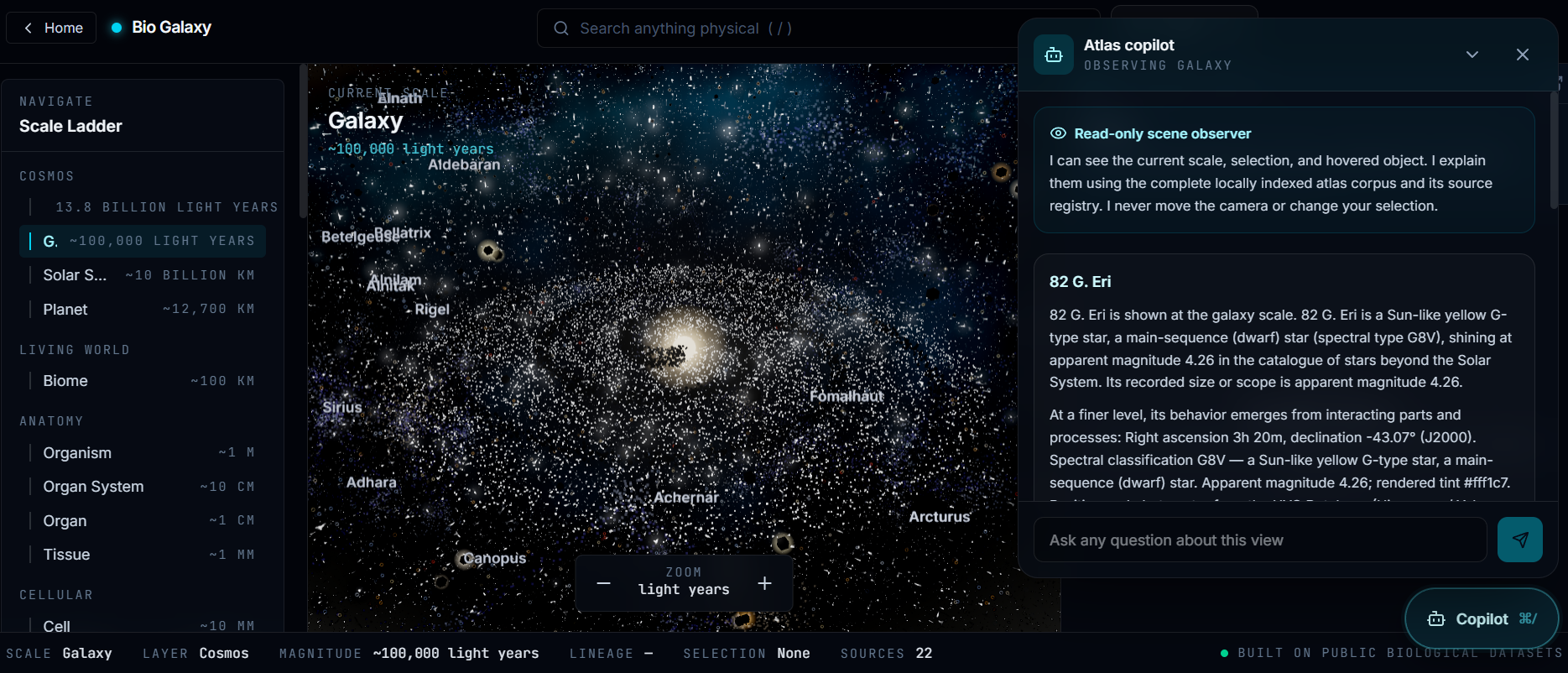
Cosmos View
-
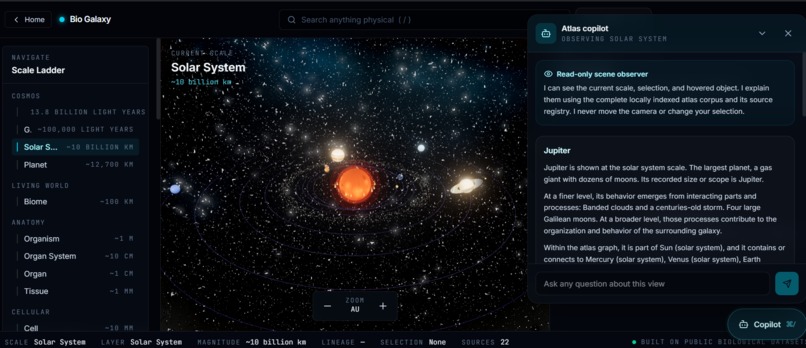
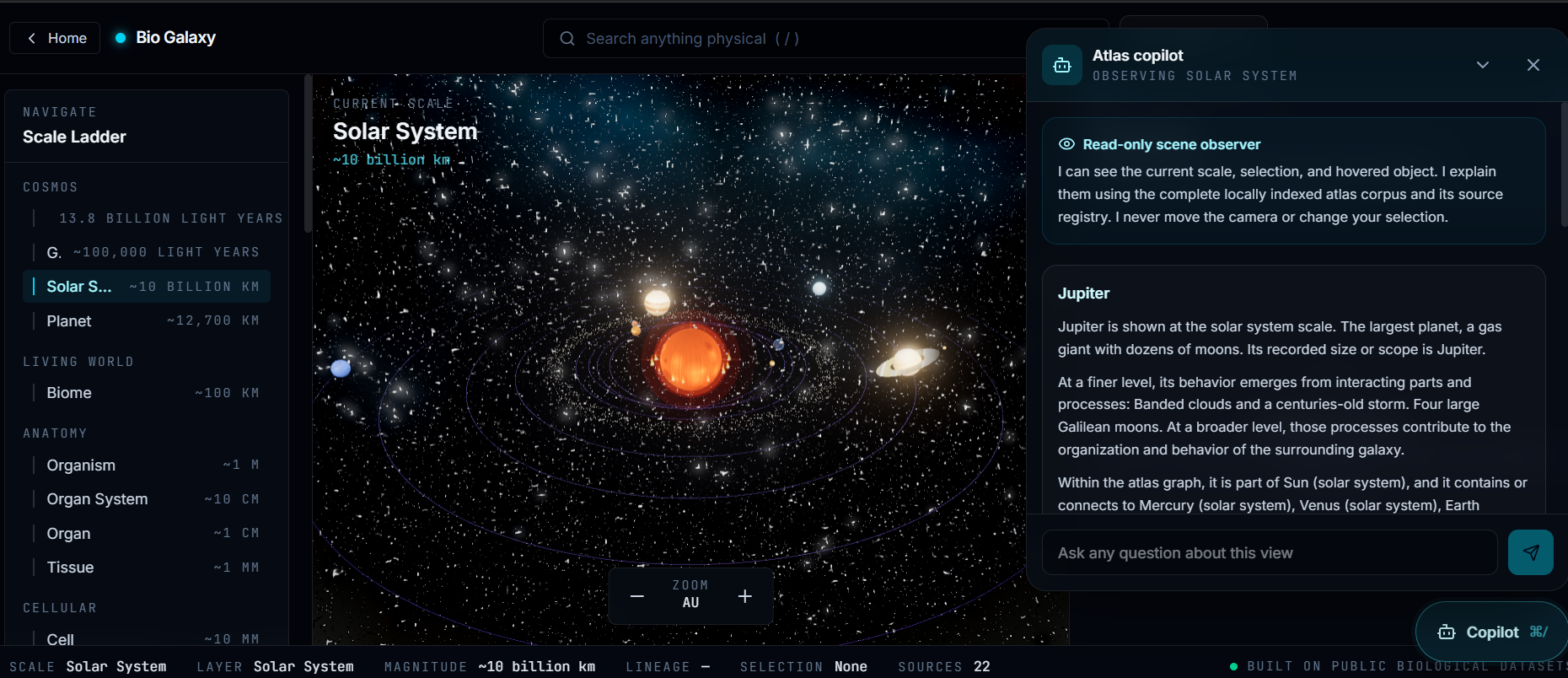
Solar System View
-
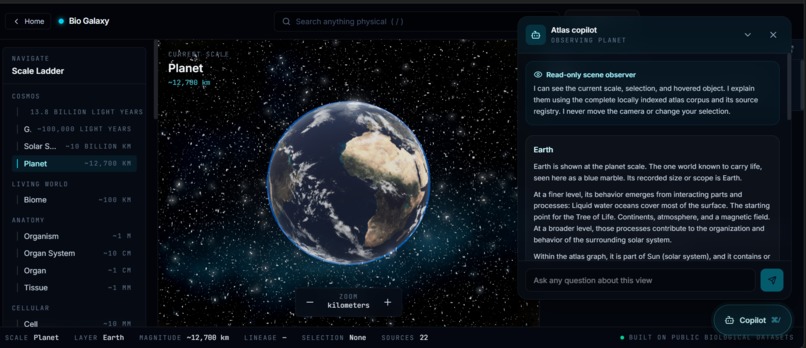
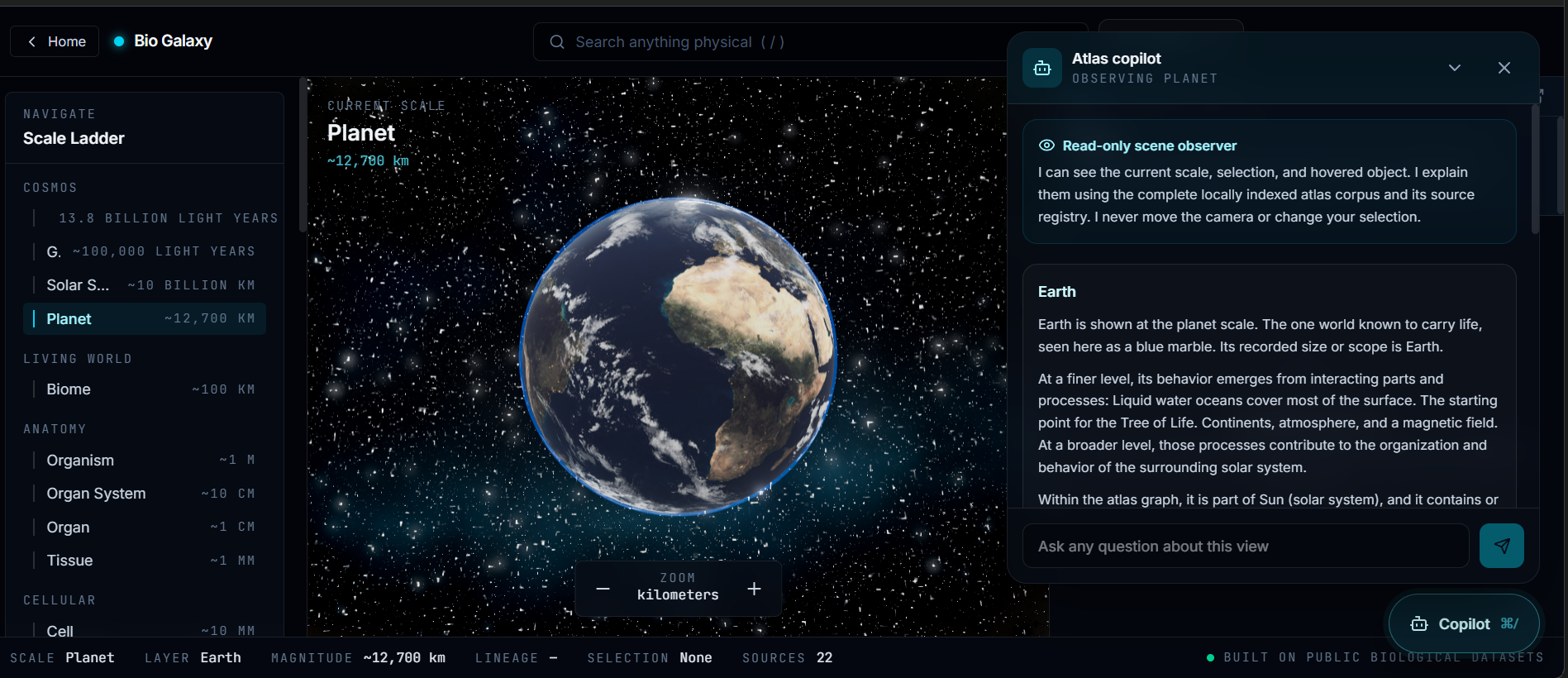
Earth View
-
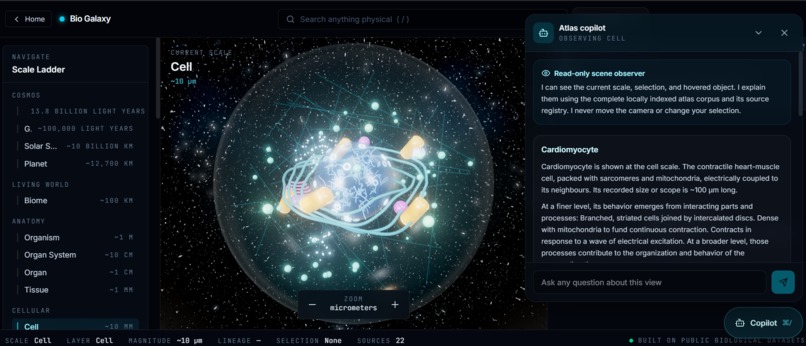
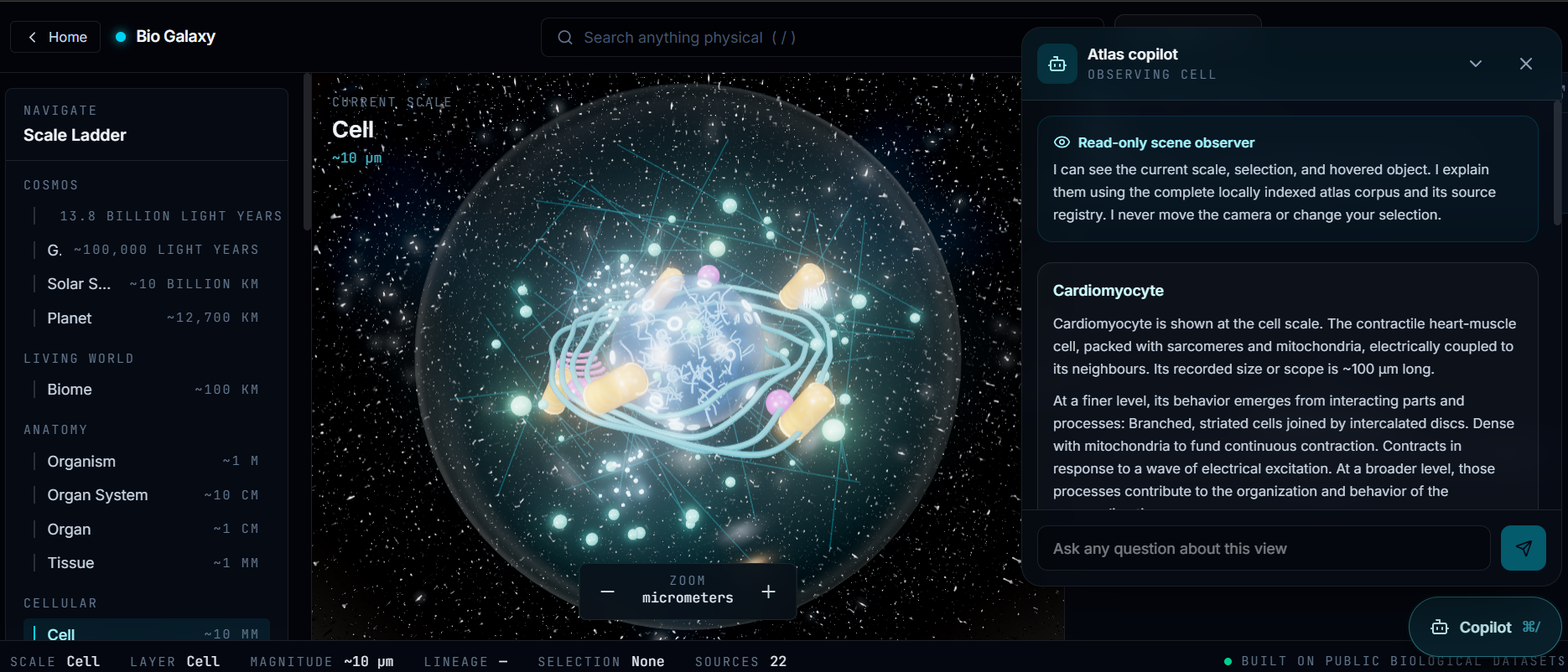
Cell View
-
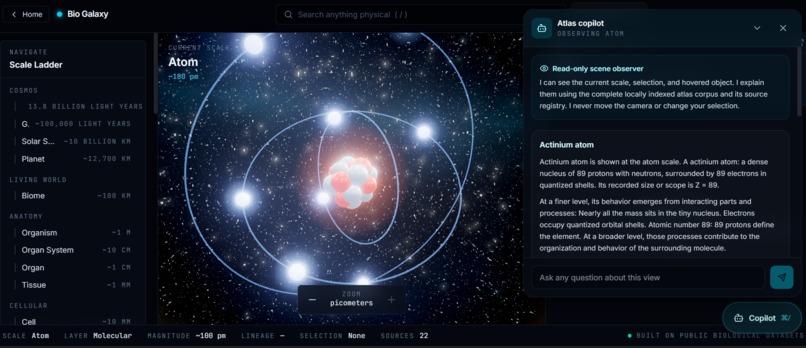
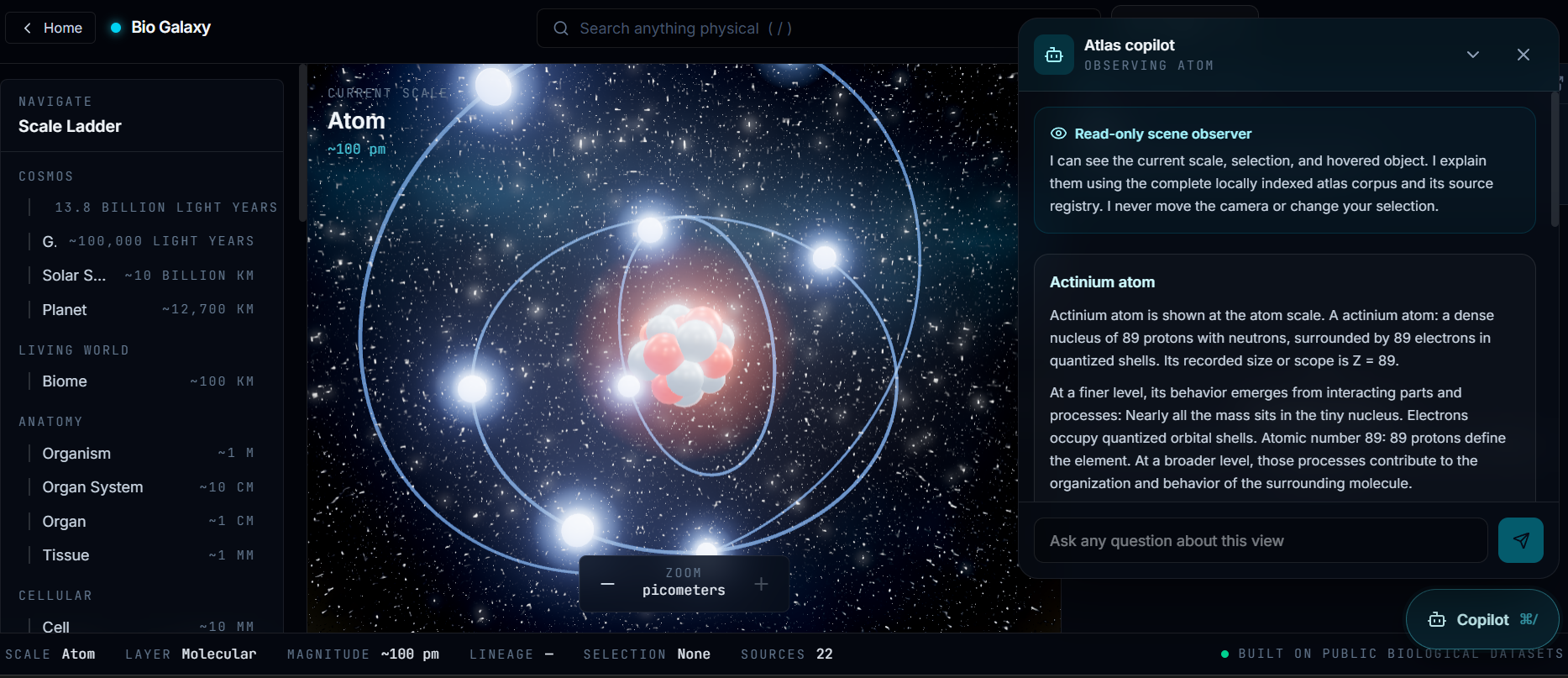
Atom View
-
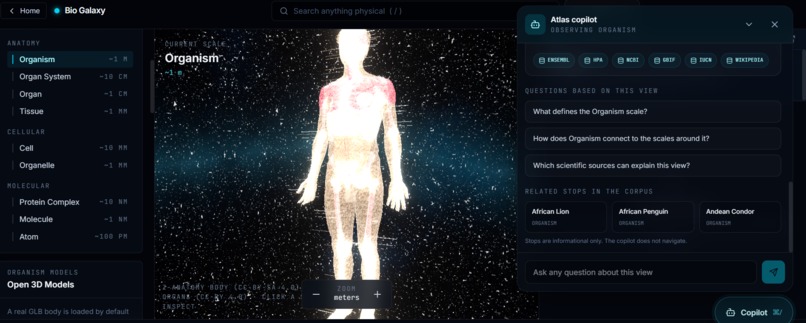
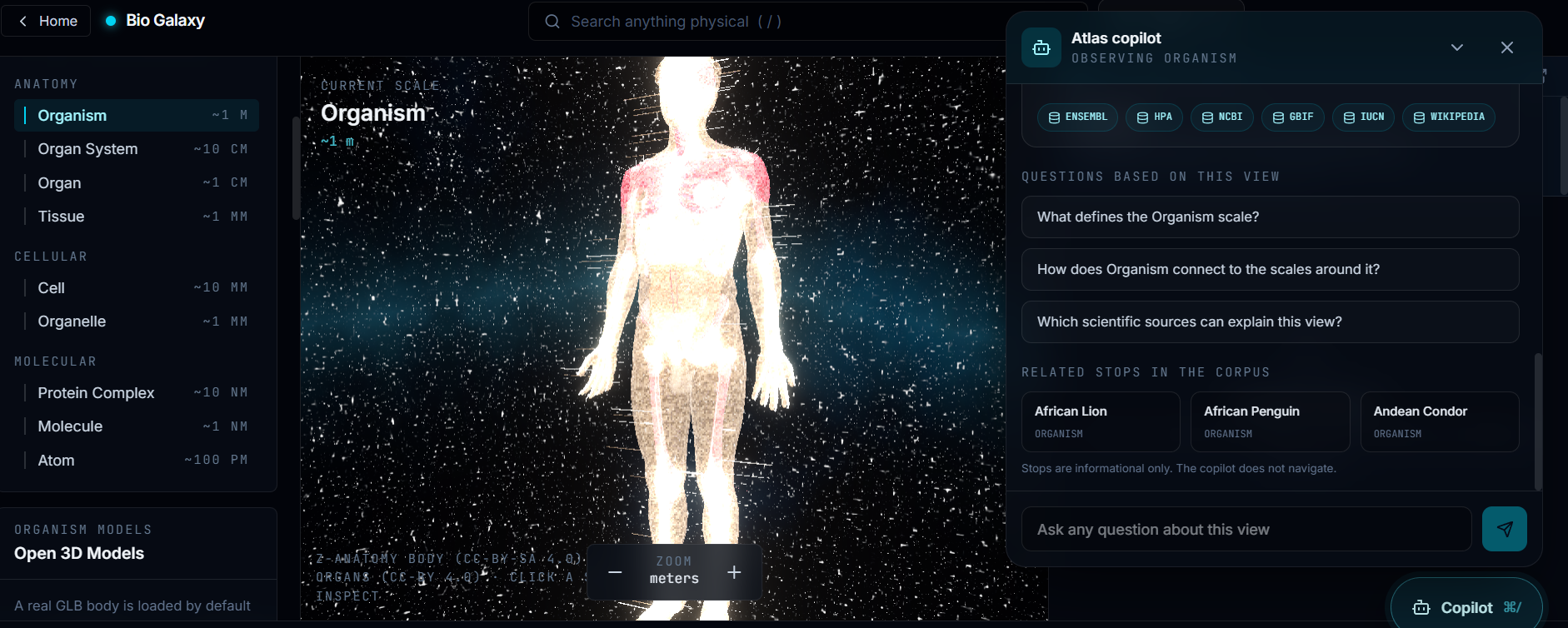
Organism View
Inspiration
Biology is full of incredible information, but it is scattered across dozens of databases, websites, textbooks, and visualizations. You can open one site to learn about a protein, another to explore anatomy, and another to look at taxonomy, but it is difficult to see how everything connects.
I wanted to build something that made biology feel like a place rather than a collection of pages.
Bio Galaxy started with a simple question: what if you could travel from the scale of galaxies all the way down to a single atom in one continuous experience?
What it does
Bio Galaxy is an interactive 3D atlas that lets users explore life across 22 connected scales.
The journey begins in deep space and moves through galaxies, the Solar System, Earth, the Tree of Life, organisms, anatomy, tissues, cells, organelles, proteins, molecules, and atoms.
Along the way, users can explore real biological information from public scientific databases, all inside a single visual interface.
Instead of jumping between disconnected websites, Bio Galaxy brings everything together into one navigable world.
How I built it
Bio Galaxy was built with React, TypeScript, and Three.js.
The platform combines real-time 3D rendering with data from scientific resources including UniProt, Reactome, Ensembl, NCBI, the Human Protein Atlas, and the Protein Data Bank.
I built a custom scale navigation system that allows users to move smoothly between vastly different levels of biological organization. The same interface can take you from a galaxy to a human body, from a cell to a protein, and eventually to an atom.
The project also uses 3D anatomy models, organism models, interactive selection systems, data caching, and custom rendering techniques to keep the experience responsive in the browser.
Challenges
The hardest challenge was making everything feel connected.
A galaxy, a human body, a cell, and a protein exist at completely different scales. Creating a navigation system that made movement between those worlds feel natural required a lot of experimentation.
Another challenge was integrating data from multiple scientific databases that all use different formats and structures. Making those sources work together in a way that felt seamless took far longer than expected.
Performance was also a constant challenge because the application renders complex 3D scenes while loading scientific data in real time.
What I learned
This project taught me how powerful spatial interfaces can be for learning.
People often understand complex ideas more easily when they can explore them visually instead of reading about them in isolation.
I also learned a huge amount about scientific data integration, 3D graphics, performance optimization, and designing interfaces for exploration rather than traditional navigation.
What's next
I want to continue expanding Bio Galaxy into a larger open science platform.
Future plans include richer ecosystem visualizations, evolutionary timelines, additional anatomy and organism models, more scientific data sources, and new educational tools.
The long-term goal is to create an atlas where anyone can explore the relationships between the universe, life, and the molecular systems that make life possible.

