-
-
BIN
Inspiration
Waste sorting in malls, schools, campuses, and other public spaces often depends on people making the right decision in just a few seconds.
A cup, wrapper, or food container may look recyclable, compostable, or like garbage depending on its material, contamination, and local disposal rules. When people guess incorrectly, contamination increases and facilities lose visibility into what is actually happening inside their waste system.
We wanted to remove that decision from the user.
That became Binlytic AI.
Our goal was to build a system that could:
Identify. Route. Verify. Learn. Act.
What it does
Binlytic is an AI-powered waste-management platform that combines computer vision, physical sorting, IoT verification, analytics, network learning, citizen reporting, and organization management.
When an item is placed in front of the camera, OpenCV processes the frame and CLIP compares the image against text descriptions of waste objects.
CLIP represents both images and text as numerical vectors and compares them using cosine similarity:
cosine similarity = dot product / (magnitude of image vector x magnitude of text vector)
However, Binlytic does not simply choose the highest-scoring result.
Even an unfamiliar object will still have a "best" match, so we added multiple rejection gates.
The strongest similarity score must pass a minimum threshold, the winning destination must be sufficiently separated from competing routes, contamination conflicts are checked, and the destination must remain consistent across multiple frames.
Our current minimum CLIP similarity threshold is approximately 0.22.
This is not 22% confidence. It is a similarity threshold selected through repeated testing.
If Binlytic cannot make a sufficiently reliable decision, the item enters the UNKNOWN stream instead of being forcefully classified.
Physical Sorting and Verification
Once a classification is accepted, the destination is sent to an ESP32 over the local network.
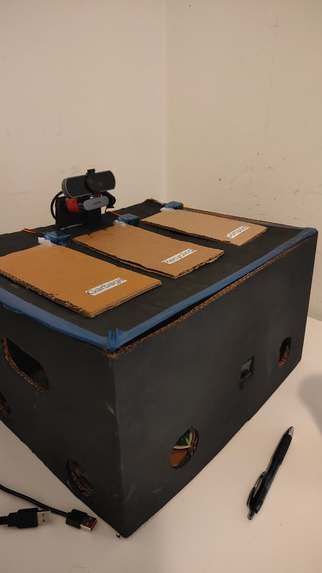
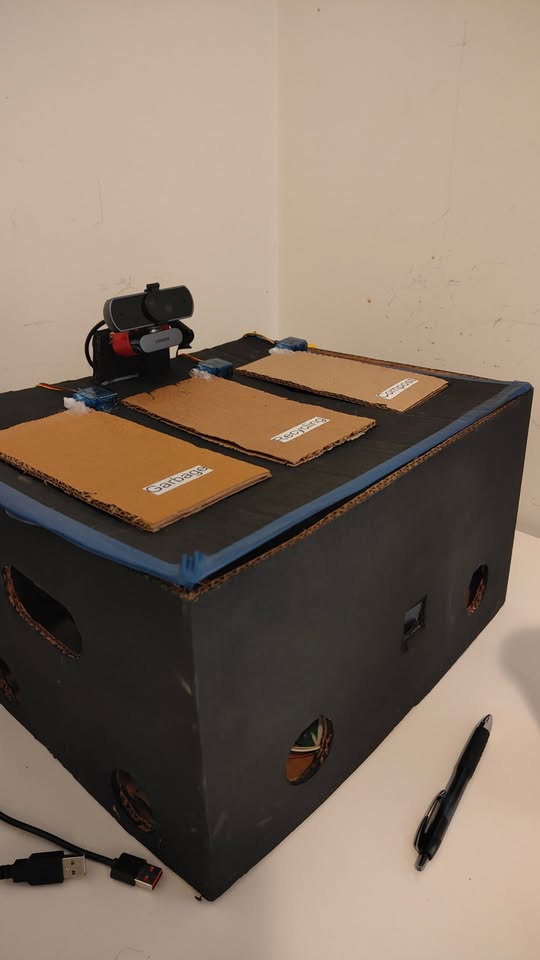
The ESP32 controls servo-driven flaps for:
- Garbage
- Recycling
- Compost
The appropriate flap opens automatically.
But opening a flap does not prove that the item was actually disposed of.
To solve this, each stream contains an ultrasonic sensor that detects whether an item actually passes through.
Only after the correct sensor confirms the disposal does Binlytic record the event.
AI Prediction + Physical Routing + Sensor Confirmation = Verified Disposal
This distinction between prediction and reality became one of the most important parts of our design.
Learning From Unknown Objects
Binlytic is also designed to improve over time.
When an unfamiliar object enters the UNKNOWN stream, the system can learn in two ways.
Automatic learning groups similar unknown examples and can promote reliable references once sufficient evidence has been collected.
For uncertain examples, a human can manually review the object and confirm its identity.
The verified CLIP reference can then be stored online and synchronized across connected Binlytic units.
This means:
One Binlytic learns -> the network benefits.
Recognition and routing are kept separate, so Binlytic can learn what an object is globally while still applying different waste rules for different facilities or municipalities.
Citizen Reporting
Binlytic hardware can monitor waste where our units are installed, but it cannot see every waste problem in a community.
That is why we built a citizen reporting platform.
Citizens can create accounts and report issues such as:
- Litter
- Overflowing bins
- Illegal dumping
- Damaged waste infrastructure
- Missed collection
- Contamination
Reports can contain an image, location, category, description, and timestamp.
Other citizens can also vote on existing reports, helping repeated observations increase the visibility of important issues.
Reports can also trigger communication to a configured responsible organization or municipal contact.
Organization Accounts
Binlytic also includes organization accounts for malls, schools, campuses, municipalities, property managers, and waste-management teams.
Organizations can manage their connected Binlytic units, monitor disposal activity, view alerts, analyze waste trends, manage multiple locations, and access citizen reports from one system.
This connects physical infrastructure with community observations.
Binlytic Unit Data + Citizen Reports + Network Learning = Waste Intelligence
Instead of only sorting waste, Binlytic helps organizations understand what is happening and respond to it.
How we built it
Our AI pipeline was built primarily in Python using:
- OpenCV
- CLIP
- PyTorch
- Hugging Face Transformers
- NumPy
- Pillow
OpenCV handles camera frames and image processing while CLIP performs semantic image recognition.
The physical system uses an ESP32 connected to servo motors, ultrasonic sensors, environmental sensors, an OLED display, and Wi-Fi communication.
The overall flow is:
Camera -> OpenCV -> CLIP -> Validation -> Local Waste Rules -> ESP32 -> Servo -> Ultrasonic Confirmation -> Dashboard -> Analytics
Alongside this runs the community system:
Citizen Report -> Community Activity -> Organization
And the learning system:
Unknown Object -> Automatic Learning or Human Review -> Verified Reference -> Online Shared Learning -> Connected Binlytic Units
The challenge was not simply using these technologies individually.
It was making them work together as one closed-loop system.
Challenges we ran into
One of our biggest challenges was handling AI uncertainty.
CLIP always produces a highest-scoring result, even when none of the options are particularly good.
Because Binlytic controls physical hardware, a wrong confident decision can be worse than rejecting the item entirely.
This led us to implement minimum similarity thresholds, destination margins, multi-frame verification, contamination checks, and an UNKNOWN state.
Hardware also introduced completely different problems.
Servo timing, sensor interference, camera positioning, Wi-Fi communication, physical blockages, and synchronization all had to work reliably together.
We also learned that software predictions should never automatically be treated as real-world events.
That realization led directly to our ultrasonic confirmation system.
Accomplishments that we're proud of
We are most proud that Binlytic became more than an AI classification demo.
It connects:
AI recognition -> physical action -> sensor verification -> data collection -> analytics -> organization response
We also developed a learning system where unknown objects can improve future recognition and verified knowledge can be shared across connected units.
Finally, adding citizen and organization accounts allowed Binlytic to grow from a smart sorting bin into a broader waste-intelligence platform.
What we learned
Binlytic taught us that building AI for the physical world is very different from running a model on a laptop.
A prediction can be mathematically correct while the overall system still fails because of hardware, communication, sensors, or unexpected user behavior.
We learned to think about the entire system rather than individual components.
Most importantly, we learned that a smart system should not only know how to make decisions.
It should also know when to say:
"I don't know."
What's next
Our next goal is to develop Binlytic into a more durable retrofit system that can be integrated into existing waste infrastructure.
Future improvements include:
- More real-world testing
- Improved physical construction
- Load-cell and additional sensor verification
- Larger-scale network learning
- Better organizational integrations
- Waste hotspot detection
- Expanded citizen reporting
- Dynamic collection planning
Our long-term goal is not simply to build smarter bins.
It is to build a waste-management network that can identify problems, verify what happens, learn from new information, and help organizations act on it.
Sort Smarter. Verify Everything. Learn Together.
Built With
Python OpenCV CLIP PyTorch Hugging Face Transformers ESP32 C++ HTML CSS JavaScript IoT Sensors Servo Motors Ultrasonic Sensors
Dream Hack Judges; it took us 5 hours to build this and we did all experiments he previous day. All assembly and features and app were added today...We hope we can create an impact. Thank You


Log in or sign up for Devpost to join the conversation.