-
-
-
-
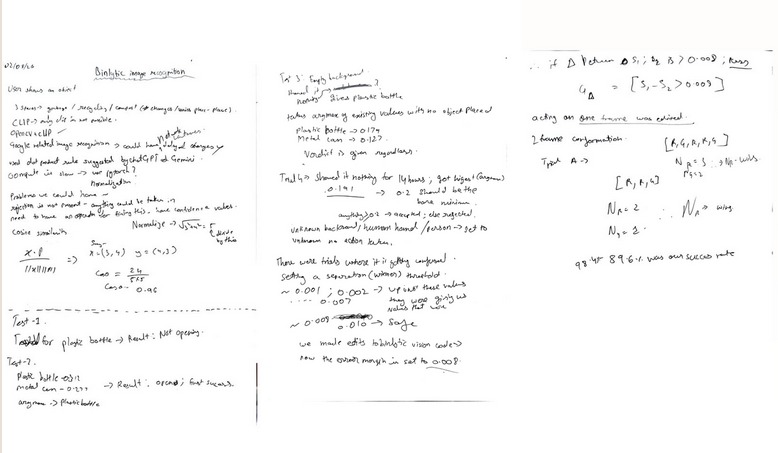
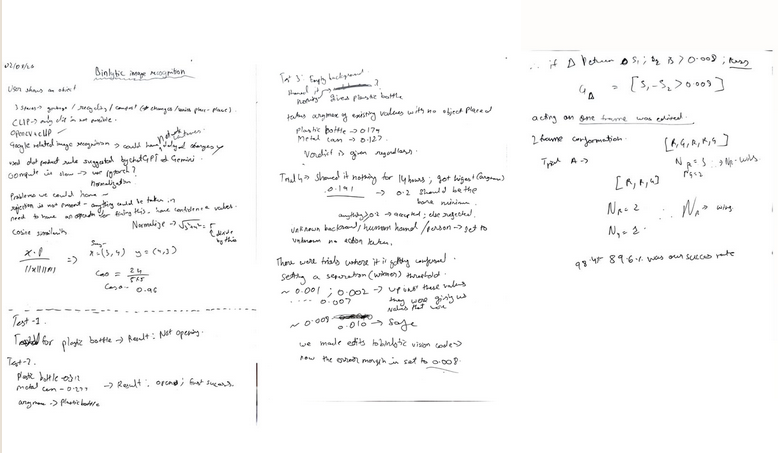
Math did for confidence thresholds
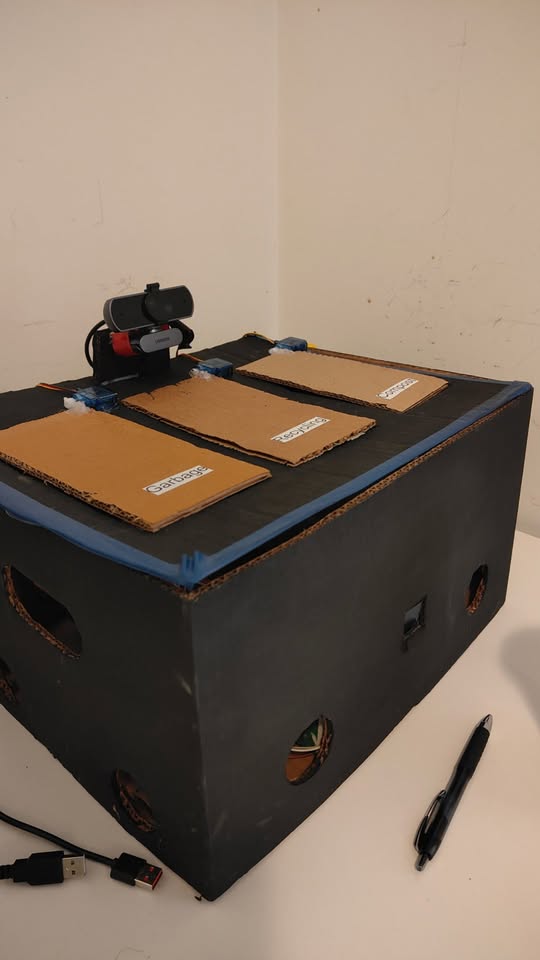
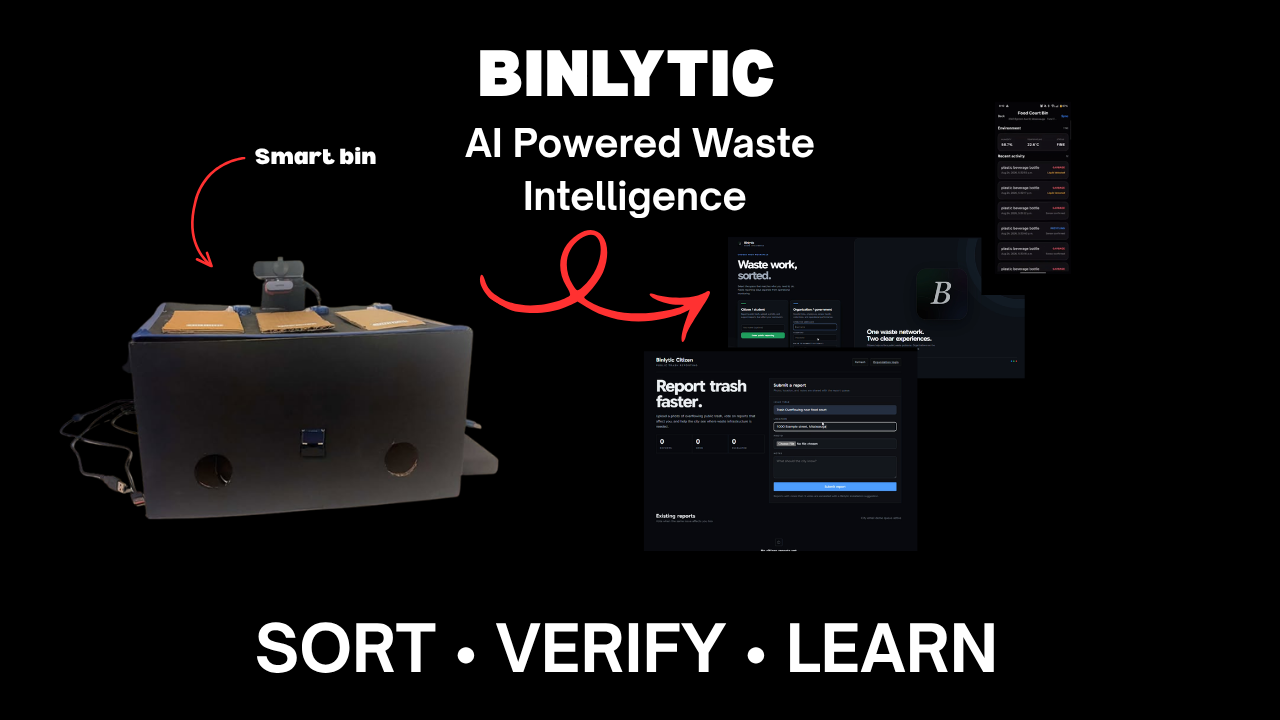
Binlytic AI
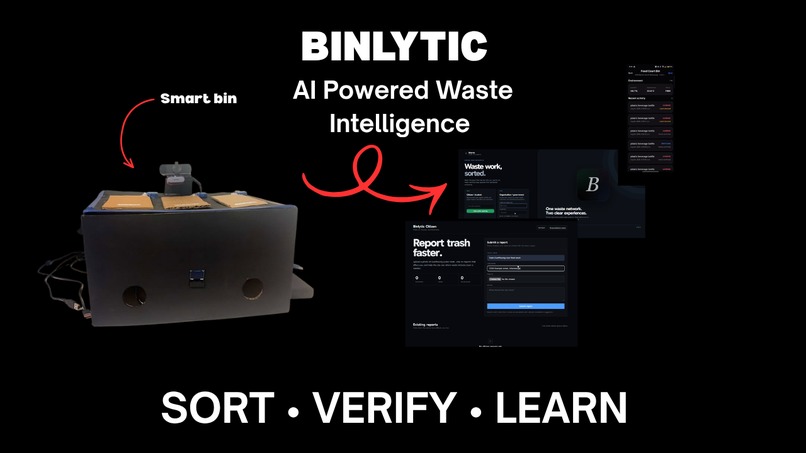
Binlytic is an AI-powered waste-management platform designed to reduce contamination, improve diversion, detect waste problems earlier, and turn everyday disposal into useful environmental data.
It identifies waste, validates where it belongs, physically routes it, verifies the disposal, learns from unknown objects, and connects facilities and citizens through one waste-intelligence network.
$$ \text{Identify} \rightarrow \text{Validate} \rightarrow \text{Route} \rightarrow \text{Verify} \rightarrow \text{Learn} $$
Inspiration
Waste does not become an environmental problem only when it reaches a landfill.
It starts much earlier.
A recyclable item placed in garbage may never be recovered. A food-contaminated container can reduce the quality of a recycling stream. An overflowing public bin can spread litter into streets, parks, storm drains, and surrounding habitats.
And in busy public spaces, people make disposal decisions thousands of times.
We wanted to intervene at that exact moment.
What if waste infrastructure could help make the correct disposal decision automatically?
Poorly managed waste can also expose workers and the public to broken glass, decomposing material, pests, mold, and other hazardous conditions. Better waste management can therefore contribute to both cleaner environments and safer working conditions.
But sorting was only one part of the problem.
Facilities also need to know when bins require service, where contamination is happening, and what types of waste they are actually receiving. Communities need ways to report litter, overflowing bins, illegal dumping, and damaged waste infrastructure outside the reach of smart bins.
That led to Binlytic:
a connected system designed to sort waste better, verify what actually happened, learn from new waste, and give people better environmental information.
Environmental Impact
Binlytic is designed to address waste at several points before it can create larger environmental consequences.
Better sorting at the source
By helping determine whether an object belongs in recycling, compost, or garbage at the moment of disposal, Binlytic can reduce incorrect sorting and contamination.
This matters because recyclable or compostable material that becomes heavily contaminated may ultimately lose its recovery value and be sent to landfill.
Instead of trying to recover mistakes later, Binlytic focuses on preventing those mistakes at the source.
Earlier detection of waste problems
Binlytic's citizen platform allows people to report:
- litter
- overflowing bins
- illegal dumping
- damaged waste infrastructure
- missed collection
- contamination
Reports can contain a photo and location and can be routed to a configured organization or municipal contact.
This creates a way for environmental problems outside Binlytic installations to become visible earlier, before waste spreads further into public or natural spaces.
Smarter collection
Every verified disposal becomes operational data.
Facilities can use that information to estimate stream capacity, understand disposal rates, identify contamination, and forecast when service may be required.
The long-term goal is to move away from unnecessary routine inspection toward collection based on actual waste conditions.
That creates a path toward fewer unnecessary servicing trips, more efficient collection, and better use of facility resources.
Retrofit instead of replace
Binlytic is being developed around inexpensive components and the ability to retrofit existing waste infrastructure.
Instead of requiring facilities to discard existing bins and replace them with entirely new systems, the goal is to make current infrastructure smarter.
That reduces another potential source of material consumption and electronic waste.
The environmental goal is not simply to build a smarter trash can. It is to keep recoverable materials in the correct waste streams, detect environmental problems earlier, and give communities better information to keep waste out of landfills and natural habitats.
What it does
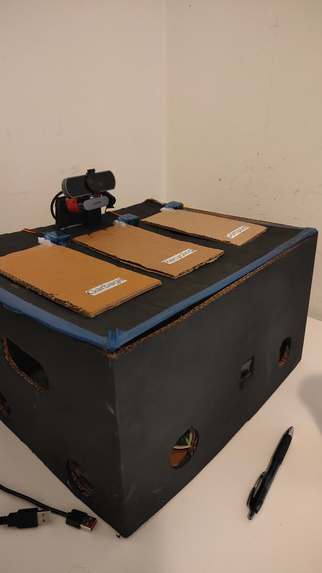
A camera observes an item placed in front of Binlytic.
OpenCV processes the frame and CLIP compares the object against waste descriptions in a shared embedding space.
For an image vector V and text vector T:
$$ s(I,T)=\frac{v_I \cdot v_T} {\lVert v_I\rVert \lVert v_T\rVert} $$
But Binlytic does not simply take the highest-scoring result.
Before anything moves, the prediction passes through:
- minimum similarity rejection
- destination-margin checks
- contamination conflict checks
- framing checks
- confirmation across consecutive frames
Our current minimum similarity boundary is approximately (0.20).
This is a cosine-similarity threshold, not 20% confidence.
If Binlytic isn't sufficiently certain, it returns UNKNOWN instead of blindly forcing a classification.
We currently maintain a garbage fallback so a user is not left holding an item indefinitely. After a 7-second timeout without a successful classification, the item can fall back to garbage.
Once a classification is accepted, local disposal rules determine whether the object belongs in recycling, compost, garbage, or another supported stream.
This distinction is important environmentally because waste regulations differ between municipalities and facilities.
Binlytic separates:
What is this object?
from
How should this location dispose of it?
The destination is then sent to an ESP32, which controls the physical routing servos.
Prediction does not equal confirmation
A major design principle in Binlytic is:
The AI saying an item belongs somewhere does not prove that it actually went there.
After routing, an ultrasonic sensor waits for the item to physically enter the selected compartment.
Only then is the disposal recorded.
$$ \text{Camera} \rightarrow \text{AI} \rightarrow \text{Decision} \rightarrow \text{Servo} \rightarrow \text{Sensor} \rightarrow \text{Confirmed Event} $$
That gives Binlytic environmental data based on events the system actually observed rather than simply recording AI predictions.
In our documented prototype testing, Binlytic achieved approximately 92% end-to-end success, where success required both correct routing and completion of the physical disposal flow.
More than a smart bin
Every confirmed disposal becomes part of the Binlytic operations platform.
Organizations such as malls, campuses, schools, municipalities, and commercial facilities can monitor:
- connected Binlytic units
- confirmed disposal activity
- estimated stream capacity
- collection forecasts
- contamination events
- operational alerts
- system health
- multiple locations
- employees
- waste trends
This turns individual disposal events into larger environmental patterns.
A facility could begin answering questions such as:
Which locations generate the most waste?
Which streams are filling fastest?
Where is contamination occurring?
What materials appear most often?
Which bins actually require service?
Instead of managing waste only after something goes wrong, Binlytic is designed to help facilities move toward:
observe → predict → prioritize → act
Citizen reporting
Binlytic hardware can see what happens around its own installations.
Citizens can see everything else.
The citizen side of Binlytic allows people to report environmental waste problems such as litter, overflowing bins, illegal dumping, damaged infrastructure, missed collection, and contamination.
Reports can include a photo and location and can be routed to a configured organization or municipal contact.
Other citizens can also vote on reports, helping repeated observations gain greater visibility.
$$ \text{Smart Bin Data}+\text{Citizen Reports} \rightarrow \text{Waste Intelligence} $$
This allows Binlytic to combine two different sources of environmental information:
machines observing waste infrastructure
and
people observing their communities
The result is a broader view than either source could provide alone.
Binlytic learns
Waste changes constantly.
New packaging, unusual objects, local products, and materials that were not anticipated during development will eventually appear.
Binlytic therefore treats unknown objects as learning opportunities rather than dead ends.
The system supports both manual learning and automatic evidence-based learning.
A human can review an unknown object, label it, and approve its CLIP embedding as a learned reference.
Repeated unknown objects can also form clusters. Once sufficient evidence is collected, including observations across separate installations, they can enter the shared learning process.
Approved learned references are stored online and synchronized across connected Binlytic units.
$$ \text{One Binlytic Learns} \rightarrow \text{Network Synchronizes} \rightarrow \text{Other Units Benefit} $$
Recognition knowledge can therefore improve across the network while local recycling and disposal rules remain specific to each facility or municipality.
The long-term idea is that environmental infrastructure should not remain static.
As the waste stream changes, Binlytic should be able to learn with it.
How we built it
Binlytic combines computer vision, AI, embedded hardware, IoT, web software, and mobile software.
The main disposal pipeline is:
$$ \text{Webcam} \rightarrow \text{OpenCV} \rightarrow \text{CLIP} \rightarrow \text{Validation} \rightarrow \text{Local Rules} \rightarrow \text{ESP32} \rightarrow \text{Servo} \rightarrow \text{Ultrasonic Verification} \rightarrow \text{Dashboard} $$
The computer-vision pipeline is written primarily in Python using PyTorch, Hugging Face Transformers, OpenCV, NumPy, and CLIP ViT-B/32.
An ESP32 handles the physical layer, including routing servos, ultrasonic sensors, camera positioning, environmental sensing, OLED output, device health, and network communication.
The operational system is designed so each Binlytic installation can run its main dashboard and device operations locally.
That keeps core sorting, hardware control, monitoring, and facility operations close to the installation itself.
Learning is handled differently.
Verified learned references collected by local Binlytic installations can be synchronized through an online shared-learning network, allowing discoveries from one location to improve recognition elsewhere.
This gives Binlytic a hybrid architecture:
Local operation → independent and site-specific
Shared learning → online and network-wide
The web platform also provides organization and citizen experiences, while the employee mobile interface gives staff an operational workflow for responding to waste problems.
The difficult part wasn't simply making every technology work.
It was making all of them behave as one environmental system.
Challenges we ran into
Knowing when AI should not act
CLIP will almost always produce a closest result, even when the image is unfamiliar.
For environmental sorting, blindly forcing that answer can contaminate an otherwise recoverable waste stream.
We built rejection thresholds, destination margins, stability checks, and conflict logic so Binlytic could recognize uncertainty instead of automatically trusting an argmax.
Prediction wasn't proof
Originally, it would have been easy to record the AI classification immediately.
But that would create environmental data describing what the model thought should happen, not what actually happened.
We redesigned the system around ultrasonic confirmation.
Now an AI prediction and a completed disposal are two separate states.
Connecting AI to the physical world
A classification being correct on a laptop is meaningless if the wrong flap moves, the object never falls, or the sensor fails to detect it.
Synchronizing inference, networking, servo movement, sensor timing, and dashboard state required significant testing.
Real-world environments
Public spaces are messy.
Hands, backgrounds, changing lighting, reflections, unusual orientations, and partially visible waste all affect recognition.
We added framing and background-processing logic to make classification more robust under real usage conditions.
Accomplishments that we're proud of
We're most proud that Binlytic became a functioning environmental hardware/software ecosystem rather than an image-classification demo.
We built the complete path:
camera → AI → validation → routing → physical movement → sensor verification → environmental data
Alongside that core system, we built:
- physical three-stream routing
- local CLIP inference
- uncertainty rejection and multi-frame verification
- contamination handling
- ultrasonic disposal confirmation
- organization operations dashboard
- employee mobile workflow
- citizen reporting and community voting
- collection and capacity intelligence
- unknown-object learning
- shared learning between connected installations
Our prototype also achieved approximately 92% end-to-end success in documented testing.
Most importantly, we built Binlytic around a problem that exists outside the screen.
Every AI prediction eventually has to become a physical action in the real waste stream.
What we learned
The biggest lesson was:
$$ \text{AI Prediction} \neq \text{Engineering Certainty} $$
A model producing an answer doesn't mean a physical system should immediately act on it.
We learned to design uncertainty, verification, hardware failures, network problems, and unknown objects into the system itself.
We also learned that environmental technology needs trustworthy data.
The most useful information isn't necessarily what an AI believes happened.
It's what the system can verify actually happened.
And perhaps most importantly:
A smart environmental system shouldn't just make decisions. It should know when to question them.
What's next for Binlytic AI
Next we want to expand real-world testing across more environments, waste types, lighting conditions, and users.
We're also exploring:
- load cells for direct weight measurement
- improved physical capacity sensing
- expanded shared learning
- larger multi-location deployments
- more advanced environmental analytics
- deeper municipal reporting integrations
- improved contamination monitoring
- Binlytic Mobile, a future mobile waste station for temporary high-demand areas
Long term, the value of Binlytic is not one intelligent bin.
It is a network of waste infrastructure capable of sorting better, detecting problems earlier, learning from new materials, and giving people better data about what is happening to their waste.
The goal is to stop treating waste as something we only think about after it has already become an environmental problem.
Built With
- android-studio
- esp-32
- jetpack-compose
- kotlin
- opencv
- python


Log in or sign up for Devpost to join the conversation.