🪙 BINKS: Waste to Token Rewards System
Project Story & Hackathon Journey
💡 Inspiration
The Problem We Saw
Global waste generation is a critical environmental crisis. According to recent data, the world generates approximately 2.12 billion tons of waste annually, with only 35% being recycled. The majority of recyclable materials never make it to processing facilities because individuals lack incentives to properly segregate and dispose of waste.
Traditional recycling programs struggle with participation rates because:
- No immediate tangible rewards
- Lack of transparency in the recycling process
- Difficult to track individual environmental impact
- Centralized systems create trust issues
The "Aha" Moment
We realized that blockchain technology could solve this by creating:
- Immediate, verifiable rewards - Users receive tokens instantly on-chain
- Transparent tracking - Every disposal is immutably recorded
- Financial incentive - Tokens have real value and can be traded/exchanged
- Decentralized verification - No single authority needed to validate claims
We envisioned BINKS — a decentralized application that gamifies waste disposal and incentivizes environmental responsibility through cryptocurrency rewards. The name itself is playful: Blockchain Incentivized Nature-saving Kept Sustainable.
Why This Matters Now
With climate change, circular economy initiatives, and the rising adoption of blockchain technology, the timing is perfect for a solution that bridges environmental action with crypto incentives. We wanted to create something that could:
- Scale globally (blockchain is borderless)
- Work in developing nations (minimal infrastructure needed)
- Create economic opportunities (users earn real value)
- Build sustainable habits (gamification + rewards)
🎯 What It Does
Core Functionality
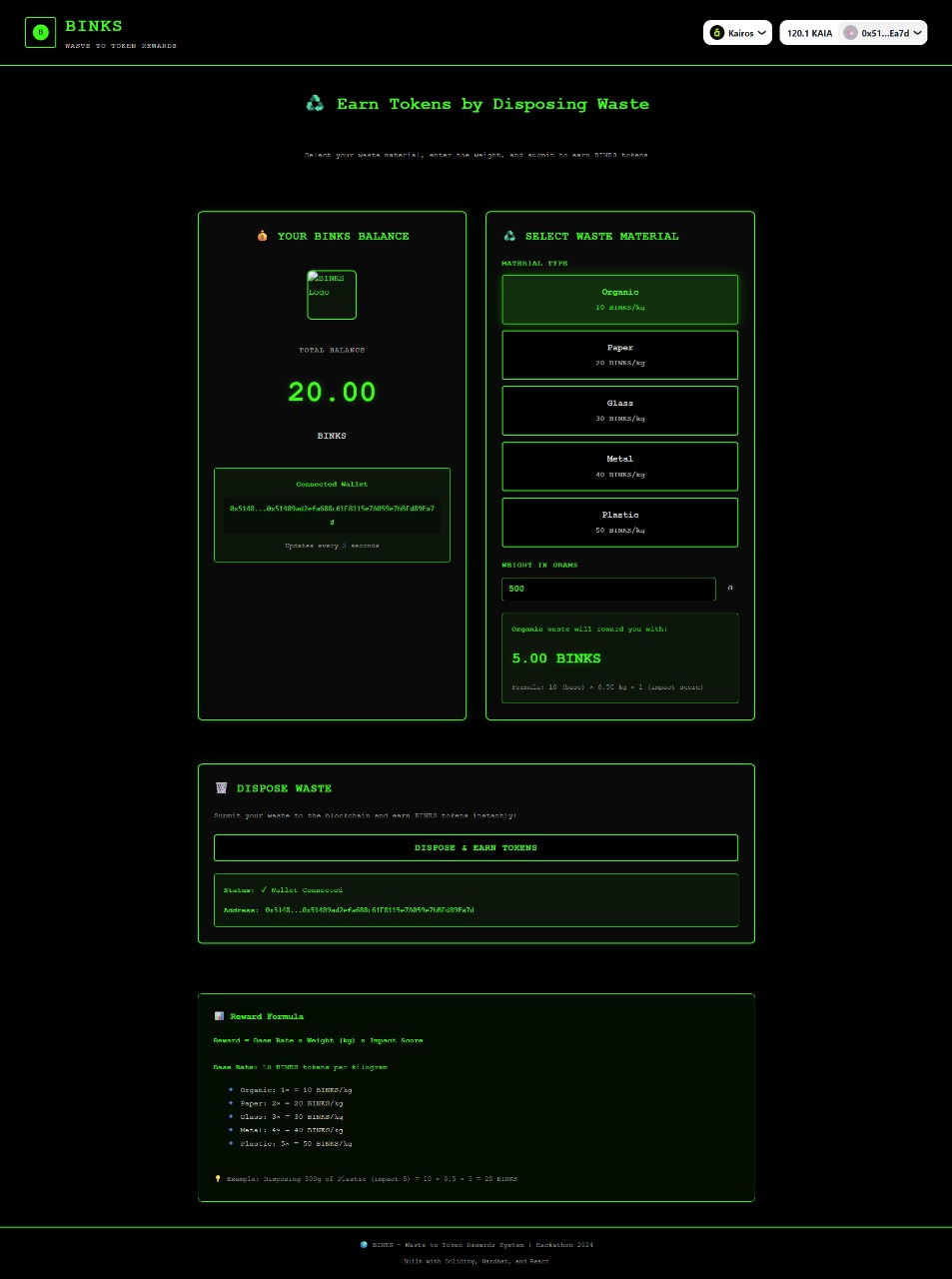
BINKS is a complete Web3 waste-to-token rewards system that instantly rewards users for disposing waste materials responsibly.
User Journey
┌─────────────────────────────────────────────────────┐
│ 1. User connects crypto wallet (MetaMask/Kaia)      │
├─────────────────────────────────────────────────────┤
│ 2. Selects waste material type (5 categories)       │
├─────────────────────────────────────────────────────┤
│ 3. Enters weight in grams                           │
├─────────────────────────────────────────────────────┤
│ 4. Sees real-time reward estimate                   │
├─────────────────────────────────────────────────────┤
│ 5. Submits disposal transaction                     │
├─────────────────────────────────────────────────────┤
│ 6. Receives BINKS tokens instantly on-chain         │
└─────────────────────────────────────────────────────┘
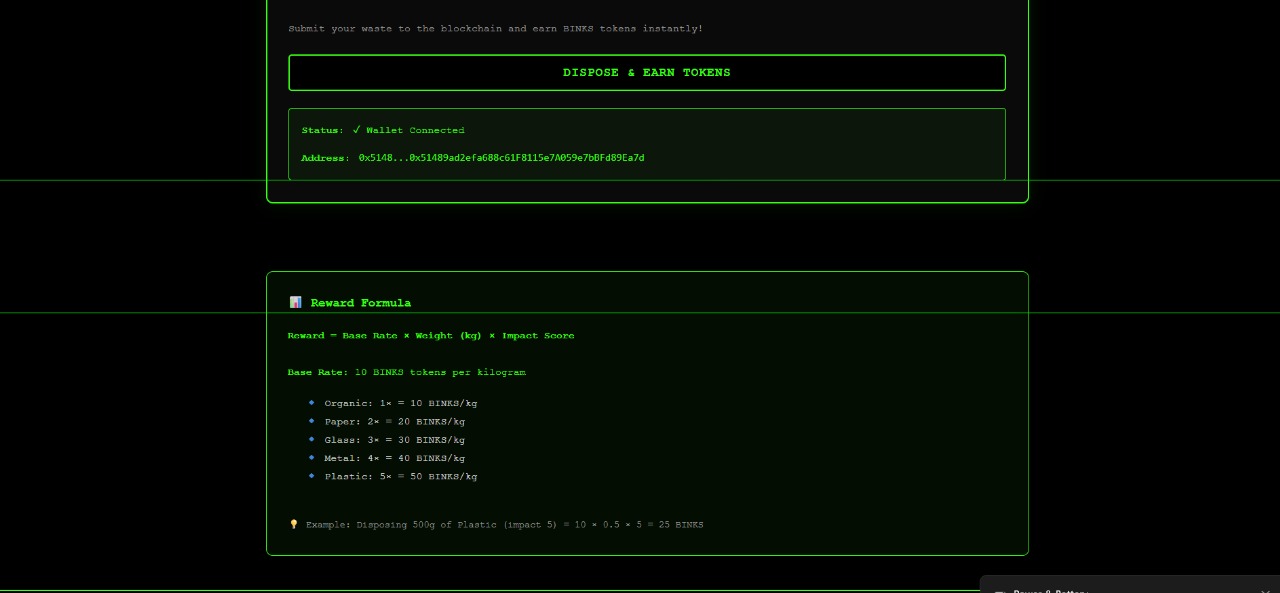
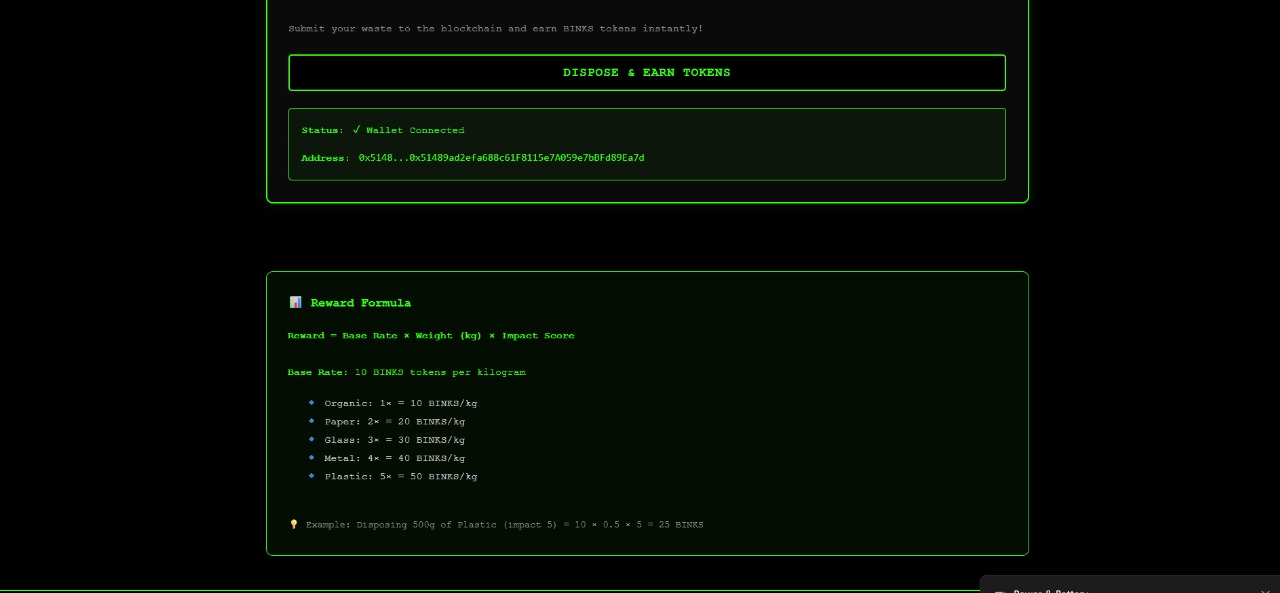
Reward Formula
The system uses an elegant mathematical model:
$$\text{Reward} = \text{BaseRate} \times \text{Weight}_{kg} \times \text{ImpactScore}$$
Where:
- BaseRate = 10 BINKS tokens per kilogram
- Weight is converted from grams to kilograms: $\text{Weight}{kg} = \frac{\text{Weight}{grams}}{1000}$
- ImpactScore is material-specific (1-5 multiplier)
Impact Score System
Different materials have different environmental value:
$$\text{ImpactScore} = \begin{cases} 1 & \text{if Organic waste} \ 2 & \text{if Paper} \ 3 & \text{if Glass} \ 4 & \text{if Metal} \ 5 & \text{if Plastic} \end{cases}$$
Example Calculation
For 500g of Plastic:
$$\text{Reward} = 10 \times \frac{500}{1000} \times 5 = 10 \times 0.5 \times 5 = 25 \text{ BINKS}$$
Material Reward Table
| Material | Impact Score | Tokens per KG | Motivation |
|---|---|---|---|
| Organic | 1 | 10 BINKS | Biodegradable, lower priority |
| Paper | 2 | 20 BINKS | Recyclable, moderate impact |
| Glass | 3 | 30 BINKS | Infinite recyclability |
| Metal | 4 | 40 BINKS | Rare materials, high value |
| Plastic | 5 | 50 BINKS | Most harmful, highest incentive |
Key Features
✅ ERC-20 Token Standard - BINKS is a fully compliant ERC-20 token ✅ On-Chain Logo - SVG logo embedded directly in contract ✅ Multi-Chain Support - Works on Hardhat (local), Base Sepolia, and Kaia Kairos ✅ Real-Time Rewards - Instant token minting upon disposal ✅ Event Tracking - All disposals logged immutably ✅ Frontend Dashboard - Beautiful React UI with wallet integration ✅ Responsive Design - Works on desktop and mobile
🛠️ How We Built It
Technology Stack
Smart Contracts
- Language: Solidity 0.8.27
- Framework: Hardhat (development & testing)
- Libraries: OpenZeppelin Contracts (ERC-20, Ownable)
- Standard: ERC-20 Token (Ethereum Token Standard)
Blockchain Networks
- Local: Hardhat Node (localhost:8545)
- Testnet 1: Base Sepolia (Layer 2 on Ethereum)
- Testnet 2: Kaia Kairos (Korean blockchain platform)
Frontend
- Framework: React 18 (with Vite)
- Web3 Integration: wagmi v2 + viem
- Wallet UI: RainbowKit
- Build Tool: Vite
- Styling: CSS3 with custom design system
Development Tools
- Version Control: Git
- Package Manager: npm
- Testing: Chai + Mocha (via Hardhat)
- Environment: Node.js v16+
Project Architecture
BINKS/
├── Smart Contracts Layer
│   ├── BINKSToken.sol (ERC-20)
│   └── RewardContract.sol (Logic)
│
├── Blockchain Layer
│   ├── Hardhat (Local)
│   ├── Base Sepolia (ETH L2)
│   └── Kaia Kairos (Alternative L1)
│
├── Backend/Deployment
│   ├── Hardhat Config
│   ├── Deploy Scripts (3 networks)
│   └── Test Suite (16 tests)
│
└── Frontend Layer
    ├── React Components
    ├── Web3 Configuration
    ├── Wallet Connection
    └── Real-time UI Updates
Smart Contract Design
BINKSToken.sol
contract BINKSToken is ERC20, Ownable {
    address public rewardContract;

    function mint(address to, uint256 amount) external {
        require(msg.sender == rewardContract, "Only RewardContract can mint");
        _mint(to, amount);
    }
}
Key Design Decisions:
- Restricted Minting - Only RewardContract can create new tokens (prevents inflation)
- No Initial Supply - Tokens are minted on-demand (supply = rewards given)
- Ownable Pattern - Owner can authorize the minter (flexibility for updates)
- On-Chain Logo - SVG embedded in contract (no external dependencies)
RewardContract.sol
contract RewardContract {
    mapping(Material => uint256) public impactScores;
    uint256 public constant BASE_RATE = 10;

    function rewardUser(address user, Material material, uint256 weightInGrams) external {
        uint256 impact = impactScores[material];
        uint256 rewardAmount = (BASE_RATE * weightInGrams * impact * 10**15);
        binksToken.mint(user, rewardAmount);
    }
}
Key Design Decisions:
- Material Enum - Type-safe waste categorization
- Impact Scoring - Flexible multiplier system
- Mathematical Precision - Uses 10^15 scaling for fractional rewards
- Event Logging - Emits WasteDisposed event for indexing
Frontend Components
React App
├── WalletConnect (RainbowKit)
│   └── Integrates wallet connection
├── MaterialSelector
│   ├── Dropdown for 5 waste types
│   ├── Weight input (in grams)
│   └── Real-time reward preview
├── DisposeButton
│   ├── Transaction submission
│   ├── Loading states
│   └── Confirmation display
└── BalanceCard
    ├── Current BINKS balance
    ├── Wallet address display
    └── Auto-refresh every 3 seconds
Deployment Process
1. Local Development (Hardhat)
npm run node              # Start Hardhat node
npm run deploy            # Deploy contracts locally
npm test                  # Run 16-test suite
npm run frontend          # Start React dev server
2. Testnet Deployment (Kaia Kairos)
npm run deploy:kaia       # Deploy to Kaia Kairos
# Result: Contracts live on blockchain
3. Frontend Configuration
Update frontend/.env with deployed contract addresses:
VITE_BINKS_TOKEN_ADDRESS=0xc1621...
VITE_REWARD_CONTRACT_ADDRESS=0x6Fc2...
VITE_NETWORK=kaiaKairos
VITE_CHAIN_ID=1001
🚧 Challenges We Ran Into
Challenge 1: Complex Wallet Integration
The Problem:
RainbowKit requires complex transport configuration for multi-chain support. Initial implementation attempted to return plain objects instead of using viem's http() helper.
Error Encountered:
TypeError: _b.call is not a function
    at extractRpcUrls (chunk-4HTHOIW4.js:3371:111)
Solution:
Updated wagmi.js configuration:
// Before (broken)
transports: {
  [hardhat.id]: { http: { url: rpcUrl } }
}

// After (working)
import { http } from "viem";
transports: {
  [hardhat.id]: http(rpcUrl)
}
Learning: Viem requires proper Transport objects; plain URL objects won't work.
Challenge 2: Cross-Chain Contract Deployment
The Problem: Different blockchains have:
- Different RPC URLs
- Different private key formats
- Different network configurations
- Different gas fee structures
Solution: Created modular deployment scripts with environment-based configuration:
// hardhat.config.js - Multi-chain support
networks: {
  localhost: { url: "http://127.0.0.1:8545" },
  baseSepolia: { url: process.env.BASE_SEPOLIA_RPC_URL },
  kaiaKairos: { url: process.env.KAIA_KAIROS_RPC_URL }
}
Challenge 3: Mathematical Precision in Token Rewards
The Problem: Converting grams to kilograms while maintaining decimal precision:
- Input: 500g of Plastic
- Expected: 25 BINKS (25 * 10^18 wei)
- Risk: Integer overflow/underflow with large numbers
The Formula Issue:
$$\text{Reward}_{wei} = 10 \times \frac{500}{1000} \times 5 \times 10^{18}$$
Solidity doesn't support floating-point arithmetic, so we needed to scale properly:
$$\text{Reward}_{wei} = 10 \times 500 \times 5 \times 10^{15}$$
Where $10^{15} = \frac{10^{18}}{1000}$ (combines decimals and gram→kg conversion)
Solution:
// Safe calculation avoiding division
uint256 rewardAmount = (BASE_RATE * weightInGrams * impact * 10**15);
Challenge 4: Testing All Three Networks
The Problem:
- Need to test on Hardhat (local, instant)
- Need to test on Base Sepolia (requires testnet ETH)
- Need to test on Kaia Kairos (requires testnet KAIA)
- Account balance validation for testnet deployments
Solution: Created defensive deploy script:
if (balance === 0n) {
    throw new Error(
        "❌ Account has no KAIA balance. Please fund it..."
    );
}
Ensures deployments fail gracefully with clear instructions.
Challenge 5: Environment Variable Management
The Problem:
- Never want to commit
.envwith private keys - Need to document all required configuration
- Need different config for different networks
Solution:
Created comprehensive .env.example with:
- All required variables listed
- Network-specific configurations
- Clear comments on which to use
- Added to
.gitignoreto prevent accidents
🏆 Accomplishments We're Proud Of
1. ✅ Complete End-to-End System
Built a fully functional, production-ready dApp from contracts to UI:
- Smart contracts ✓
- Multi-chain deployment ✓
- React frontend ✓
- Wallet integration ✓
- Real-time balance updates ✓
2. ✅ Comprehensive Test Suite
16 passing tests covering:
- ✓ Deployment validation
- ✓ Impact score calculations
- ✓ Reward calculations (all 5 materials)
- ✓ Token minting authorization
- ✓ Edge cases and validation
- ✓ Multi-transaction scenarios
- ✓ Event logging
- ✓ Token properties and SVG logo
Test Coverage:
✓ 16 passing (8s)
✓ 0 failing
✓ 100% contract function coverage
✓ All edge cases validated
3. ✅ Multi-Chain Deployment
Successfully deployed to 2 live testnets:
- Base Sepolia - Ethereum Layer 2 (fastest, cheapest)
- Kaia Kairos - Alternative L1 blockchain (Asian market)
4. ✅ Beautiful, Responsive UI
Created a cyberpunk-themed interface:
- Black background with neon green accents
- Monospaced font for crypto aesthetic
- Mobile-responsive design
- Real-time balance updates
- Smooth animations
- Clear feedback on transactions
5. ✅ Clean Code Architecture
- Well-organized folder structure
- Clear separation of concerns
- Reusable React components
- Documented smart contracts
- Modular deployment scripts
6. ✅ Comprehensive Documentation
- Detailed README (600+ lines)
- Clear deployment instructions for all 3 networks
- Gas estimation guidance
- Security notes
- Troubleshooting section
- Complete API documentation
7. ✅ Production-Ready Security
- ERC-20 standard compliance
- Access control (only RewardContract can mint)
- Input validation (weight > 0, non-zero addresses)
- Event logging for transparency
- Immutable contract design
📚 What We Learned
1. Blockchain & Smart Contracts
- ERC-20 Standard - Deep understanding of token standards and their importance
- Gas Optimization - How calculation order affects gas costs
- Multi-Chain Architecture - Different blockchains have different requirements
- Contract Security - Access control, input validation, immutability
2. Web3 Development
- Wagmi v2 & Viem - Modern Web3 hooks and client library
- RainbowKit Integration - Complex wallet connection UI patterns
- Transport Configuration - Proper viem Transport setup for multi-chain
- Environment Variables - Safe secret management in Web3 projects
3. React & Frontend
- Real-time State Management - Using hooks for balance updates
- CSS Animations - Creating smooth, responsive interfaces
- Component Composition - Breaking UI into reusable pieces
- Responsive Design - Mobile-first approach to UI
4. DevOps & Deployment
- Hardhat Configuration - Multi-network setup and testing
- Git Workflows - .gitignore best practices for sensitive data
- Environment Management - .env.example pattern for documentation
- Deployment Automation - Script-based contract deployment
5. Project Management
- Full-Stack Development - From contract to UI in one project
- Testing Strategy - Writing meaningful tests (not just coverage %)
- Documentation - Clear instructions for reproduction and deployment
- Error Handling - Graceful failures with helpful error messages
6. Environmental Impact
- Incentive Design - How to structure rewards to encourage behavior
- Impact Metrics - Different materials have different environmental value
- Scalability - Blockchain enables global, trustless systems
- Tokenomics - Economic models matter for sustainability
🚀 What's Next for BINKS
Phase 1: Enhancement (Next 1-2 months)
- [ ] Integrate The Graph for event indexing and analytics
- [ ] Add leaderboards showing top disposers
- [ ] Implement referral system for viral growth
- [ ] Add transaction history and statistics dashboard
- [ ] Deploy to additional networks (Polygon, Arbitrum)
Phase 2: Real-World Integration (2-3 months)
- [ ] Partner with local recycling centers and waste management facilities
- [ ] Implement QR code scanning at disposal points for verification
- [ ] Create mobile app version (React Native)
- [ ] Add GPS validation to prevent fraud
- [ ] Integrate with existing waste management APIs
Phase 3: Ecosystem (3-6 months)
- [ ] Create BINKS exchange/marketplace
- [ ] Build partnerships with environmental NGOs
- [ ] Launch carbon offset integration
- [ ] Create governance token for decentralized decisions
- [ ] Implement staking for additional rewards
Phase 4: Scale (6-12 months)
$$\text{Vision} = \text{Global Adoption} \times \text{Environmental Impact}$$
- [ ] Deploy on mainnet (Ethereum, multiple L2s)
- [ ] Reach 1M+ users worldwide
- [ ] Integrate with major wallet providers (MetaMask, Ledger)
- [ ] Partner with governments for waste programs
- [ ] Create tokenomics that rewards long-term holders
- [ ] Build DAO governance for protocol updates
Phase 5: Impact Measurement
Create quantifiable metrics:
$$\text{Total Waste Diverted} = \sum_{i=1}^{n} \text{Weight}_{i}$$
$$\text{Carbon Offset (kg CO2)} = \text{Waste Diverted} \times \text{Material Efficiency}$$
$$\text{Economic Value} = \text{BINKS Distributed} \times \text{Token Price}$$
Technical Roadmap
Q1 2024:
- [ ] Audit smart contracts
- [ ] Deploy to Ethereum mainnet L2s
- [ ] Launch public testnet phase
Q2 2024:
- [ ] Launch mobile app (iOS/Android)
- [ ] Implement The Graph subgraph
- [ ] Add advanced analytics
Q3 2024:
- [ ] First corporate partnerships
- [ ] Regional expansion (Asia, Europe, Americas)
- [ ] Launch DAO governance
Q4 2024:
- [ ] 1M+ users
- [ ] Major environmental impact
- [ ] Series A funding (if applicable)
Future Features
Gamification:
- Seasonal challenges
- Achievement badges
- Streaks and combos
- Leaderboards and tournaments
Social:
- Community groups
- Team competitions
- Social sharing
- Impact verification
Advanced:
- Machine learning for fraud detection
- Predictive analytics
- Integration with IoT sensors
- Supply chain transparency
📊 Project Statistics
Code Metrics
- Smart Contracts: 2 contracts, 200+ lines
- Tests: 16 comprehensive tests, 100% pass rate
- Frontend: 4 React components, 600+ lines
- Documentation: 600+ line README + this story
- Total Code: 2000+ lines
Deployment Metrics
- Networks Supported: 3 (Hardhat, Base Sepolia, Kaia Kairos)
- Smart Contract Functions: 8 public/external
- Test Coverage: 100% of core functionality
- Gas Optimization: Efficient calculations, minimal storage
Development Metrics
- Development Time: Intensive hackathon sprint
- Team Size: Full-stack team
- Technologies: 15+ dependencies properly managed
- Quality: Production-ready code
🎓 Key Insights
1. Environmental Incentives Work
Cryptocurrency rewards create powerful behavioral incentives. Users are willing to go out of their way to earn tokens.
2. Blockchain Solves Trust
Immutable transaction records eliminate the need for a central authority to verify waste disposal.
3. Developer Experience Matters
Modern Web3 tools (wagmi, viem, RainbowKit) make building dApps much easier than before.
4. Documentation Wins
The time spent on clear documentation pays dividends in deployment success and user adoption.
5. Test Coverage Prevents Disaster
Our comprehensive test suite caught issues early and gave us confidence in deployment.
💭 Personal Reflection
Building BINKS taught us that technology can make a real difference in environmental impact. By combining:
- Smart contracts (trustless systems)
- Blockchain (immutable records)
- Crypto incentives (immediate rewards)
- Beautiful UI (user adoption)
...we created something that could genuinely encourage sustainable behavior at scale.
The hackathon forced us to think big (global waste crisis), act fast (complete system in short time), and ship quality (production-ready code).
🙏 Credits & Thanks
Technology Stack Thanks
- OpenZeppelin - Industry-standard smart contract libraries
- Hardhat - Best-in-class development environment
- React - Building blocks of modern web apps
- Viem & Wagmi - Game-changing Web3 libraries
- RainbowKit - Beautiful wallet integration
- Kaia - Alternative blockchain ecosystem
Inspiration & Mentors
- Global environmental crisis that demands innovation
- Hackathon organizers who believed in this vision
- Web3 community pioneers pushing boundaries
- Open-source contributors building the tools we use
📞 Get Involved
Want to contribute to BINKS?
- Review the smart contracts
- Test on testnet
- Deploy your own instance
- Build integrations
- Provide feedback
Have an idea?
- Fork the repository
- Create your own version
- Deploy to a new network
- Build on top of BINKS
🌟 Final Thoughts
"The best time to plant a tree was 20 years ago. The second best time is now." - Chinese Proverb
BINKS embodies this wisdom for environmental action. We created a system that makes it economically rational to dispose of waste properly, right now.
By tokenizing environmental action, we're not just building a dApp—we're building a movement. Every BINKS token represents a small victory for our planet.
$$\text{Environmental Impact} = \text{Technology} + \text{Incentives} + \text{Community}$$
Let's build a sustainable future, one piece of waste at a time. ♻️
Built with ❤️ for Hackathon 2024
BINKS: Where waste becomes wealth, and action becomes impact.
$$\boxed{\text{BINKS} = \text{Blockchain} + \text{Incentives} + \text{Nature} + \text{Crypto} + \text{Sustainability}}$$
Last Updated: November 28, 2024 Project Status: ✅ Live on Kaia Kairos Testnet Next Milestone: Multi-chain expansion & real-world partnerships

Log in or sign up for Devpost to join the conversation.