Inspiration
Crossing the municipal boundary between the City of Sugar Land and the City of Houston changes what happens when you toss an item into your curbside recycling cart. Sugar Land contracts with Republic Services and routes household hazardous waste and clean polystyrene foam to the Fort Bend County Recycling Center on Blume Road in Rosenberg, whereas Houston operates its own Solid Waste Management Department (SWMD) fleet, the FCC Environmental Materials Recovery Facility (MRF), and six Neighborhood Depositories.
Because residents hear generic national recycling advice rather than local facility rules, two destructive habits happen every week: "wish-cycling" (tossing plastic grocery bags, greasy pizza boxes, or styrofoam cups into the curbside cart, where plastic film wraps around rotating star-screen shafts and forces MRF workers to shut down the line and cut bags out by hand) and throwing recyclable items or hazardous lithium-ion batteries into the wrong bin. BinCheck was built to give Sugar Land and Houston households an instant, barcode-verified rules engine grounded in real MRF sorting physics.
What it does
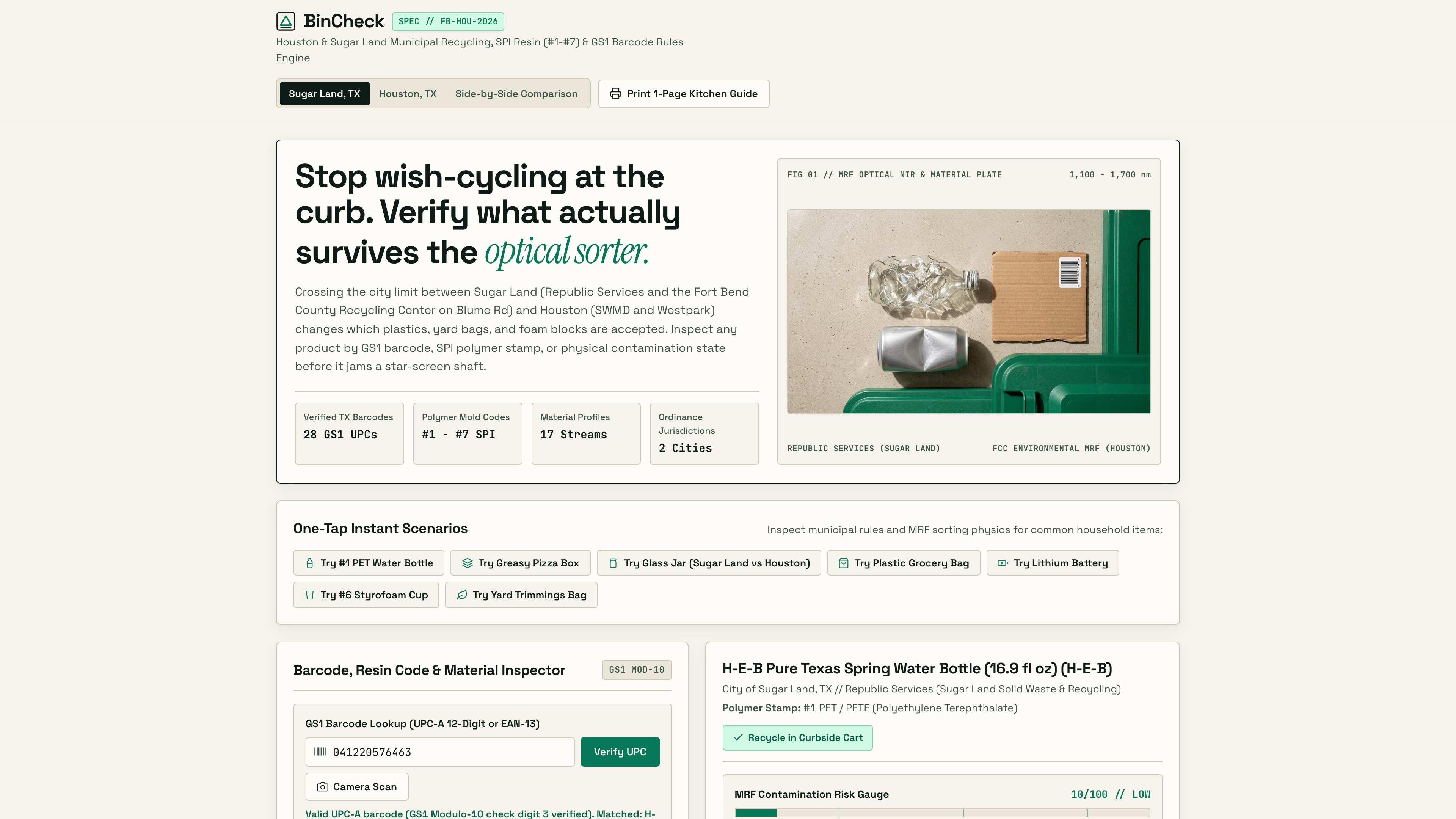
BinCheck (SPEC // FB-HOU-2026) is a municipal recycling, SPI resin code (#1 through #7), and GS1 barcode verification web application tailored to City of Sugar Land and City of Houston ordinances.
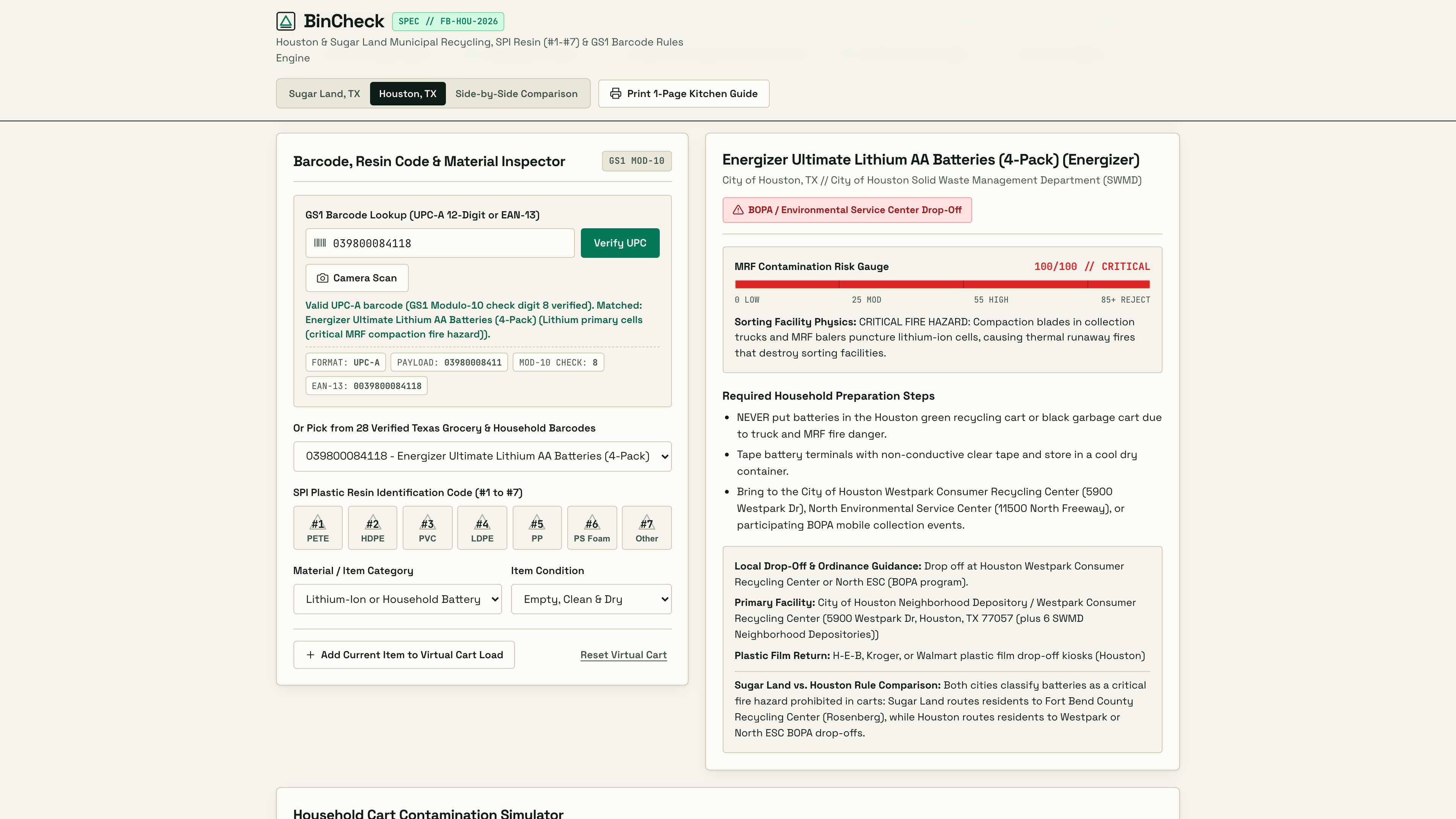
- GS1 Modulo-10 Barcode Inspector & Camera Scanner: Users can type or scan any 12-digit UPC-A or 13-digit EAN-13 barcode (including 28 pre-verified Texas grocery and household products from H-E-B, Blue Bell, Whataburger, Shiner, Topo Chico, and Energizer). BinCheck validates the GS1 Modulo-10 check digit in real time, displays the payload math, and maps the product's primary packaging polymer and cap/lid components to local rules.
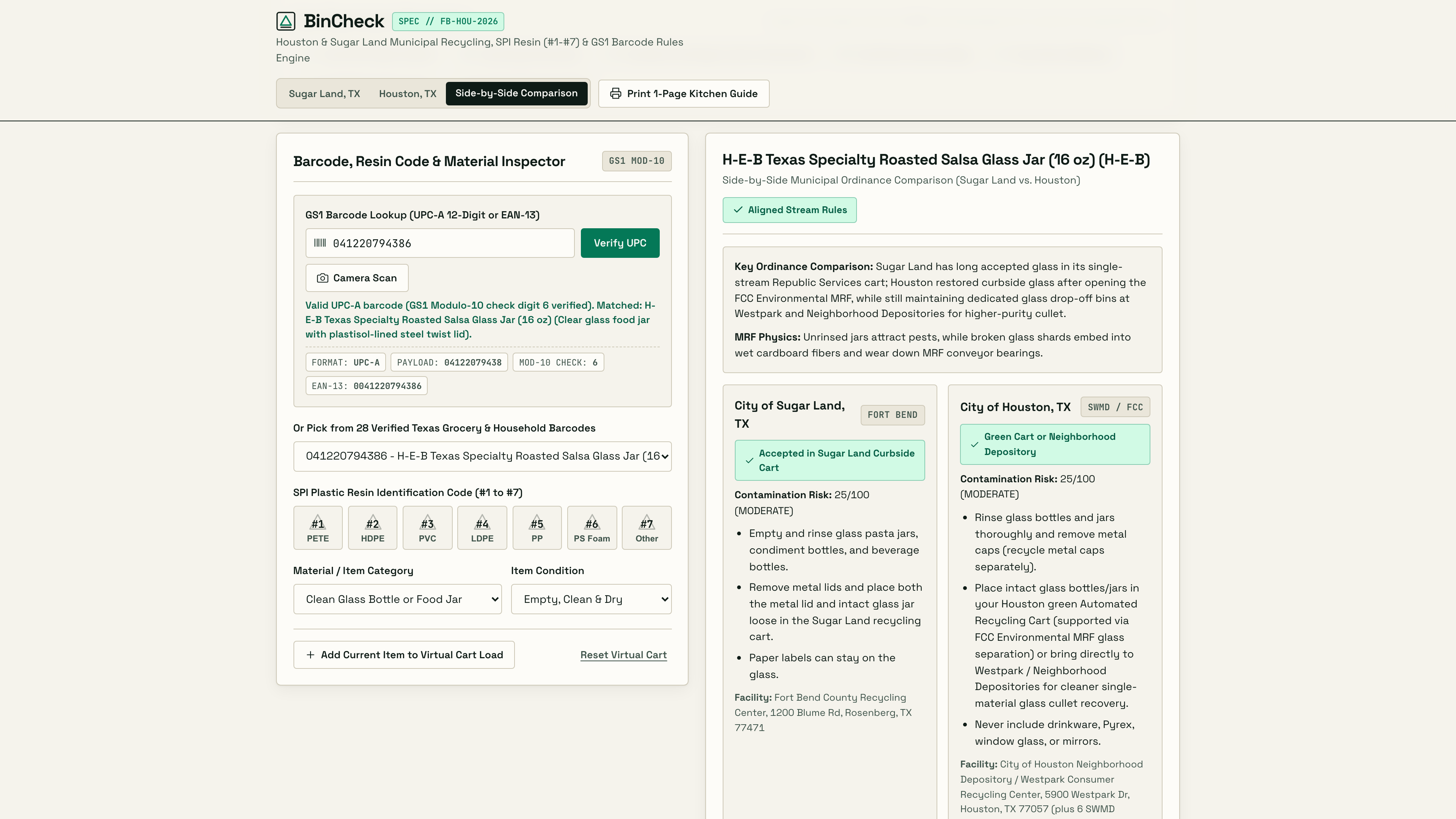
- Side-by-Side Jurisdiction Comparison: A single toggle switches between Sugar Land, TX, Houston, TX, and Side-by-Side Comparison, highlighting where the two cities align and where they diverge (such as clean
#6polystyrene foam blocks accepted at the Fort Bend County Recycling Center versus prohibited in Houston curbside carts, or Sugar Land's 40 lb kraft paper yard-trimming bag rule versus Houston's 50 lb City-logo compostable bag mandate). - MRF Optical Sorter & Contamination Physics: Every item verdict includes a
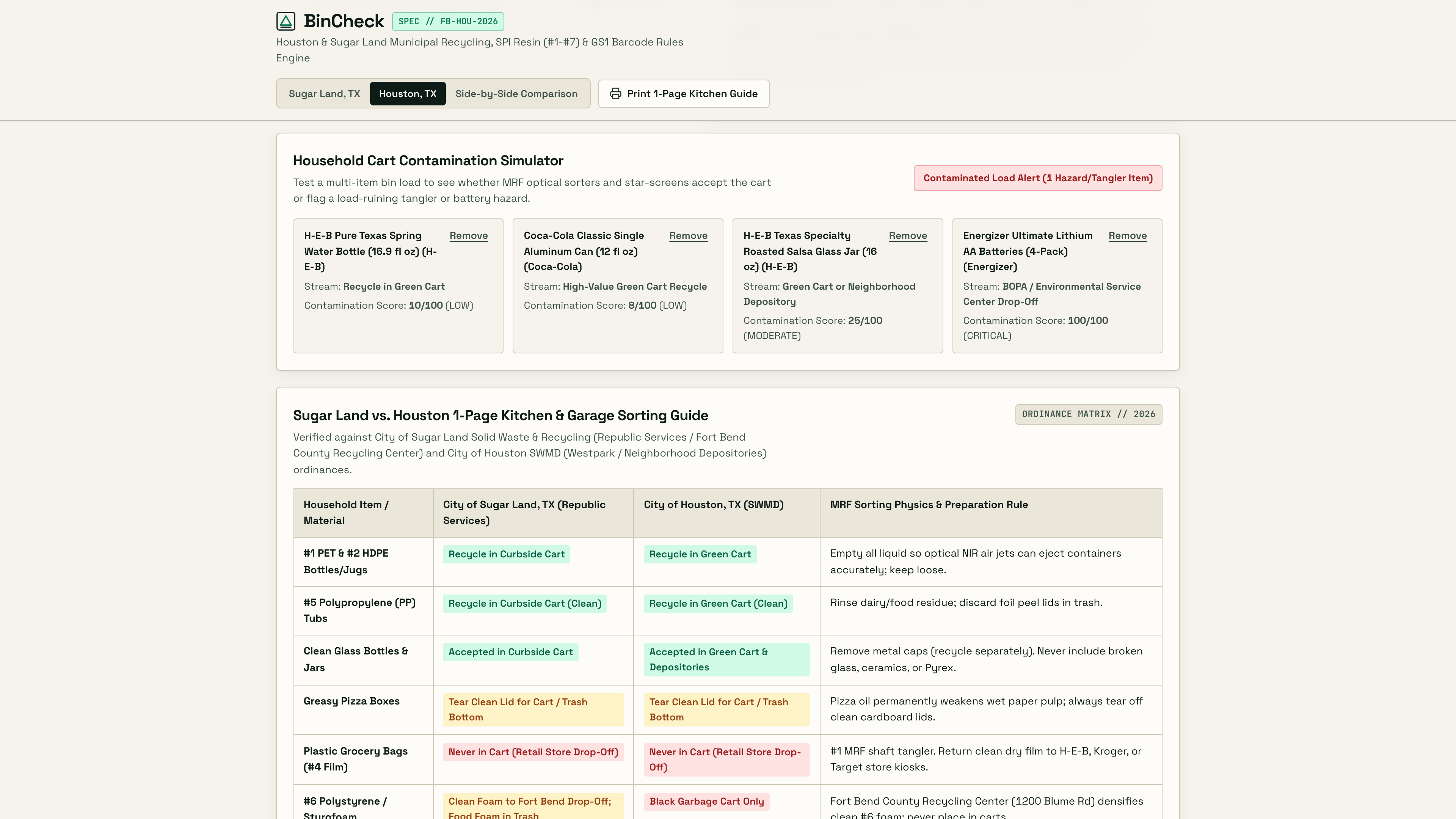
0-100MRF Contamination Risk Gauge explaining why a material succeeds or fails inside an optical near-infrared (1,100 - 1,700 nmNIR) sorter, eddy-current magnet, or star-screen separator, plus how item condition (Empty, Clean & Dryvs.Food or Grease Stainedvs.Still Contains Liquid) alters the outcome. - Household Cart Contamination Simulator: Users can build a multi-item virtual cart load to see whether a single tangler (
#4LDPE film bag) or compaction fire hazard (lithium-ion battery) triggers a contaminated load alert for the entire bin. - 1-Page Printable Kitchen & Garage Guide: A dedicated print stylesheet formats the Sugar Land vs. Houston ordinance matrix into a clean one-page reference sheet for a refrigerator door or garage wall.
How we built it
BinCheck is built with zero runtime framework dependencies using modular ES6 JavaScript (src/bincheck-engine.js and src/app.js), semantic HTML5, and a Swiss Civic Industrial CSS design system (styles.css and DESIGN.md):
- Deterministic Rules & Check-Digit Engine (
src/bincheck-engine.js): Implements pure functions for GS1 UPC-A/EAN-13 Modulo-10 check-digit verification, SPI resin code lookup, condition-adjusted contamination scoring, side-by-side municipal diffing, and virtual cart batch auditing. - Resilient Municipal Source Verifier (
scripts/verify-city-sources.js): A Node.js verification script that checks official City of Sugar Land and City of Houston SWMD documentation endpoints and validates the deterministic offline rules snapshot (data/municipal-rules-2026.json). - Automated Test Suite (
tests/bincheck.test.js): 42 automated unit tests run via Node's native test runner (node --test), covering check-digit math, all 17 material streams, condition modifiers, Sugar Land vs. Houston ordinance divergences, and batch contamination alerts.
Challenges we ran into
One major challenge was modeling how physical condition overrides material chemistry inside a Materials Recovery Facility. A #1 PET water bottle is one of the highest-value polymers on the sorting belt, but if a resident tosses it in half-full of liquid, the added mass prevents the optical sorter's timed pneumatic air jet from blowing the bottle over the divider into the PET bale chute, sending it into the residue stream instead. Similarly, corrugated cardboard is highly recyclable, but pizza grease saturates paper fibers and ruins an entire pulper batch unless the clean top lid is torn off from the greasy bottom tray. We designed the engine so condition (clean, greasy, liquid-full, broken) dynamically recalculates both the contamination score and the preparation instructions.
Accomplishments that we're proud of
- Real GS1 Modulo-10 Math + 28 Texas Household Products: Instead of a fake search box, BinCheck computes real odd/even positional weight sums (
3x + 1x mod 10) on every barcode entered and pairs it with local Texas grocery staples. - Tactile Swiss Industrial Interface: Designed around a
#F5F3ECrecycled newsprint surface,#0E1B16forest-ink typography,#047857municipal cart emerald, custom inline SVG technical schematics of an NIR optical sorter, andtabular-numsalignment across every metric. - 42/42 Passing Unit Tests: Zero external runtime bloat, instant load times, and full offline capability.
What we learned
We learned how deeply municipal recycling depends on mechanical separation physics at the regional MRF. Teaching residents why plastic bags jam rotating star-screens or why lithium batteries cause thermal runaway fires inside compactor trucks is far more effective at changing household sorting behavior than a generic "yes/no" list.
What's next for BinCheck
Next, we plan to add municipal rules for surrounding Fort Bend and Harris County jurisdictions (Missouri City, Stafford, Katy, and Pearland), expand the verified Texas barcode catalog to over 200 H-E-B and Kroger store-brand items, and add reminder schedules for Fort Bend County Household Hazardous Waste drop-off days.
Built With
- css3
- html5
- javascript
- node.js
- recycling
- sustainability
- web

Log in or sign up for Devpost to join the conversation.