Inspiration
BinBuddy was inspired by a simple but important everyday problem: people often do not know where the nearest bin is, what type of waste it accepts, or how to report missing, damaged, or overflowing bins. This can be even more difficult when you are outside the main city centre or in less busy areas, where bins may be harder to find and public information is often limited. We wanted to build something practical that could make waste disposal easier for the public while also creating more useful data for local communities and local authorities.
As this was our first overnight hackathon, we also wanted to challenge ourselves by building something meaningful while learning new technologies in a fast-paced environment.
What it does
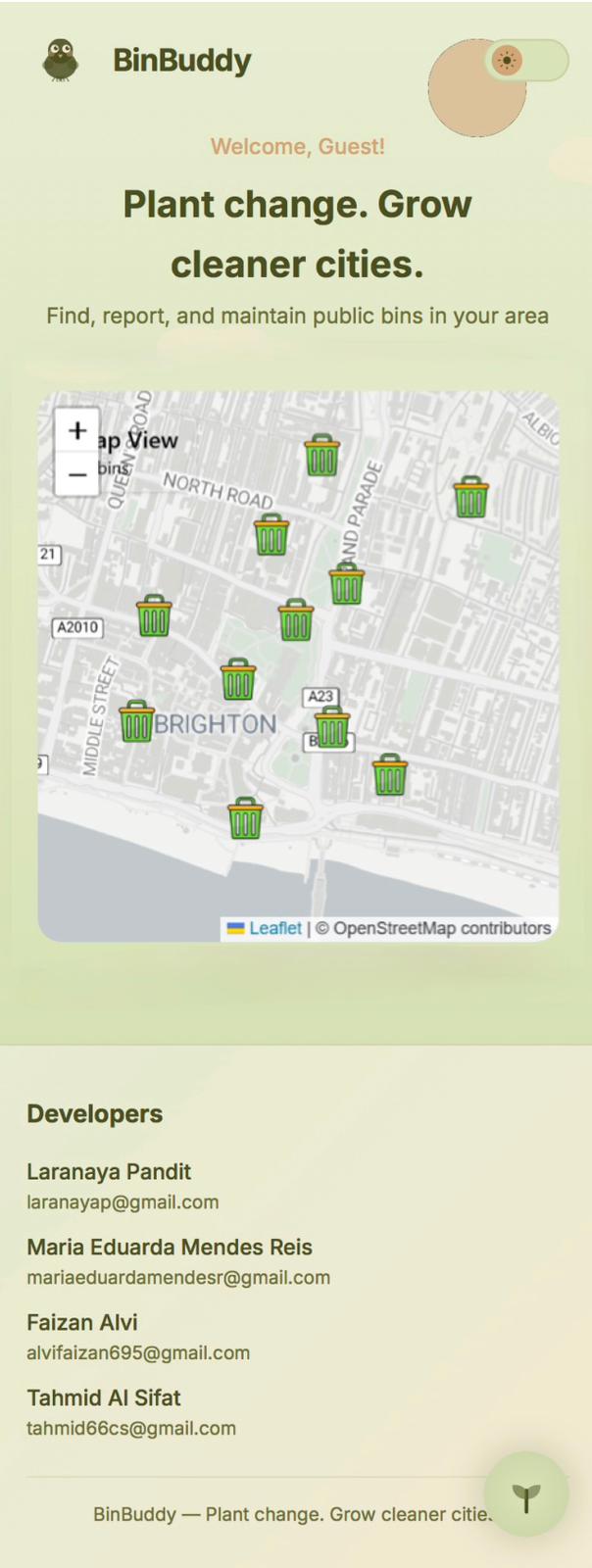
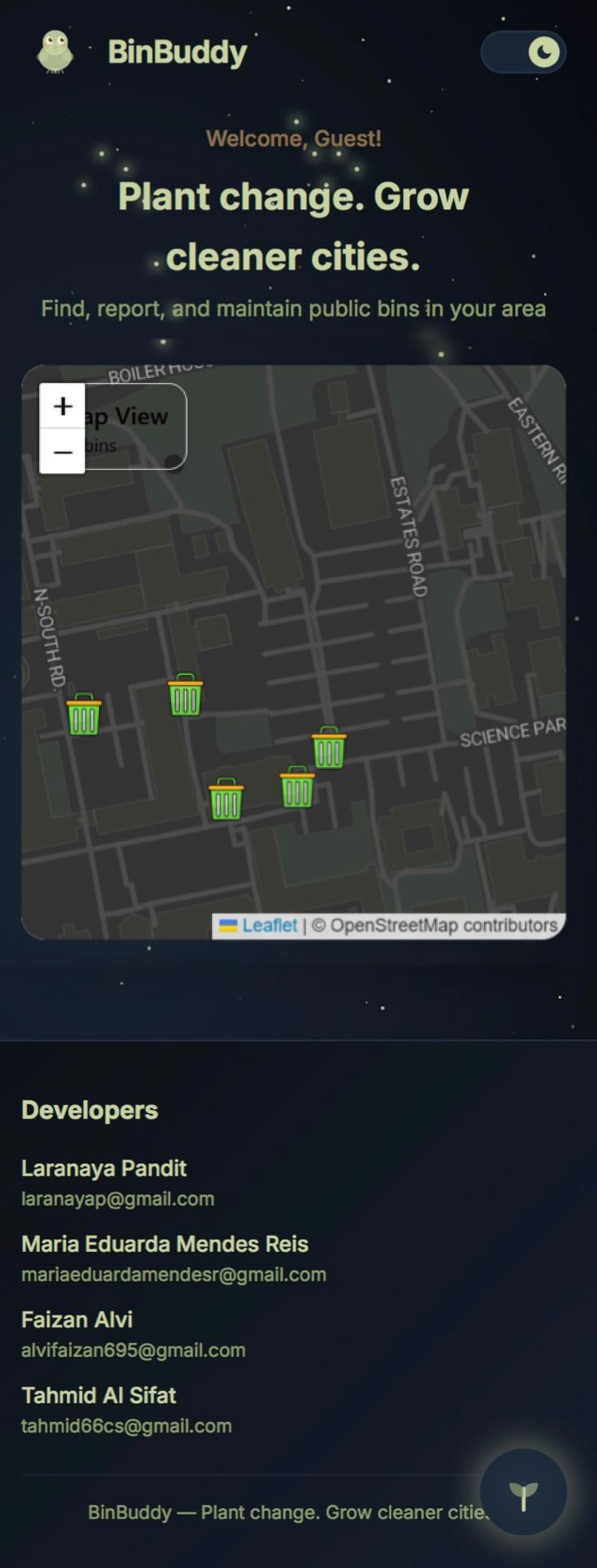
BinBuddy is a mobile-first web app that helps users find nearby bins on a map, view useful information such as type, location, and images, and submit live reports using a real-time photo taken through the app. A key feature of the project is that users must take a live photo through the app camera, rather than uploading an existing image. We then use Gemini to help check whether the image actually contains a real bin, appears relevant to the report, and is trustworthy before the report is created.
The project is designed not only to help individual users, but also to support cleaner communities and more useful waste data for local authorities.
How we built it
We built BinBuddy using React for the frontend, Leaflet / Mapbox for map functionality, MongoDB for storing bin and report data, Gemini API for image validation, and Auth0 for authentication and user identity.
We also explored DigitalOcean as a possible deployment option. Although we were not able to fully use it during the hackathon because we could not access the required keys for free, it was still valuable to explore it and understand how it could support deployment in a more complete version of the project.
Challenges we ran into
One of our biggest challenges was balancing ambition with what was realistic in a hackathon timeframe. We wanted to combine maps, authentication, AI validation, and reporting into one clear product while keeping the idea practical and achievable.
Another challenge was making the system trustworthy. We did not want it to be just a simple map, so we focused on features such as live image capture and AI validation to improve the quality of reports.
Accomplishments that we're proud of
We are proud that we created a project with a clear real-world purpose rather than just a technical demo. BinBuddy combines mapping, reporting, authentication, and AI-supported validation into one idea that could genuinely help communities.
We are also proud that during our first overnight hackathon, we explored and worked with tools such as Auth0, Gemini, and DigitalOcean, while still managing to build a meaningful prototype.
What we learned
We learned a lot in a short amount of time. We became more familiar with Auth0, explored how Gemini could support a real validation feature rather than being just an add-on, and looked into DigitalOcean as part of thinking about deployment.
We also learned how to prioritise features, work under pressure, divide tasks effectively, and turn an idea into a working prototype within a limited time.
What's next for BinBuddy
Next, we would like to make BinBuddy more complete by improving deployment, expanding the bin dataset, and strengthening the reporting system. We would also like to add more features for local authorities, such as better reporting insights and data dashboards, so the platform can support not only users trying to find bins, but also organisations working to improve waste management in their area.
In the future, BinBuddy could become a more complete environmental platform that supports cleaner public spaces, better waste reporting, and smarter sustainable city planning.
Built With
- auth0
- digitalocean
- gemini
- leaflet.js
- mangodb
- next.js
- node.js
- react
- typescript


Log in or sign up for Devpost to join the conversation.