-
-
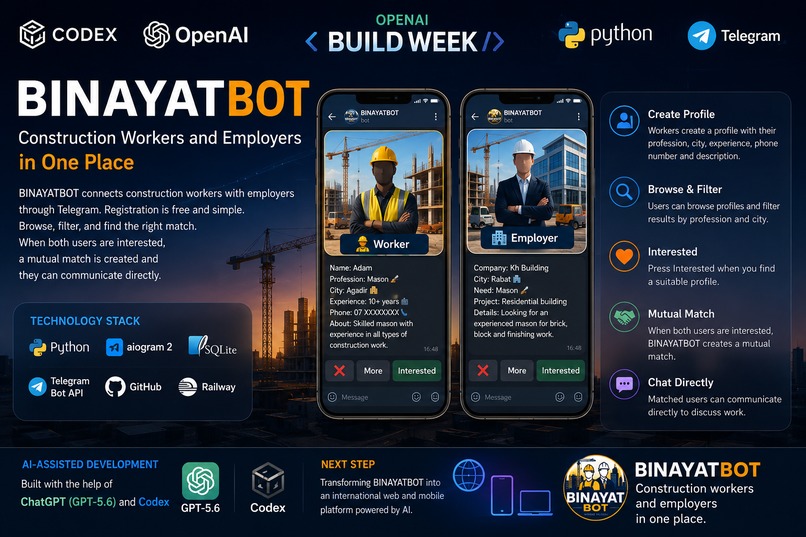
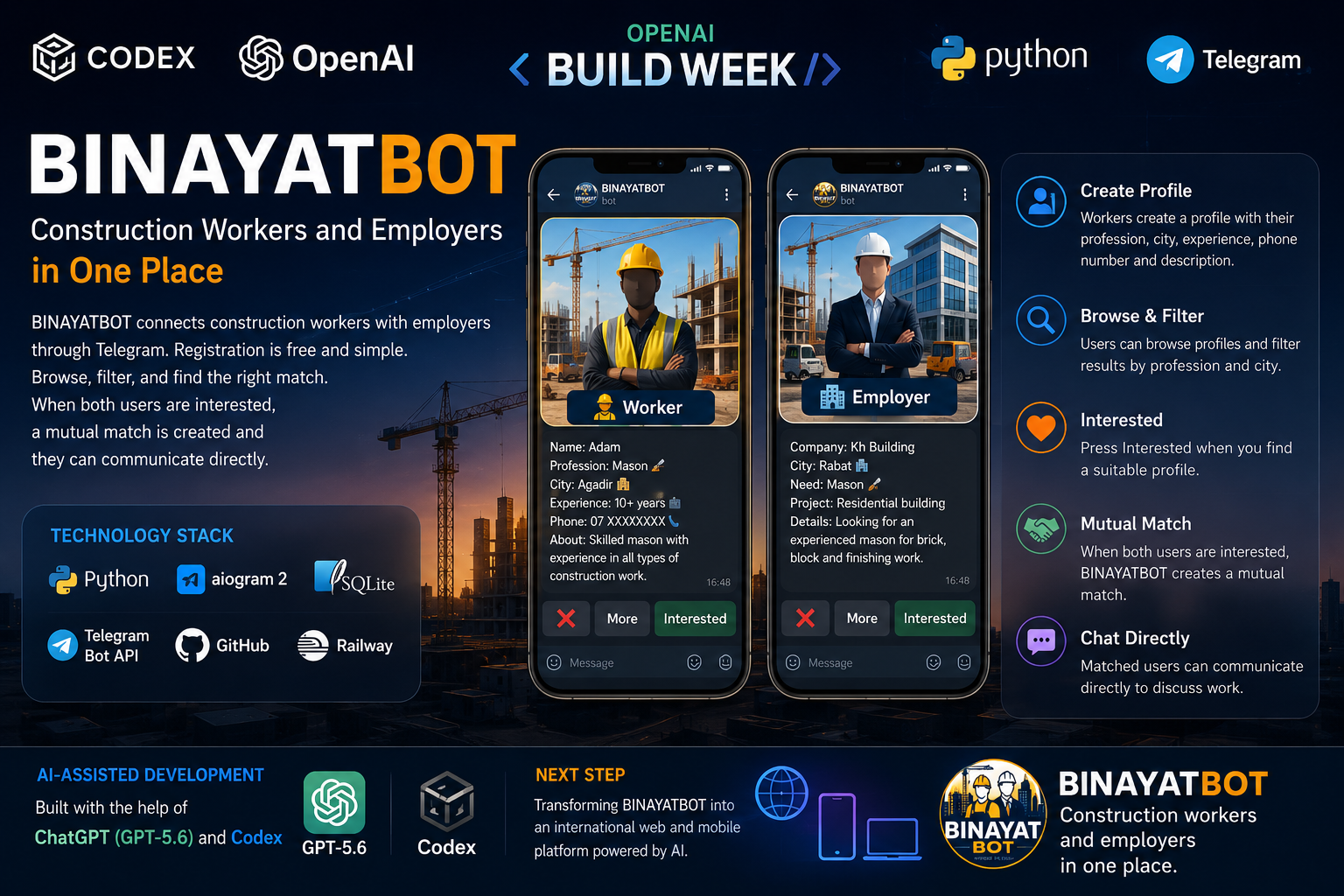
BINAYATBOT project overview showing its mission, main features, technology stack, and AI-assisted development.
-
BINAYATBOT logo — a construction platform connecting workers, employers, contractors, companies, and homeowners.
Inspiration
In Morocco, many construction workers find jobs through personal contacts, phone calls, or informal local networks. At the same time, homeowners, contractors, and companies often struggle to find available workers with the right skills.
We created BINAYATBOT to make this process faster, simpler, and more organized. Our goal was to build an accessible platform that connects construction workers directly with employers, without requiring complicated applications or technical knowledge.
Telegram was chosen for the first version because it is lightweight, familiar, and easy to use from almost any smartphone.
What it does
BINAYATBOT connects two main categories of users:
Construction workers looking for job opportunities Employers, contractors, companies, and homeowners looking for workers
Workers can create a profile containing their profession, city, experience, phone number, description, and profile photo.
Employers can create a profile describing who they are, where they are located, and the type of worker or construction service they need.
Users can browse relevant profiles and express interest. When both sides are interested in each other, BINAYATBOT creates a mutual match and notifies them so they can communicate directly.
The bot also includes:
Worker and employer registration Profile creation and editing Profession and city filtering Likes and mutual matches Notifications Daily usage limits Premium subscriptions User reporting Administrative controls
How we built it
We built the first version as a Telegram bot using:
Python Aiogram SQLite Telegram Bot API GitHub Railway
We designed separate conversational registration flows for workers and employers. Each user answers a sequence of simple questions, and the information is validated and stored in the database.
We used finite-state machines to manage the different registration steps and user actions.
The project was divided into separate modules for:
Registration Worker and employer profiles Search and browsing Likes and matches Notifications Subscriptions Usage limits Database management Administration
The matching system records user interest and checks whether the other person has already expressed interest. When both users are interested, the system creates a match while preventing duplicate records and repeated notifications.
We also deployed the bot online so it could operate continuously and be tested with real Telegram accounts.
Challenges we ran into
One of our biggest challenges was creating an interface that remained simple for people who might not be familiar with digital recruitment platforms.
Many construction workers regularly use messaging applications but may find complex websites or traditional employment platforms difficult. We therefore had to make every question short, clear, and understandable in Moroccan Arabic.
We also faced several technical challenges, including:
Preventing duplicate likes and matches Avoiding false mutual-match notifications Hiding profiles already liked, rejected, or matched Managing browsing sessions correctly Resetting daily usage limits Handling incomplete registrations Updating the database without losing existing information Managing Telegram callback buttons Preventing repeated messages Deploying new versions without interrupting the service
Testing with different accounts revealed edge cases that were difficult to identify during the initial development.
Accomplishments that we're proud of
We are proud that BINAYATBOT grew from a simple idea into a functional platform with complete user flows for both workers and employers.
Some of our main accomplishments include:
Building a complete registration system in Moroccan Arabic Creating separate worker and employer experiences Developing a functional like-and-match system Adding real-time Telegram notifications Implementing profile browsing and filtering Creating subscription and usage-limit systems Building administrative tools Organizing the project into maintainable modules Deploying a working version online Improving the product through repeated testing and debugging
Most importantly, we created a solution focused on a real local problem affecting workers, employers, contractors, and homeowners.
What we learned
BINAYATBOT taught us that creating a useful product requires more than writing code. It requires understanding users, their language, their habits, and the difficulties they face.
Through this project, we learned how to:
Structure a complete Python application Use asynchronous programming Build conversational interfaces Manage user states and sessions Design and update a relational database Develop matching logic Validate and protect user data Deploy and maintain a live service Use GitHub for version control Test with different user scenarios Improve a product based on real feedback
We also learned the importance of starting with a simple working product and gradually improving it rather than trying to build every feature at once.
What's next for BINAYATBOT
The next major step is to transform BINAYATBOT into a complete international web and mobile platform while preserving the simplicity of the Telegram experience.
Our goal is to expand beyond Morocco and make the platform available in multiple countries, with support for different languages, currencies, local job markets, and regional construction practices.
The future platform will allow users to:
- Register without Telegram
- Create and manage professional profiles
- Browse workers, technicians, engineers, companies, and job opportunities
- Search by profession, specialization, city, country, experience, and availability
- Communicate through a secure messaging system
- Manage subscriptions and payments
- Access the platform from phones, tablets, and computers
- Publish job offers, service requests, and construction projects
BINAYATBOT will also expand beyond traditional construction workers. The platform will include:
- Civil engineers
- Architects
- Site managers
- Project managers
- Quantity surveyors
- Surveyors
- Electricians
- Plumbers
- Welders
- Machine operators
- Construction technicians
- Skilled workers
- Engineering firms
- Contractors and suppliers
We also plan to create a marketplace for the sale and rental of:
- Construction machinery
- Heavy equipment
- Trucks and utility vehicles
- Tools and professional equipment
- Building materials
- Spare parts
Another important feature will be online engineering advice. Individuals, contractors, and companies will be able to contact engineering firms and qualified professionals for remote consultations, document reviews, cost estimates, technical advice, project planning, and construction problem solving.
Artificial intelligence will play a central role in the future development of BINAYATBOT. AI-powered features may include:
- Automatic worker and job recommendations
- Intelligent profile matching
- CV and professional profile analysis
- Construction document review
- Technical document classification
- Detection of missing or inconsistent information
- Assistance with bills of quantities and cost estimates
- Analysis of project specifications
- Verification of certificates and submitted documents
- Translation of profiles, job offers, and technical documents
- Fraud and suspicious-account detection
- Personalized recommendations based on location, skills, and experience
The platform may also include worker and company verification, ratings and reviews, location-based search, improved privacy and security, multilingual customer support, and recruitment management tools for construction companies.
Our long-term vision is for BINAYATBOT to become an international digital ecosystem for the construction and engineering sectors. It will connect workers, engineers, technicians, employers, contractors, equipment sellers, suppliers, and engineering firms across different countries.
The goal is not only to help people find jobs, but also to help companies recruit talent, sell or rent equipment, obtain technical advice, verify documents, and manage construction-related services through one intelligent platform.


Log in or sign up for Devpost to join the conversation.