-
-
CivicFix
Inspiration
We started with a simple question: why do small problems around us never get fixed? Every day we step out and see potholes, overflowing garbage bins, or streetlights that never work. These issues are not “big enough” to get national attention, but they affect us directly. Usually, people either complain in WhatsApp groups or just accept them as part of daily life.
That didn’t sit right with us. We thought — what if reporting issues was as easy as posting on social media? And what if the system was open, transparent, and gave people a sense of reward when things actually got fixed? That’s where CivicFix was born.
What it does
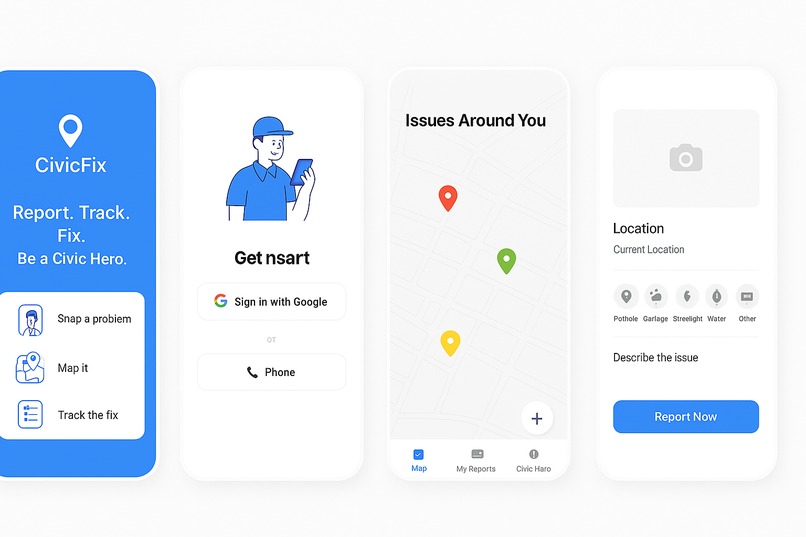
CivicFix is like a Google Maps for problems around you.
You see an issue → snap a picture.
The app tags the location automatically and posts it on a public map.
Other people can upvote the issue if they face the same problem.
The complaint doesn’t get lost — it’s sent to the right municipal authority.
For citizens, this means your voice is heard. For authorities, it’s a dashboard that shows exactly what people are facing and how quickly problems are being resolved.
To keep things fun, we added a “Civic Hero” system. If you report issues that later get fixed, you earn points. It’s like a small pat on the back for making your neighborhood better.
How we built it
We wanted it to be mobile-first, because that’s how most people in India go online.
The frontend is in React with a simple, clean UI.
We used Firebase for authentication, database, and storing photos.
For maps, we tried both Google Maps API and MapmyIndia since it’s more accurate in some Indian cities.
Everything syncs in real time, so when someone posts an issue, it instantly shows up on the map.
We kept the design super simple — if someone can use WhatsApp, they should be able to use CivicFix.
Challenges we ran into
Not going to lie, it wasn’t all smooth:
Making sure locations were pinned correctly was harder than expected. Poor GPS signal in crowded areas gave us trouble.
Privacy vs transparency was a big question. We wanted public data, but without exposing personal details.
We also realized that municipal authorities don’t all work the same way. Some are responsive, some… not so much. So, our system had to be flexible.
And of course, the classic hackathon challenge: too many ideas, not enough time.
Accomplishments that we're proud of
We actually got a working prototype that can report, tag, and display issues on a live map.
We didn’t just stop at reporting — we made it engaging with gamification.
We created something that could genuinely make a difference if adopted at scale.
The best part? During testing, when we marked one issue as “resolved,” the whole team got this rush of excitement — it felt like we were seeing our idea work in real life.
What we learned
This project taught us a lot more than just coding:
Design for everyone. If it’s too complex, no one will use it.
Real-world problems don’t always have neat, clean solutions — you have to work with messy systems.
And maybe the most important lesson: tech is powerful, but change only happens when people trust and use it.
What's next for Binary Bros
We don’t want this to stay just a hackathon project. Here’s where we see it going:
Testing it in a real city with actual citizens and authorities.
Adding offline mode so reports can be made without internet.
Training an AI model to auto-detect issue type from images.
Expanding dashboards for authorities so they can track trends, like “which wards have the most potholes.”
And long-term, making CivicFix available in other countries too.
Our dream is simple: turn every citizen into a Civic Hero and make local governance feel closer, faster, and more accountable.


Log in or sign up for Devpost to join the conversation.