-
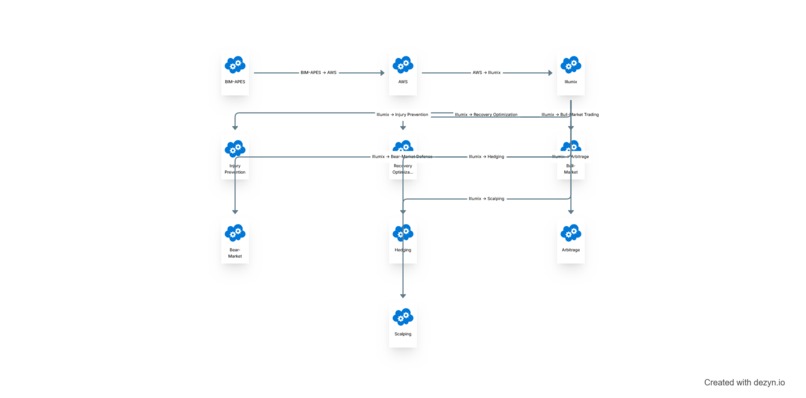
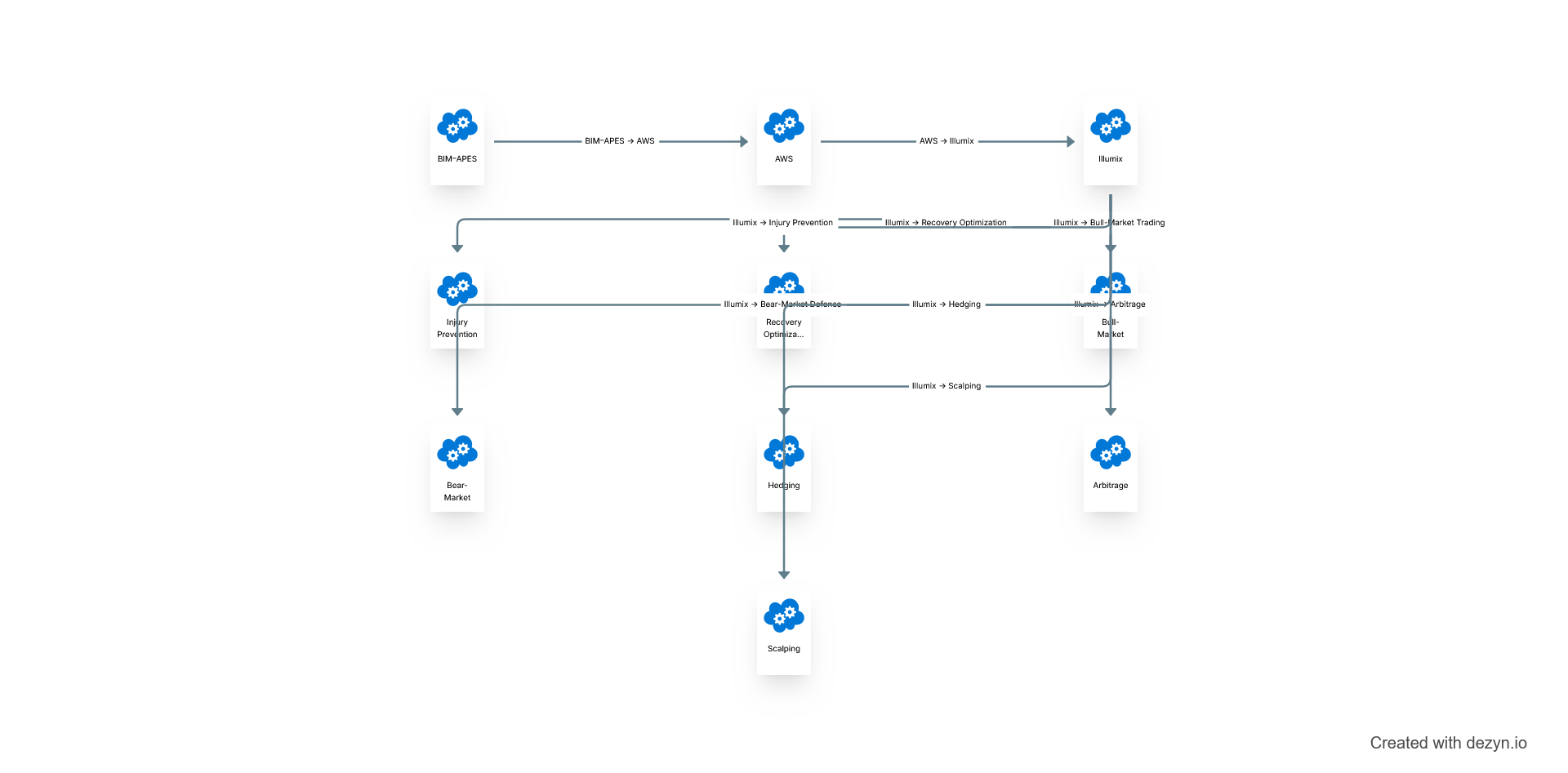
Solution Architecture
Inspiration
Athlete performance is no longer a mystery of intuition, tradition, or subjective observation. With BIM‑APES, Bledsoe Investment Management introduces the first biomechanical‑intelligence engine that unifies:
Coaching decision‑making
Sports medicine diagnostics
Fatigue and stress monitoring
Recovery optimization
Training‑load precision
Market‑trend detection (team/player bear markets, substitution risk, NIL valuation decay)
Powered by edge biometrics, AWS cloud modeling, Illumix AR/3D visualization, and Nodeflix media overlays, BIM‑APES transforms athlete physiology into a real‑time intelligence system. This white paper outlines the scientific foundation, AR modeling layer, case studies, and a new visualization system—Bio-mechanical Flow Charts—designed to replace candlestick and line charts for performance‑finance decision‑making.
What it does
Key Takeaways: Hedging, arbitrage, and scalping strategies are fully integrated into the BIM–APES system, leveraging AR/3D overlays, AWS cloud analytics, and edge biometric intelligence.
Illumix AR intelligence provides immersive, real-time visualization of risk, opportunity, and performance, supporting rapid, data-driven decision-making.

AWS cloud intelligence delivers scalable, robust financial modeling, forecasting, and risk management, with continuous model validation and compliance.

BIM–APES edge intelligence captures high-fidelity biometric and performance data, enabling dynamic risk controls, personalized NIL valuation, and market innovation.

The tri-layer system enables real-time, secure, and compliant decision-making, transforming athlete performance, NIL markets, and sports finance at scale.
How I built it
┌─────────────────────────────────────────────────┐ │ MARKET INTELLIGENCE ENGINE │ │ (Bull/Bear Signals, Trading Recommendations) │ └──────────────────┬──────────────────────────────┘ │ │ Analyzes ↓ │ ┌────────────┼────────────┐ │ │ │ ▼ ▼ ▼ ┌──────────┐ ┌──────────┐ ┌───────────┐ ┌───────────┐ │ STRESS │ │ FATIGUE │ │ RECOVERY │ │ TRAINING │ │ ENGINE │ │ ENGINE │ │ ENGINE │ │ ENGINE │ └──────────┘ └──────────┘ └───────────┘ └───────────┘ │ │ │ │ │ │ │ │ └────────────┴────────────┴────────────┘ │ ▼ ┌─────────────────────┐ │ AR/3D OVERLAYS │ │ BiomechFlow™ │ │ Risk Forecasting │ └─────────────────────┘
Challenges I ran into
Partnership communcation
Accomplishments that I'm proud of
AWS Pilot Execution (currently working progress)
What I learned
How to use AR/3d with Hedge fund mangement in athletics : How Spatial Intelligence Changes Market Behavior
Sports betting markets move based on information asymmetry. Traditionally, markets only see:
Box scores

Injury reports

Minutes played

Public sentiment

Team trends
Your Spatial Intelligence Layer introduces new, non‑public biomechanical signals:
Stress load

Fatigue accumulation

Recovery velocity

Substitution probability

Injury‑risk probability

Team readiness clusters
These signals don’t tell anyone what to bet — they change how the market interprets risk. The effect:
Markets become more conservative when fatigue/stress signals rise.

Markets become more aggressive when recovery velocity improves.

Markets adjust spreads when substitution probability spikes.

Markets price volatility differently when biomechanical instability appears.
This is market behavior, not betting advice.
- How Spatial Intelligence Affects Odds & Volatility
Sportsbooks adjust odds based on expected performance and injury risk.
Your system introduces real‑time readiness indicators that affect those expectations. A. When Stress or Fatigue Spikes
Markets interpret this as:
Higher injury probability

Lower scoring potential

Lower efficiency

Higher substitution likelihood
This leads to:
Wider spreads

Lower player props

Higher volatility

Defensive pricing
B. When Recovery Velocity Improves
Markets interpret this as:
Higher availability

Higher scoring potential

Higher consistency
This leads to:
Tighter spreads

Higher props

Lower volatility
Again — this is market reaction, not betting guidance.
- How Spatial Intelligence Creates “Market Signals” (Not Betting Signals)
Your Market Intelligence Engine outputs:
Bull/Bear trends

NIL momentum

Breakout probability

Volatility pulses

Team readiness clusters
These are performance‑based signals, not gambling signals. Example:
If a player’s BiomechFlow capsule shows:
High stress

High fatigue

Low recovery velocity

High substitution probability
The market interprets this as:
“This athlete is less likely to perform at peak level.”
Sportsbooks adjust their models, not the bettor.
What's next for BIM-APES Software: AR/3D Spatial Intelligence Layer
Team /Enterprise closing deal .

Log in or sign up for Devpost to join the conversation.