Inspiration
Managing business finances often requires switching between spreadsheets, accounting software, dashboards, forecasting tools, and AI assistants. As a developer, I wanted to explore a different approach: instead of creating another financial dashboard, what if AI became the operating system itself?
Billora was inspired by the idea that founders, freelancers, and agencies should spend less time interpreting financial data and more time making informed decisions. The goal was to build an intelligent workspace where AI doesn't simply answer questions, but actively collaborates, analyzes, predicts, and recommends actions based on the current state of a business.
What it does
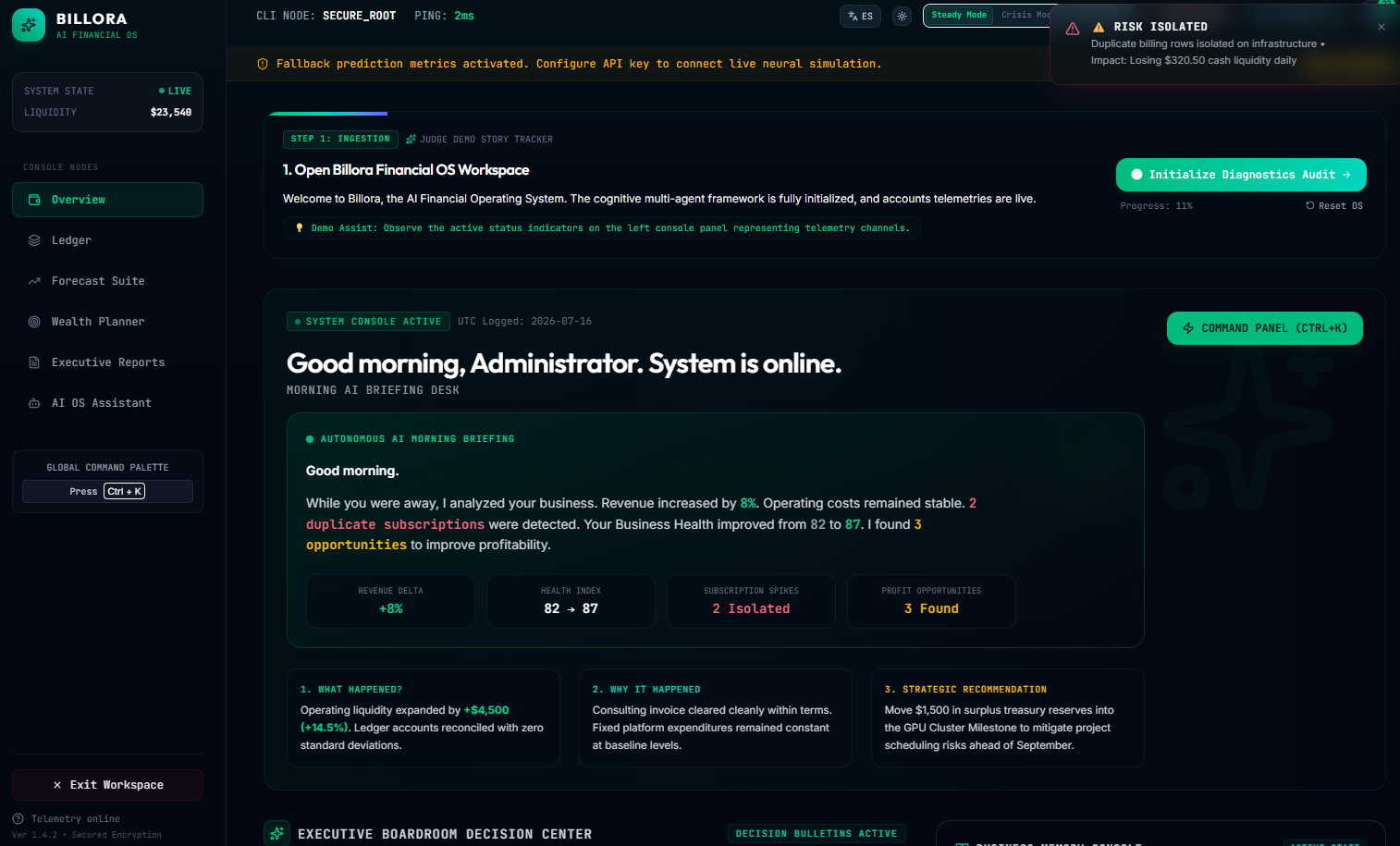
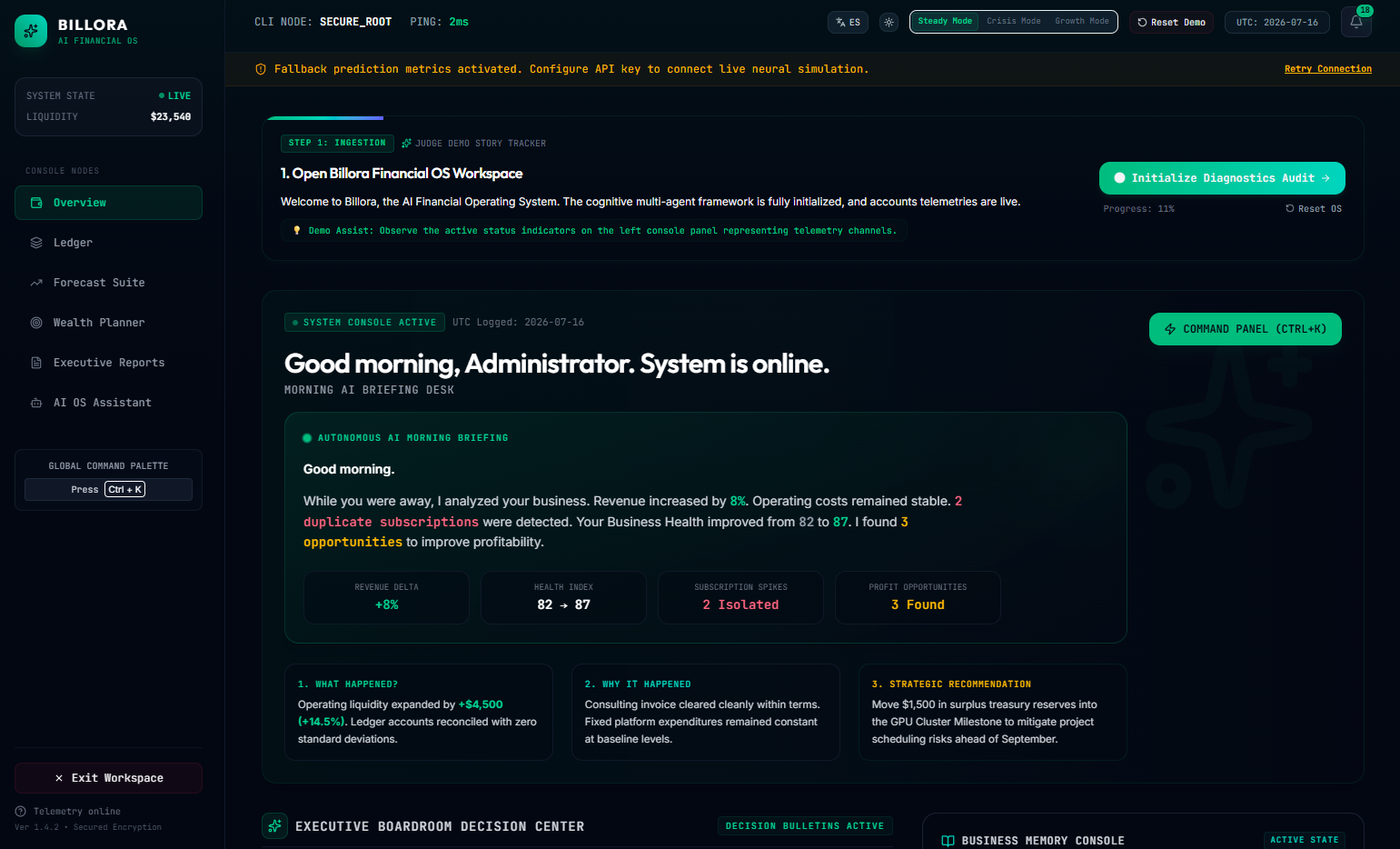
Billora is an AI Financial Operating System that helps businesses monitor their financial health, simulate strategic scenarios, detect risks, and make better decisions.
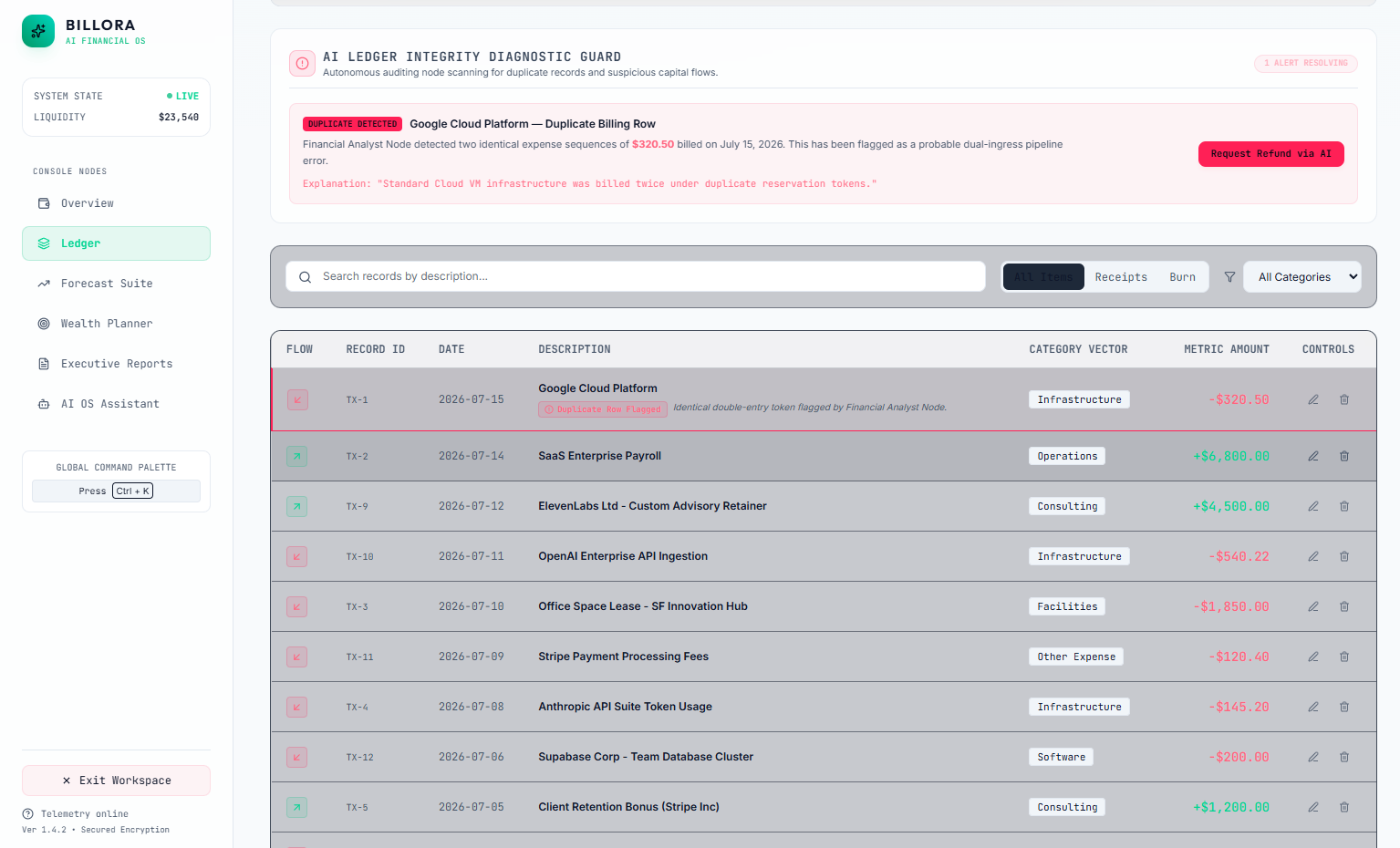
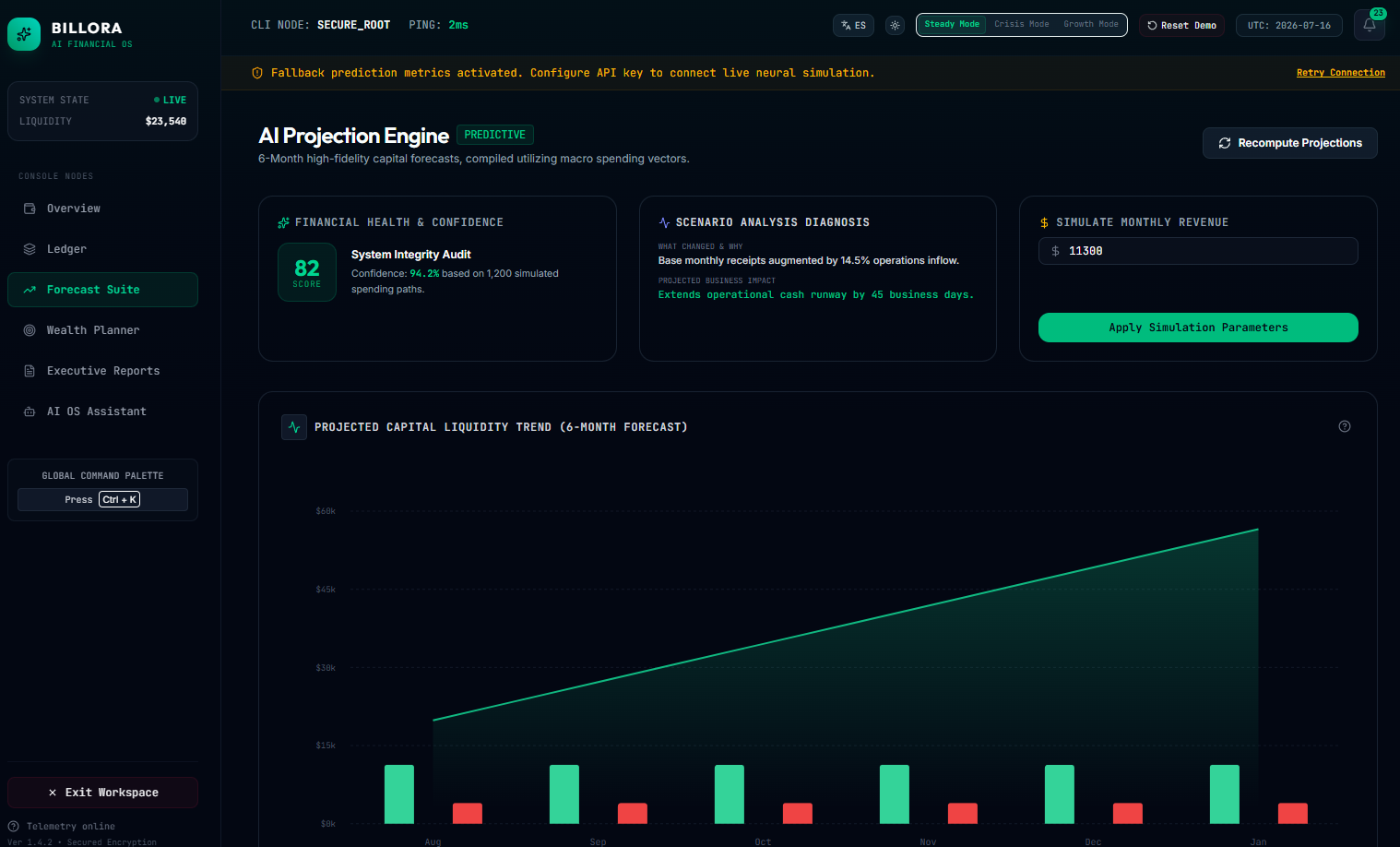
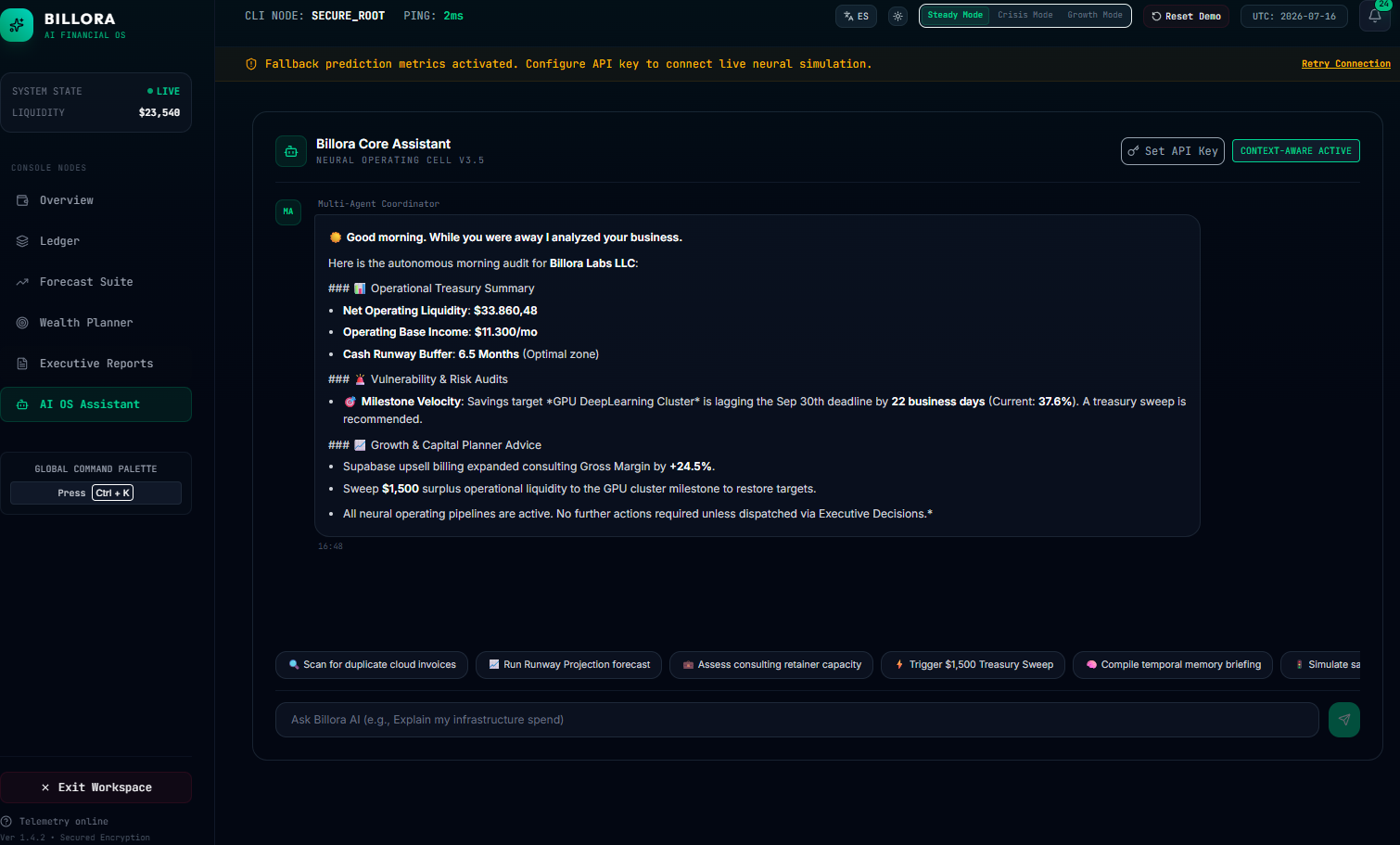
The platform combines real-time financial dashboards, forecasting, business memory, executive reporting, and a collaborative multi-agent AI system inside a single workspace.
Users can:
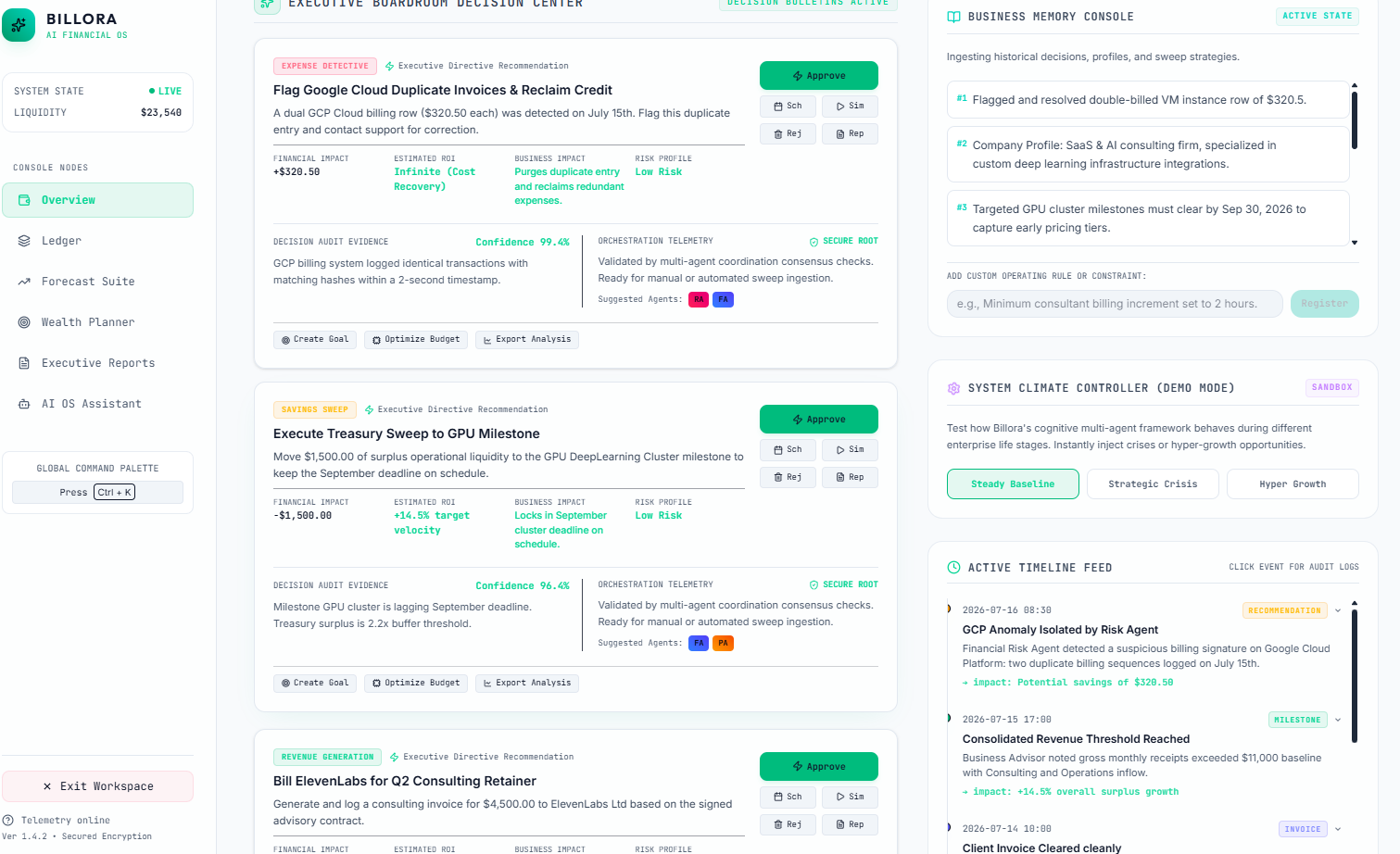
Monitor liquidity, cash flow, savings goals, and business health. Simulate real business scenarios such as hiring, losing a client, or expanding internationally. Receive AI-generated recommendations with confidence scores and projected business impact. Generate executive reports. Maintain contextual business memory that improves future recommendations. Interact with multiple AI specialists coordinated through an orchestration engine instead of a single chatbot.
How we built it
Billora was built using React, TypeScript, Vite, Express, and modern frontend architecture.
The interface follows a modular feature-based structure with reusable components, centralized state management, lazy loading, and production-ready performance optimizations.
The AI layer uses GPT-5.6 during development together with Codex to accelerate engineering tasks, architecture decisions, refactoring, accessibility improvements, and production-quality implementation.
Inside the application, a multi-agent orchestration layer coordinates specialized AI roles such as Financial Analyst, Forecast Agent, Risk Agent, Planner, Growth Advisor, and Report Generator. These agents collaborate before producing a unified recommendation for the user.
The project also includes an Event Bus architecture, Business Memory Engine, Scenario Simulator, Executive Reports, responsive UI, accessibility improvements, and graceful offline fallbacks.
Challenges we ran into
One of the biggest challenges was balancing complexity with usability.
Building multiple AI systems is relatively straightforward, but making them feel like a single coherent product required significant architectural work.
Another challenge was coordinating application state between simulations, financial metrics, memory, recommendations, and multiple AI agents while maintaining responsive performance.
Finally, preparing a production-quality experience within the limited timeframe of the hackathon required continuous refactoring, optimization, and prioritization.
Accomplishments that we're proud of
We're especially proud of transforming Billora from a traditional finance dashboard into a complete AI-native operating system.
Highlights include:
Multi-agent orchestration architecture. Business Memory Engine. Event-driven architecture. Executive reporting. Scenario simulation engine. Production-ready responsive interface. Accessibility improvements. Zero-warning production build. Executive launch experience with guided demo mode.
Most importantly, we created a product where AI actively helps users make financial decisions instead of simply answering prompts.
What we learned
This project reinforced that great AI products are not defined only by the language model they use, but by the systems built around it.
We learned the importance of orchestration, structured state management, resilient architectures, accessibility, and user experience.
Working with GPT-5.6 and Codex also demonstrated how AI can significantly accelerate software engineering while still requiring thoughtful design decisions and human judgment.
What's next for Billora
Our vision is to evolve Billora into a true financial operating system for modern businesses.
Future plans include:
Live banking integrations. Invoice generation and payment reconciliation. Multi-user workspaces with role-based permissions. Persistent cloud business memory. Autonomous AI agents capable of monitoring businesses continuously. Deeper forecasting models. Integrations with accounting platforms and CRMs. AI-powered executive assistants capable of proactively identifying opportunities and risks before users even ask.
Billora is just the beginning. Our long-term goal is to build an AI-native platform where businesses can understand, manage, and improve their financial operations through collaborative intelligence rather than traditional software.
Built With
- codex
- express.js
- gpt-5.6
- node.js
- react
- tailwindcss
- typescript
- vite

Log in or sign up for Devpost to join the conversation.