Inspiration
Working in medical communications, I witnessed firsthand the sheer complexity of healthcare documentation. While creating awareness posters for hospitals, I realized that while we focus on patient health, we often ignore financial health. Most patients feel a sense of "bill shock"—a paralyzing confusion when faced with 20-page medical statements. I wanted to build a bridge between complex medical data and the average person's understanding.
What it does
BillLogic is an AI-driven financial advocate that translates cryptic medical bills into plain English. Users simply upload a photo or PDF of their hospital statement and insurance policy. The platform then:
Audits for Errors: Identifies duplicate charges, "unbundling" (charging separately for items that should be a single fee), and coding mistakes.
Policy Mapping: Cross-references the bill with the user’s specific insurance benefits to find hidden coverage.
Price Transparency: Compares charges against regional Medicare/Fair Health benchmarks to highlight overcharging.
How we built it
Leveraging my background in Data Analysis and ML, I built a pipeline that processes unstructured medical data:
OCR & Extraction: We used AWS Textract to extract tabular data from inconsistent hospital bill layouts.
Classification: A Python/PyTorch backend maps billing descriptions to standardized ICD-10 and CPT codes.
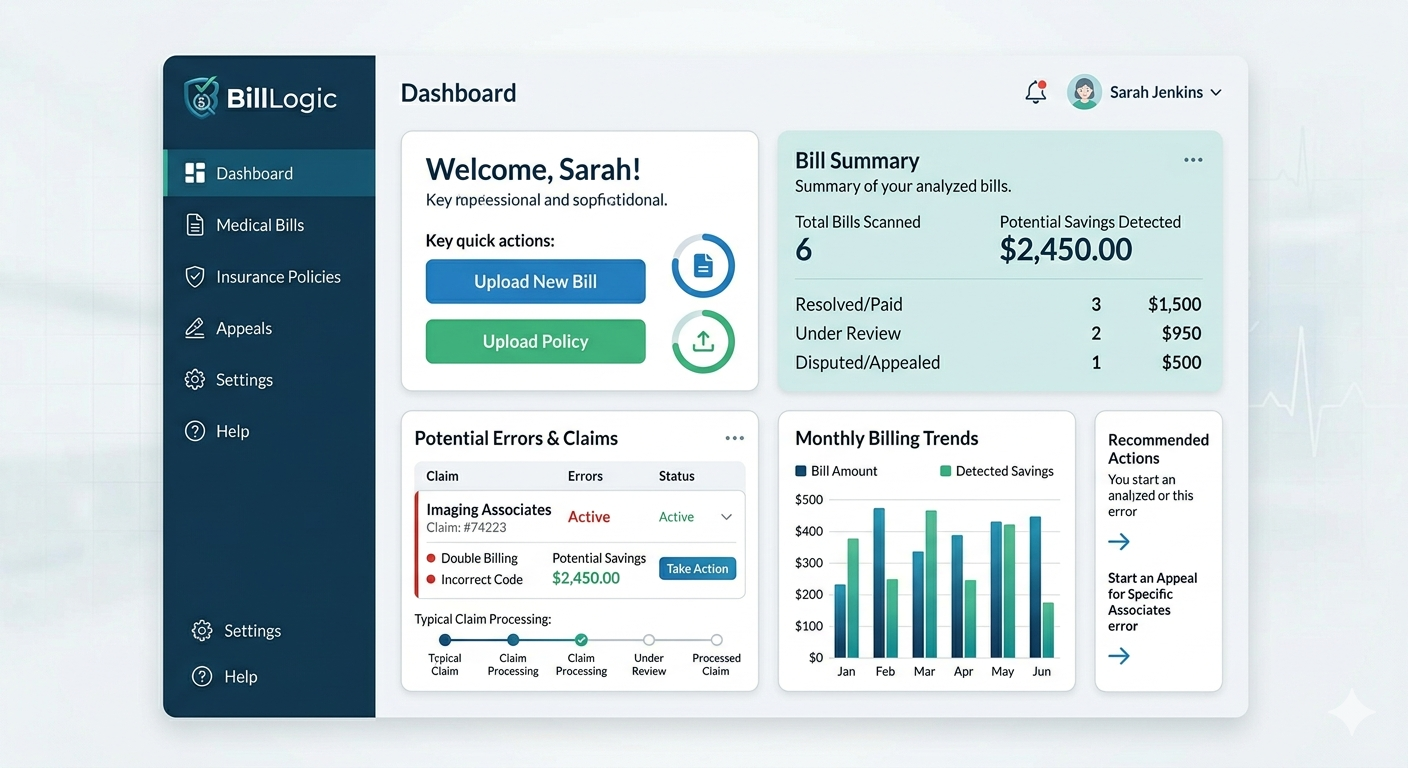
UI/UX Design: As a designer, I prioritized a "Mobile-First" approach in Figma, focusing on clear data visualization so users can see their "Potential Savings" at a glance.
Tech Stack: Built with a React frontend for responsiveness and FastAPI for a high-performance analysis engine.
Challenges we ran into
The biggest hurdle was Document Variability. No two hospitals format their bills the same way. We had to build a robust data-cleaning layer to handle "noisy" text and misaligned columns in scanned PDFs. Additionally, balancing HIPAA-compliant data security with a seamless user experience required careful architecture to ensure all sensitive health information is encrypted and processed with minimal retention.
Accomplishments that we're proud of
We successfully developed an algorithm that can identify a 30% discrepancy in standard procedure billing within seconds—a task that usually takes a human advocate hours of manual work. We are also proud of the UI/UX transition that takes a chaotic, 20-page document and distills it into a simple "Green/Yellow/Red" status indicator for the user.
What we learned
We learned that medical billing is not just a financial problem, but a language problem. Most billing errors go unchallenged because patients are intimidated by the terminology. We also gained deep insights into how ML models can be fine-tuned to understand the nuance between similar medical procedures that have vastly different price points.
What's next for BillLogic
The next phase for BillLogic is the development of an Automated Appeals Generator. This feature will allow users to click a button to generate a legally-sound, data-backed appeal letter addressed to their hospital or insurance provider. We also plan to integrate with hospital price transparency APIs to provide real-time cost predictions before a patient even enters the hospital.
Built With
- design:
- languages:-python
- openai-gpt-4-api-cloud-&-database:-aws-(lambda
- postgresql
- pytorch
- react-(web)-/-flutter-(mobile)-ai/ml:-tesseract-ocr
- s3)
- typescript-frameworks:-fastapi

Log in or sign up for Devpost to join the conversation.