Billing Rep — AI Telecom Billing Agent
Inspiration
Telecom billing becomes difficult to manage when organizations operate across multiple carriers, locations, and contracts. Invoices change, amendments take effect on different dates, and finance teams must distinguish legitimate price increases from charges requiring clarification.
We built Billing Rep to address a practical question: When a bill increases, how can a business determine whether the increase is justified before taking action?
Our goal was to create an AI agent that investigates financial discrepancies using documented evidence, performs verifiable calculations, and keeps people in control of consequential actions.
What it does
Billing Rep is an AI-powered telecom billing assistant that reviews invoices against contracts, pricing amendments, and historical billing records.
The agent:
- Retrieves invoices from a sample accounts-payable inbox or accepts uploaded PDFs.
- Extracts invoice details and compares charges against contractual rates effective on the billing date.
- Distinguishes explained price increases from charges requiring further investigation.
- Runs financial comparisons in an isolated Daytona sandbox.
- Schedules explained payments in a simulated queue.
- Drafts vendor inquiries for unexplained charges and requires human approval before submission.
- Uses browser automation to submit approved inquiries to a synthetic carrier portal and records the confirmation.
- Gives finance teams visibility into billed amounts, disputed charges, promised credits, and realized savings.
The prototype uses synthetic company, invoice, contract, and vendor data. It does not execute real payments.
How we built it
We developed Billing Rep using an agent workflow that combines AI reasoning, structured financial records, deterministic verification, and controlled external actions.
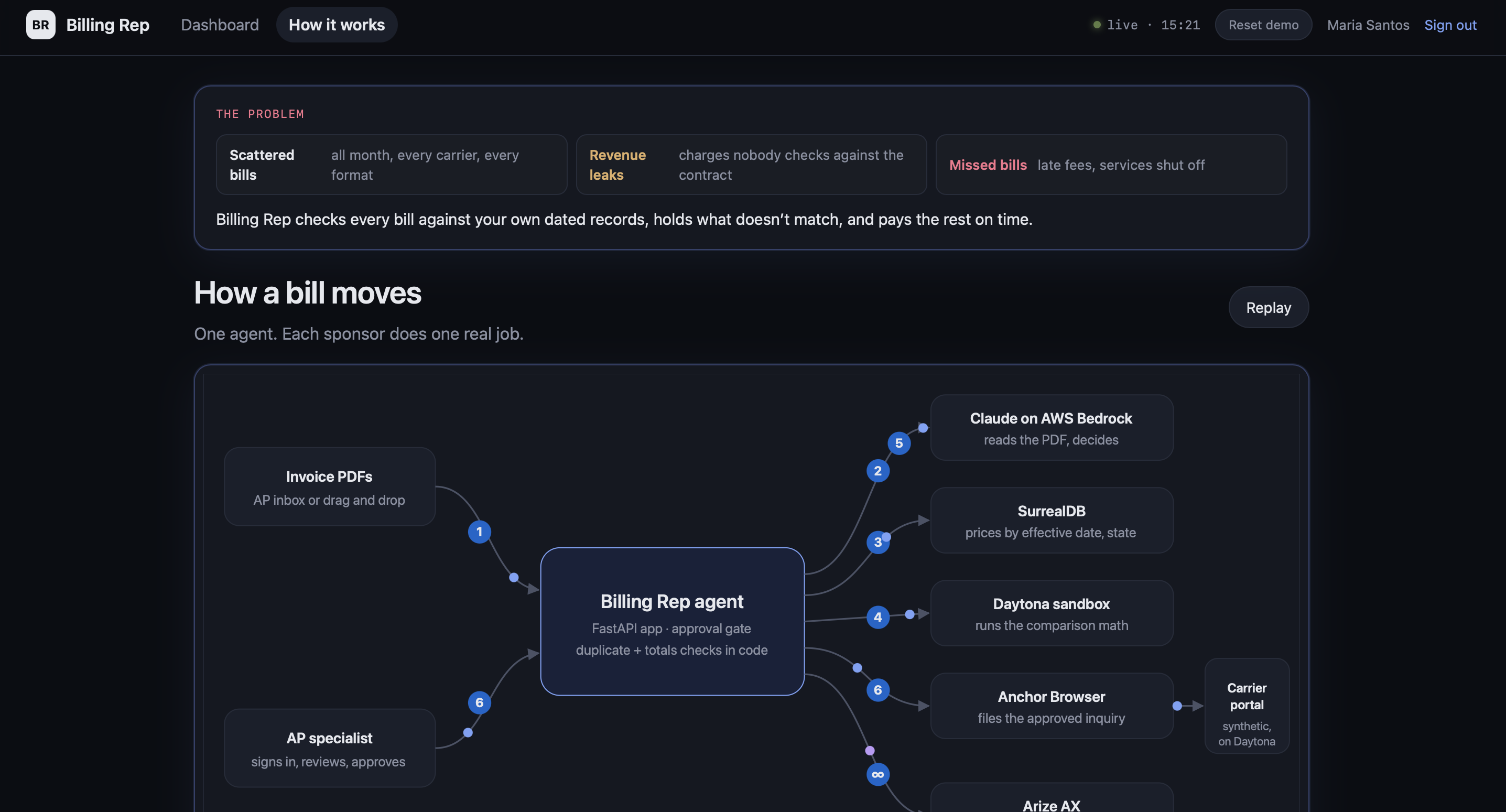
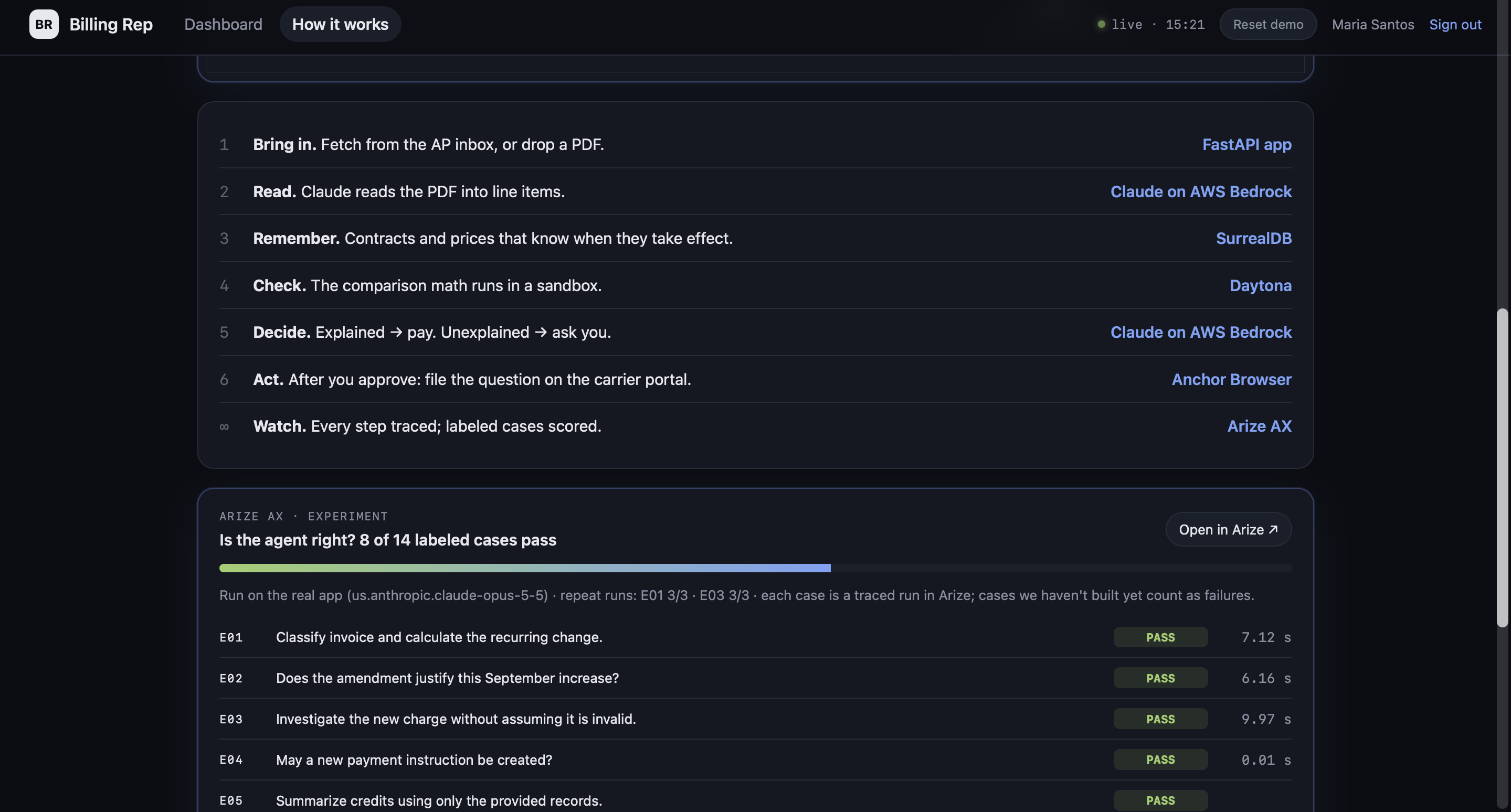
FastAPI powers the application, invoice ingestion, approval workflow, and financial dashboard.
Claude on AWS Bedrock extracts structured information from invoice PDFs and evaluates discrepancies.
SurrealDB stores invoices, contracts, pricing amendments, and their effective dates, allowing the agent to apply the correct contractual terms to each billing period.
Daytona provides isolated execution for invoice comparison calculations and hosts the synthetic carrier portal.
Anchor Browser automates submission of approved billing inquiries through the synthetic carrier portal.
Arize AX provides agent traces and supports evaluation experiments against labeled test cases.
We also implemented application-level safeguards for duplicate invoices, arithmetic validation, contractual evidence, and approval requirements.
Challenges we ran into
One important challenge was making financial reasoning reliable when contractual prices change over time. A charge may be legitimate in October but unsupported in September. We addressed this by comparing invoice dates against the effective dates of contractual amendments.
We also needed to prevent the AI agent from taking unauthorized actions. Approval requirements are enforced in application code rather than relying only on model instructions.
Our Daytona tier also restricted outbound connectivity needed for the Anchor Browser workflow. We therefore hosted the main demo application on a laptop while retaining Daytona for sandboxed calculations and the synthetic carrier portal.
Accomplishments
We built a working prototype that demonstrates:
- Date-aware telecom invoice reconciliation.
- Identification of explained and unexplained billing changes.
- Deterministic financial comparisons in Daytona.
- Human approval before external billing inquiries.
- Browser-based submission with confirmation tracking.
- Financial reporting that separates disputed amounts, promised credits, and realized savings.
- Agent tracing and evaluation through Arize AX.
In our documented evaluation, 8 of 14 labeled test cases passed, including 8 of the 9 cases executed by the application. The two principal demonstration cases each passed three repeat trials.
These are results from a limited synthetic evaluation, not production accuracy claims.
What we learned
The project demonstrates why financial AI agents need more than language-model reasoning. Reliable financial decisions require effective-date checks, reproducible calculations, verified evidence, and explicit authorization for external actions.
It also shows the importance of distinguishing potential billing discrepancies from confirmed overcharges, and promised credits from savings actually realized.
What's next
Our next development priorities are integrating real accounts-payable inboxes, expanding invoice reconciliation and exception handling, improving the evaluation coverage, and supporting authenticated carrier integrations.
We also plan to strengthen production security, operational monitoring, and financial controls before introducing real-world payment workflows.
Our longer-term vision is an auditable financial operations agent that helps businesses investigate billing discrepancies and manage recurring expenses with greater accuracy, efficiency, and accountability.
Built With
- anchor-browser
- arize-ax
- aws-bedrock
- claude
- daytona
- fastapi
- python
- surrealdb

Log in or sign up for Devpost to join the conversation.