Inspiration
Medicare exists to protect older adults and people with disabilities, the very people least able to absorb a surprise medical bill. Yet an estimated 80% of medical bills contain at least one billing error, contributing to roughly $265 billion in overcharges every year. When patients challenge those bills, they succeed about 74% of the time.
The problem is not that disputes do not work. It is that most people never file one. Medical billing is confusing, time consuming, and intimidating, especially for patients already managing illness or living on fixed incomes.
We built BillBacked to close that gap. Instead of expecting patients to become billing experts, we built an AI advocate that reviews bills, explains what it finds in plain language, and helps patients dispute incorrect charges while keeping them in control every step of the way.
What it does
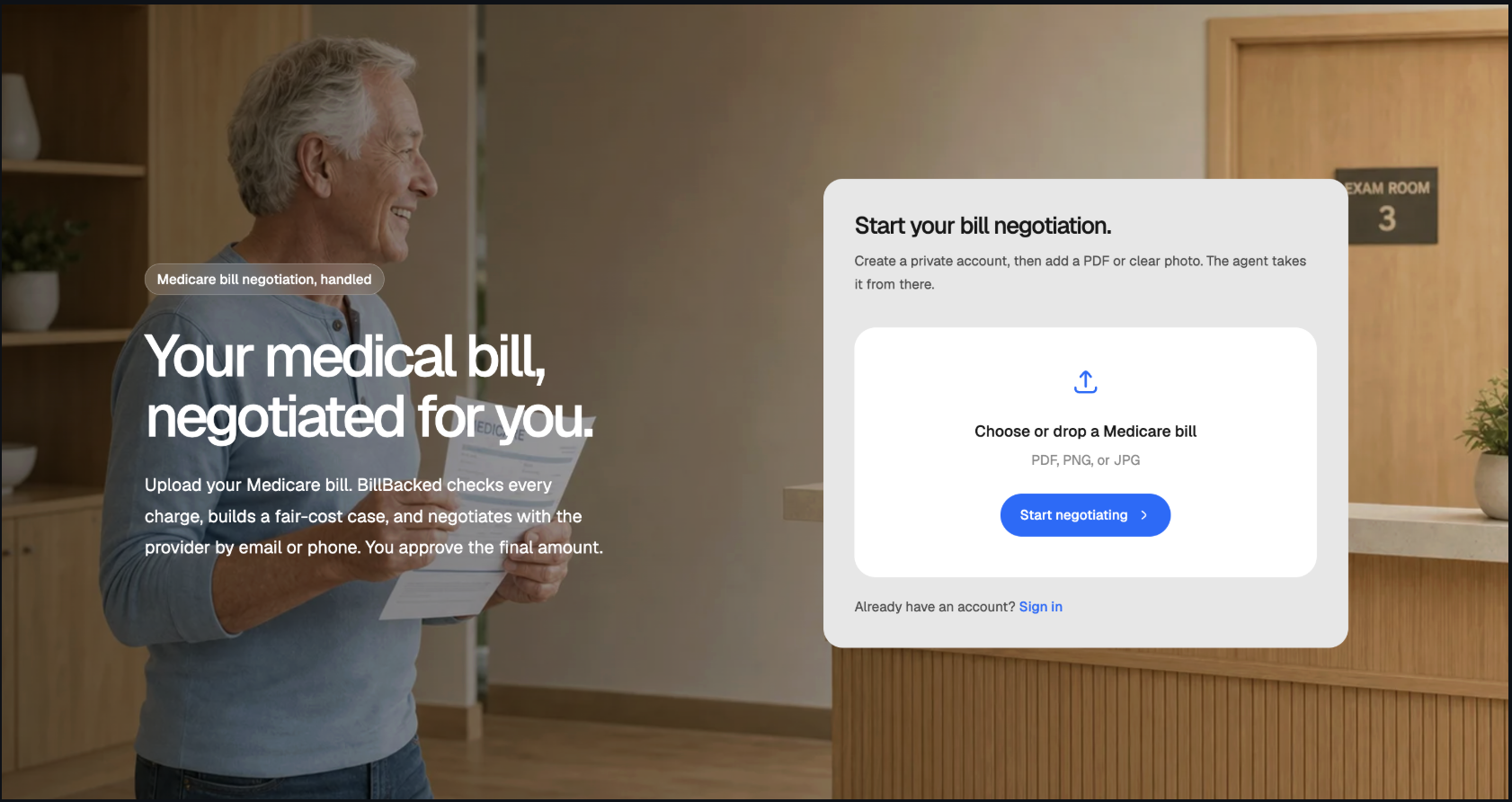
BillBacked audits Medicare bills the way an experienced billing advocate would. A user uploads a Medicare Summary Notice (MSN), Explanation of Benefits (EOB), or provider bill, and four specialized agents process it from start to finish.
The system extracts every charge, compares each line item against official Medicare reimbursement rates, identifies potential billing errors such as overcharges, duplicate billing, and mismatched codes, then ranks the strongest discrepancies. Finally, it generates a dispute letter supported by the evidence it found.
Before anything is sent, the patient reviews the findings, sees the estimated "true cost," and approves every action. Once approved, BillBacked drafts emails or assists with provider communication. A dashboard stores previous audits and negotiations, making the platform an ongoing financial safety net instead of a one time tool.
How we built it
We split the workflow into four specialized agents, each responsible for a single stage of the audit process.
Document Extractor reads uploaded Medicare Summary Notices, EOBs, and provider bills, converting them into structured line items.
Discrepancy Engine compares each charge against the CMS Physician Fee Schedule, Clinical Laboratory Fee Schedule, and other public benchmark data to detect overcharges, duplicate billing, and coding inconsistencies.
Strategist prioritizes discrepancies by financial impact and confidence so users immediately see the strongest issues first.
Composer and Negotiator ("George") drafts evidence backed dispute correspondence that references the identified discrepancies and supporting Medicare pricing data.
Challenges we ran into
The biggest challenge was not negotiation. It was the data itself. Medicare Summary Notices, EOBs, and provider bills all describe the same services in different formats, making reliable comparisons difficult. Building a pipeline that could consistently normalize and reconcile those documents became one of the most technically challenging and impactful parts of the project.
Accomplishments that we're proud of
We are proud that BillBacked is more than a chatbot. It is a true multi agent workflow where each agent has a clearly defined and auditable responsibility. Building that pipeline with Jac's object spatial model during the hackathon was one of our biggest achievements.
We are also proud that BillBacked grounds its recommendations in official CMS reimbursement data instead of relying on an LLM to estimate what a procedure should cost. That makes every recommendation explainable, transparent, and easier for patients to trust.
What we learned
We started by thinking the hardest problem was building an AI that could negotiate medical bills. We finished realizing the harder problem was building one that patients could trust to act on their behalf. That influenced every design decision, from grounding recommendations in public CMS data to requiring user approval before any communication is sent.
What's next for BillBacked
Our next step is partnering with patient advocacy groups and legal aid clinics to pilot BillBacked with real elderly and disabled patients. As we scale, we want to measure and publish the total savings recovered, turning a nationwide billing problem into measurable financial relief for the people who need it most.


Log in or sign up for Devpost to join the conversation.