Inspiration
In India, most hospital costs are paid out of pocket, often as one bill at discharge. The help that exists is real but scattered: PM-JAY and Maharashtra's MJPJAY cover, a legal duty on charity-trust hospitals to keep free and concessional beds, the Chief Minister's and Prime Minister's relief funds, insurance people forget they have, and the simple fact that billing desks negotiate. Families usually find out after paying, if at all. We designed for one moment: a relative standing at a hospital billing counter, stressed, on a budget phone, often more comfortable in Hindi or Marathi than English.
What it does
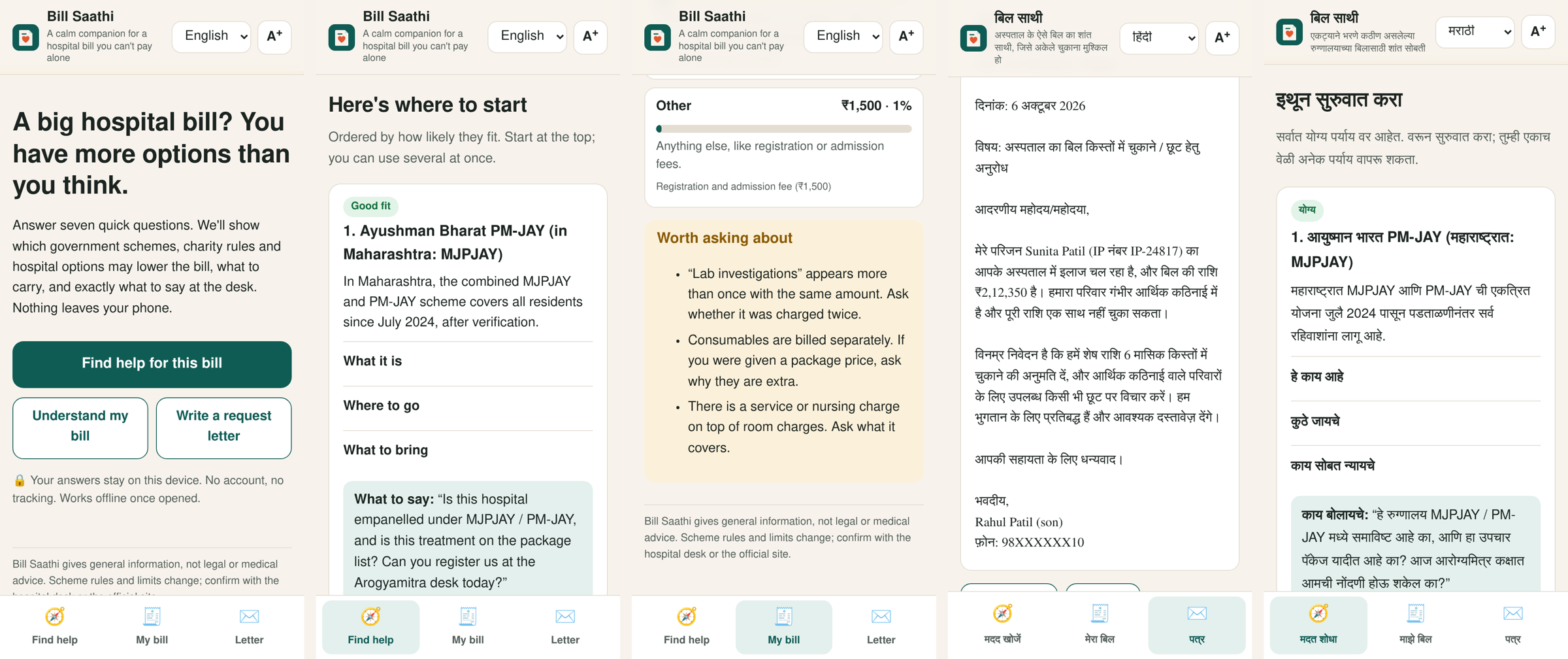
- Find help: seven tap-only questions, about one minute. Bill Saathi ranks the options that may apply (Good fit / Worth applying / Check this / Always ask). Each card says why it may fit, which desk inside the hospital to go to, what to carry, and the exact sentence to say at the desk, with read-aloud and copy buttons, call buttons for official helplines and links to official portals.
- My checklist: every document from the matching options in one tickable, printable list.
- Understand my bill: paste the bill lines and it groups them (room, doctor, surgery, medicines, consumables, tests, nursing), shows each group's share, explains it in plain words, and flags what's worth asking about: duplicate charges, consumables outside a package, nursing on top of room rent, large lump sums.
- Write a request: a polite letter for an itemised bill, instalments or a concession, or a charity (IPF) reserved bed, in English, Hindi or Marathi. Copy, print or share on WhatsApp.
How we built it
A static, installable web app (HTML, CSS and plain JavaScript, with no framework and no backend) hosted on GitHub Pages. A service worker caches it for offline use, so it works in a hospital basement with no signal. All content lives in two data files: the interface text in three languages, and the eight options with their fit rules, documents and desk scripts. Read-aloud uses the phone's own speech engine (hi-IN / mr-IN / en-IN). We tested every screen with Playwright on a 390 × 844 phone viewport and audited accessibility with axe-core.
Design decisions
- Screen time is stress time. One question per screen, tap targets of 52 px or more, auto-advance after a choice, "Not sure" always allowed, and the most useful thing, what to say, highlighted on every card.
- Language from the start. Every string, all eight options and all three letters exist in English, Hindi and Marathi. Switching language re-renders the current screen in place, keeping your answers and your letter.
- Accessible by default. Semantic HTML, a skip link, live regions, a visible focus ring, a text-size toggle, dark mode, reduced-motion support and read-aloud. axe-core reports 0 WCAG 2.1 AA violations on every screen, in light and dark mode.
- Private. No account, no analytics, no server. Answers stay in the browser on that phone.
- Honest about uncertainty. It never says "you are eligible". It says "good fit", why, and what to ask. Every option links to its official source and shows when the rules were checked (October 2026).
Challenges we ran into
- Facts that change. Scheme rules, income limits and coverage change often and are spread across government resolutions. We verified each one against official portals (e.g. the Maharashtra Charity Hospital Help Desk: 1800-123-2211; income limits ₹1.8 lakh free / ₹3.6 lakh concessional), cited them, and designed the cards to send people to the right desk rather than promise an outcome.
- Three scripts, one layout. Devanagari needs more line height and longer labels. We tuned spacing per language and avoided fixed-width buttons, so Hindi and Marathi never truncate.
- Ranking without overclaiming. A low-income family at an unknown private hospital should see "ask if this is a charity trust" near the top, because it can mean free treatment, without being told they qualify.
Accomplishments that we're proud of
- A full flow in three languages that a stressed person can finish in about a minute, with no typing.
- Zero automated accessibility violations, offline support, and no data collection.
- Letters that turn a hard conversation into a polite, specific, printable request.
What we learned
In a crisis, the most valuable UI element isn't information; it's the exact sentence to say next. Designing "what to say at the desk" first changed every other screen.
What's next for Bill Saathi
- Other states' schemes and charity rules, starting with Karnataka, Telangana and Delhi.
- A photo-to-lines bill reader that runs on the device.
- Field testing with medical social workers at a public hospital.
Built With
- axe-core
- css3
- github
- html5
- javascript
- localstorage
- playwright
- pwa
- service-worker
- web-speech-api

Log in or sign up for Devpost to join the conversation.