-
-
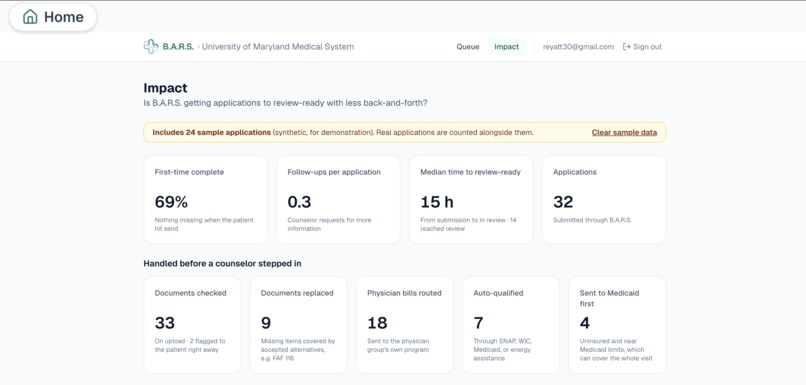
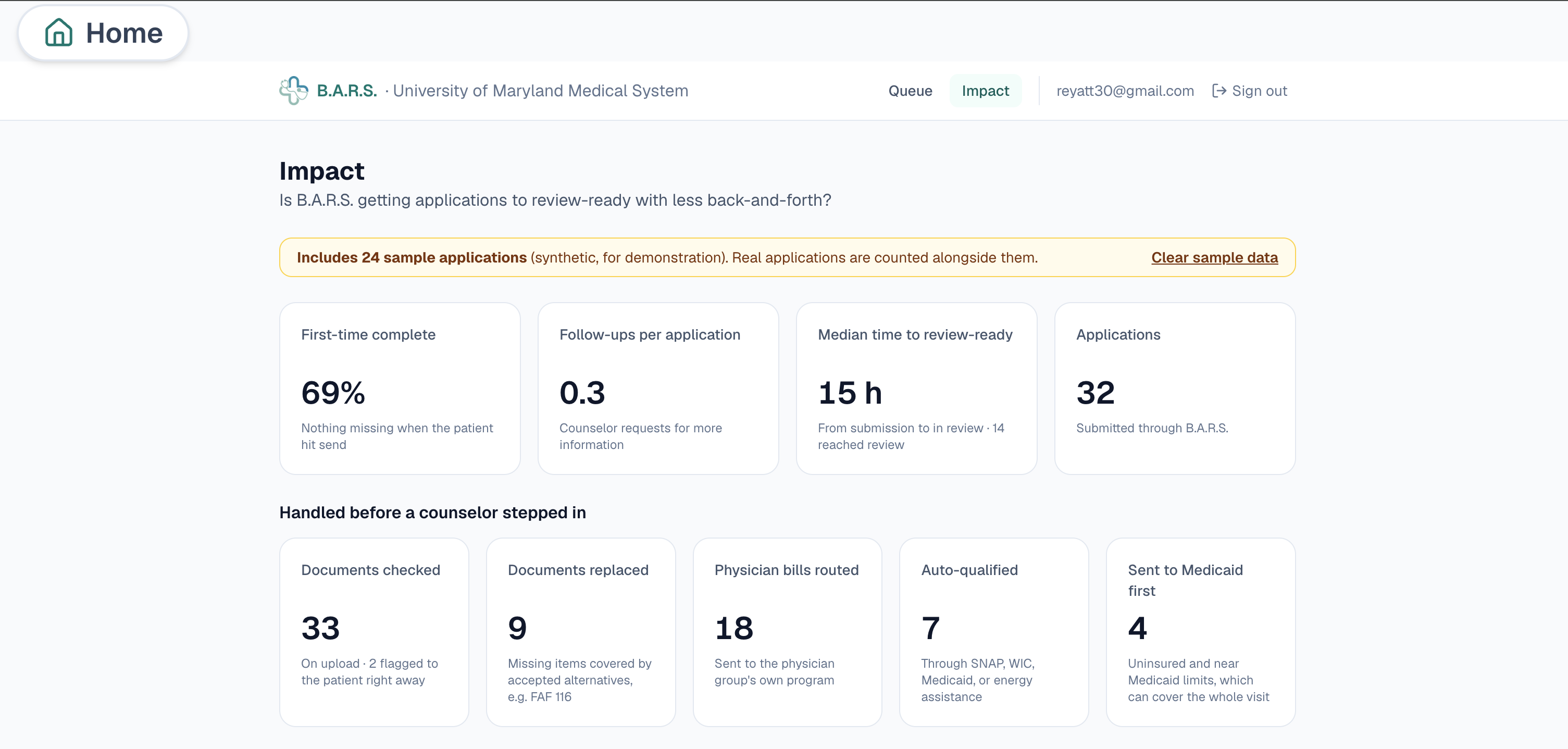
Counselor Impact View
-
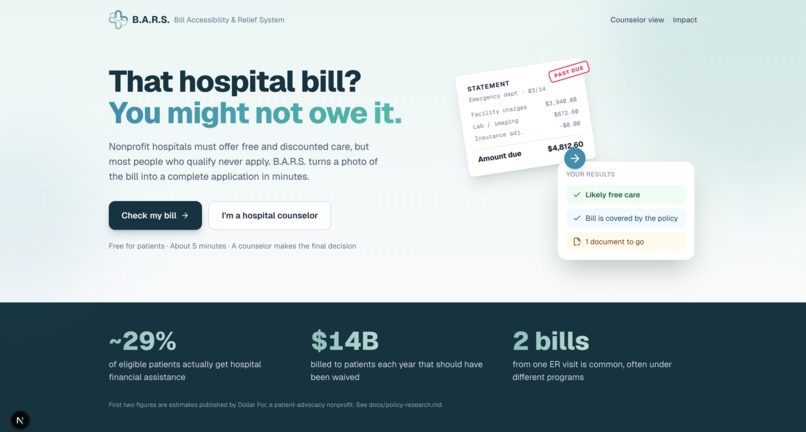
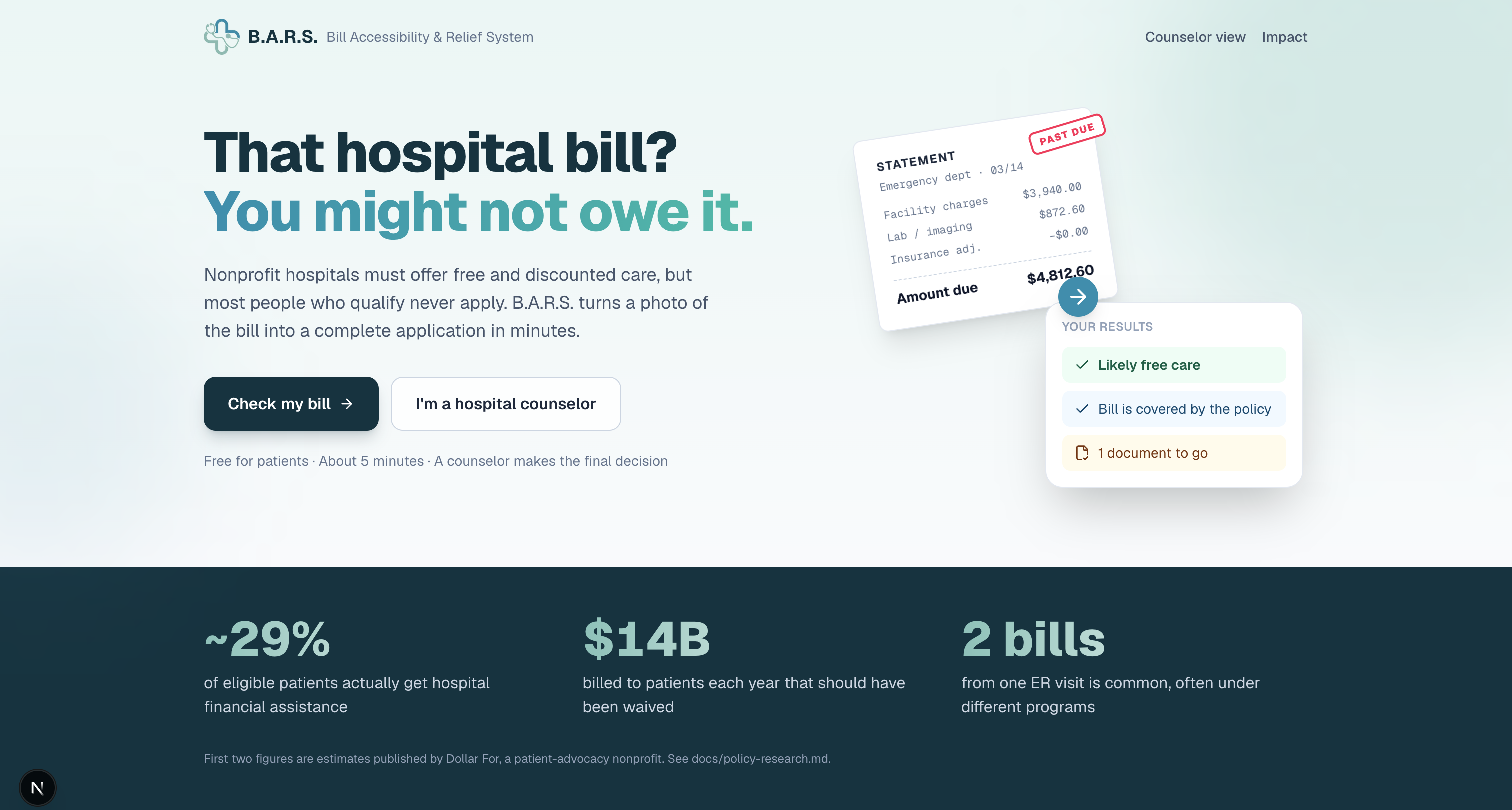
Home Page
-
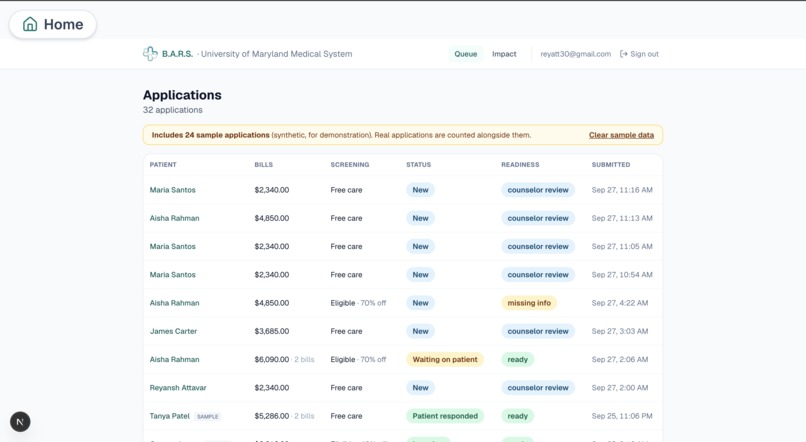
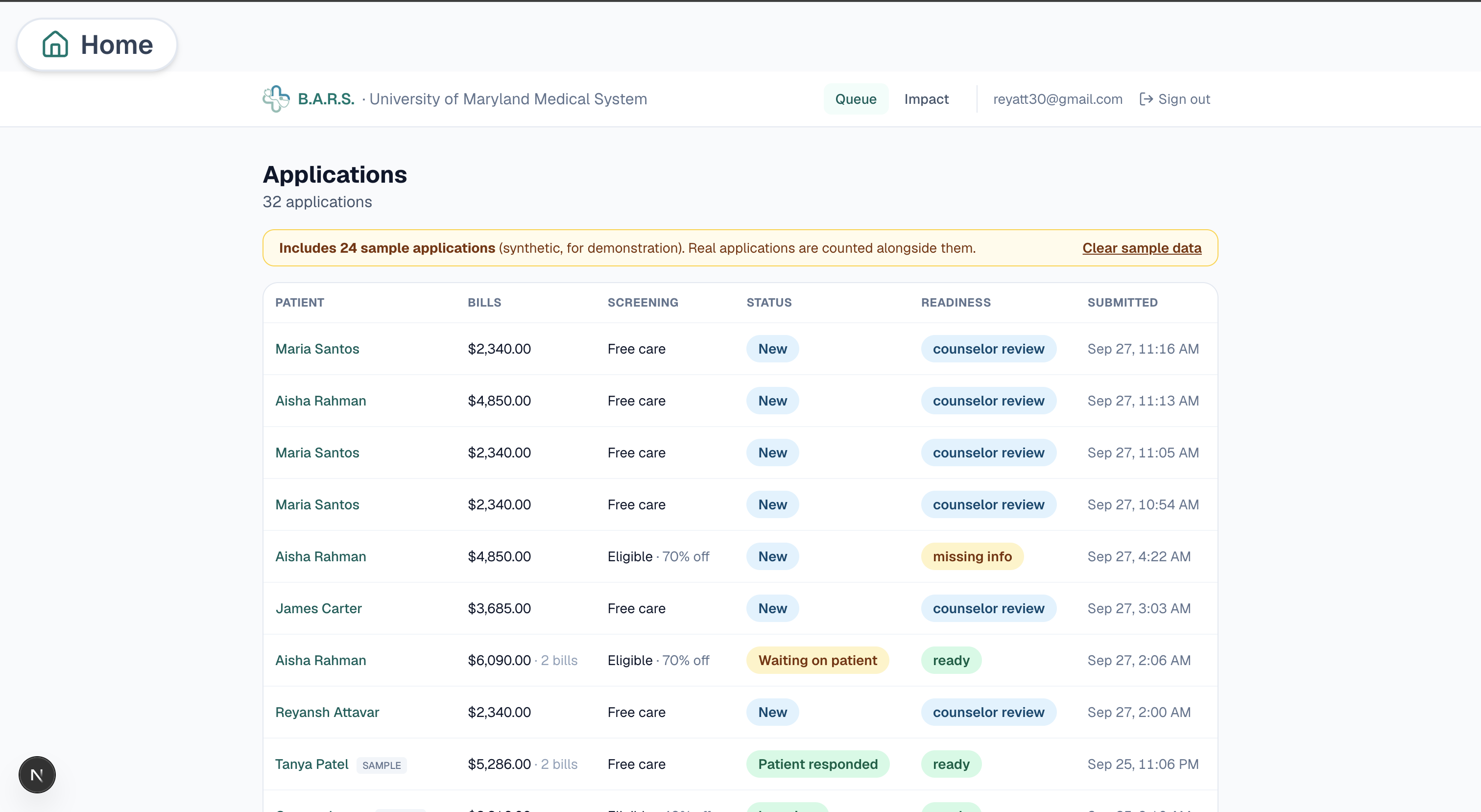
Counselor Queue View
-
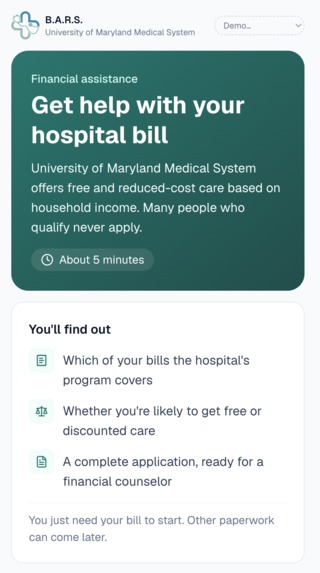
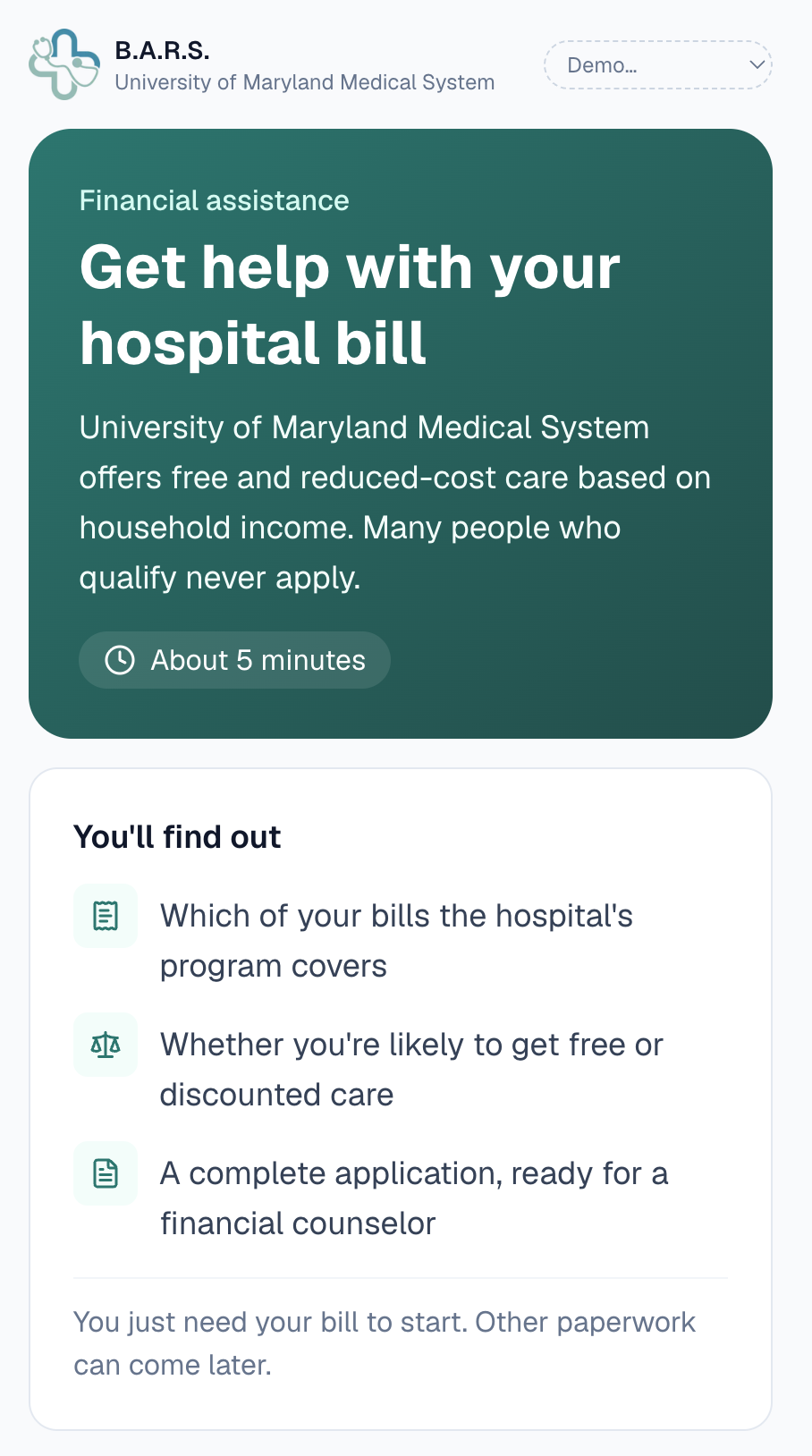
Patient View
Inspiration
Hospital bills are confusing, and they arrive when people can least afford them. Most nonprofit hospitals are legally required to offer free or discounted care to lower-income patients, yet the patient-advocacy nonprofit Dollar For estimates that only about 29% of eligible patients actually receive it, and that roughly $14 billion a year is billed to patients who should have been forgiven. The obstacles aren't eligibility. They're confusion and paperwork:
- People don't know the program exists.
- They can't tell which charges it covers. One ER visit often produces separate hospital and doctor bills under different programs.
- They get stuck when asked for documents they don't have, like pay stubs after a layoff.
We wanted to connect a specific bill to a complete, ready-to-review application.
What It Does
B.A.R.S. (Bill Accessibility & Relief System) is a B2B2C platform that transforms confusing hospital bills into fully complete, review-ready financial assistance applications.
Patient Interface ->
- Patients upload a photo of their bill and complete a 5-7 question screening in their preferred language.
- It will give the patients clear answers to confusing and complicated parts of the bill, provide information about which bill the hospital covers, and start their application process.
- Physician bills that the hospital policy doesn't cover are routed to the right program, with a number to call.
- Uninsured patients near Maryland's Medicaid limits are shown that Medicaid could cover the whole visit, with a concrete "apply by" date so retroactive coverage still reaches their bill.
- It also resolves missing documents by having a "I don't have this" option to quickly provide alternate options and also verify documents currently uploaded to make sure they are correct, not outdated and verified with factual information.
Counselor Dashboard ->
- Financial counselors log into a secure UI to view application packets that are strictly categorized by readiness. Instead of acting as administrative clerks chasing paperwork, counselors receive organized packets with patient-confirmed data, verified policy rules, and flagged exceptions requiring their final legal sign-off.
When a bill comes from a hospital we don't know yet, B.A.R.S. finds that hospital's published policy online, extracts its rules with page citations, validates them against state law, and queues them for an admin to approve. Three Maryland hospital systems are currently in the system.
How we built it
- Our rules engine is defined in TypeScript, built from the real UMMS Financial Assistance Policy (12 household sizes, 10 discount bands, presumptive eligibility, the financial-hardship rule) and Maryland Medicaid's 2026 income limits, all verified against official sources. There are 37 automated tests.
- Anthropic API calls read bills and uploaded documents, search the web for hospital policies for any hospital not already in our system, and extract policy rules into our format.
- Database and auth is supported by Supabase Postgres with row-level security. Counselors sign in through Supabase Auth with Google. Patients use private links whose secret key is stored only in scrambled form.
- Policy import pipeline is as follows, find -> download -> extract data -> validate -> draft -> human approval. Each hospital's policy is versioned, and every application records which version screened it.
Challenges we ran into
Policies across hospitals are messy. Many documents were found to be contradicting each other on appeal deadlines. We had to deal with this by marking uncertain aspects for counselor human review. Another challenge we ran into is automating the hospital policy search for each new hospital rather than having to upload each hospital into our system manually.
Accomplishments that we're proud of
Every eligibility result cites the policy page it came from, and the rules match the published documents. It works on real hospitals like MedStar and Johns Hopkins' actual policies. It also incorporates smart AI usage, guaranteeing that AI never makes a final decision without human approval.
What we learned
It is very challenging to create a complete application for everybody as everyone has a different scenario that can make it challenging for the normal process of financial assistance.
What's next for B.A.R.S. (Bill Accessibility & Relief System)
Adding more hospital systems and states is our biggest factor in expanding B.A.R.S., although this means keeping track of many different hospital policies. Integration with hospital billing systems so that bill data arrives automatically.
Built With
- anthropic
- api
- api-integration
- claude-ai
- data-management
- database
- next.js
- pipeline
- postgresql
- react
- react-native
- rules-engine
- supabase
- tailwind
- typescript


Log in or sign up for Devpost to join the conversation.