-
-
Dashboard
-
Report an Outage
-
Community Signals
-
Evidence Pack
BijliPulse — Turning Power Outages into Community Evidence
Inspiration
Electricity interruptions can disrupt studying, remote work, businesses, and everyday life. When residents experience outages individually, it can be difficult to understand whether other people in their neighborhood experienced similar interruptions or to organize those experiences into useful evidence.
I built BijliPulse for WarriorHacks 2.0 to explore a simple question: what if communities could turn individual electricity outage reports into a clearer picture of local disruption?
The goal is to make community-reported information easier to organize, interpret, and communicate without pretending that reports are official or independently verified facts.
What it does
BijliPulse is a community-focused electricity outage reporting and evidence platform.
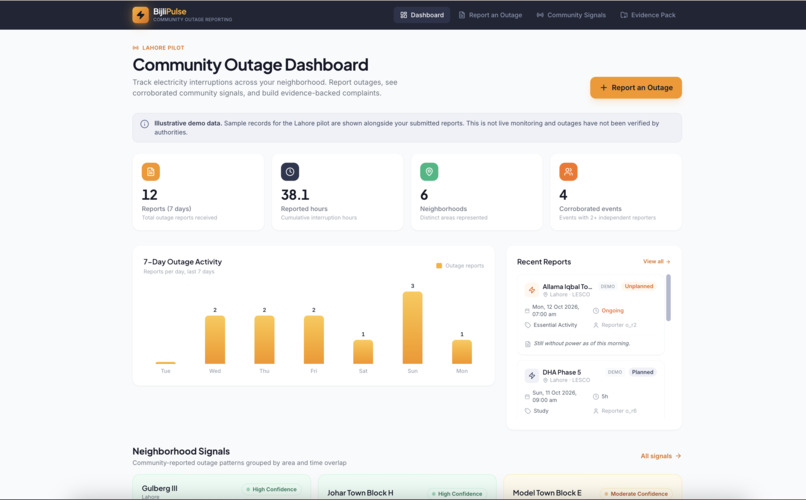
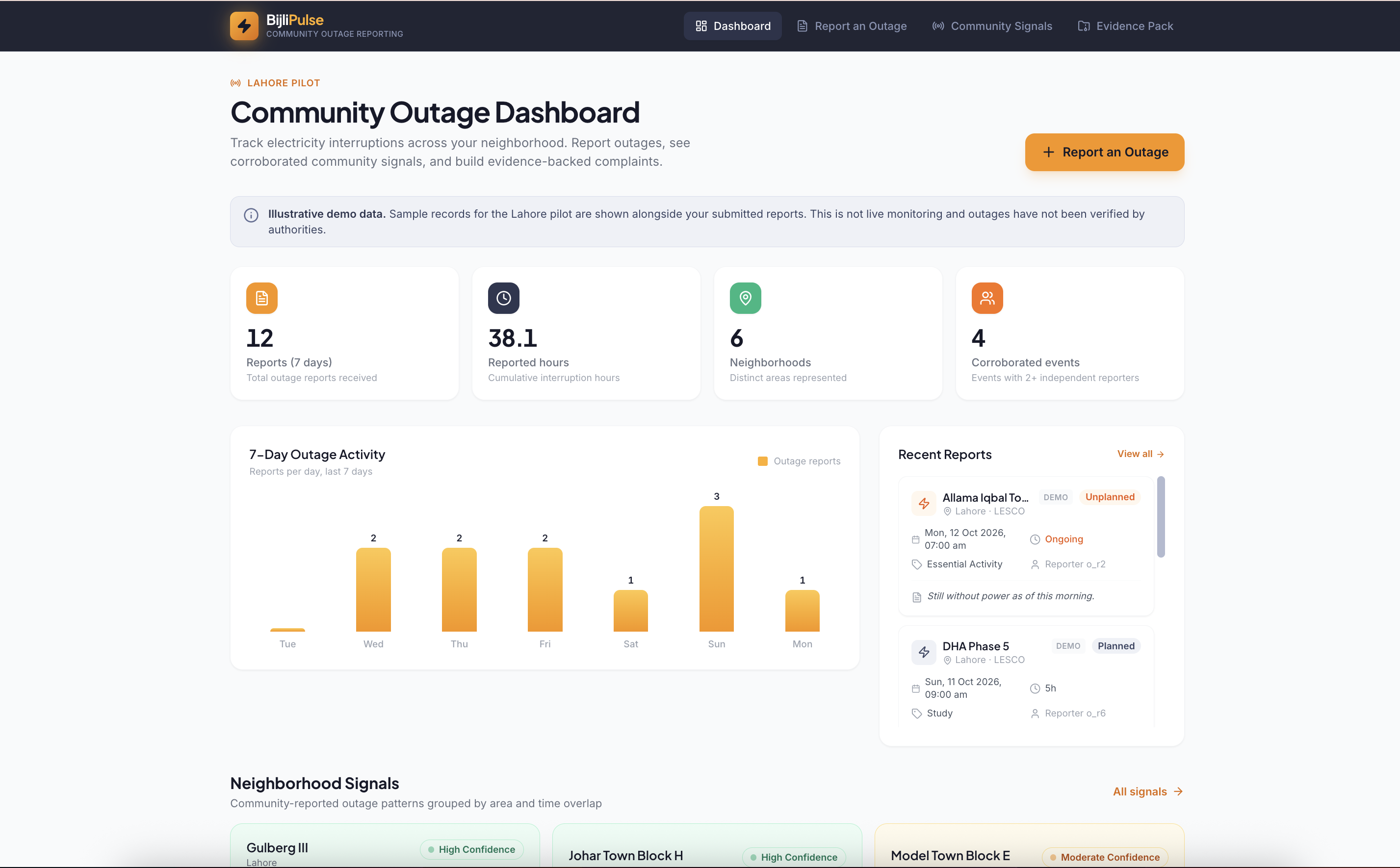
- Community dashboard: Summarizes recent reports, reported interruption hours, represented neighborhoods, and outage activity.
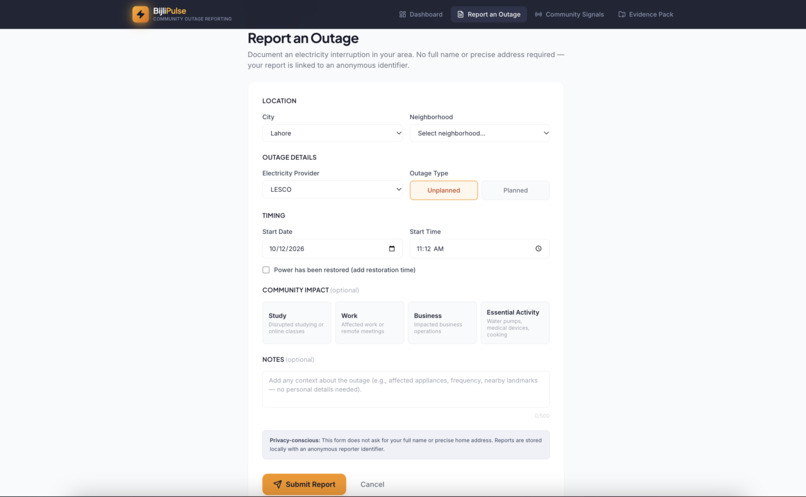
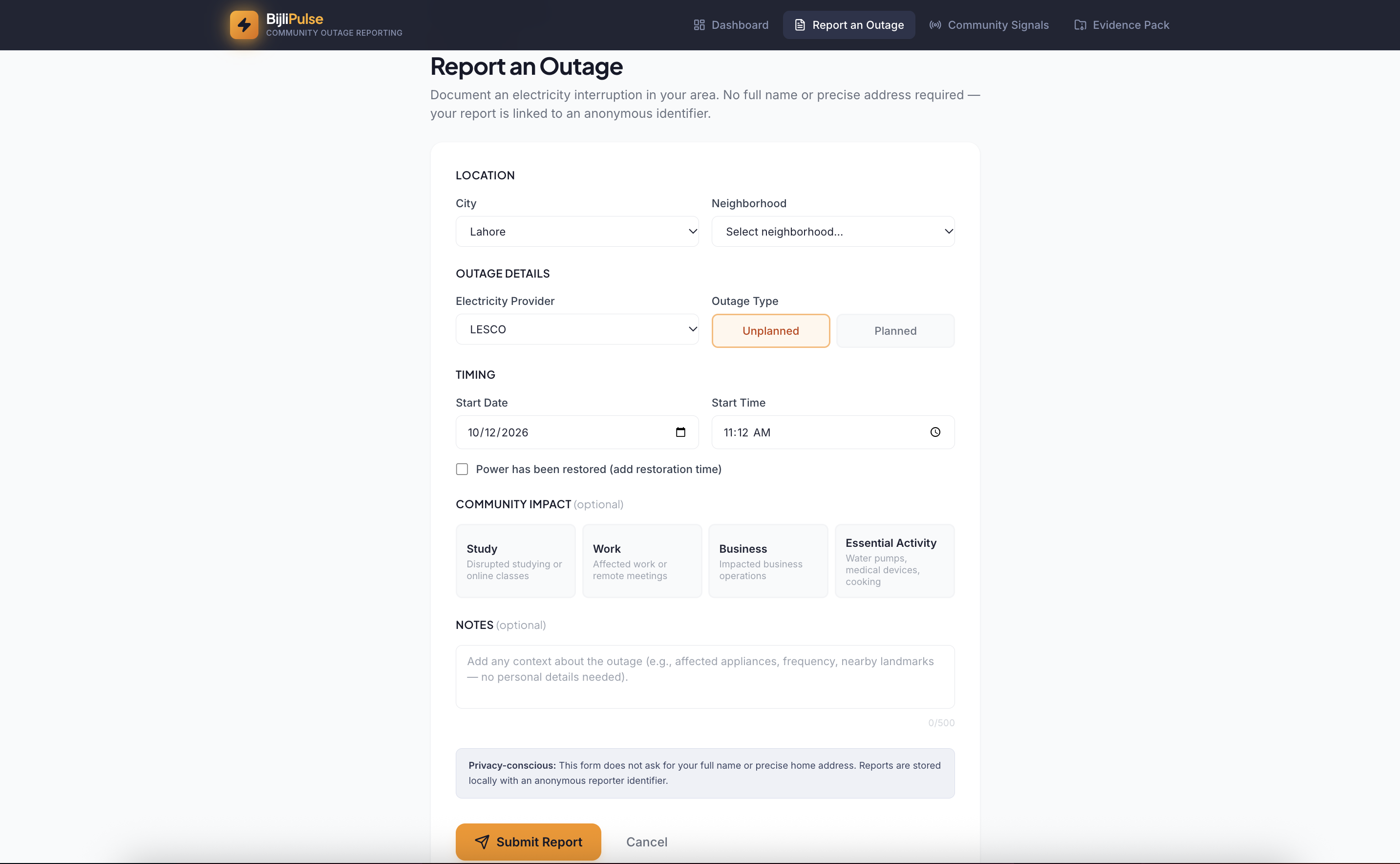
- Structured outage reporting: Allows residents to record their neighborhood, electricity provider, outage type, timestamps, and reported impact.
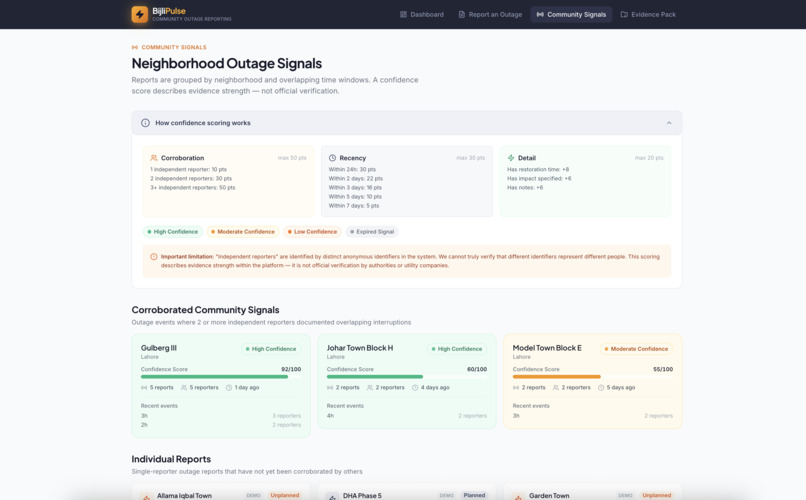
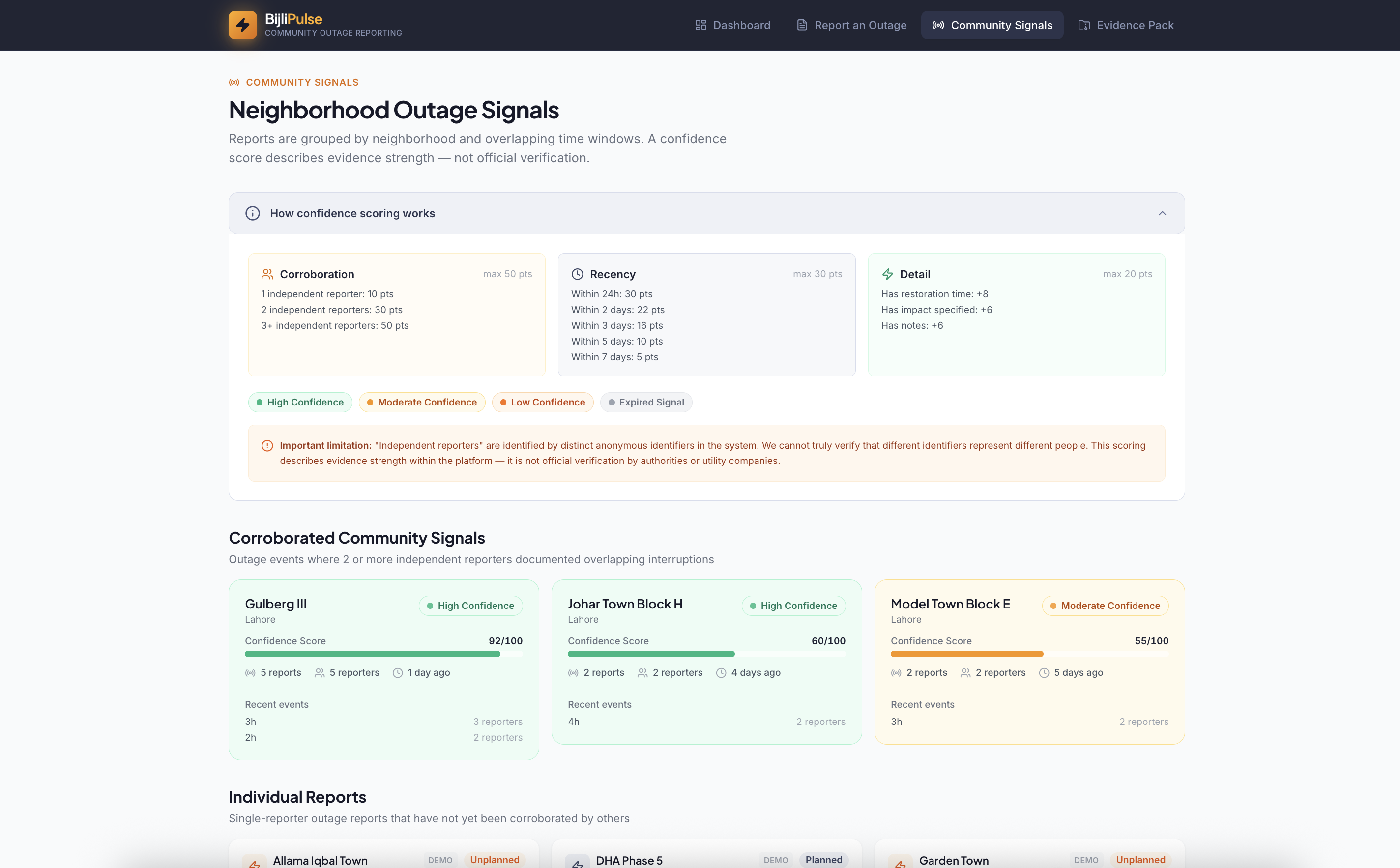
- Community signals: Groups reports by neighborhood and overlapping outage windows to reveal potential patterns.
- Transparent confidence scoring: Uses corroboration, recency, and report detail to calculate a deterministic confidence score, with maximum contributions of 50, 30, and 20 points respectively.
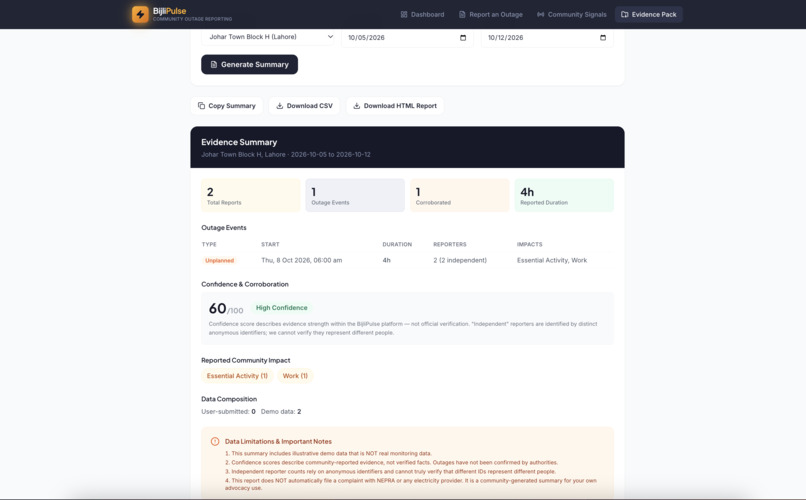
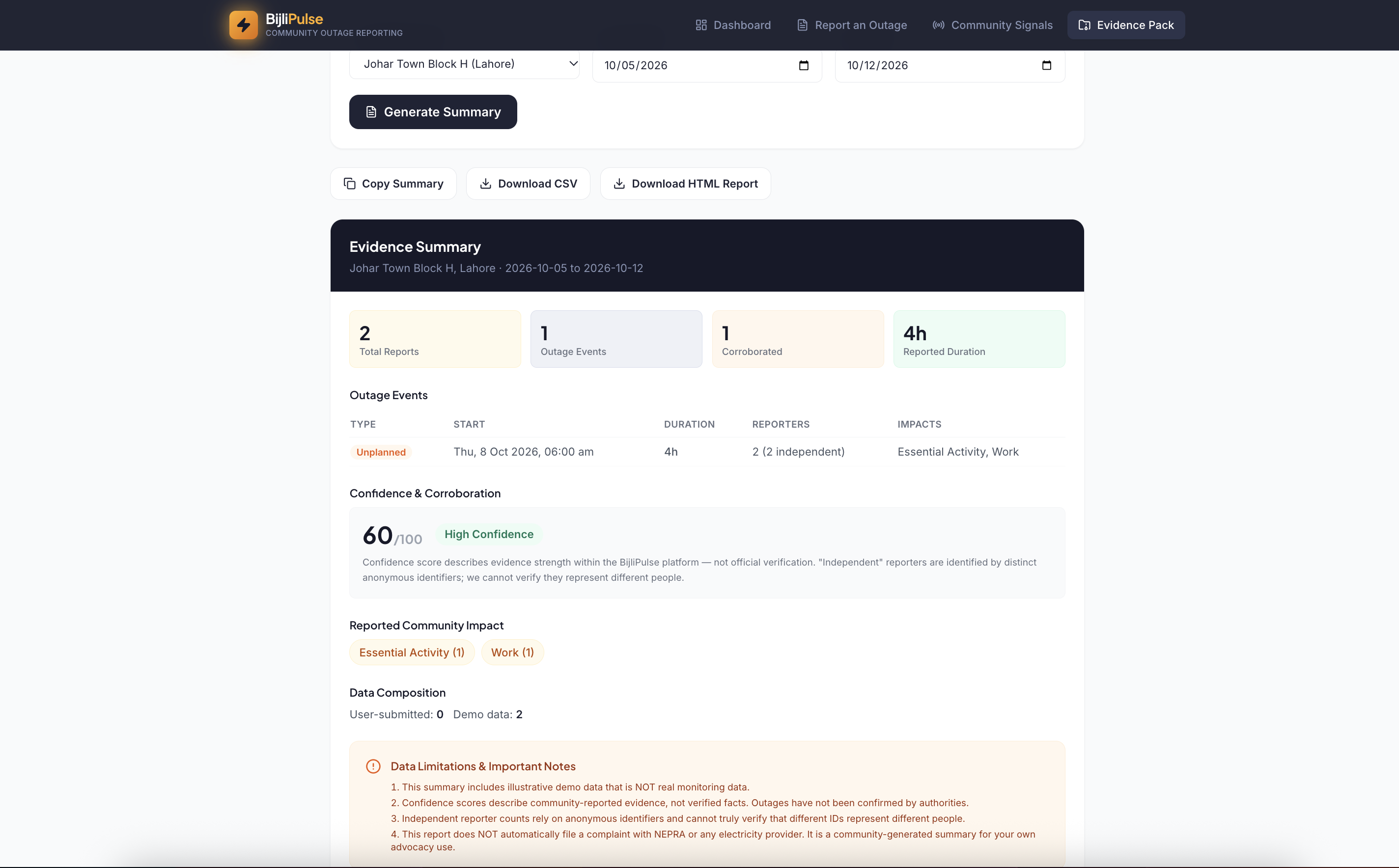
- Evidence Pack: Generates a structured summary for a selected neighborhood and date range, with downloadable HTML and CSV options.
- Privacy-conscious design: Does not require a full name or exact home address to submit a report.
The application distinguishes individual reports from corroborated community signals and explains when there is insufficient evidence for a reliable conclusion.
How I built it
I built BijliPulse using React, TypeScript, Vite, and Tailwind CSS.
The application uses a deterministic data-processing approach to group reports, calculate confidence scores, and prepare evidence summaries. User-submitted reports are stored locally in the browser using localStorage, while illustrative demo records are kept separate from submitted reports.
This approach keeps the prototype lightweight and usable without external API keys or a live utility data feed. The interface includes a dashboard, reporting form, community signals view, and evidence-generation workflow.
Challenges we faced
One of the main technical challenges was designing a confidence score that communicates evidence strength without implying official verification. A recent report, a detailed report, and several overlapping reports contribute different kinds of evidence, but anonymous reporting cannot reliably establish that every submission comes from a distinct individual.
Another challenge was making the evidence useful while being transparent about its limitations. BijliPulse therefore separates individual reports from corroborated signals, distinguishes outdated activity, and identifies when available data is insufficient.
The development process also required attention to data safety, timestamp validation, browser persistence, and accurate reporting. The application's reset and clipboard actions were refined to avoid misleading success messages or unintentionally deleting submitted reports.
What I learned
Building BijliPulse reinforced the importance of designing for trust, not just functionality. A useful civic-tech tool must communicate where its information came from, what the system can reasonably infer, and what remains uncertain.
I also learned how deterministic processing, transparent scoring, careful state management, and exportable evidence can create a meaningful workflow without requiring an unnecessarily complex AI system.
Community impact
BijliPulse aims to help residents organize their experiences of electricity interruptions into clearer, more structured community evidence. Such summaries could help people identify recurring patterns and prepare better-informed communications with their electricity provider or relevant authorities.
Limitations and future direction
BijliPulse is a prototype, not a live electricity monitoring service. It does not connect to a live grid feed, independently verify outage reports, or automatically submit official complaints. Demo records are illustrative, confidence scores reflect the available reports, and user-submitted reports are currently stored in the local browser rather than a shared community database.
Future development could include a secure shared reporting database, stronger duplicate-report detection, independently sourced outage information, and carefully verified integrations with relevant utility complaint channels.
BijliPulse turns scattered reports into a clearer signal for community action.
Built With
- civic
- css3
- data-visualization
- html5
- javascript
- localstorage
- react
- tailwind-css
- tech
- typescript
- vite

Log in or sign up for Devpost to join the conversation.