-
project fame
About the Project (BiggiEyes Protocol)
I built BiggiEyes Protocol to solve two recurring problems in NFTs:
1) trust in “rarity” and NFT assignment, and
2) opaque tokenomics, where users can’t see where mint value flows after purchase.
The goal is a system where fairness is provable and the economy is fully readable on-chain in real time. That’s why the core is powered by Chainlink VRF v2 Plus (verifiable randomness) and Chainlink Automation (reliable, auditable operations that keep the ecosystem running without manual intervention).
What inspired me
- Projects that claim fairness but rely on hidden off-chain logic.
- Communities that want to understand pricing and treasury flows instead of “trusting the team”.
- Building a protocol that can scale into multiple collections/episodes under a single tokenomics system.
What I learned
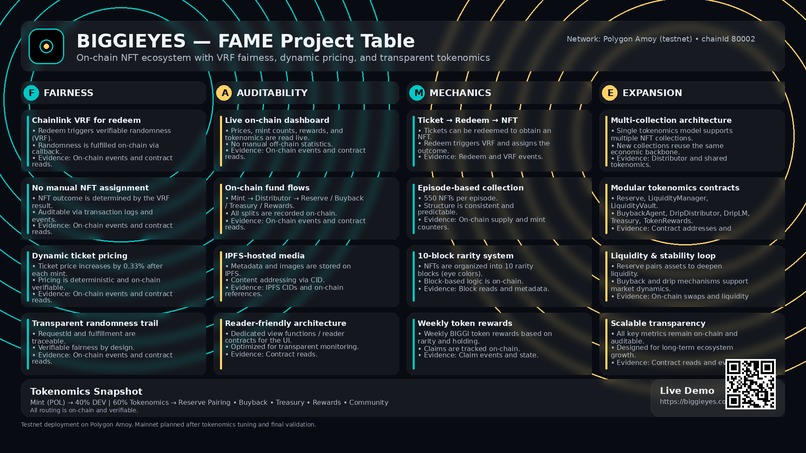
- How to design a full end-to-end on-chain flow: Ticket mint → redeem → VRF request → VRF callback → NFT mint + metadata/pricing updates.
- How to combine VRF (fairness) with Automation (operations) to reduce human error and make system behavior predictable.
- DeFi integration patterns: DEX liquidity operations, LP management, slippage/deadline policies, and LP custody in a vault.
- “Trust by design”: Reader/snapshot contracts + a dashboard that reads critical metrics directly from on-chain state.
How I built it (architecture)
1) Core VRF minting
Users mint a ticket and then redeem it. Redeem triggers a VRF request through a router adapter:
BiggiVRFRouter.requestRandomFor(minter, ticketId)- Chainlink VRF v2 Plus later calls
fulfillRandomWords(...) - The router forwards the result to the main contract:
fulfillRandomFromRouter(requestId, randomWord)
The VRF output selects the final NFT (IPFS-hosted metadata) and updates on-chain parameters (e.g., dynamic pricing state).
2) Tokenomics and transparent value flow
Mint value is routed through a Multi-Collection Distributor into multiple ecosystem branches (reserve / buyback / rewards / treasury / community).
All important state is aggregated through reader contracts and displayed live in the dashboard.
3) Rewards system
- Weekly BIGGI rewards for holders (rarity/block-weighted, claimable on-chain).
- CollectionRewards: milestone-based rewards paid out on-chain in the native token (rules and payouts are fully auditable).
4) Liquidity branch (Reserve → LM → Vault)
The Reserve holds pairing funds, the Liquidity Manager adds liquidity on the DEX, and LP tokens are stored in a Liquidity Vault.
The dashboard exposes reserve/treasury balances, LP health, pair pricing, and ecosystem metrics.
5) Automation (Chainlink Automation)
Chainlink Automation is used for:
- buyback upkeep (threshold + cooldown + policy checks),
- automated maintenance of the Reserve → LiquidityManager → LiquidityVault branch,
- automated DRIP routines.
Pricing growth math (Markdown + LaTeX)
Ticket price increases by (0.33\%) after each mint:
[ P_{n} = P_{1} \cdot (1.0033)^{(n-1)} ]
The cumulative sum over (N) mints is a geometric series:
[ \sum_{i=1}^{N} P_i = P_1 \cdot \frac{(1.0033)^N - 1}{1.0033 - 1} ]
This matters because users can verify the live on-chain price and see exactly why it changes.
Challenges I ran into
- RPC reliability and event history: ensuring consistent dashboards required fallback RPCs and, when needed, archive endpoints.
- Contract verification: matching compiler/optimizer settings and constructor arguments across many modules.
- Security and edge cases: reentrancy protections, pausability, role management, and rollback behavior when DEX calls fail or liquidity is insufficient.
- VRF UX: making the request lifecycle transparent (request → pending → fulfilled) so users always understand what’s happening.
- Tokenomics consistency: keeping distributor splits, buyback, DRIP sell-back, and reserve pairing measurable and auditable.
Why it matters
BiggiEyes Protocol isn’t just a mint page. It’s a complete on-chain ecosystem where:
- fairness is provable (Chainlink VRF),
- ecosystem operations are automated and auditable (Chainlink Automation),
- tokenomics is transparent in real time (dashboard + readers),
- and the design supports multiple collections/episodes under one shared tokenomics.
Built With
- and-drip-routines-**polygon-(amoy-testnet)**-?-target-evm-network-for-deployment-and-testing-(chainid-80002)-**uniswap-v2?style-dex**-?-router/factory/pair-integrations-for-swaps
- and-on-chain-price-discovery-**openzeppelin-contracts**-?-ownable/ownable2step
- automatio
- buyback
- distributor
- drip
- fallback-rpc-providers-**ipfs**-?-nft-metadata-and-assets-(multi-gateway-fallbacks)-**netlify**-?-frontend-hosting-and-deployment-(env-based-configuration
- ipfs
- liquidity
- liquidity)-**chainlink-vrf-v2-plus**-?-verifiable-randomness-for-nft-assignment-(router-adapter-+-callback-flow)-**chainlink-automation-(keepers)**-?-automated-buybacks
- liquidity-branch-maintenance-(reserve-?-lm-?-vault)
- liquidity-provisioning
- node.js
- pausable
- reentrancyguard
- reserve
- rewards
- safeerc20-**react-+-vite**-?-frontend-dashboard-(vrf
- signer-flow
- tokenomics
- treasury
- user-panels)-**ethers.js-(v6)**-?-contract-reads/writes
- vrf


Log in or sign up for Devpost to join the conversation.