-
-
Big Sister OS - social media launch image
-
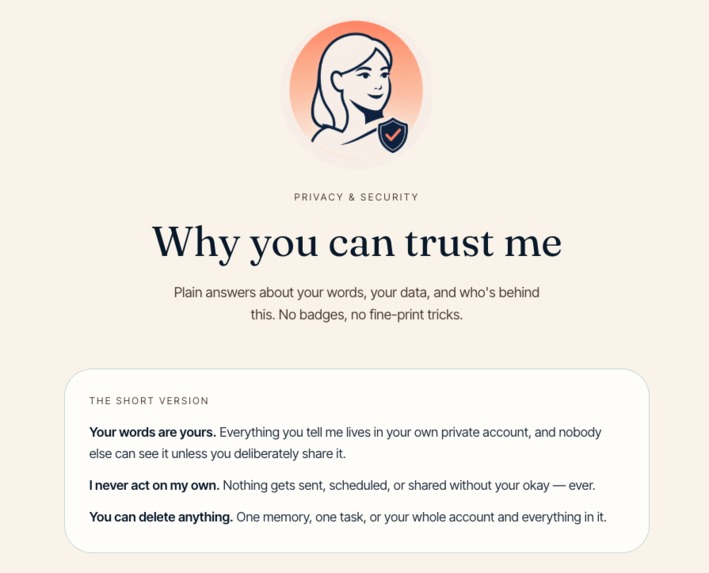
Why you can trust me
-
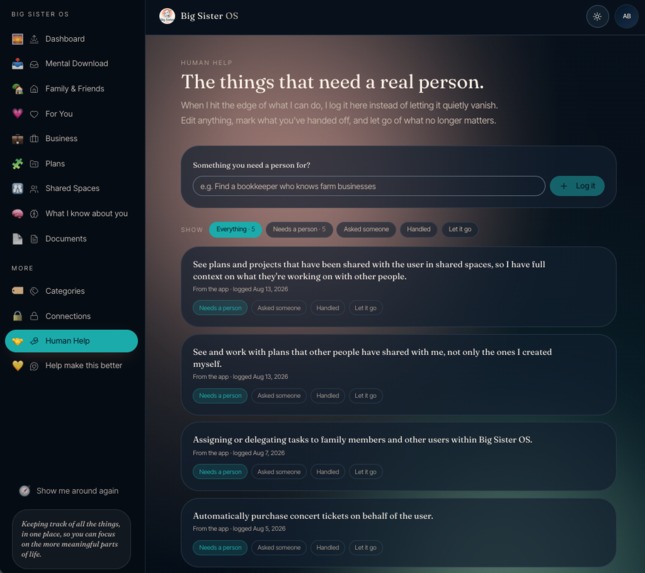
Today's 3
-
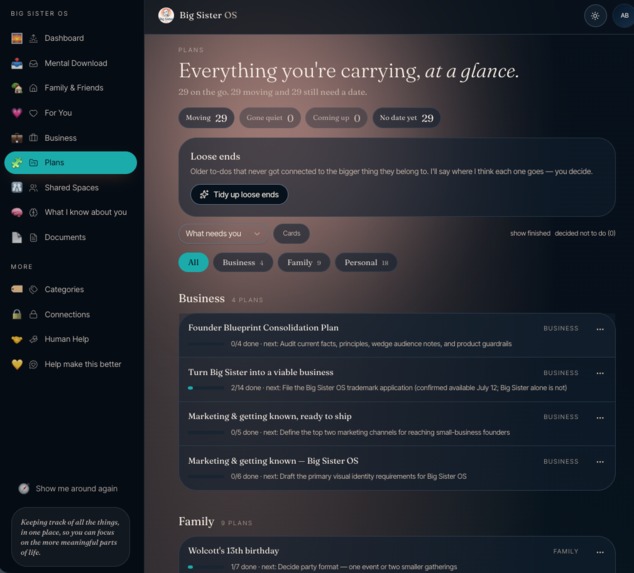
Everything you're carrying
-
FB Testimonial
-
From overwhelmed to moving forward
Inspiration
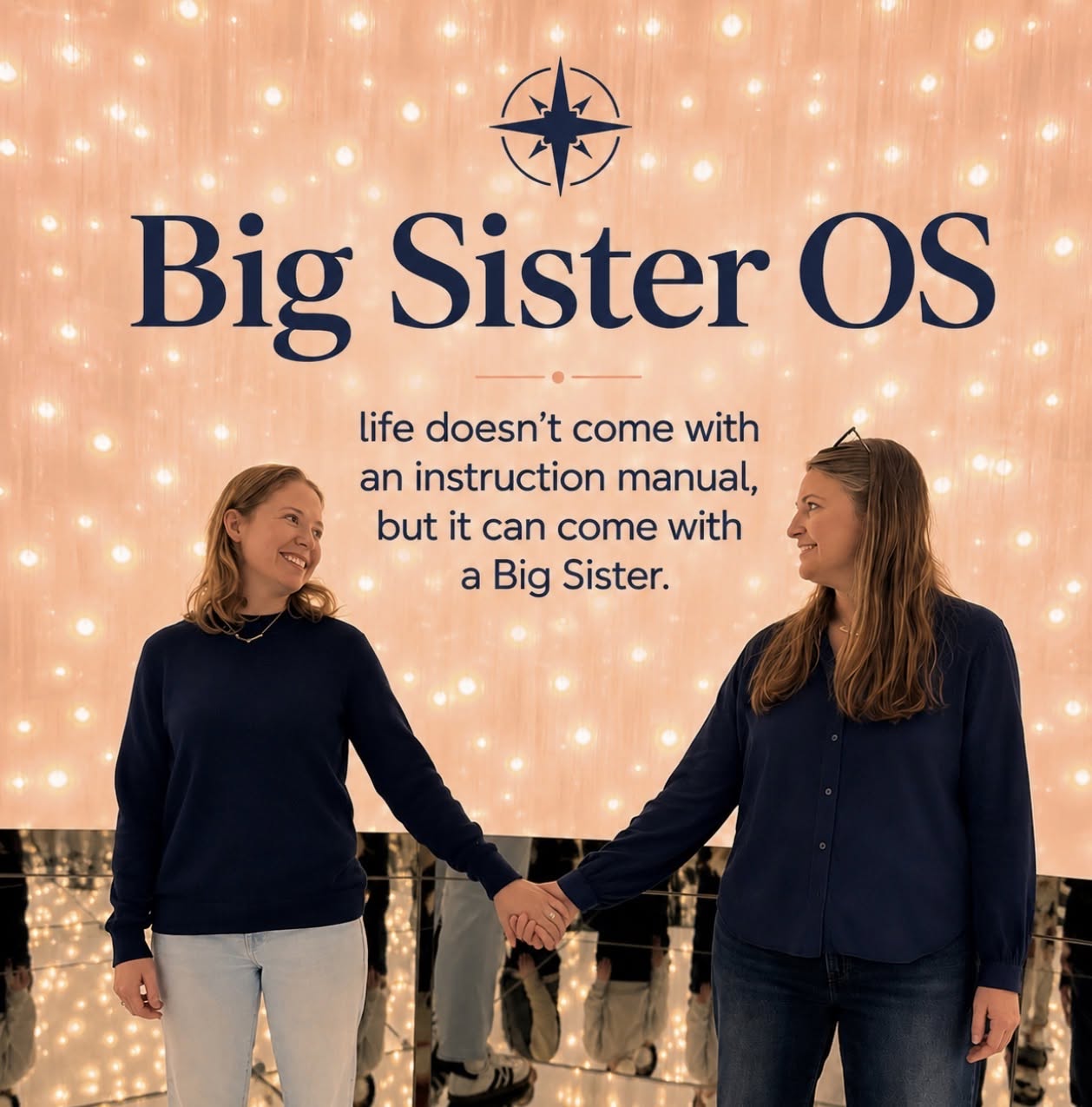
The name came before the app. "Big Sister" started as a brand idea — a deliberate answer to Big Brother. Orwell gave us the AI story everyone fears: something that watches you, knows everything about you, and uses it against you. A big sister is the exact opposite of that. She knows everything about you because you told her, she's unmistakably on your side, she does the work — and she never goes behind your back.
The problem she exists for is one I'd watched for years: capable, ambitious small business owners drowning not in the hard decisions, but in the mess — the inbox, the follow-ups, the "I'll deal with that later" pile that never shrinks. Every AI tool answered their questions and then handed the work right back. And everywhere I looked I heard about AI for business — never AI for the whole person. Because a small business owner isn't two people; the school pickup and the client invoice live in the same head. I wanted everyday people to get what AI can actually give: relief from the clutter and chaos of daily life, time back for the things only we can do — and maybe even the things we've been saving for "one day" that never seems to come.
I almost didn't build her. My godfather kept encouraging me to enter the Google Gemini XPRIZE — build a real AI-run business, judged on actual revenue — and I kept writing it off. A hackathon? I'm in no way a techy coder. But the truth I finally admitted to myself: I've spent over a decade managing enterprise tools and project management platforms and driving user adoption. I know software — I just don't write it. And with vibe coding and what frontier AI can do now, that stopped being a disqualifier.
So on June 24 — already deep into the contest window — I started building.
What it does
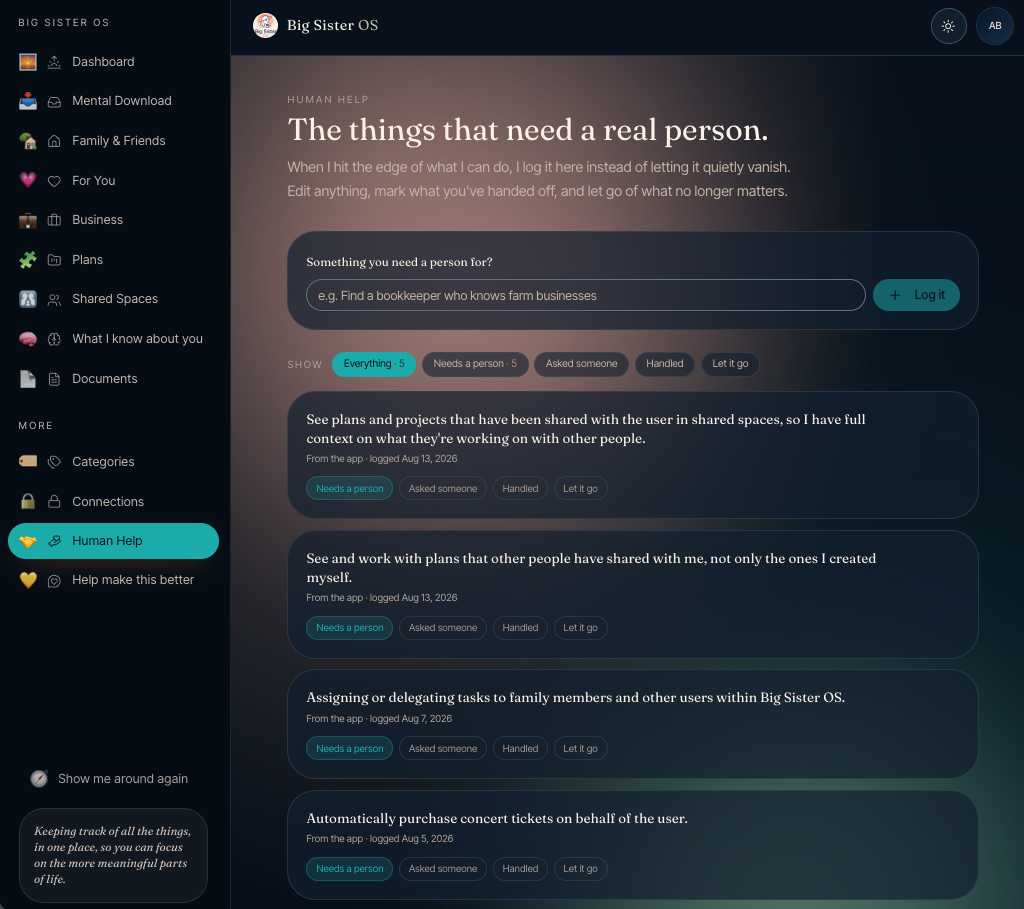
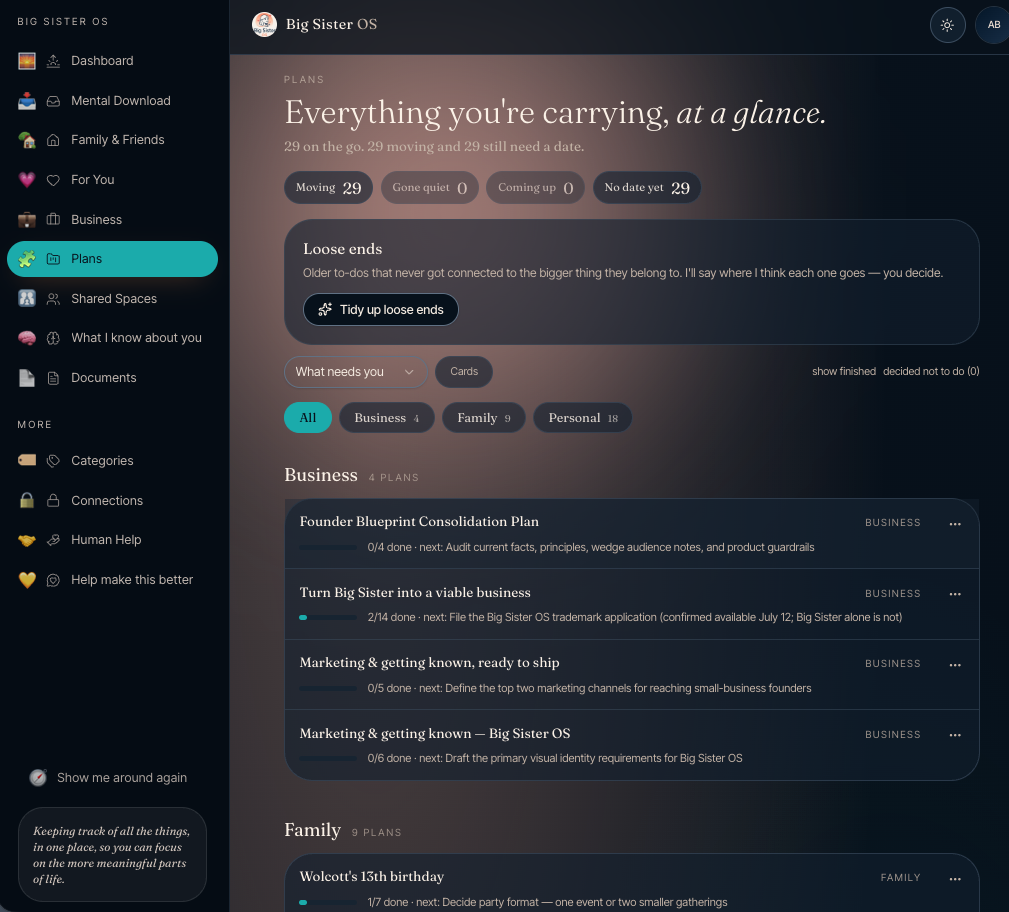
You dump everything on Big Sister — a voice-of-your-head brain dump, pasted notes, whatever's rattling around. She sorts it into real tasks, calendar events, people, and projects, then comes back with proposals: a plan, a drafted email, a researched answer.
Then she does the work, through a team of specialist agents:
- Drafter writes the actual email or document
- Researcher goes and finds the answer
- Campaign Designer builds a full marketing campaign, images included
- Analyst reviews the business numbers
- Loop Closer sweeps the last two weeks and follows up on her own proposals — what got agreed, what shipped, what stalled, what's worth letting go
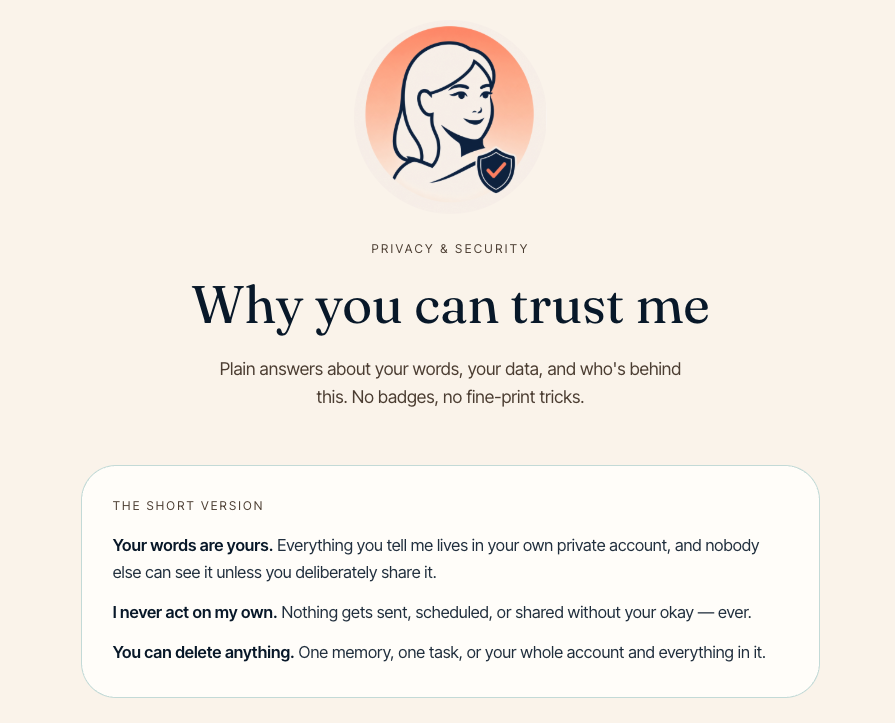
The one rule that everything else hangs on: nothing is ever sent or acted on without your yes. That's not a promise in the marketing copy — it's enforced in code. Anything she creates lands in a proposed state you approve, every fact she extracts about you waits for your sign-off before it enters her memory, and there is a test suite pinning the gate shut.
She's also honest about two things most AI products fudge: she tells you plainly that she's an AI, and she never implies abilities she doesn't have — her own system prompt includes a machine-generated list of what she can, could, and cannot do.
How we built it
"We" is literal here: one non-engineer founder directing AI. I don't write code. After a false start (see Challenges), I settled on a hybrid: Lovable for the app scaffold, cloud, and deploys, and Claude Code for the deep engineering — directed session by session — product decisions, taste calls, and sign-off on every plan — while the AI wrote, tested, and reviewed the implementation. Big Sister herself thinks on Google Gemini.
The architecture has one load-bearing idea: one brain. Every surface in the app routes through a single reasoning module — no feature gets its own forked prompt. Around that brain sits a deterministic framework: registries declare what tools, agents, and connectors exist, code decides what's possible, and the model only chooses among declared options. Every model output that selects an action is validated server-side before anything happens.
The stack in plain terms: a modern React web app (TanStack Start, React 19, Tailwind), Supabase for accounts and data via Lovable Cloud, and all model calls through one gateway module — so switching or adding providers is a one-file change, with automatic fallback if Gemini has a config problem. Real Stripe billing, real legal pages, and a self-serve account deletion that was verified against the production database with a 32-check test: every trace of a departing user gone, everyone else's shared work intact.
By submission the app carried 1,365 passing automated tests, a clean typecheck, and a custom build verifier — more on why that exists below.
Challenges we ran into
Finding a workflow a non-engineer could actually drive. My first attempt was Google Antigravity — installed on June 24, the very day I decided to go for it. After two days of trying to get somewhere with it, I was genuinely stuck and completely frustrated — it's built for developers who can read what the agents are doing, and I couldn't. So instead of forcing it, I pivoted to the tools I'd already paid for and knew how to use, even if only at a beginner level: Lovable and Claude Code. That pivot was the unlock — everything below happened after it. It wasn't frictionless: I sometimes worked in both at once, and the code each pushed would land in conflict. But I learned a lot resolving those collisions, and six weeks later I had a tool that actually worked.
Green tests, broken production. The nastiest bug of the whole build: the production bundler silently deleted the agent registrations as "unused code." All 488 tests passed — tests don't tree-shake — while the deployed app classified every task as human-only. The fix was structural (registration that can't be shaken out) plus a new script that greps the actual production bundle for every agent and fails loudly if one is missing. That script later caught its own false alarm and got hardened again.
Her first suggestion was filler. The first time we asked "what should we work on?", she proposed a reminder — the one thing the product promises not to be. Root cause: our sorting loop was working too well. It filed dates and people into structured tables the reasoning pass didn't read, so the pass was told to find approaching dates while receiving none. We fixed the inputs, not the prompt — and computed the date math in code instead of trusting the model to do arithmetic.
Reading reality instead of assuming it. A session that actually read our Stripe account (instead of trusting the plan) found the advertised founding discount didn't exist and zero webhooks were configured — a customer could pay and never be marked subscribed. One API call caught what weeks of assumptions missed.
A living app moving underneath us. The Lovable-plus-Claude-Code conflicts had a bigger cousin: with multiple AI sessions shipping in parallel, one session started work 266 commits behind reality. That staleness nearly shipped a bug that would have dropped every birthday from the calendar. "Fetch first" is now the first line of the roadmap.
The Google Cloud maze. Getting direct Gemini access took four sequential locks — an org policy, a disabled API, a key restriction, and a billing subtlety (the $300 free-trial credit deliberately doesn't cover Gemini API prepay) — across an account with five near-identical projects. The lasting fix: automatic provider fallback, so no single config problem can knock her offline during a demo.
Accomplishments that we're proud of
- The trust promise is code. Propose-and-approve is enforced at the data layer — we even caught and closed a hole where a merge function could fold unapproved AI content past the gate, and pinned it with tests.
- Big Sister helps run Big Sister's business. Her Analyst agent produces the revenue-by-month business review the XPRIZE asks for — the contest months are literally its default reporting window — and the Loop Closer follows up on her own proposals: what got agreed, what shipped, what stalled. An AI that holds itself accountable.
- A non-engineer shipped production software in six weeks — to real paying customers. Live billing, privacy policy and terms, production-verified account deletion, row-level security on every table, and 1,365 passing tests — with AI as the entire engineering team.
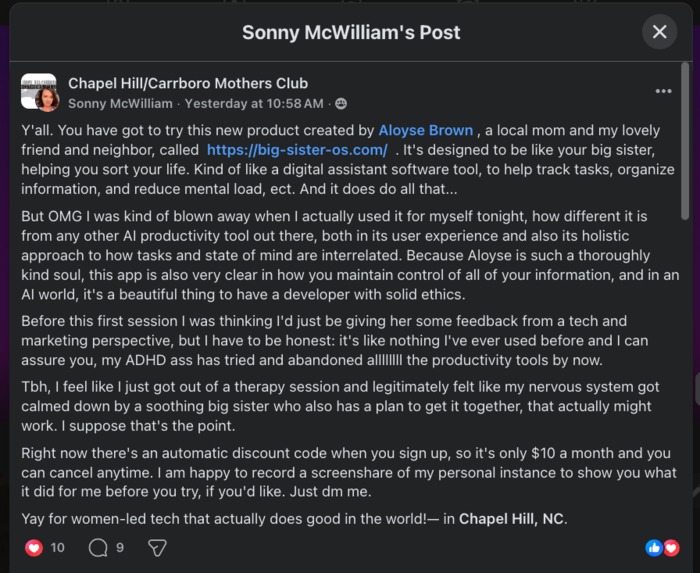
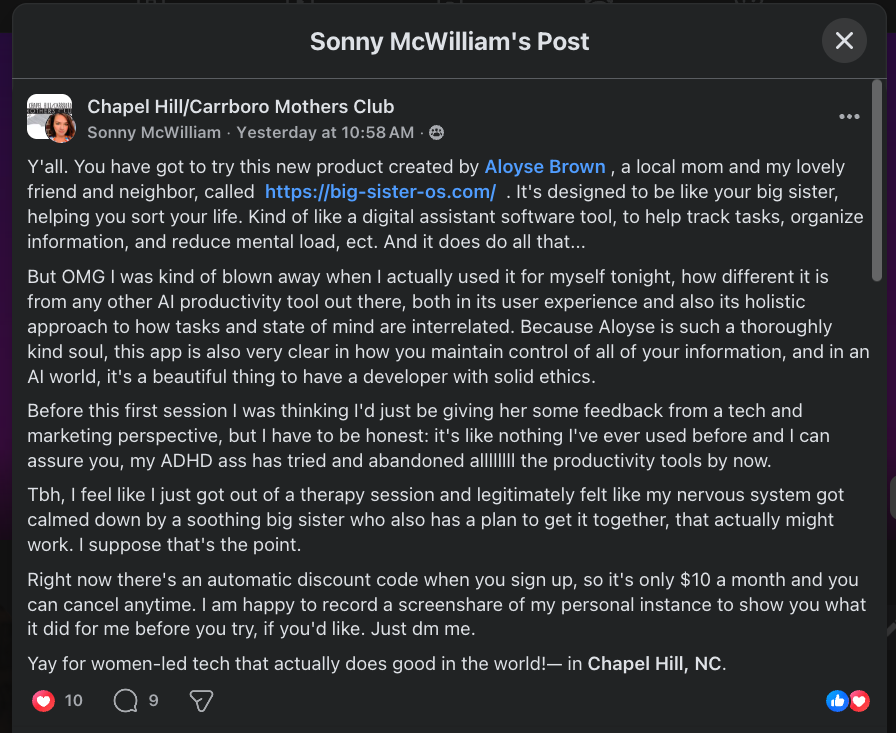
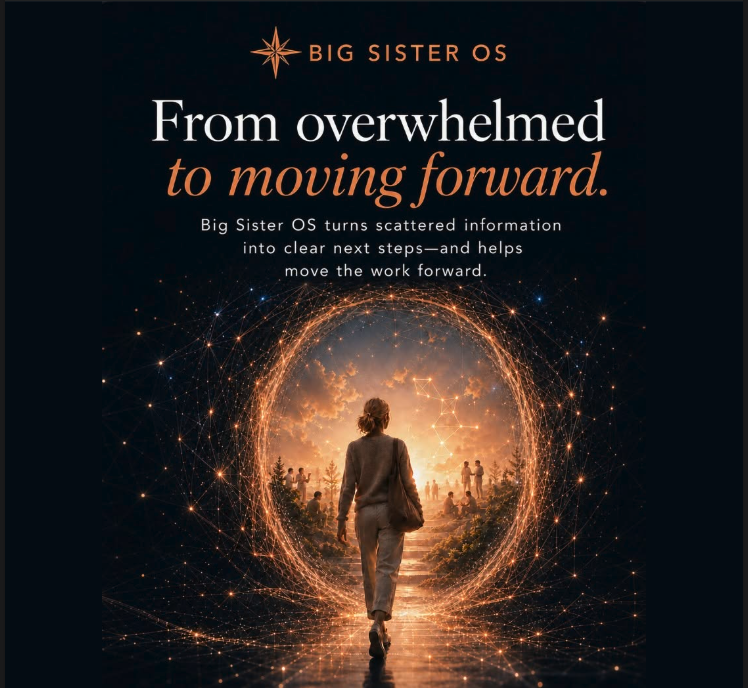
- We launched — with a Facebook post on my little sister's birthday, just 11 days before the contest deadline. Honestly, I would have held off; the XPRIZE requires real paying customers, so I went for it. Eleven days is no time to market anything, but the traction was real and steady — and the work didn't stop at launch: I kept testing and fixing to make sure the promise of Big Sister OS was actually delivering to the people paying for it.
- Honesty as a feature. When an internal review found we were offering a founder-only capability to every user, we closed it the same day at three layers. She never advertises what she can't deliver.
What we learned
- Passing tests are not a working product. Verify the deployed artifact. Our bundle verifier exists because 488 green tests coexisted with a broken production app.
- Fix the inputs before the prompt. Most "the AI is being dumb" moments were us starving the model of signal or asking it to do arithmetic.
- AI can be your whole engineering team — if you demand evidence. Every session ends with a regression checklist, and claims like "zero migrations needed" get corrected on the record when they turn out wrong.
- Use the tools you can actually drive. A day stuck in the "right" tool taught me less than six weeks shipping with the ones I understood. The best stack is the one you can direct.
- Launch before you feel ready. Left to myself I'd still be polishing. The XPRIZE's real-paying-customers requirement forced the launch — and real customers taught me more than any amount of pre-launch polish would have.
- Trust compounds. Every honest "I can't do that yet" made the product more credible, not less.
What's next for Big Sister OS
The features I wanted from day one come first. SMS texting, voice dictation, and connecting to your email and calendar were all on my original wish list — and all too complicated to do right by August 17. Rather than ship them half-trusted, I cut them. Now they come back, properly:
- Text her like a real big sister. SMS is the most natural channel this product could have. We actually built it once — then stripped it out entirely before launch rather than promise a channel that couldn't yet deliver reliably. It comes back with proper carrier registration and the polish it deserves.
- Email and calendar connectors, privacy-first. We deliberately deferred reading anyone's Gmail or calendar until we could meet the verification bar it deserves. Today's calendar is one-way out by design.
- Voice capture on our own terms — recorded and transcribed through our own model, not shipped to a third party's speech service.
- She learns you — a decision log so her judgment gets personal over time, with the same approval gate on everything she remembers.
- Opening the Analyst to every business, not just ours — the numbers review that helped us should ship to the people we built her for.
And past the near-term list, the vision widens:
- Proactive life support. Not reminders — motion. She notices spring break is coming and starts planning before flights get expensive; flags the passport renewal months early and preps the forms; keeps the dermatology screening, the voter registration, the will that never got written, and the unused credit-card lounge access from slipping through the cracks. The bar is never "this exists, don't forget it" — it's moving the thing toward done.
- Caregiver mode. Real support for the people carrying other people — children, a spouse, aging parents, a team — with hard consent boundaries, so one person's information is never visible to another without an explicit yes. Same trust rule, extended to the whole family.
- One relationship, many experts. More specialists behind the one big sister — travel, household, health prompts, finance reminders, sales, operations — coordinated so the user never has to know which agent, model, or database did the work. Eventually: she hears you describe a recurring problem and builds the workflow that solves it.
- The whole-person OS. Business support is the beachhead, but the architecture is modular by design — family, health, finance, home, career — because a small business owner was never just a business.
- A business that grows the way she was built. Founder-led services first, learn which workflows repeat, productize them into the subscription — then family plans, team plans, partnerships, and premium hands-on support for those who want a human in the loop too.
Overloaded owners don't need another tool to manage. They need someone in their corner who does the work. That's who she is.
Built With
- chatgpt
- claude
- firecrawl
- gemini
- github
- google-ai-studio
- google-cloud
- lovable
- react
- stripe
- supabase
- tailwindcss
- tanstack
- typescript
- vertex-ai
- vite

Log in or sign up for Devpost to join the conversation.