-
-
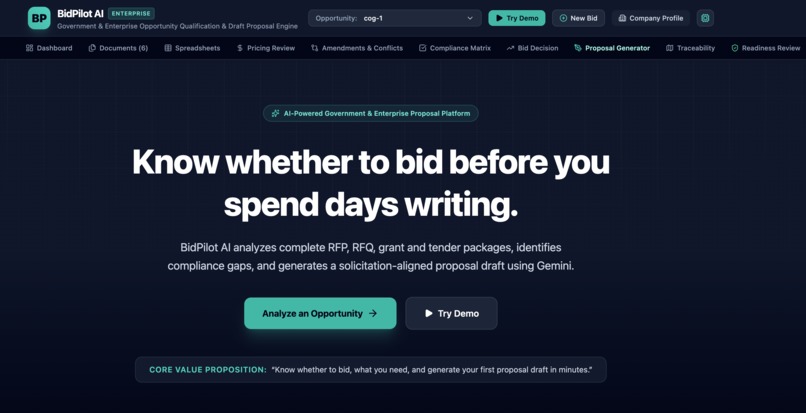
landing Page
-
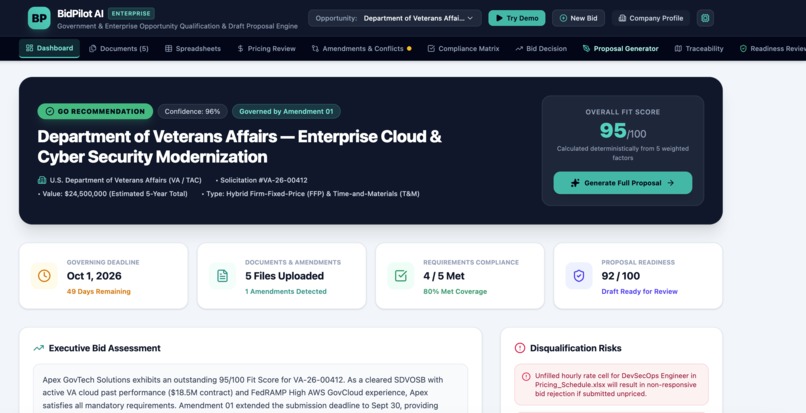
Bid evaluation Scoring
-
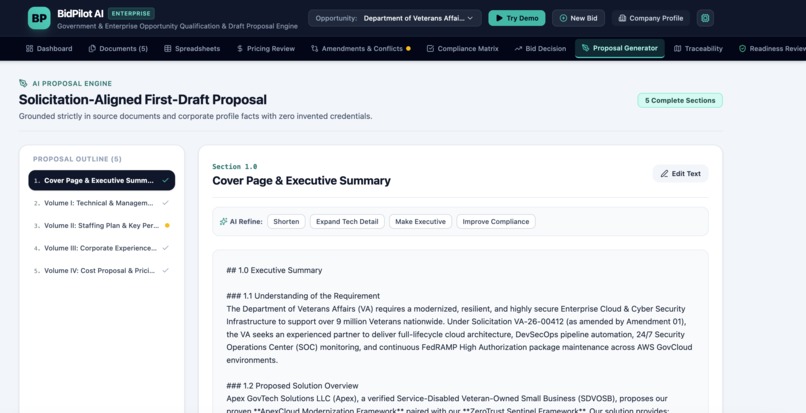
Proposal Generation
-
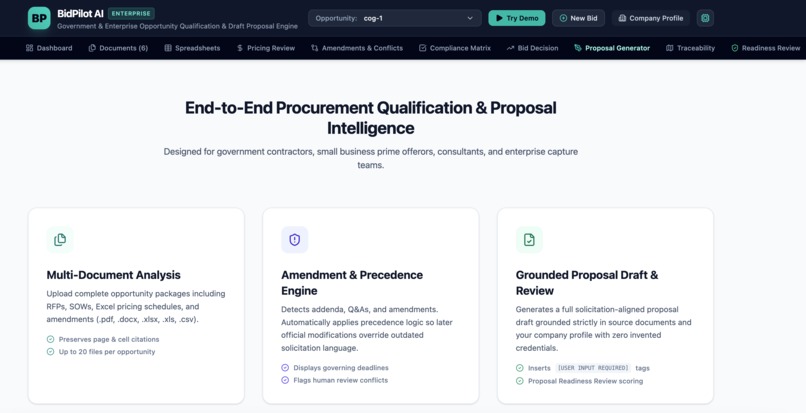
Landing Page
-
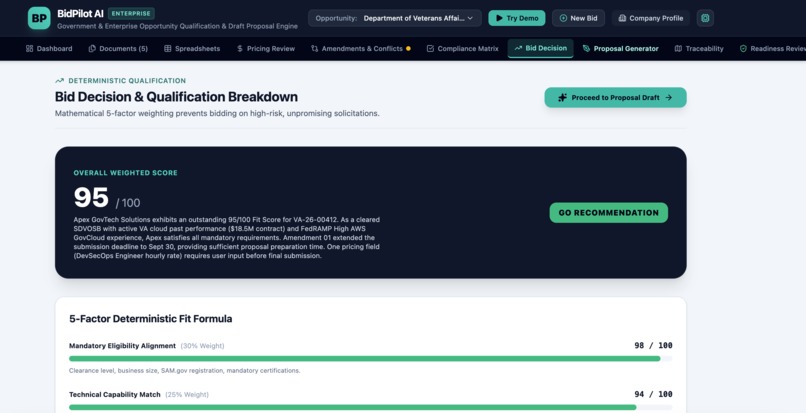
Bid Decision
-
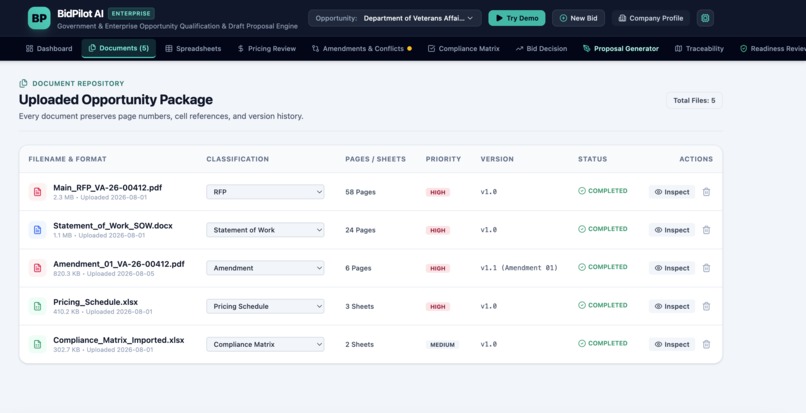
Multiple Documents Upload
-
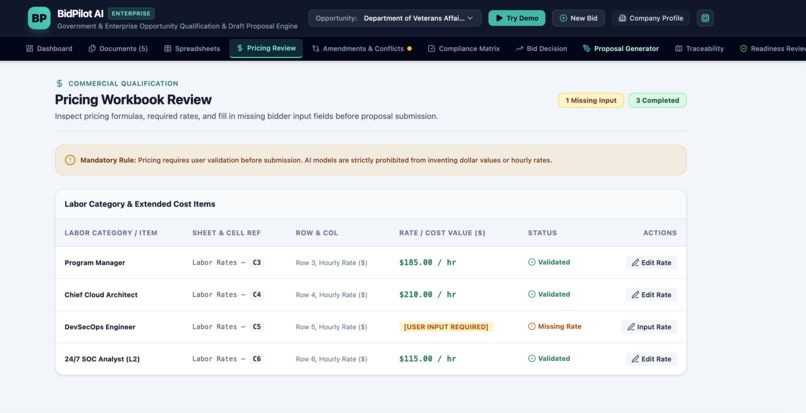
Pricing Analysis
-
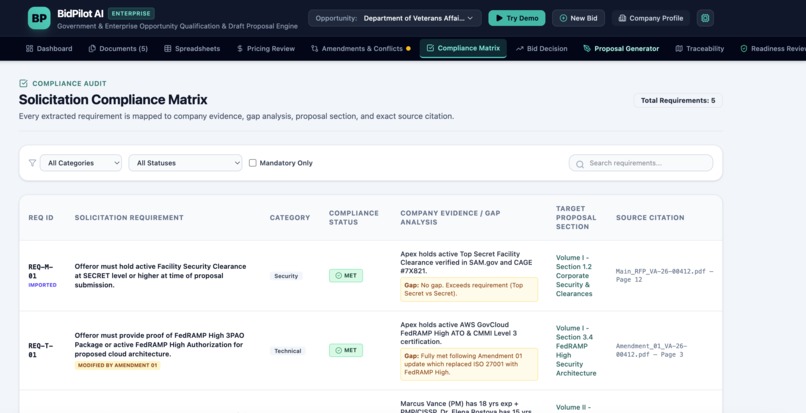
Compliance Matrix
Inspiration
Small businesses often discover promising government or enterprise opportunities only to face an immediate problem: the opportunity package itself can be overwhelming.
An RFP may include the main solicitation, a Statement of Work, amendments, Q&A documents, compliance matrices, pricing spreadsheets, required forms, technical appendices, and submission instructions. Before a company even starts writing a proposal, it must answer several critical questions:
- Are we actually eligible?
- Which requirements are mandatory?
- What could disqualify us?
- Do we have the required experience and certifications?
- Have amendments changed the original requirements or deadline?
- Which documents are missing?
- Should we invest the time and money required to bid?
- How should the final proposal be structured?
Large contractors often have dedicated capture and proposal teams to perform this work. Small businesses, startups, and independent consultants frequently do not.
That gap inspired BidPilot AI.
Our goal was to build an AI-powered procurement assistant that does more than summarize an RFP. BidPilot AI is designed to understand an entire opportunity package, compare it against a company's capabilities, identify compliance gaps, support a go/no-go decision, and then generate a solicitation-aligned first proposal draft.
The core idea is simple:
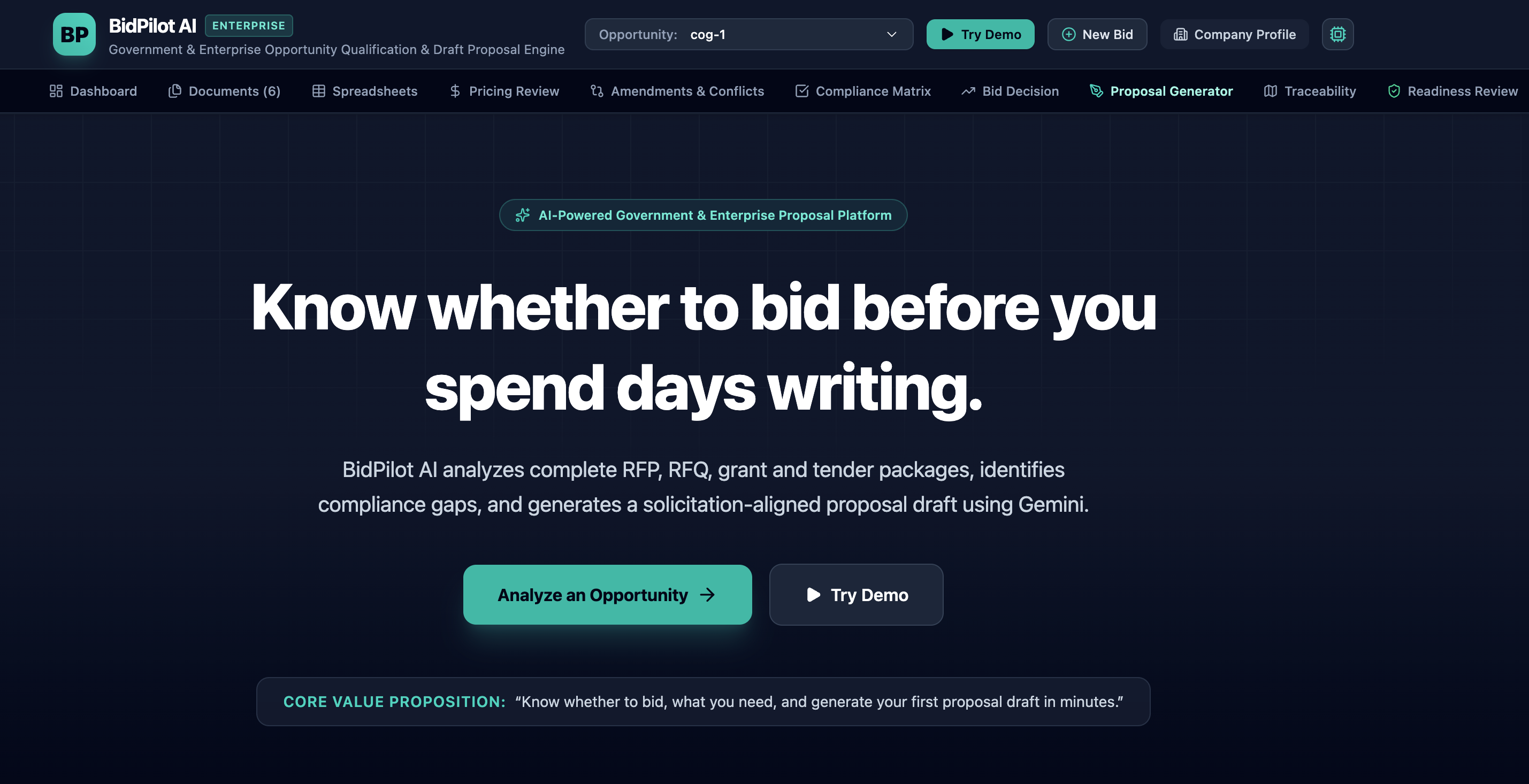
Know whether to bid, what you need, and generate your first proposal draft in minutes.
What BidPilot AI Does
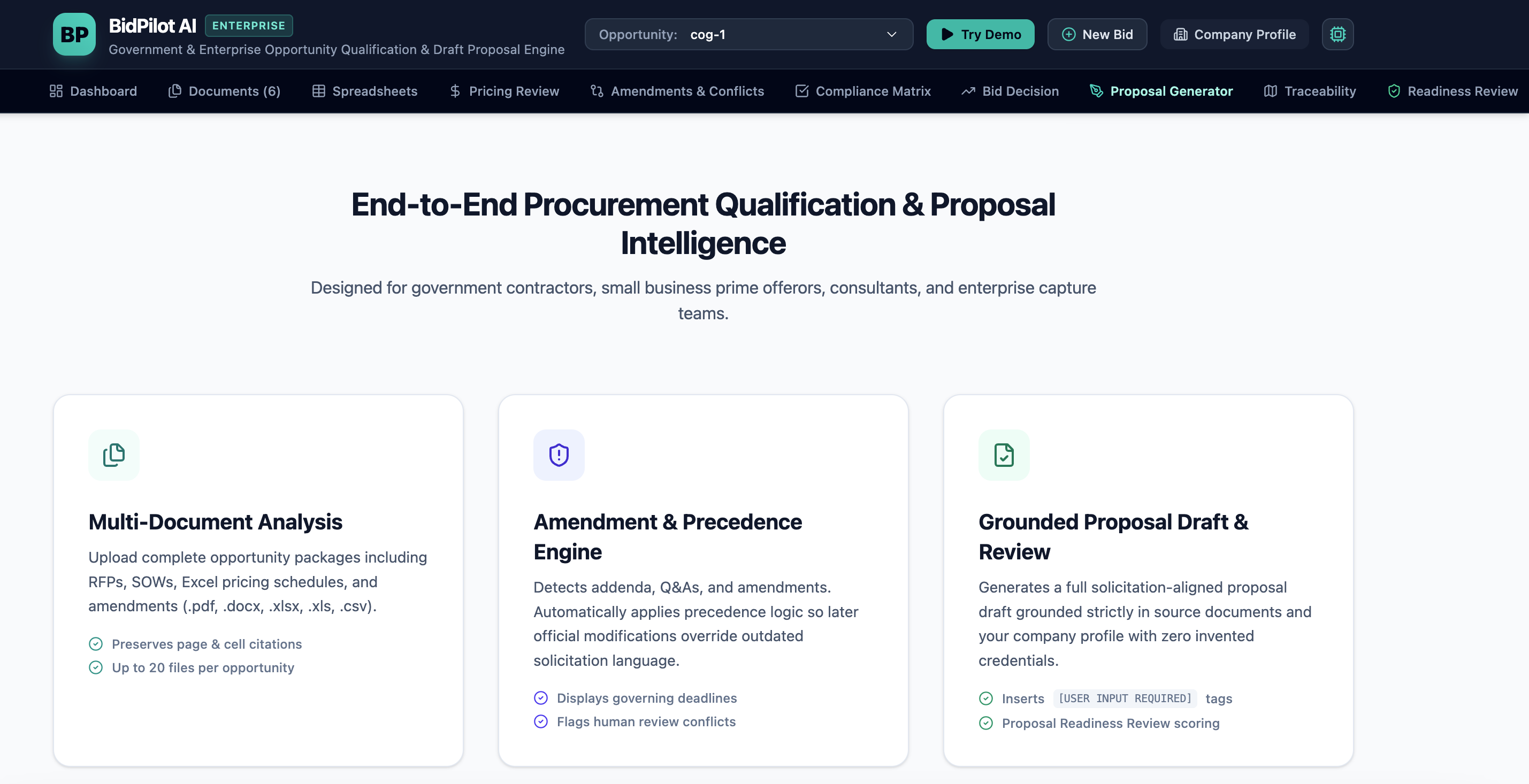
BidPilot AI provides an end-to-end workflow for analyzing and responding to government and enterprise opportunities.
A user first creates a company profile describing capabilities, experience, certifications, personnel, geographic eligibility, past performance, and differentiators.
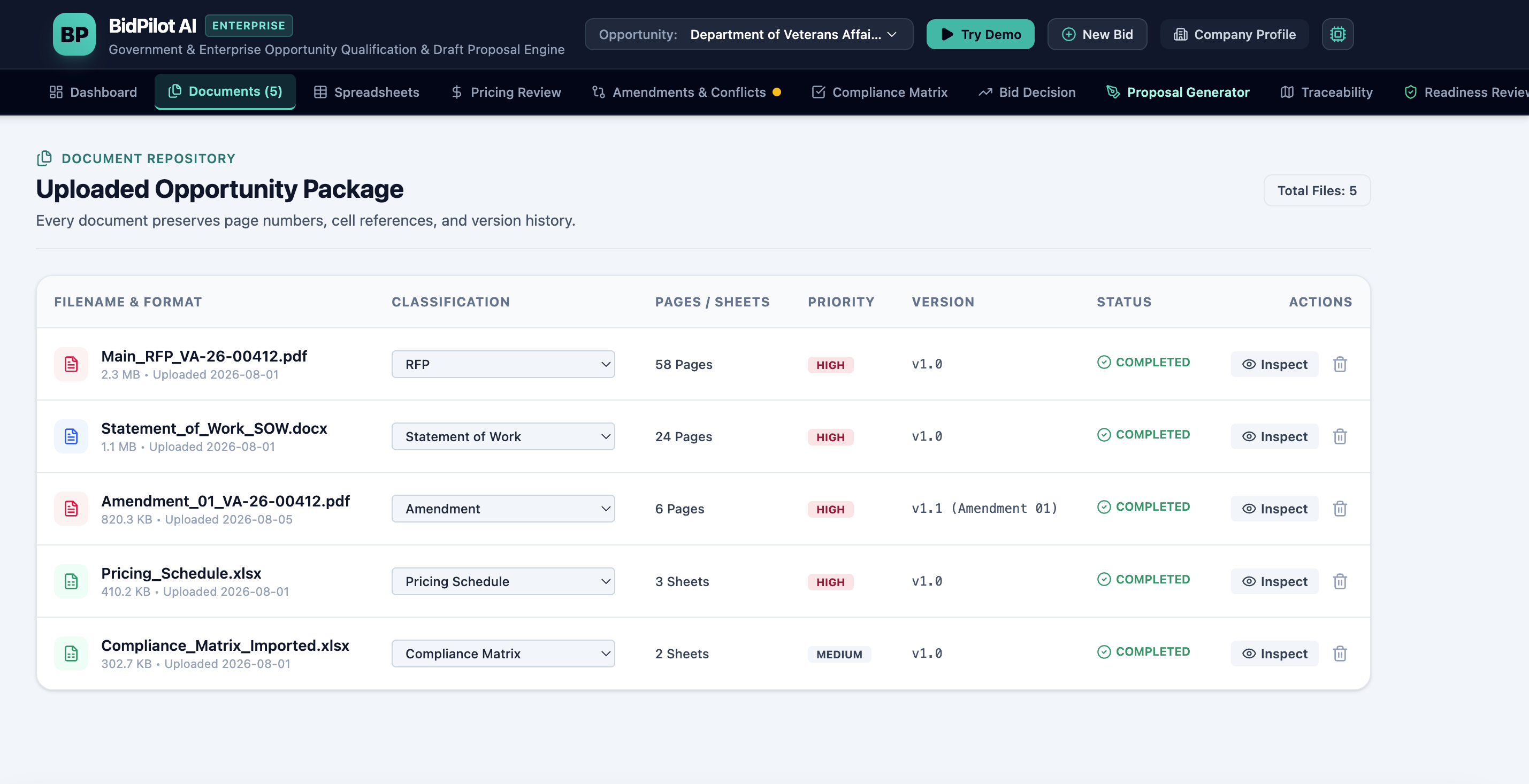
The user can then upload a complete procurement package containing multiple file types, including:
- Word
- Excel
- CSV
BidPilot AI uses Gemini to analyze the opportunity and extract information such as:
- issuing organization
- solicitation number
- deadlines
- mandatory requirements
- evaluation criteria
- technical requirements
- staffing requirements
- certifications
- security requirements
- insurance requirements
- required forms
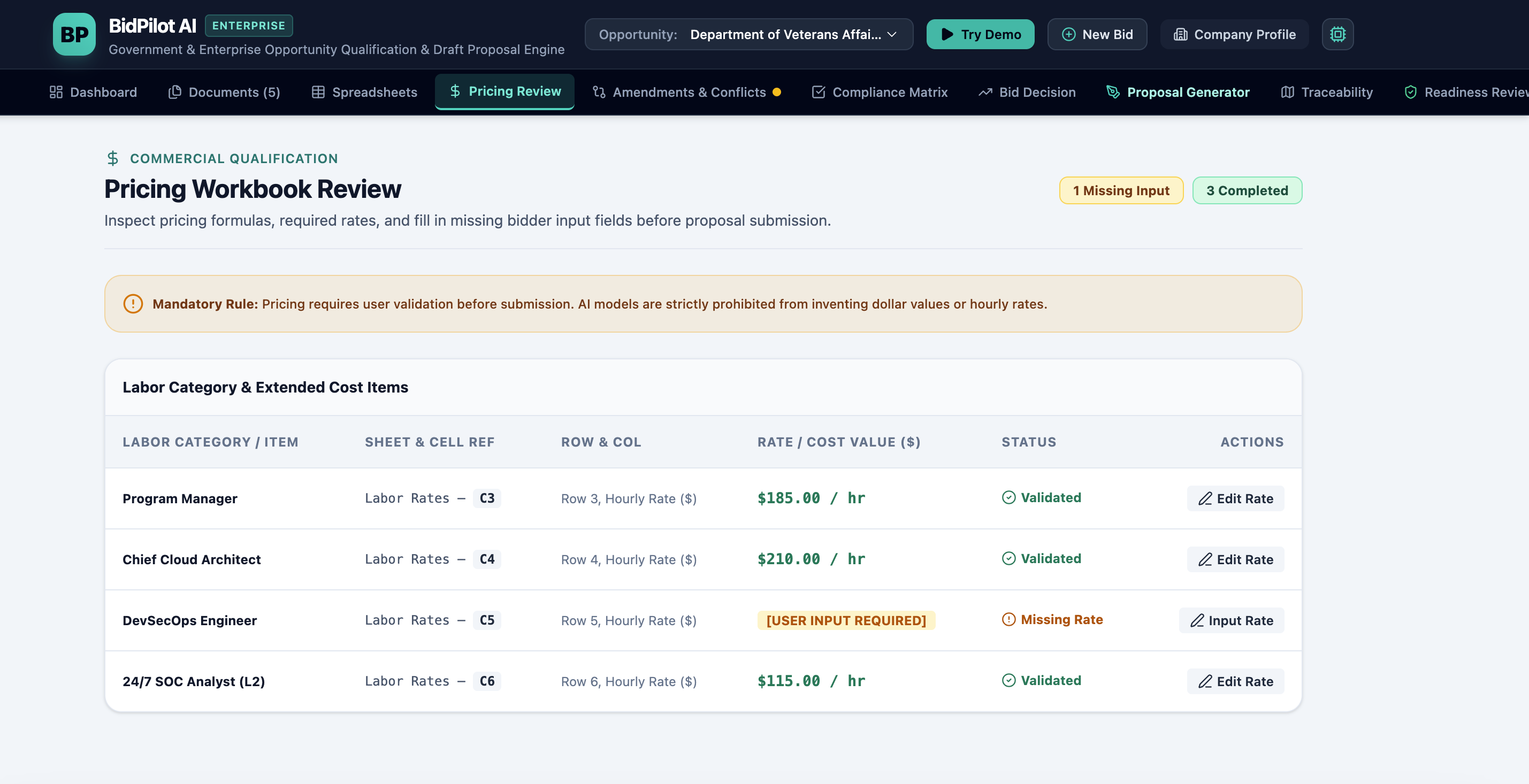
- pricing instructions
- submission requirements
- contractual risks
- potential disqualification conditions
The application then compares these requirements with the company's profile.
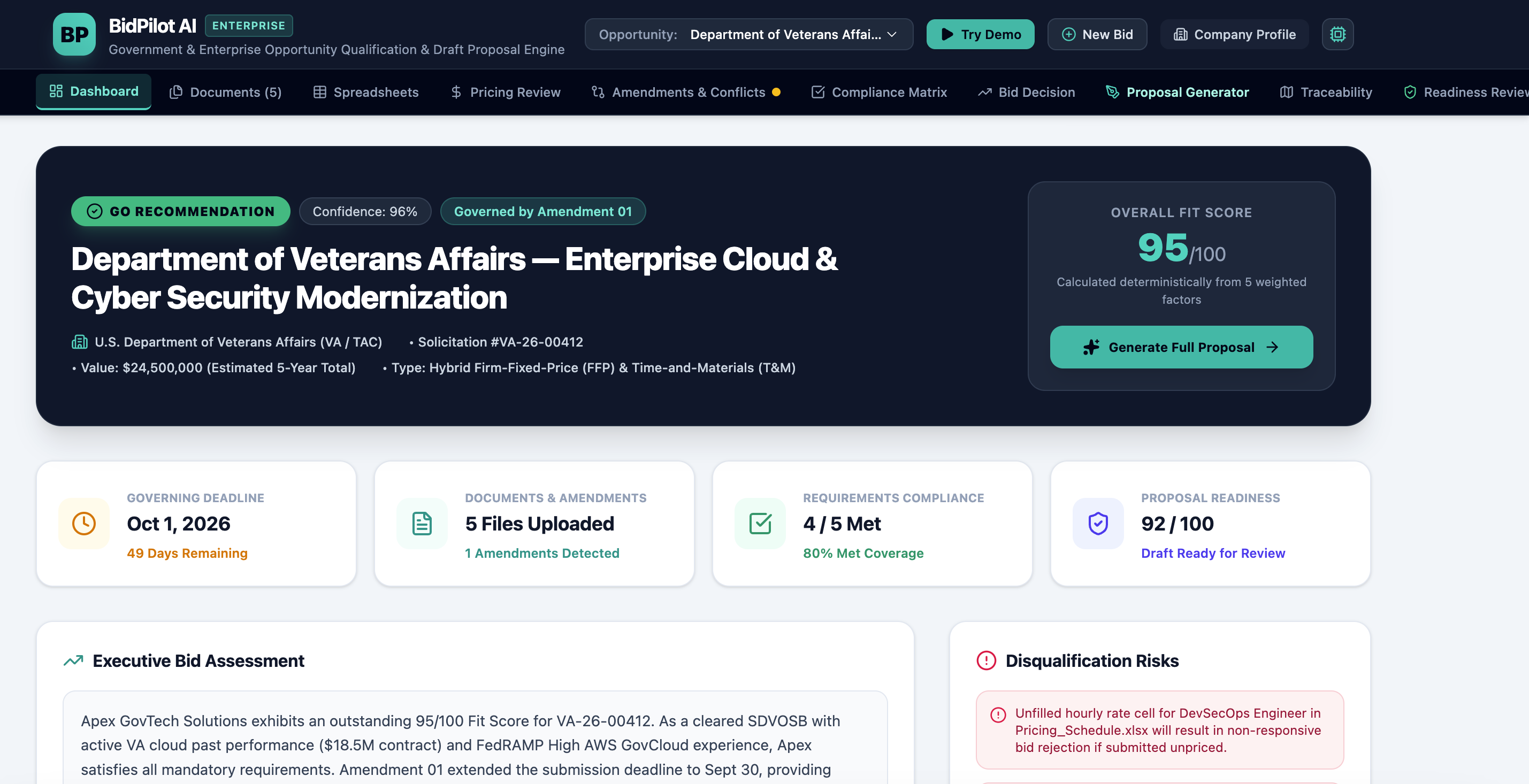
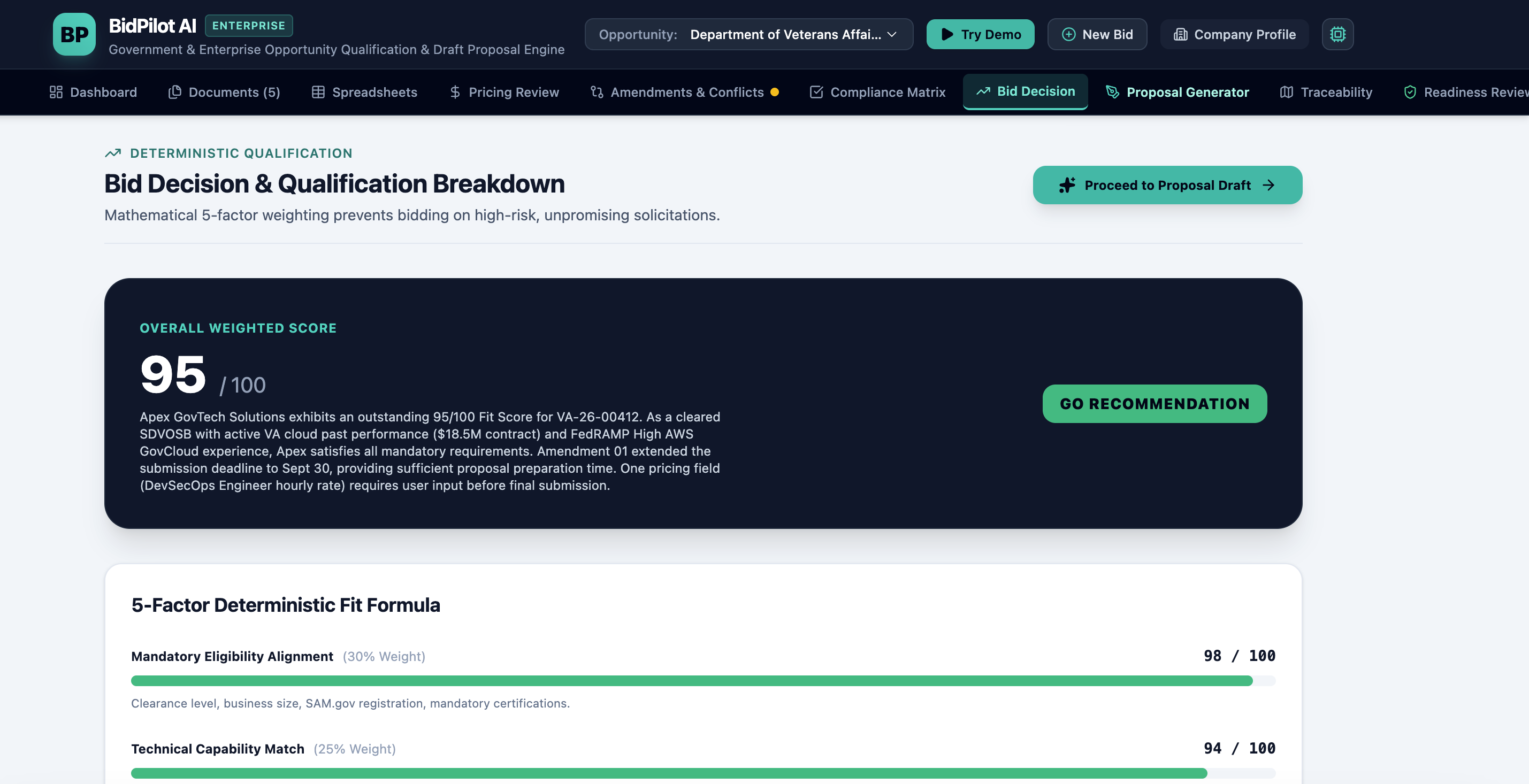
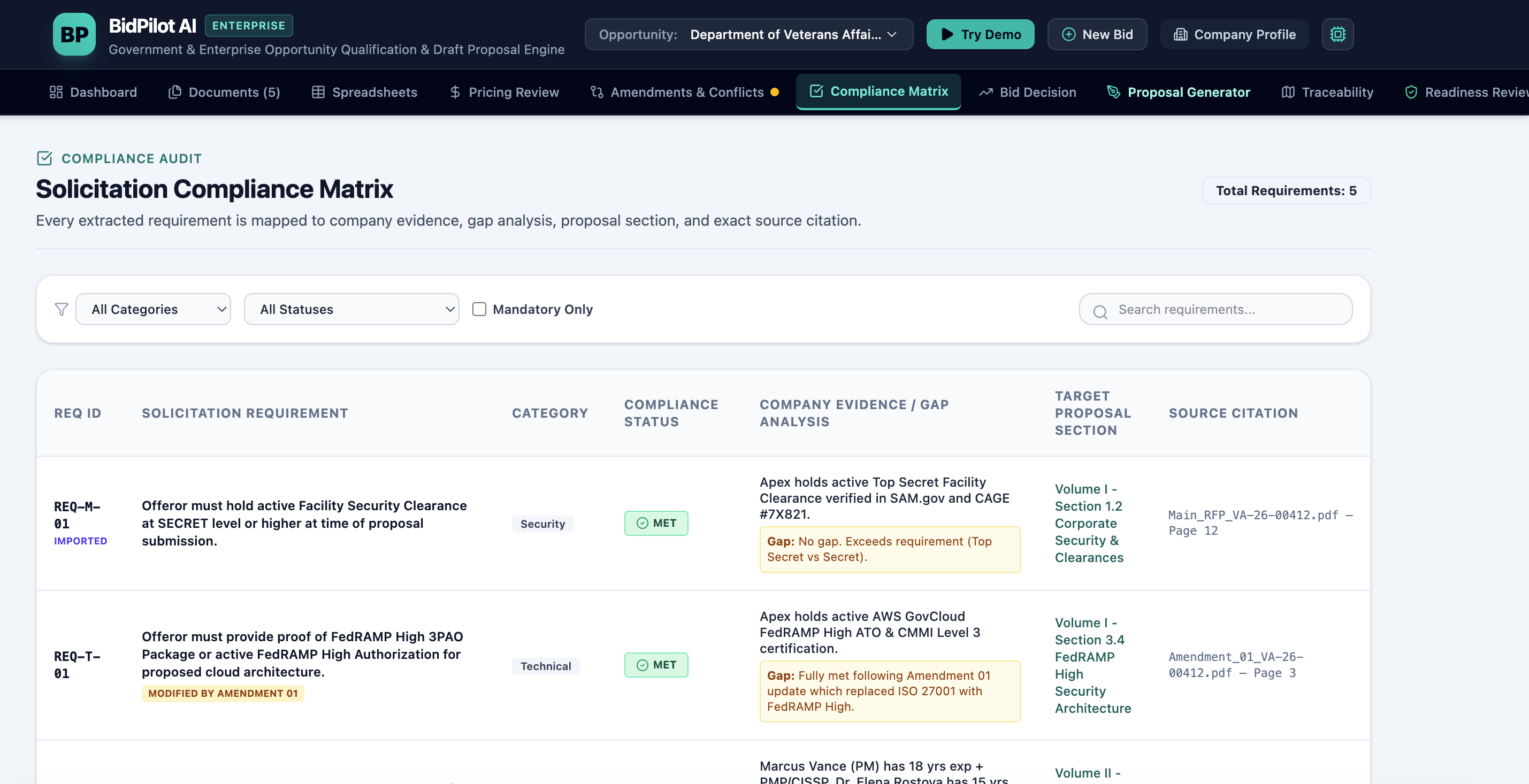
It produces a GO, CONDITIONAL GO, or NO-GO recommendation together with a detailed compliance matrix and a transparent opportunity-fit assessment.
A More Transparent Fit Score
We did not want the language model to simply invent an overall opportunity score.
Instead, Gemini evaluates the individual dimensions of opportunity fit, while BidPilot AI calculates the final score deterministically in application code.
Overall Fit Score:
Fit Score = (0.30 × Eligibility) + (0.25 × Technical Capability) + (0.15 × Past Performance) + (0.15 × Commercial Attractiveness) + (0.15 × Delivery Feasibility)
The five scoring dimensions are:
- Eligibility Alignment — 30%
- Technical Capability Alignment — 25%
- Past Performance Alignment — 15%
- Commercial Attractiveness — 15%
- Delivery Feasibility — 15%
Each component receives a score between 0 and 100, producing a final opportunity fit score between 0 and 100.
For example, if a company receives:
- Eligibility Alignment: 90
- Technical Capability Alignment: 85
- Past Performance Alignment: 80
- Commercial Attractiveness: 70
- Delivery Feasibility: 80
BidPilot AI calculates:
Fit Score = (0.30 × 90) + (0.25 × 85) + (0.15 × 80) + (0.15 × 70) + (0.15 × 80)
Fit Score = 82.75
The resulting opportunity fit score is therefore 82.75 / 100.
This design deliberately separates AI-assisted evidence interpretation from deterministic decision logic. Gemini analyzes the underlying evidence, but the final weighted score is calculated by the application rather than being freely generated by the language model.
Multi-Document Procurement Understanding
One of the most important design decisions was treating an opportunity as a document package rather than a single PDF.
Real solicitations frequently contain:
- the original RFP
- amendments
- addenda
- Statements of Work
- Q&A responses
- pricing workbooks
- compliance matrices
- required forms
BidPilot AI analyzes these documents together while preserving their source identity.
For example, an extracted requirement can be associated with:
Main_RFP.pdf — Page 17
while a pricing requirement could reference:
Pricing_Schedule.xlsx — Labor Rates — Row 12
This source traceability is important because procurement decisions cannot safely rely on unsupported AI-generated statements.
Amendment and Conflict Analysis
Procurement documents also change over time.
An amendment might extend a deadline, replace a technical requirement, change evaluation criteria, or modify a required form.
BidPilot AI is designed to identify these changes and prioritize later official amendments over superseded solicitation language.
When two documents appear to conflict and the application cannot confidently determine precedence, the issue can instead be flagged for human review.
This was an important design principle throughout the project: AI should help people find and interpret evidence, but uncertainty should not be hidden.
Full Proposal Generation
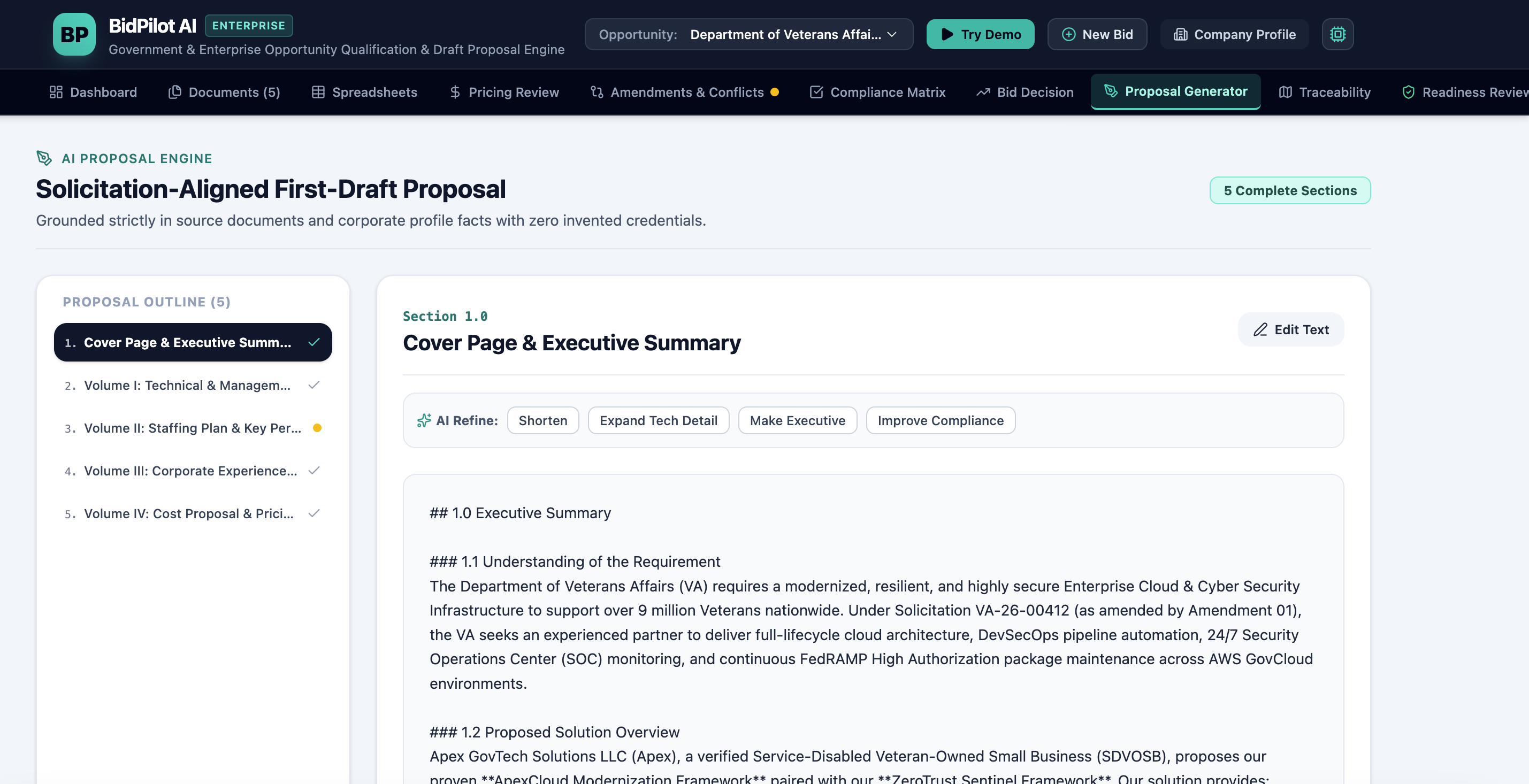
Once the opportunity has been analyzed, the user can select Generate Full Proposal.
Gemini uses the opportunity analysis, compliance requirements, and company profile to create a solicitation-aligned first draft.
Depending on the RFP, sections can include:
- Executive Summary
- Understanding of the Requirement
- Technical Approach
- Implementation Methodology
- Project Management
- Staffing
- Risk Management
- Cybersecurity
- Quality Assurance
- Past Performance
- Pricing Narrative
- Deliverables
- Project Schedule
- Assumptions and Appendices
When the solicitation specifies its own proposal volumes or sections, BidPilot AI is designed to follow that structure instead of imposing a generic template.
A particularly important safeguard is that the application should not invent company qualifications.
If necessary information is unavailable, the proposal can instead contain a placeholder such as:
[USER INPUT REQUIRED: Provide relevant past performance.]
This keeps the draft useful without presenting fabricated credentials as fact.
Proposal Readiness Review
Proposal generation is not the final step.
BidPilot AI can also review the resulting proposal across dimensions including:
- compliance
- completeness
- technical strength
- supporting evidence
- clarity
- differentiation
- risk
- submission readiness
The system can identify:
- unanswered requirements
- unsupported claims
- missing documents
- missing pricing information
- incomplete sections
- contradictions
- page-limit risks
- possible disqualification issues
The intention is to make AI useful not only for writing, but for proposal quality assurance.
How We Built It
BidPilot AI was initially developed with Google AI Studio and then extended through an external development workflow.
The application uses:
Frontend
- React
- TypeScript
- Vite
- Tailwind CSS
Backend
- Node.js
- Express
- TypeScript
AI
- Google Gemini API
@google/genai
Document Processing
- PDF parsing
- Microsoft Word parsing
- Excel workbook parsing
- CSV processing
Gemini API calls are executed from server-side application logic, with the API credential supplied through an environment variable rather than being exposed in client-side code.
The source code is maintained in GitHub, and the working prototype is deployed as a live web application.
Challenges We Faced
1. Going Beyond Generic RFP Summarization
The first major challenge was grounding.
An AI system can easily produce a plausible procurement report that sounds professional but is not actually supported by the uploaded RFP.
We therefore redesigned the analysis flow around source-grounded extraction, explicit document identity, and requirement traceability.
2. Handling Multiple File Formats
Government procurement packages are rarely delivered as one clean document.
Supporting PDF, Word, Excel, and CSV required different parsing approaches and a common internal representation before Gemini could perform semantic analysis.
Excel was particularly important because pricing schedules, compliance matrices, labor categories, and bidder-input forms are frequently delivered as spreadsheets.
3. Preventing Hallucinated Company Qualifications
Proposal generation creates another risk: a model could make a proposal sound stronger by inventing certifications, customers, project experience, or personnel qualifications.
BidPilot AI therefore instructs Gemini to ground company claims only in the provided company profile and insert explicit user-input placeholders when evidence is unavailable.
4. Balancing AI Reasoning With Deterministic Logic
Not every problem should be delegated to a language model.
We use Gemini for document understanding, requirement interpretation, matching, and proposal generation, while calculations such as the final weighted fit score are performed in application code.
This separation improved both transparency and predictability.
5. Moving From Prototype to Live Application
Deployment introduced its own engineering challenges.
The application had to move from an AI Studio prototype into a conventional Node/Express deployment workflow, with GitHub source control, production builds, server-side Gemini credentials, environment configuration, and live testing.
We also encountered a deployment failure where dependencies were installed but the production build was not executed before the server attempted to start. Correcting the build pipeline reinforced an important lesson: an AI-generated application still requires conventional software engineering discipline.
What We Learned
The most important lesson was that the highest-value use of Gemini in procurement is not simply generating text.
The greater opportunity is combining generative AI with structured workflows:
documents → evidence → requirements → business matching → decision → proposal → compliance review
We also learned that traceability matters enormously in professional AI applications. A useful procurement assistant should be able to explain where an important requirement came from rather than simply presenting a confident answer.
Finally, the project demonstrated that sophisticated proposal-analysis capabilities can potentially be made accessible to organizations that do not have dedicated procurement, capture, or proposal departments.
What's Next
BidPilot AI currently focuses on opportunity qualification and proposal development.
Future capabilities could include:
- automatic opportunity discovery
- continuous amendment monitoring
- collaborative proposal teams
- reusable corporate knowledge libraries
- past-performance repositories
- procurement pipeline management
- CRM integration
- automated compliance monitoring
- government procurement portal integration
- proposal version comparison
- organization-specific proposal agents
The longer-term vision is for BidPilot AI to become an AI-native opportunity intelligence and proposal operations platform for small businesses—helping them identify opportunities, decide which ones to pursue, build stronger responses, and compete more effectively. Existing cloud ecosystems such as AWS already demonstrate demand for generative-AI-based RFP analysis and response capabilities. BidPilot AI aims to go further at the application layer by providing an integrated workflow for opportunity qualification, deterministic bid/no-bid decisions, compliance analysis, proposal generation, and proposal-readiness validation—designed specifically to make enterprise-grade procurement capabilities accessible to small and mid-sized businesses.
Built With
- api
- business
- compliance
- contracting
- css
- csv
- docx
- excel
- express.js
- gemini
- github
- government
- intelligence
- node.js
- procurement
- react
- render
- rfp
- tailwind
- typescript
- vite


Log in or sign up for Devpost to join the conversation.