-
-
-
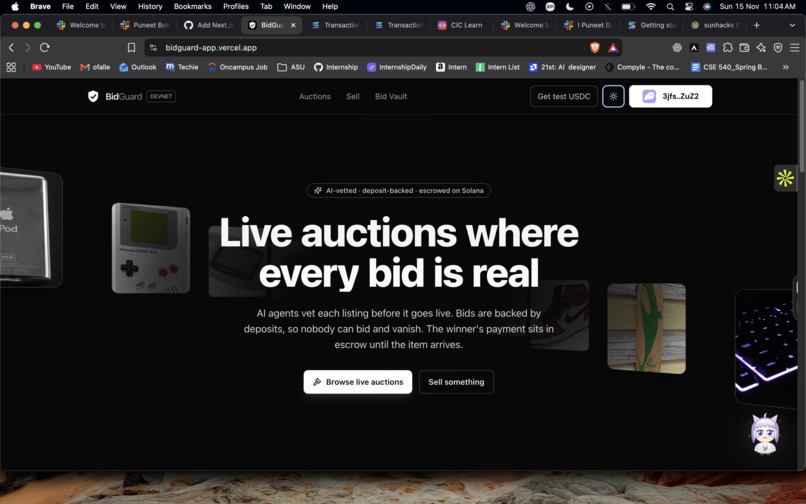
Home Page
-
-
-

Guardy
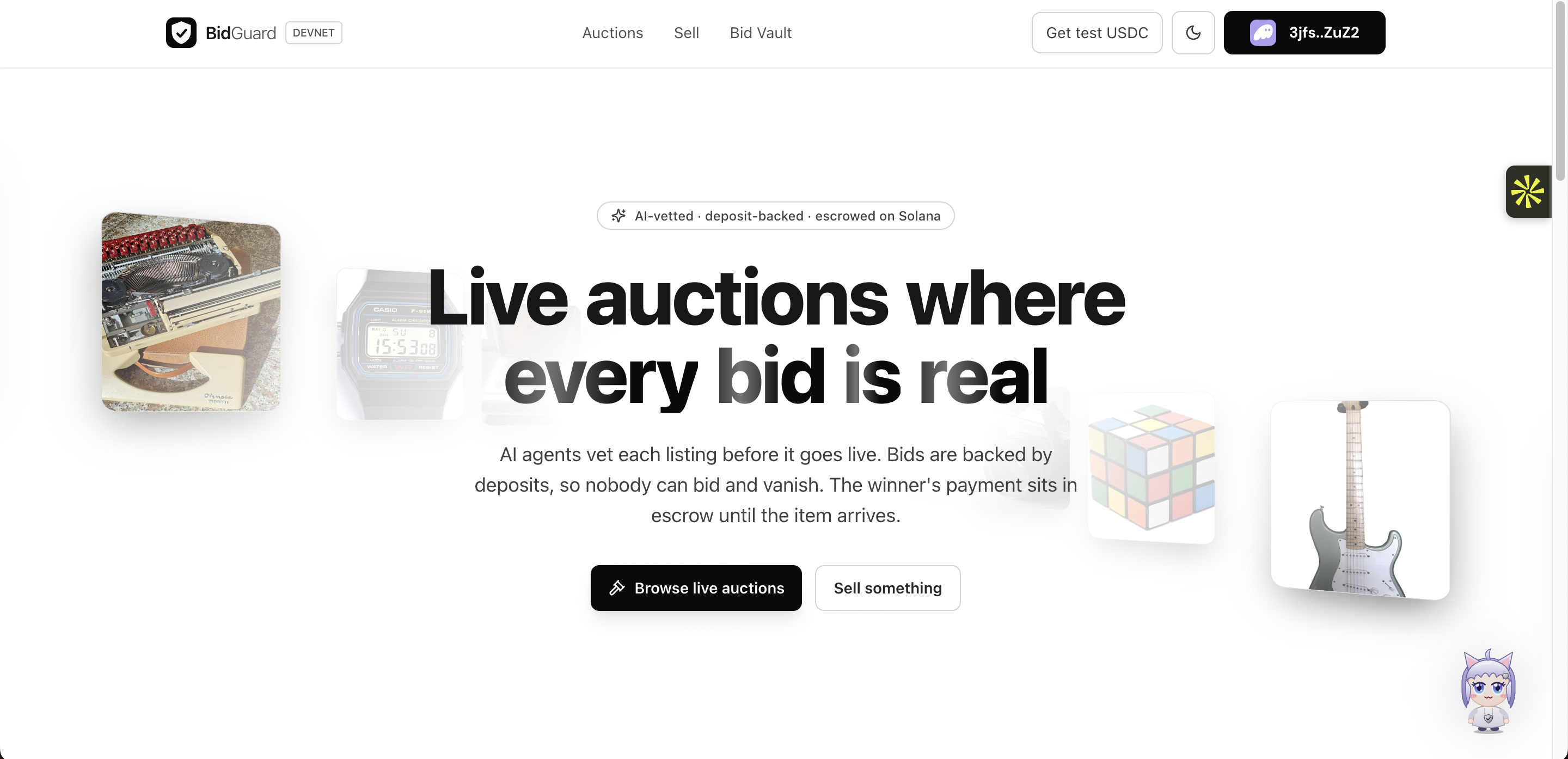
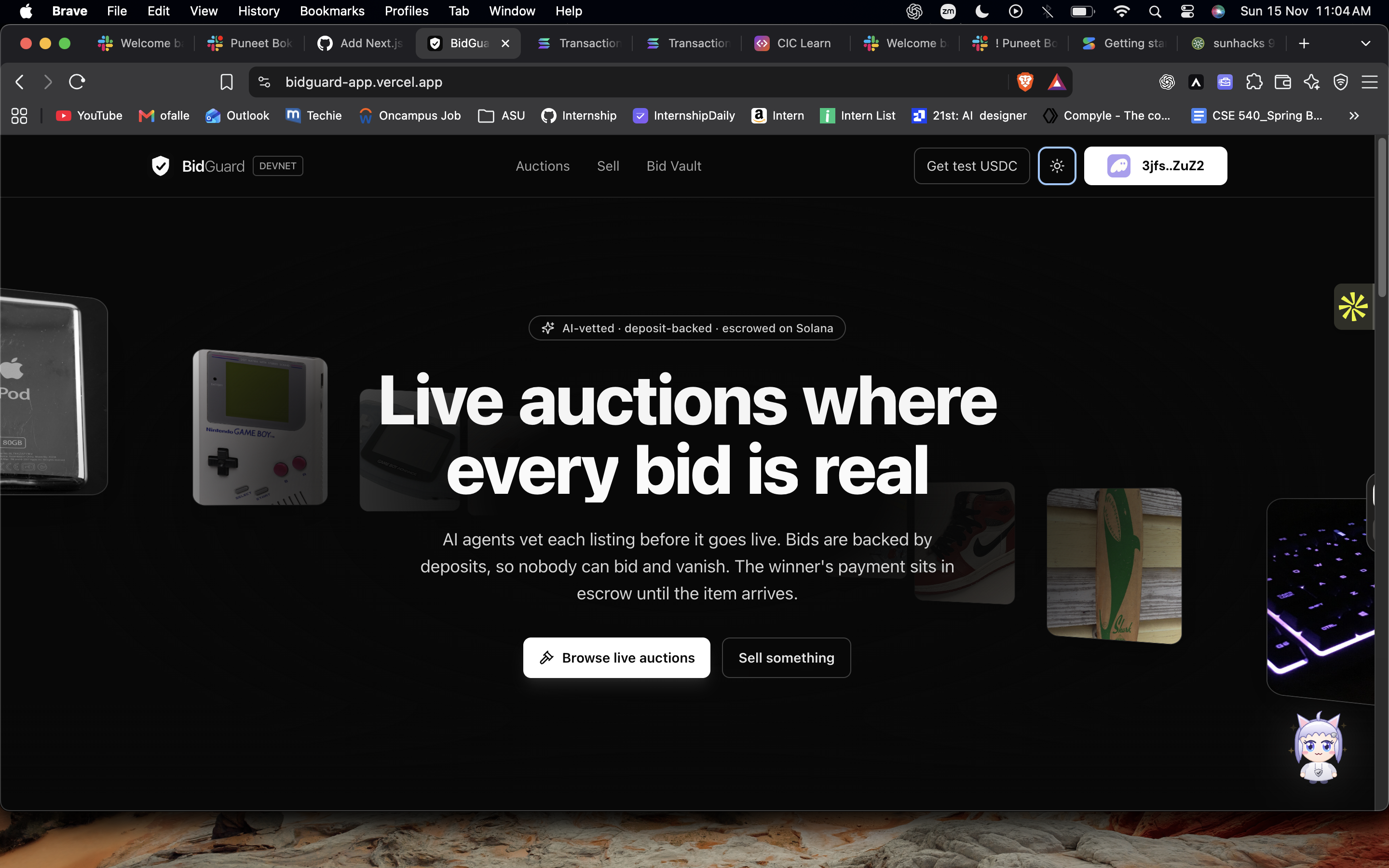

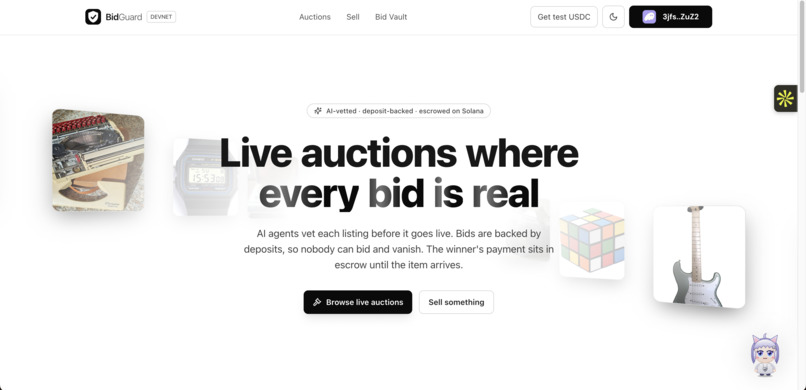
Inspiration Everyone has seen it happen on live and social auctions: stock or AI-generated photos of items the seller doesn’t own, bidders who win and vanish, and buyers who pay and never receive anything. Today, the only protection is a support ticket filed after the money is already gone.
We asked ourselves: What if fraud could be stopped before a listing ever goes live, and every payment were provable instead of trust-based?
That question became BidGuard.
What It Does
BidGuard is a live-auction marketplace with two layers of protection:
- Multi-Agent AI Fraud Detection
A multi-agent AI crew vets every listing. An orchestrator runs four specialist agents in parallel:
- Listing Inspector: Checks whether photos match the description and detects stock photos or photos reused by other sellers.
- AI Image Detector: Combines provenance metadata, including C2PA, IPTC tags, and Stable Diffusion data, with visual forensics to identify AI-generated images.
- Price Sanity: Flags suspiciously low prices that may be used as scam lures.
- Seller Risk: Evaluates wallet age, on-chain history, and sybil funding clusters.
In about 4 seconds, the agents produce a Trust Score with plain-English reasons. Based on the result, the listing is:
- Approved
- Held for human moderation
- Rejected
After a sale, a fifth agent, the Dispute Judge, evaluates wallet-signed evidence from both parties and recommends a resolution or payment split. A human arbiter makes the final decision.
- Blockchain-Secured Payments on Solana
- Bid Vault: Bidders deposit USDC into a smart-contract-controlled vault, preventing users from bidding more than they have available.
- Signed Bids: Every bid is signed through the bidder's wallet without requiring gas. During settlement, the smart contract verifies the signature on-chain.
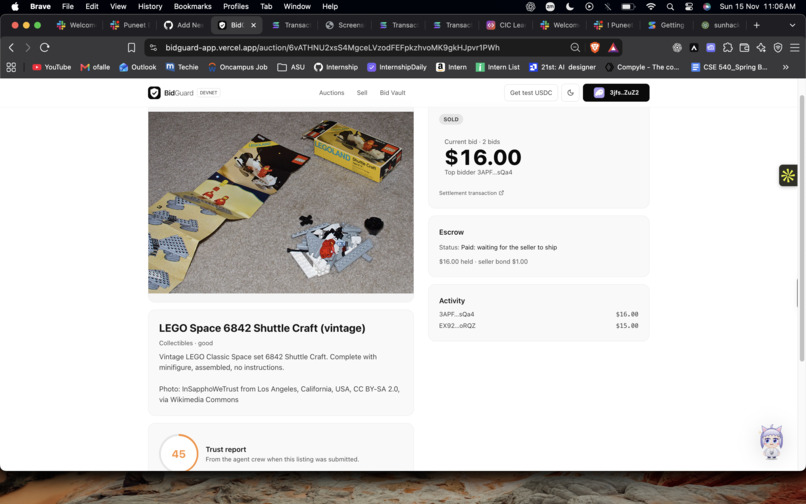
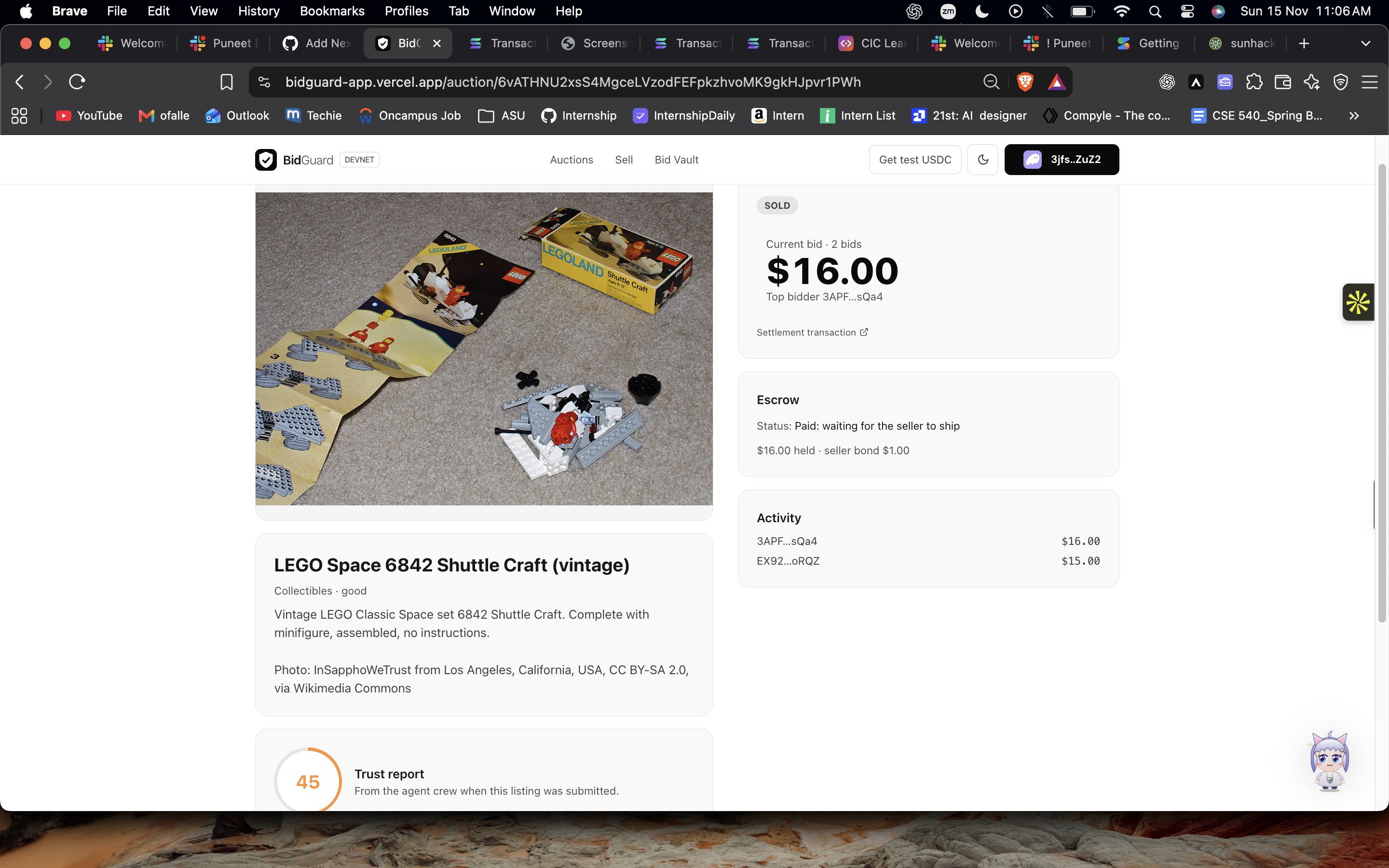
- Escrow and Seller Bond: The winner's payment remains in escrow while the seller posts a bond. If the seller fails to ship, the buyer receives a refund plus the seller's bond.
- Public Auditability: Every critical payment step is recorded as a public transaction that anyone can verify.
How We Built It
Smart Contract
We built an Anchor (Rust) program on Solana devnet that handles:
- Bid Vault with a withdrawal cooldown
- Auction creation requiring operator approval
- Settlement with Ed25519 signature verification through the instructions sysvar
- Reconstruction of the exact signed bid message
- Escrow flows for shipping, delivery, release, refunds, and disputes
- On-chain seller reputation profiles
Web App
The application uses Next.js 14 with MongoDB Atlas as the live auction engine.
- Atomic conditional updates prevent two bids from winning simultaneously.
- A 30-second soft close prevents last-second sniping.
- Server-Sent Events (SSE) provide real-time auction updates.
AI System
We use Gemini through an OpenAI-compatible API.
- Every agent returns schema-validated JSON.
- Agents fall back to deterministic rules if the AI service is unavailable.
- Agents execute in parallel for faster vetting.
- Their progress is streamed live to the seller.
User Experience
- Framer Motion animations
- Dark and light themes
- Guardy, an anime mascot chatbot that explains listings and how BidGuard works
Testing
We created:
- Anchor tests for the Solana program
- An end-to-end test covering the entire workflow:
- Listing creation
- AI vetting
- Bidding
- Settlement
- Shipping
- Disputes
- Final payout
Challenges We Ran Into
- Verifying bid signatures on-chain: We had to read the Ed25519 precompile instruction from within our program and reconstruct the signed message byte for byte.
- Clock drift: The server and blockchain could disagree about when an auction ended, so settlement had to be idempotent and safely retryable.
- Stripped metadata: Browser-side image resizing removed metadata required by the AI Image Detector, so we changed the system to scan the original file before upload.
- Expiring transactions: Sellers sometimes took too long to sign transactions, so we now generate fresh, operator-co-signed transactions on demand.
- AI quotas: Gemini's free quota ran out during testing, requiring automatic model fallback. We then discovered that the fallback model was weaker and could be fooled by doctored evidence that the primary model detected.
- Our own security system flagged us: The Seller Risk agent correctly identified our demo sellers as a potential sybil cluster because all their wallets had been funded by the same wallet.
Accomplishments We're Proud Of
- The full auction lifecycle runs live on Solana devnet, and our end-to-end test completes with payouts exact to the cent.
- The AI Image Detector flagged a photorealistic AI-generated image at 99% while rating a real photo at only 5%.
- The Dispute Judge detected a digitally doctored damage photo and ruled in favor of the honest seller.
- Every signed bid is verified on-chain, meaning bids cannot be forged, even by us.
- We maintained a clear safety principle throughout the platform: AI advises, humans decide. No AI agent can move money independently.
What We Learned
- AI fraud detection works better as multiple narrow agents with explainable signals than as one large "Is this a scam?" prompt.
- Fraud detection is inherently probabilistic, so human-in-the-loop decision-making and explaining the reasoning behind each score are as important as the model itself.
- Signed off-chain bids with on-chain verification provide Web2-level speed while retaining Web3 guarantees.
- Model quality matters in security. Our cheaper fallback model was noticeably easier to fool than the primary model.
What's Next for BidGuard
- Mainnet Launch: Move from Solana devnet to mainnet and migrate operator and arbiter keys to multisig wallets.
- Real Carrier Tracking: Integrate Shippo or EasyPost to replace the mocked delivery verification.
- Shill-Bid Detector: Identify coordinated or artificial bidding behavior.
- Chat Guard: Detect attempts to move transactions or payments outside BidGuard's protected escrow.
- Concierge Bidding Agent: Allow an AI agent to bid automatically within a user-defined spending cap. The on-chain set_agent functionality already exists.
- Solana Blinks: Enable users to bid directly from social media posts.
- Portable Seller Reputation: Issue seller reputation as an on-chain credential.
