-
-
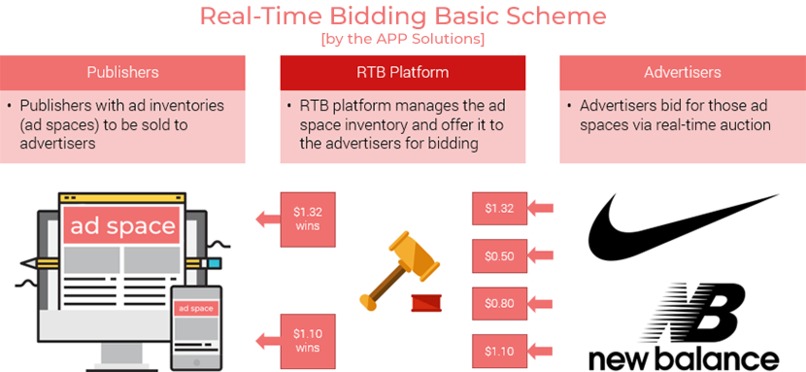
The app solutions - RTB
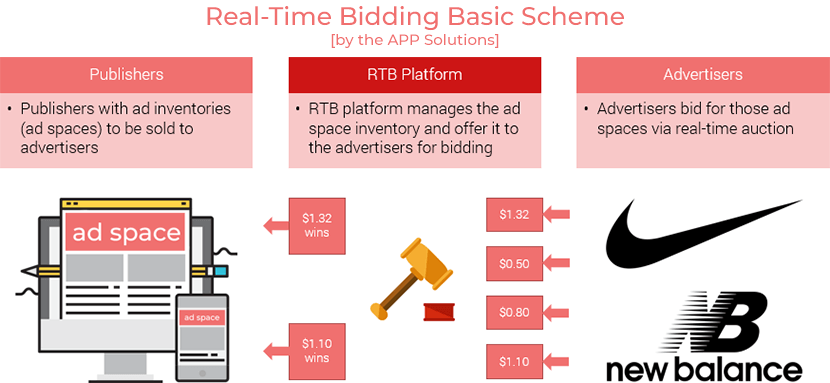
Bidding-Lens-Atrribution
Core attribution
Final Project Intro ML
The majority of display advertising inventory is sold in real-time auctions. These auctions are typically attended by bidders (such as Google, Criteo, RTB House, and Trade Desk) acting on behalf of advertisers. They typically train advanced machine learning algorithms on historical data to estimate the value of each display opportunity. The inputs in the labeled training set are feature vectors representing each display opportunity, and the labels are the generated rewards. In practice, the advertiser provides rewards, which are tied to whether or not a specific user converts. As a result, rewards are aggregated at the user level and are never seen at the display level. To the best of our knowledge, a fundamental task that has been overlooked is accounting for this mismatch and splitting, or attributing, the rewards at the appropriate granularity level before training a learning algorithm. This is known as the label attribution problem.
In this paper, I propose a theoretically justified and practically applicable approach to the label attribution problem. Because it satisfies several desirable properties, including distributional robustness, I call our solution robust label attribution. Furthermore, I create a fixed point algorithm that enables large-scale implementation and demonstrate our solution using a large-scale publicly available dataset from Criteo, a large Demand Side Platform.
Outline
What is Introduction to Machine Learning
Background Project
Digital advertising has attracted billions of dollars from advertisers over the last two decades. In 2019, global digital ad spending exceeded $300 billion USD (Enberg 2019). Digital marketing allows marketers to use data to make informed budget allocation decisions and display the right banner to the right customer at the right time. Existing approaches omit the critical step of converting the raw data provided by the advertiser into a dataset that can be fed into a machine-learning pipeline. In this study, I propose a principled solution for predicting the value of a given display opportunity that accounts for the mismatch between raw data and training data required for an ML pipeline.
Working Instructions
1 Select a topic & category 2 Select the object and look for reference/related works 3 Select Dataset 4 Start the experiment and model
Outcome Project
In this study, I propose a principled and scalable solution for predicting the value of a given display opportunity that accounts for the mismatch between the raw data provided by the advertiser and the training data required for an ML pipeline.
Code
Python (Programming Language)
Easy report
Medium
Presentasi
Youtube
Software And Tools Requirements
Create a new environment
conda create -p venv python==3.7 -y
Framework to Describe These Projects
Goal: The goal of this project was to explore and address the label attribution challenge in the context of real-time bidding (RTB) for display advertising. The project aimed to develop a robust and effective method for assigning labels to display opportunities, thereby optimizing the reward given to bidders for each user interaction.
Impact: The project's impact lies in its contribution to the field of real-time bidding and display advertising. By formalizing the label attribution problem and proposing the concept of strong label attribution, the project offers a novel solution that is theoretically grounded and practically applicable. The method's alignment with key axioms, particularly its relationship with Shapley values, suggests its potential relevance and effectiveness in real-world RTB scenarios.
Challenges: The project encountered challenges in defining and formulating the label attribution problem, as well as in devising a solution that addresses the complexities of real-time bidding. Ensuring the method's accuracy and applicability while maintaining computational efficiency were some of the challenges faced during the project.
Interesting Findings: The project's findings include: • Introduction and formalization of the strong label attribution concept. • Theoretical and structural features supporting the proposed method. • Demonstrated practical application to display ads of varying sizes. • Alignment with Shapley values, particularly in terms of key axioms.
Conclusion/Future Works: The project successfully tackled the label attribution challenge in the context of real-time bidding, introducing the concept of strong label attribution and its theoretical foundations. The findings open avenues for further research and exploration, particularly in understanding the relationship between the proposed solution and Shapley values. Future work could involve more extensive empirical validation and refinement of the method, as well as investigating its applicability to different types of RTB scenarios. Overall, the project contributes to advancing the understanding and practical implementation of label attribution techniques in the advertising domain.
Project Framework: Addressing Label Attribution in Real-Time Bidding
Goal: This project aimed to tackle the label attribution challenge within the context of real-time bidding (RTB) for display advertising. The primary objective was to devise a robust and effective methodology for assigning labels to display opportunities, optimizing bidder rewards based on user interactions.
Impact: The project's significance lies in its novel contribution to the field of real-time bidding and display advertising. By formalizing the label attribution issue and introducing the concept of strong label attribution, the project provides a theoretical framework and practical approach to enhance RTB strategies. The method's alignment with key axioms, notably its connection to Shapley values, indicates its potential for real-world applicability and impact.
Challenges: The project encountered challenges in defining and structuring the label attribution problem and in devising an approach that effectively handles the complexities of real-time bidding. Ensuring accuracy, applicability, and computational efficiency posed notable challenges throughout the project's duration.
Interesting Findings: The project's outcomes encompass:
- The formalization and introduction of the strong label attribution concept.
- Identification of theoretical and structural components that underpin the proposed methodology.
- Practical demonstration of the method's utility in diverse display ad scenarios.
- The method's alignment with Shapley values, particularly with respect to essential axioms.
Conclusion and Future Directions: The project successfully tackled the label attribution challenge within the real-time bidding landscape, unveiling the strong label attribution concept and its theoretical foundations. The project sets the stage for further exploration, particularly regarding the interplay between the proposed solution and Shapley values. Future work could encompass extensive empirical validation, refining the methodology, and investigating its applicability across varied RTB contexts. Ultimately, the project contributes to advancing the understanding and practical implementation of label attribution techniques in the dynamic advertising domain.
Built With
- ipynb
- jupyter-notebook
- python

Log in or sign up for Devpost to join the conversation.