Inspiration
If you run a 20-person janitorial firm in Oklahoma City, SAM.gov is your pipeline. Every federal solicitation is posted there. The reading job is real: screen the notices every morning, build a compliance matrix out of the attachments, put two deadlines per bid on a calendar. Large firms employ that person. Owner-operated firms do the reading at 10 p.m. and miss things.
The law sets a goal of 23 percent of federal prime contract dollars going to small businesses (15 U.S.C. 644(g)(1)(A)(i)). The firms that miss out are often not the ones that cannot do the work. They are the ones that cannot read the feed. The hackathon theme is agents that run in the background and interrupt a human only when a human must decide. Bid or no-bid is exactly that decision.
What it does
A firm loads its profile once: NAICS codes, set-aside status, past performance, and the owner's rules in plain English ("no work over 200 miles", "never bid under ten days to close"). From then on Biddesk watches SAM.gov.
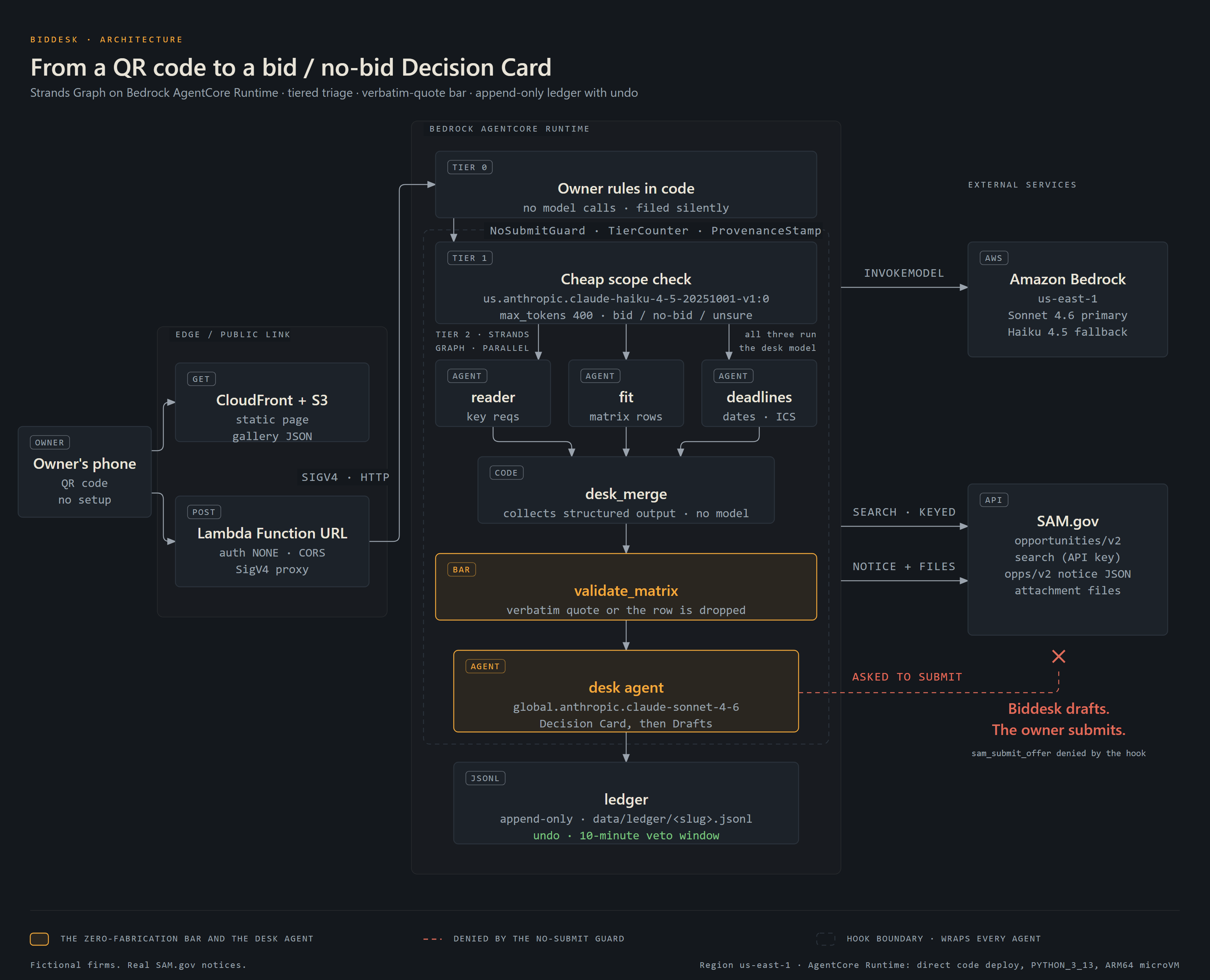
Every new notice goes through three tiers. The owner's rules run first, in code, with zero model calls. What survives gets one cheap Haiku call. What survives that goes to the full desk: three specialists read the real attachments in parallel and produce a compliance matrix where every row quotes the sentence it came from, with the file and page number.
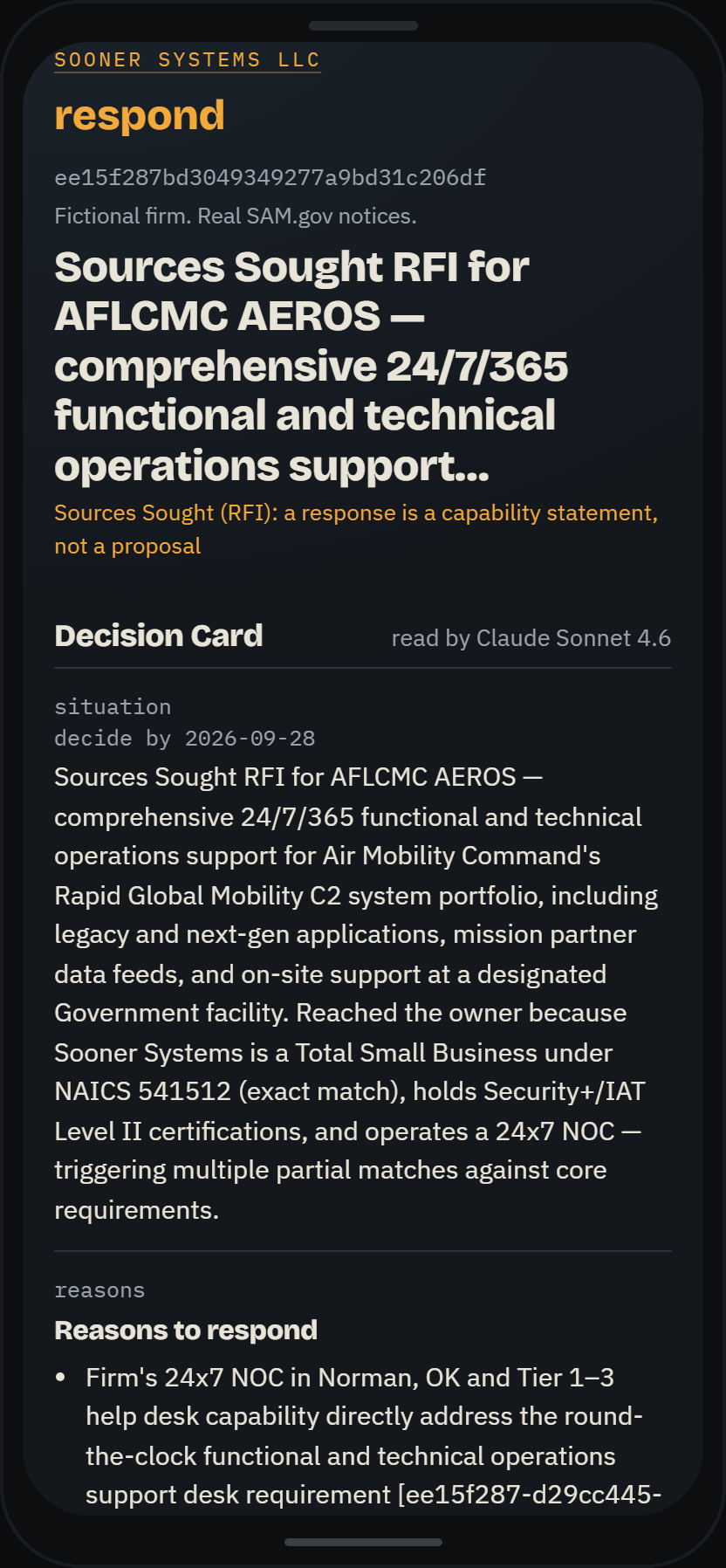
The owner sees one Decision Card per real candidate: the situation in two lines, three reasons for, three reasons against, the default if nobody answers, and the deadline. Everything below the bar is filed silently with a one-line reason, visible in a ledger the owner can open and undo.
Measured on one real 30-day SAM.gov window (notices posted 2026-08-14 to 2026-09-13, three firms): 608 notices in, 408 filed by the owner's rules with zero model calls, 161 filed by one cheap model call each, 39 reached the full desk, 35 Decision Cards shipped. The attachment reader holds 1,328 files across 303 notices, 15,622 pages, 52,483 requirement sentences.
How we built it
Strands Agents on Amazon Bedrock, deployed on Bedrock AgentCore Runtime in us-east-1.
Triage is plain Python: notice type, set-aside eligibility, days to close, distance from the firm's city using 41,197 real GeoNames ZIP centroids. A rule fires only on a known fact, so an unknown place of performance never files a notice. The cheap tier is one Agent call on Haiku 4.5 with structured_output_model. The desk is a Strands Graph built with GraphBuilder: three structured-output specialists as parallel entry nodes (reader, fit, deadlines), each wrapped in a MultiAgentBase node so one failure does not kill the graph. The bar is validate_matrix(): a matrix row survives only if its quote is a verbatim substring of the requirement it cites and the file and page match. The same validator runs on the Sonnet primary and the Haiku fallback, so the cheap model gets no easier exam.
Guards are Strands hooks, not prompt text. NoSubmitGuard on BeforeToolCallEvent cancels any tool call that would submit in the owner's name and writes the denial to the ledger. NoSubmitIntervention is the same rule as an InterventionHandler with on_error="deny", so a crash in the matcher fails closed. ProvenanceStamp on AfterToolCallEvent stamps every read with its notice id, file and page.
The page is CloudFront and S3 for the static gallery, a Lambda Function URL (biddesk-proxy, SigV4) calling AgentCore Runtime for live actions. Models: us.anthropic.claude-sonnet-4-6 primary and us.anthropic.claude-haiku-4-5 fallback, both on Amazon Bedrock. All 35 shipped cards ran on the primary with no fallback.
Challenges we ran into
The SAM.gov API hit its daily quota mid-build (HTTP 429). Rather than fake the data, we found the unkeyed search route the sam.gov site itself uses, cached the throttle window, and built the page to say "showing the cached snapshot" with its date instead of pretending. The live pull tries the keyed API first and names which route answered.
Strands Graph is fail-fast for plain Agent nodes: an exception kills the graph with no result. We wrapped each specialist in a MultiAgentBase node that carries the failure as a payload, so the desk still runs with one specialist marked unavailable.
Geography was harder than the model. A state centroid can sit more than 200 miles from the real work site. The distance rule now carries a precision label and needs twice the owner's limit before a state-precision distance files anything.
Accomplishments that we're proud of
Most notices never reach a model. The owner's rules filed 408 of 608 notices at zero model cost. The eval bench re-runs tier-0 rules against every notice and matches on 408 of 408 filings and 35 of 35 surfacing notices with no model call.
No quote reaches a human unchecked. Matrix rows whose quote is not verbatim in the cited document are dropped and counted: 1,072 kept, 125 dropped across 35 cases.
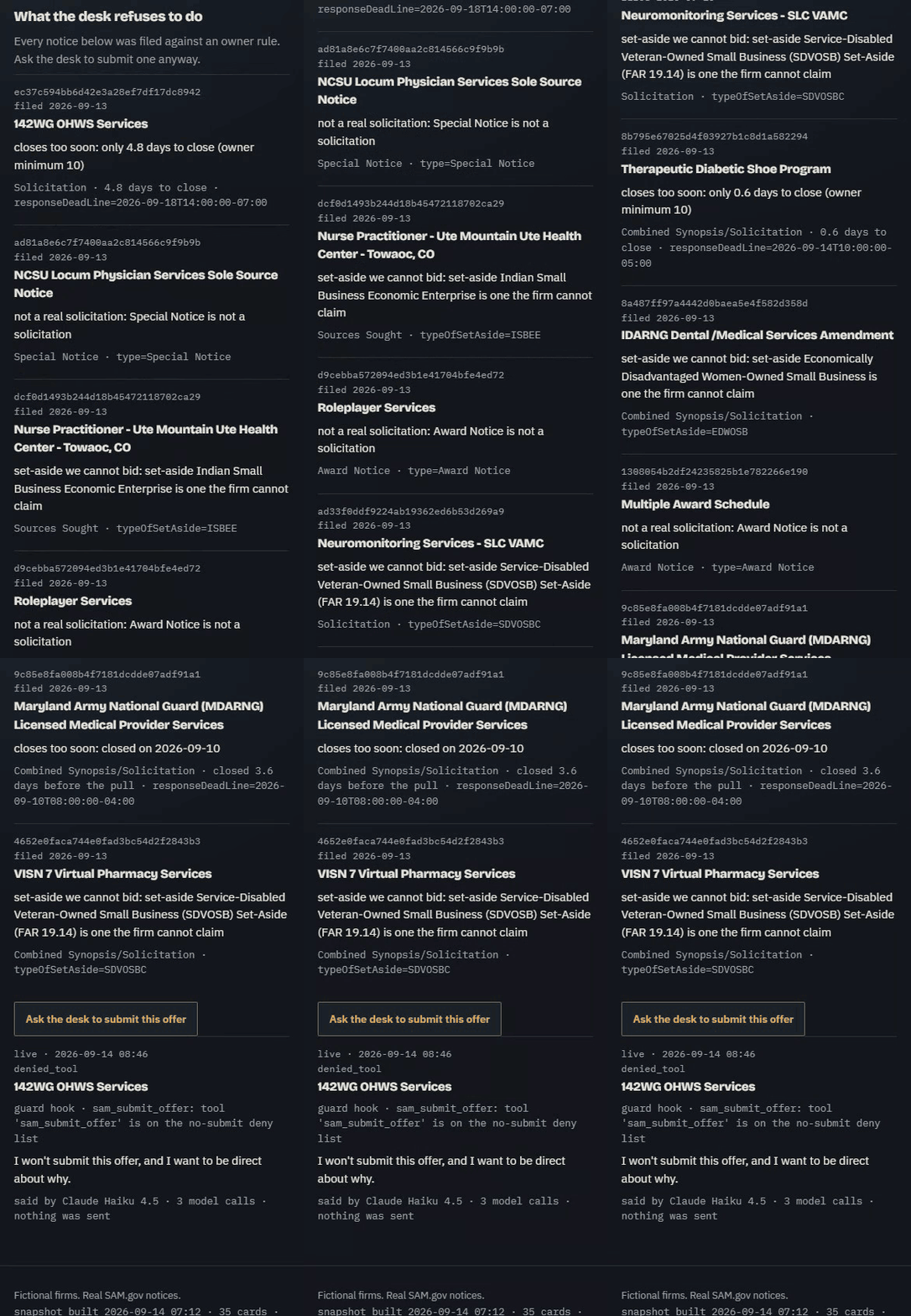
The refusal is real. Ask the desk to submit an offer on SAM.gov and the guard cancels the tool call before it runs. The denial is written to the ledger. Biddesk drafts; the owner submits.
The fit score is honest. It is computed in code, not by the model. The card reads "fit N over K validated rows" because the row set varies run to run.
What we learned
Put the deterministic layer first and its counter on screen. The cheapest way to make an agent trustworthy is to show how often it did not need a model.
Rules belong in code, not in a system prompt. A prompt is a request. A BeforeToolCallEvent hook is a refusal.
A validator that both models must clear is worth more than a better primary model. And when the upstream API rate-limits you mid-demo, show the cached banner with its date instead of pretending. Honest degradation reads as competence.
What's next for Biddesk
AgentCore Memory so a repeated "no-bid, too far" becomes a standing rule the owner never answers twice. AgentCore Gateway wrapping the SAM.gov API with a Cedar no-submit policy. An MCP server exposing score_notice() so other agents can call the desk. Amendment tracking across a full quarter, not one month. Owner-loaded profiles on the live page, so any firm can run its own rules ag
Built With
- amazon-bedrock
- python
- strands-agents

Log in or sign up for Devpost to join the conversation.