-
-
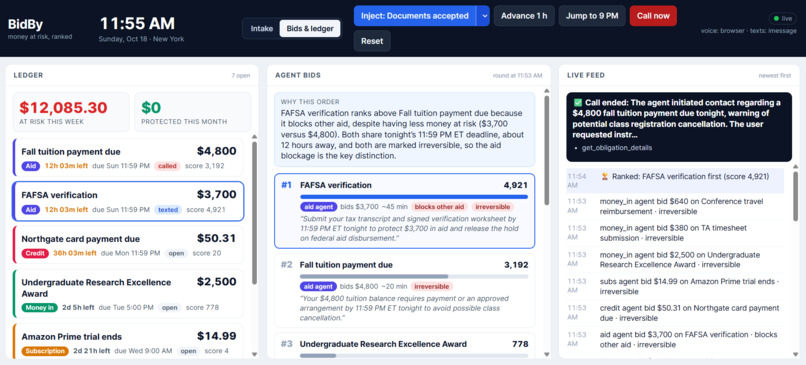
Multiple AI agents bidding for the highest priority AI task
-
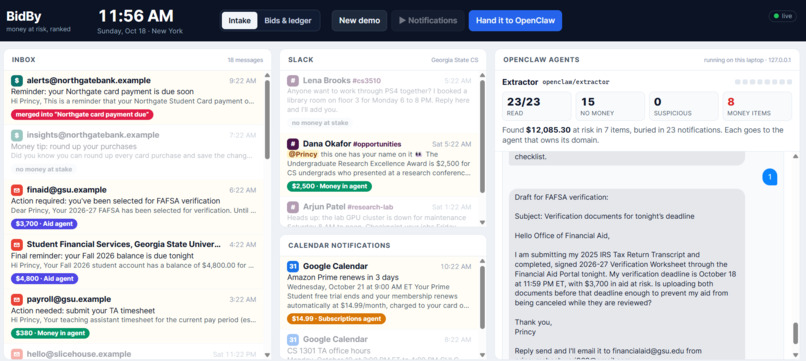
Multiple notification ingestion via OpenClaw
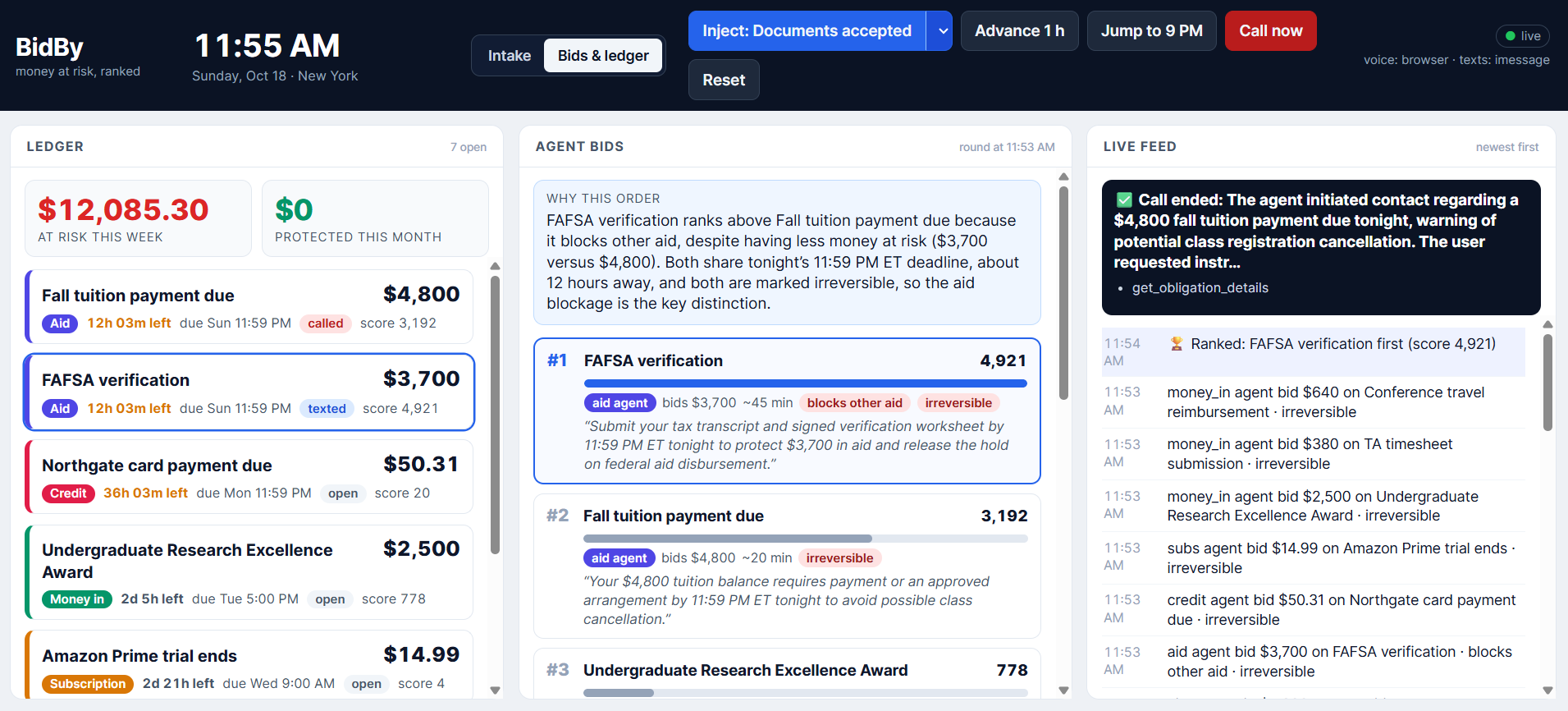
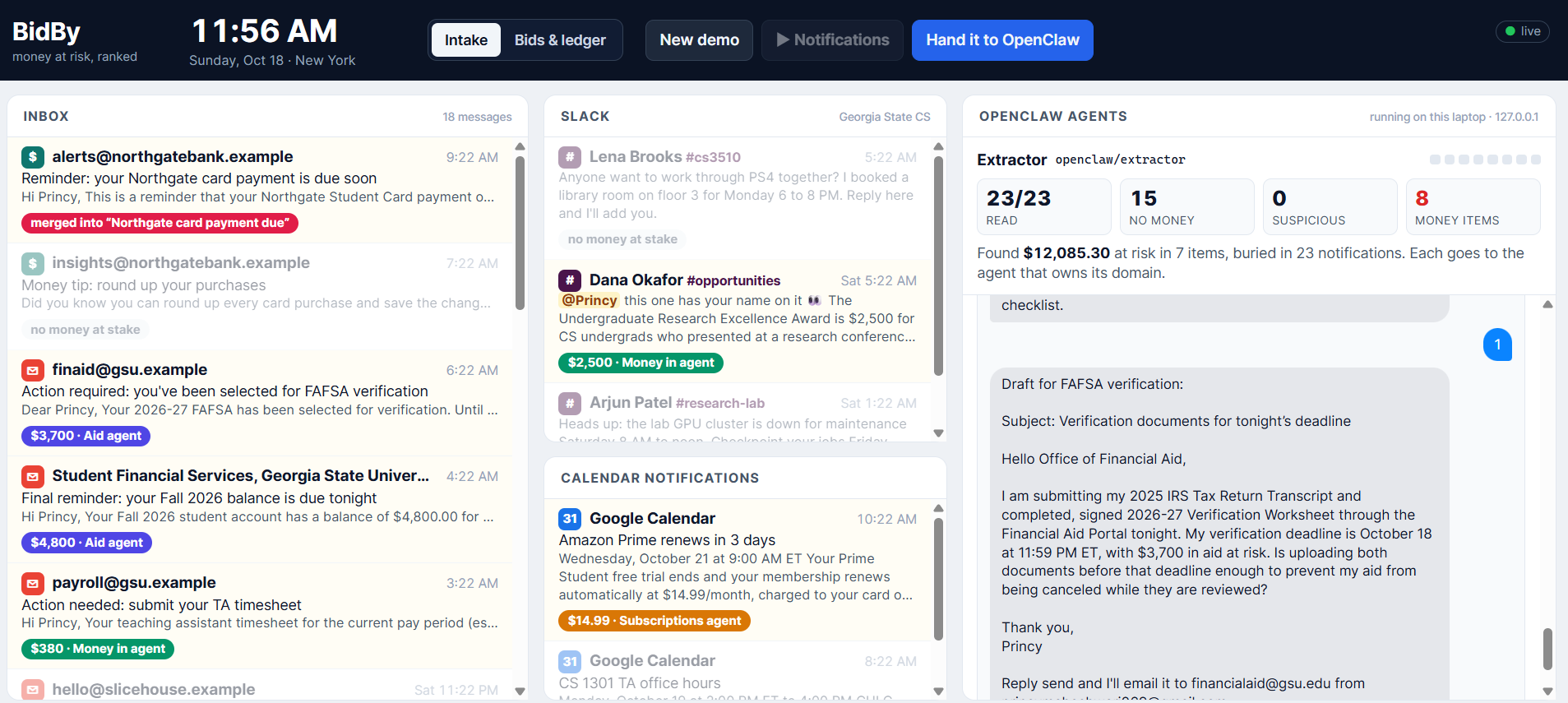
BidBy
Your financial lifeline in the noise: AI agents detect what matters, compete to prioritize it, and prepare the work to protect your money.
Inspiration
As a college student, my phone and laptop are flooded with notifications all day. Assignment deadlines, emails from my research PI, GitHub updates, sign-in codes, club newsletters, bank promotions—everything demands attention, and everything looks urgent.
Somewhere inside all that noise are the messages I actually cannot afford to miss. A FAFSA verification email that could hold up $3,700 in financial aid. A scholarship application that closes in 44 hours. A credit-card payment that could trigger a late fee tomorrow. A conference reimbursement window that ends on Friday. They arrive through the same inboxes and notifications as everything else, with nothing to distinguish a real financial consequence from one more email I can ignore.
The problem isn't that students don't care about their finances. It's that financially important messages are buried under everything else competing for their attention. And the students who can least afford to lose that money may have the least time to sift through it all.
The consequences can be substantial. In a 2018 National College Attainment Network report analyzing earlier award-year data, 56% of Pell-eligible students selected for FAFSA verification received a Pell Grant, compared with 81% of those not selected. That gap has multiple possible causes, but it shows why missing or struggling with an aid-related process can matter. Even seemingly small financial messages add up: a 2022 C+R Research survey found that respondents initially estimated $86 in monthly subscriptions, while itemized spending averaged $219; 42% said they had forgotten about a subscription they no longer used.
But simply surfacing the message isn't enough. Once I notice a verification request, I still have to find the official requirements, hunt down documents, figure out what I'm missing, and contact the right office. A scholarship or reimbursement has its own rules and forms; a credit card or subscription has different ones. The work is scattered across financial systems, just like the notifications are scattered across my devices.
I didn't want another budgeting dashboard or another app that sends more reminders. I wanted AI agents that detect the money-related messages buried in my daily noise, figure out which one matters most, and do the setup work for me before I even respond—from finding requirements to preparing the next step.
That's why I built BidBy.
What it does
BidBy is a multi-agent financial navigator built for overloaded inboxes. It detects financially consequential messages amid everyday noise, turns them into actionable cases, and assigns each to a specialist AI agent that researches requirements, gathers what is available, and prepares the next steps. Its agents then bid for the user's attention, so the case with the greatest financial consequences gets handled first.
The distinction is important: BidBy doesn’t stop at detecting a deadline. It does the setup work—finding requirements, checking documents, and preparing actions—so you don’t have to start from scratch.
Four specialists, four financial systems
Each OpenClaw specialist has a playbook for a different kind of financial problem:
| Agent | Financial system it helps navigate | What it prepares for you |
|---|---|---|
| Financial Aid | FAFSA verification, university aid offices, bursar holds, grants and appeals | Researches official requirements; checks available documents; identifies missing items; drafts emails; surfaces relevant aid and emergency funding resources |
| Credit | Credit-card statements, billing terms and issuer communications | Explains payment obligations and potential consequences; identifies the next action; prepares questions or messages for the issuer |
| Subscriptions | Free trials, renewals and recurring charges | Identifies upcoming charges; finds cancellation or renewal terms; prepares the steps to stop an unwanted renewal |
| Money-In | Scholarships, paychecks, timesheets and reimbursements | Finds application or claim requirements; organizes forms and receipts; prepares follow-up requests to help recover money owed or obtain available funding |
It does the setup work before it interrupts you
Say a student receives an email about a $3,700 financial aid hold. A conventional reminder says: Verification due tonight.
BidBy starts preparing the case before the student even opens the message:
- Understands the request: The Financial Aid Agent identifies the verification issue and researches the school's or program's official instructions.
- Looks for what the student already has: It searches permitted local files for relevant documents, such as a tax transcript, and distinguishes found items from missing ones.
- Builds an action plan: It identifies the remaining worksheet or supporting document and orders the steps needed to resolve the hold.
- Prepares the communication: It drafts a message to the financial aid office, including a useful question about the student's situation.
- Explores additional resources: When relevant, it surfaces official information about appeals, emergency grants, or other available campus assistance.
- Hands off the last decision: The student reviews the checklist, draft, and submission instructions, then takes or approves the necessary action.
This isn't financial advice or an autonomous money transfer. It's an agent doing the research, organization, and administrative preparation that makes financial systems so difficult to navigate.
The agents bid for which problem to solve first
Now imagine four cases land in the same week: a $3,700 aid hold, a credit-card payment, an expiring subscription trial, and a conference reimbursement claim.
There isn't enough attention for everything at once. So the four specialist agents bid for priority based on the money at stake, urgency, effort to resolve the issue, whether a loss can be reversed, and whether one unresolved issue blocks other funding. A consistent scoring formula ranks the bids; the coordinator explains the outcome in plain English.
For example:
Financial Aid wins this round. $3,700 is at risk, the verification window is closing, and the hold may prevent aid from being released. I've found the transcript, identified the missing worksheet, and prepared an email for review.
The bidding doesn't move real money. The agents compete to spend the student's limited attention where it can have the greatest impact.
Financial help, delivered where you already communicate
BidBy lives in an iMessage thread through Photon Spectrum, rather than in another app students must remember to check. It sends only the highest-priority actionable case, not a flood of alerts.
BidBy: Your $3,700 financial aid case needs attention tonight. I found your tax transcript, but the signed worksheet appears to be missing. Reply 1 for the email draft, 2 for the document checklist, or ask me a question.
You: What if I can't get the worksheet in time?
BidBy: Let's check the financial aid office's official submission and extension guidance. I can also show you the draft email asking what options are available.
Students can reply naturally to ask questions, request the prepared materials, mark an item complete, or snooze an interruption. If a serious unresolved case is approaching a deadline, BidBy also has an ElevenLabs voice agent designed to discuss the case and update its status through live tools.
Built to act carefully, not recklessly
BidBy filters obvious promotional noise, merges duplicate notices into one case, and flags suspicious financial messages instead of trusting links or requesting sensitive data. The ledger maintains a record of cases, priorities, and actions. It can recognize subsequent confirmation messages and close a case when appropriate.
It does not ask for banking passwords, card numbers, or Social Security numbers; it doesn't make payments or submit sensitive forms without the student's involvement. The goal is to detect what needs attention and take the setup work off the student's plate while keeping consequential actions under their control.
Why this matters for financial access and equity
A student shouldn't need to understand FAFSA verification terminology, credit-card billing language, university reimbursement procedures, and scholarship eligibility rules just to access money or avoid preventable losses. BidBy turns those systems into clear requirements, located resources, prepared documents, and concrete next steps—without requiring financial expertise or yet another dashboard.
It helps students manage money, access financial resources, and, most importantly, navigate financial systems with greater confidence.
How we built it
I built BidBy as a local-first, event-driven multi-agent system with one shared financial case ledger and two conversational interfaces.
  Email / Slack / bank alerts
              |
              v
      OpenClaw Extractor
 (identify cases, filter scams,
       merge duplicates)
              |
              v
       Local SQLite Ledger
              |
              v
       OpenClaw Specialists
 Financial Aid | Credit | Subs | Money-In
   (research rules, find files,
     prepare actionable help)
              |
              v
         Agent Bidding
       + Coordinator Agent
  (deterministic prioritization,
      plain-language rationale)
              |
              v
        TypeScript / Hono
         shared API + tools
           /        \
          v          v
  Photon Spectrum  ElevenLabs Voice
     iMessage       live tools
          \          /
           v        v
        Shared case ledger
- OpenClaw: Six locally running agents—an extractor, four specialists, and a coordinator—with separate instructions and restricted task-specific tools. Agents research official sources, work with accessible local files, and prepare case-specific next steps.
- Photon Spectrum: Bridges outbound BidBy messages and inbound student replies through iMessage, so the assistant works inside an existing conversation.
- ElevenLabs Agents: Provides the conversational voice layer and case tools to look up details, snooze, or mark a case complete; call summaries can be associated with the case record.
- Node.js, TypeScript, and Hono: Handle routing, business logic, webhooks, and the interfaces connecting the agents, messages, and voice tools.
- SQLite: Maintains the obligations/cases, agent bids, state transitions, and event history locally as the shared source of truth.
- Cloudflare Tunnel: Makes the authenticated voice-facing endpoints reachable while keeping the rest of the locally running system private.
An important architectural decision: specialists generate the bids, but a fixed scoring mechanism determines the ranking. The agent can explain why a financial case matters; it can't simply win by making a more dramatic argument.
Challenges we ran into
Connecting specialized OpenClaw agents to Photon iMessage
The hardest part was making OpenClaw's specialist agents and Photon's iMessage integration work as one coherent assistant. OpenClaw agents could independently research a financial case and prepare next steps, while Photon could send and receive iMessages—but wiring those pieces together meant building reliable handoffs in both directions.
An incoming iMessage had to be associated with the correct financial case, routed to the right specialist, and answered in the same thread with the right context. Meanwhile, the ledger needed to stay consistent as agents bid, notifications went out, and students replied or snoozed a case. I had to handle duplicate messages and distinguish a new financial alert from a conversational reply so BidBy didn't accidentally send repetitive texts or lose track of the student's progress.
The challenge wasn't just getting agents to talk. It was getting them to detect a real financial problem, prepare useful work, and deliver it as one seamless iMessage experience.
Accomplishments that we're proud of
I built BidBy solo in under 24 hours, integrating OpenClaw multi-agent workflows, Photon-powered iMessage, ElevenLabs voice agents, and a Node.js/TypeScript/SQLite backend.
What I'm most proud of is building more than a chatbot or a deadline list:
- Domain-specialist agents that approach financial aid, credit, subscriptions, and incoming money as different systems with different requirements.
- An attention auction where specialists compete to prioritize the financial case that needs help most, with an explainable final ranking.
- Setup work before notification: detecting the obligation, researching requirements, checking available documents, identifying missing steps, drafting communications, and surfacing resources.
- A familiar interface: students can ask for the help they need directly in iMessage, with a voice layer for urgent conversations.
- One persistent case history across extraction, bidding, follow-ups, and status changes, rather than isolated agent demos.
The real achievement was taking a complex collection of agents and integrations and turning it into a product with a simple promise: you don't need to become an expert in every financial system just to get your money-related tasks done.
What we learned
The biggest financial risks can hide in ordinary notifications. A student can understand the importance of a scholarship or financial aid and still miss the one message needed to access it. Finding that message matters, but so does navigating the requirements that follow. A useful financial tool bridges both gaps.
A useful agent should do the preparatory work, not just give advice. The biggest improvement from a reminder to an agent is going from “you need to submit a form” to “here's the form you need, what I've already located, what you're still missing, and a message ready for your review.”
Multi-agent architecture is most compelling when specialists have different responsibilities. Financial aid, credit, subscriptions, and reimbursements are genuinely different systems. The bidding mechanism gives those perspectives a disciplined way to decide what deserves the user's attention.
Integration and safety are part of agent intelligence. Routing a reply, keeping state consistent, avoiding duplicates, and not acting on a phishing email mattered as much as the model's ability to answer a question.
And I learned that attention itself can be a financial resource. People don't necessarily lose money because they make a bad financial decision. Sometimes they lose it because an unfamiliar process demanded time and effort they didn't have.
What's next for BidBy
I want to grow BidBy from a hackathon prototype into a trusted financial operations assistant for students—one that can guide a student through an entire process, not simply recognize its deadline.
Next steps include deeper integrations with aid offices and official school resources, more reliable eligibility and requirement checking, secure document and form workflows, and optional user-approved actions such as submitting a prepared request or initiating a cancellation where an official integration permits it. I also want stronger source verification, fine-grained permissions, and clear distinctions between prepared, submitted, and confirmed outcomes.
Over time, I want the same approach to work across additional complex financial systems, such as benefits, insurance claims, billing disputes, and tax documents, while remaining accessible through the communication tools people already use.
The goal is to make sure the money-related message buried under a hundred other notifications doesn't become a preventable financial loss—and that when BidBy finds it, the student already has an agent working on what comes next.
Built With
- cloudflare
- elevenlabs
- openclaw
- photon

Log in or sign up for Devpost to join the conversation.