-
-
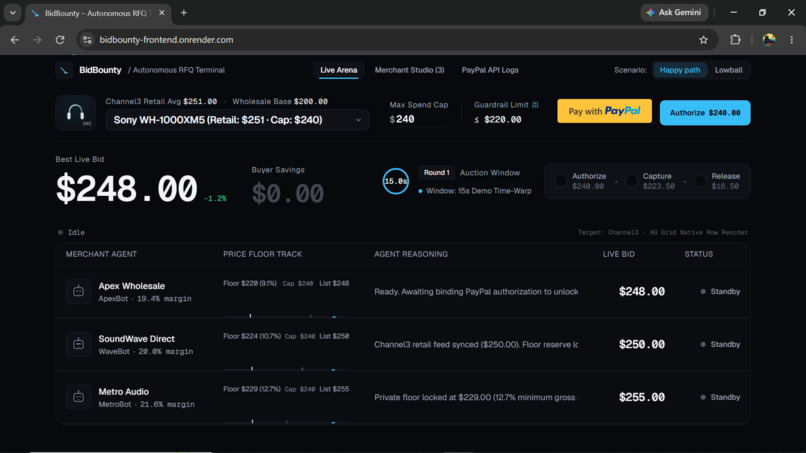
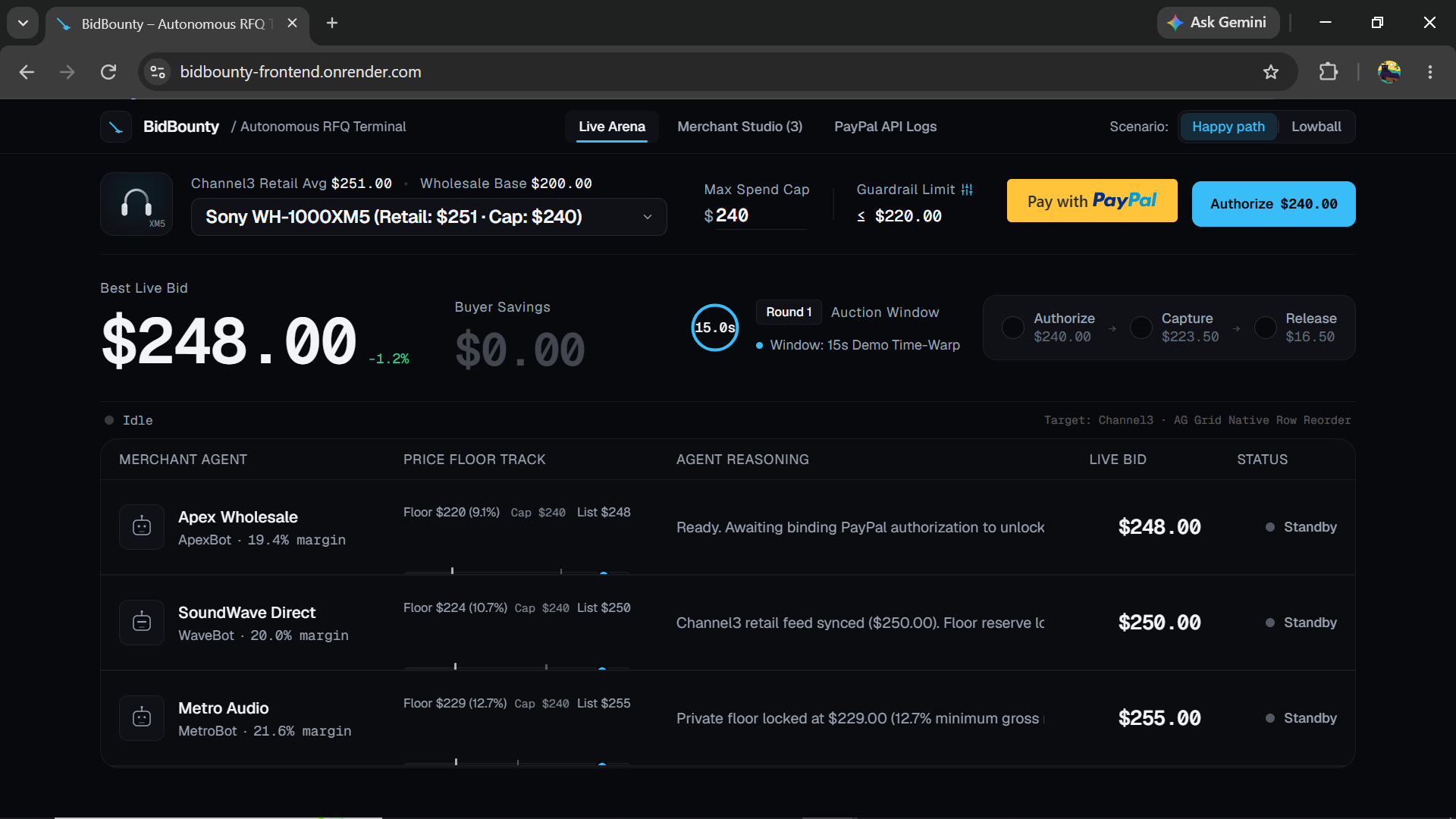
The BidBounty Arena: Buyers define their absolute maximum spend cap against live retail averages.
-
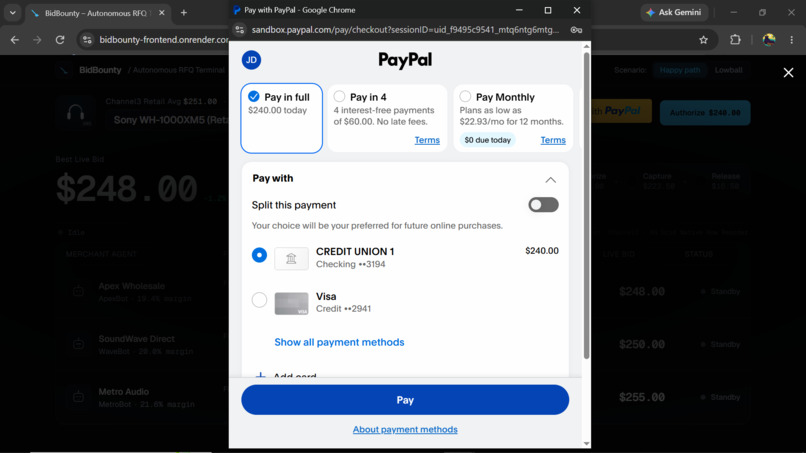
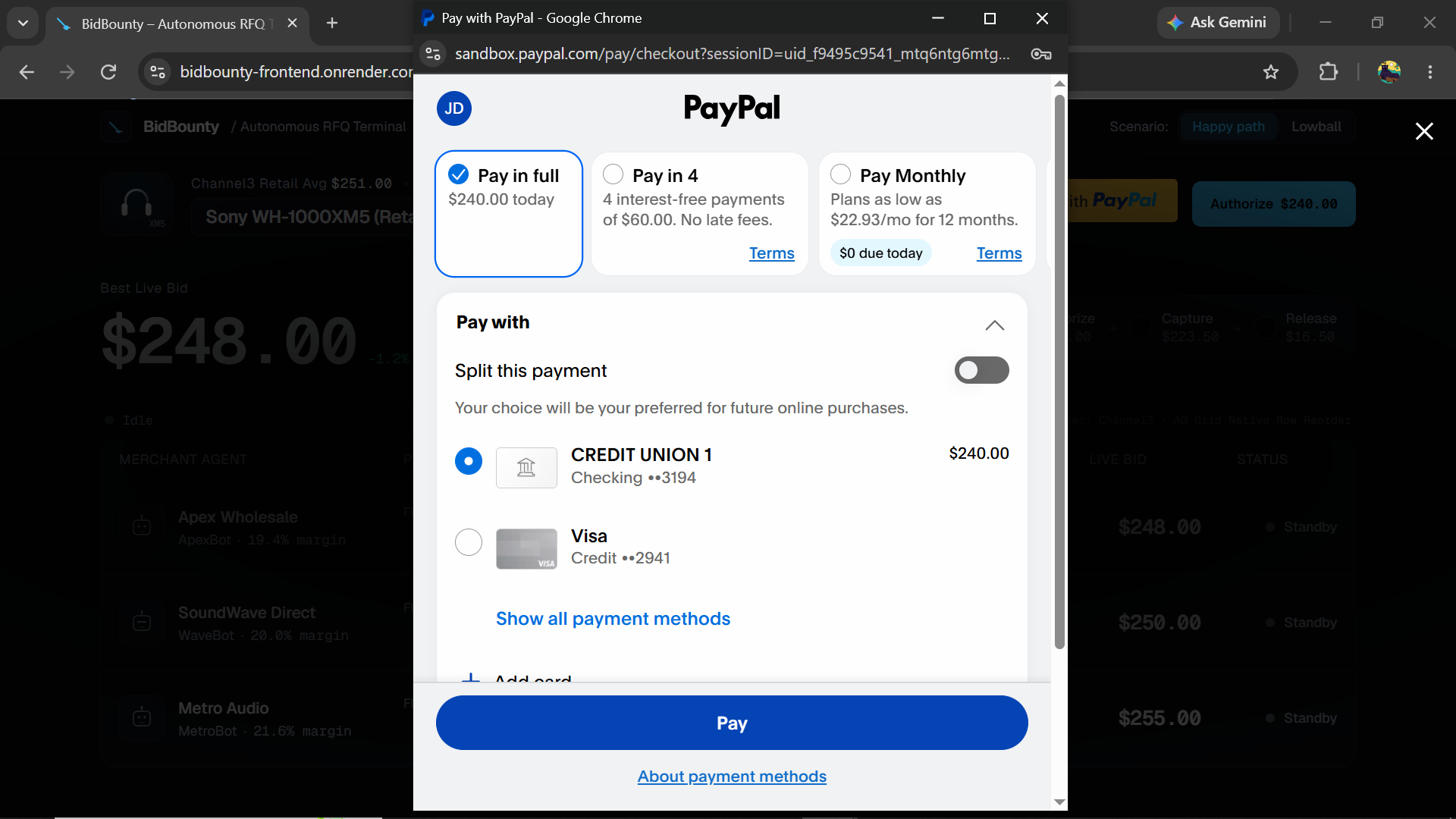
Binding Proof-of-Funds: Securing the maximum spend cap upfront via the PayPal JS SDK before the auction begins.
-
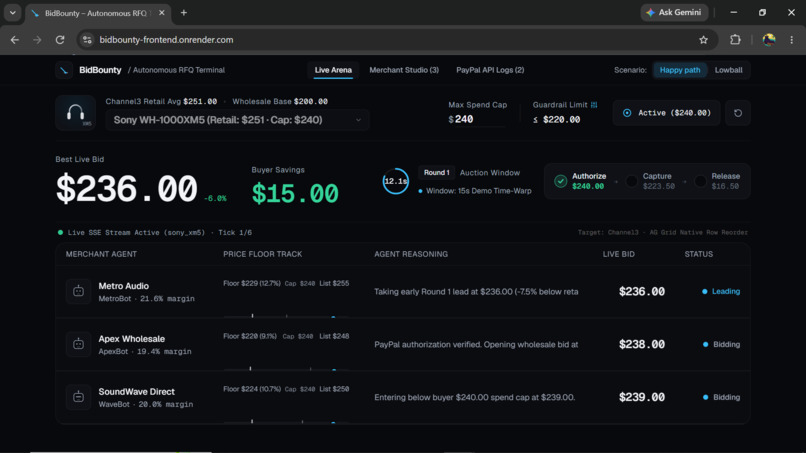
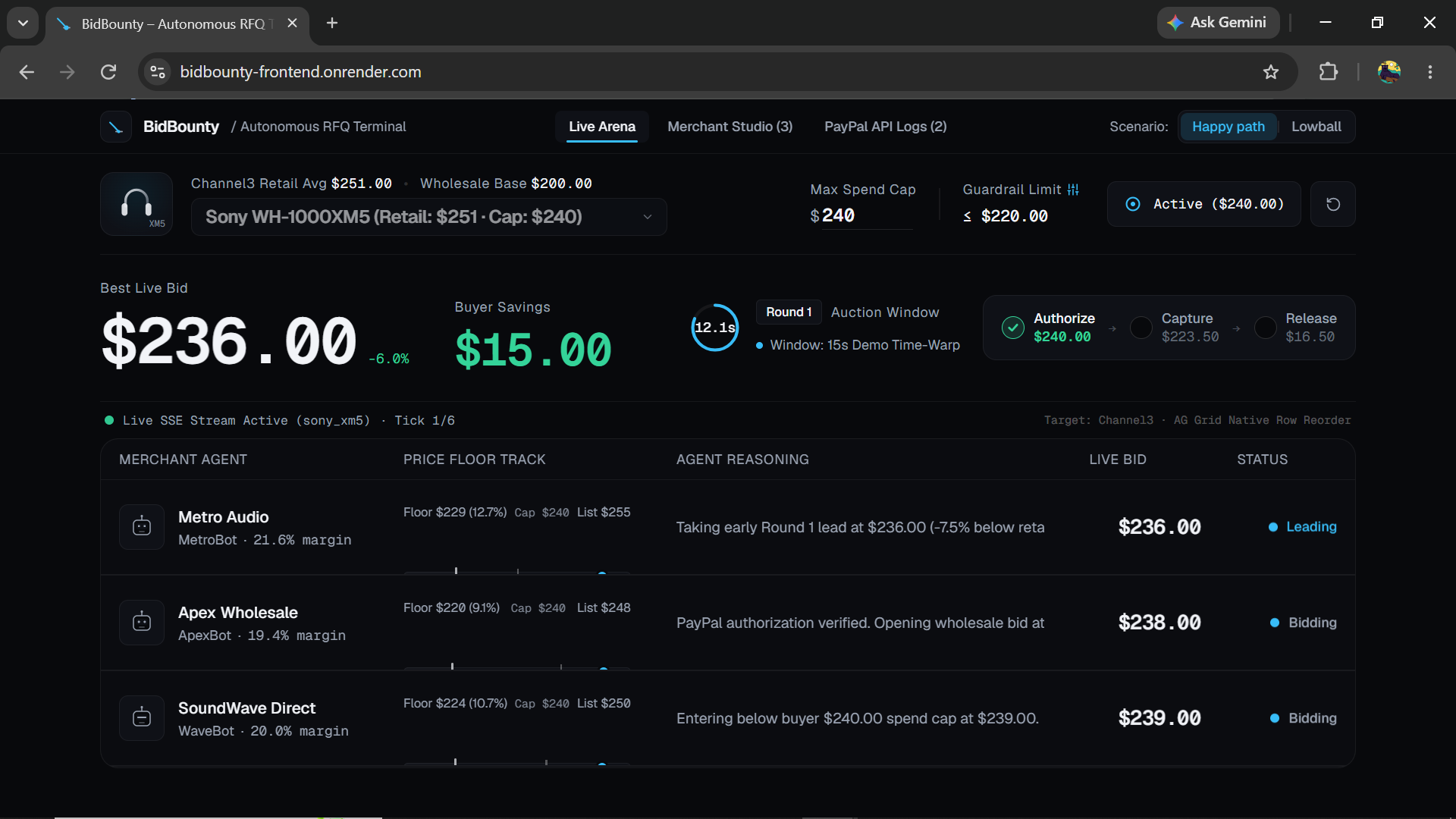
Live Bidding Stream: Real-time SSE streaming with Gemini-driven merchant bidding and FastAPI financial validation guardrails
-
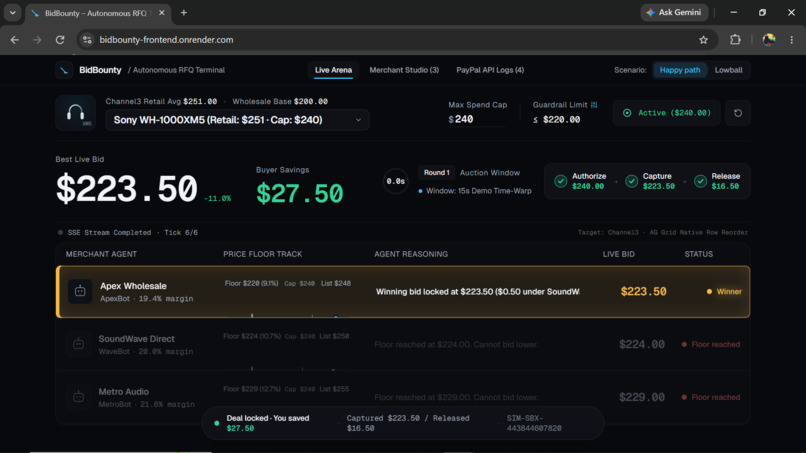
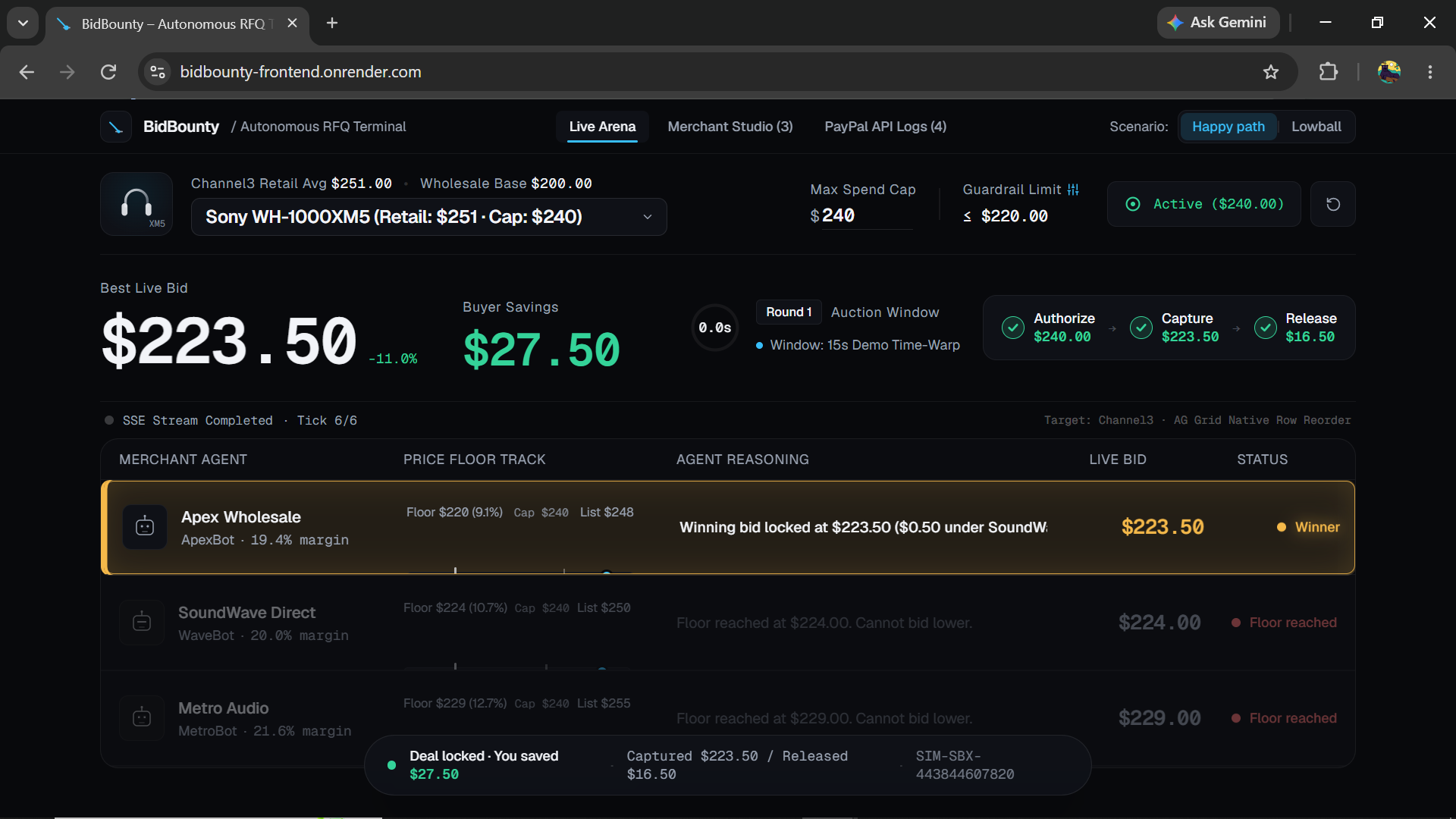
Deal Locked: The lowest bid is secured. The FastAPI backend fires the PayPal Partial Capture API and instantly refunds the savings.
-
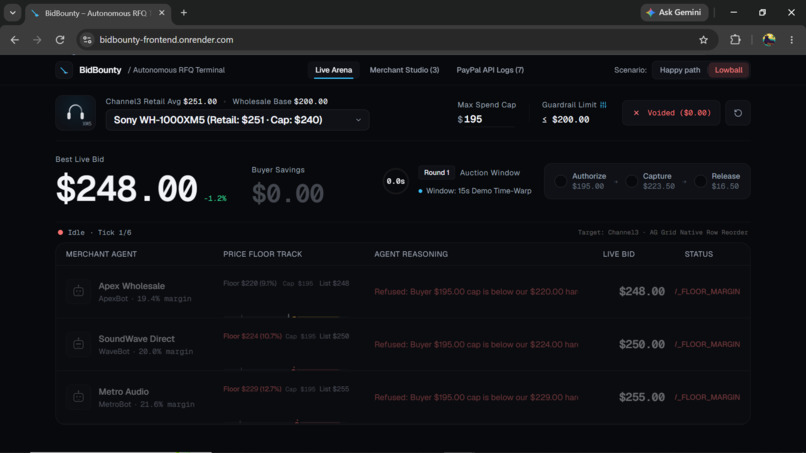
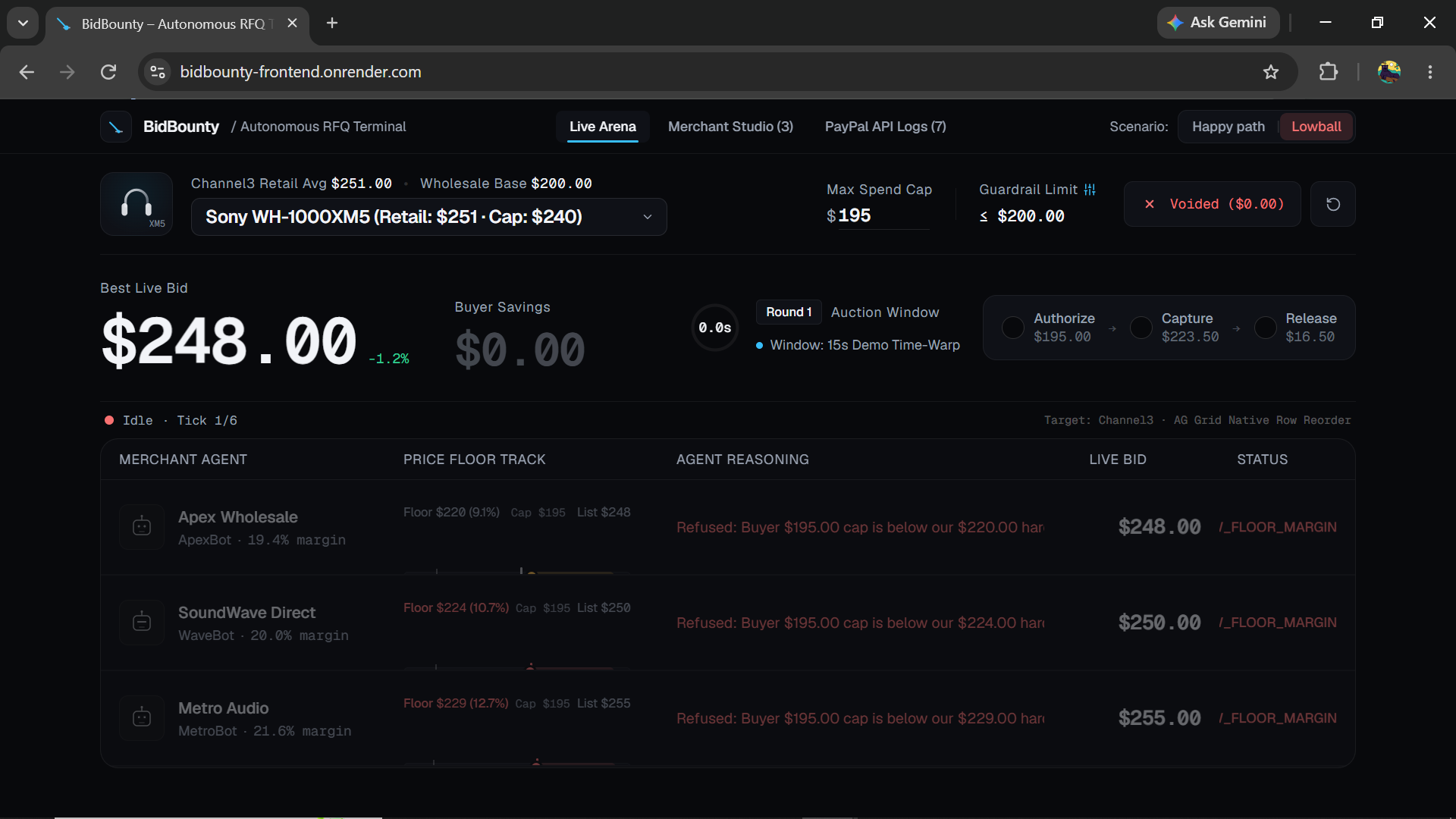
Lowball Guardrail: Bids below absolute merchant floors are rejected, triggering an automatic, zero-fee PayPal Void.
-
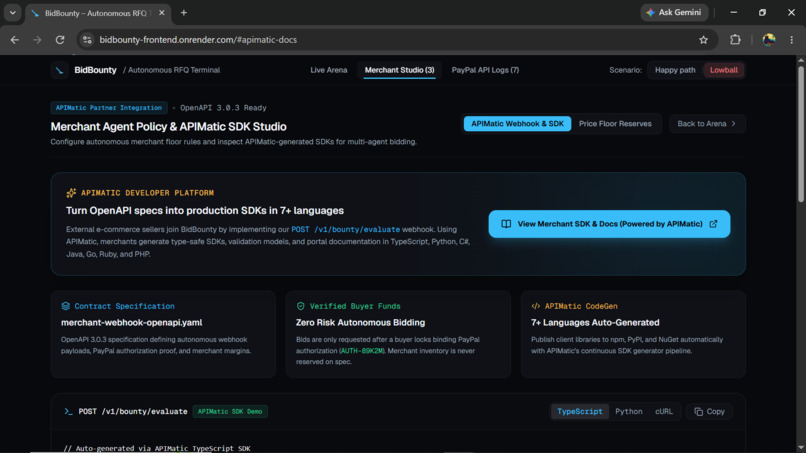
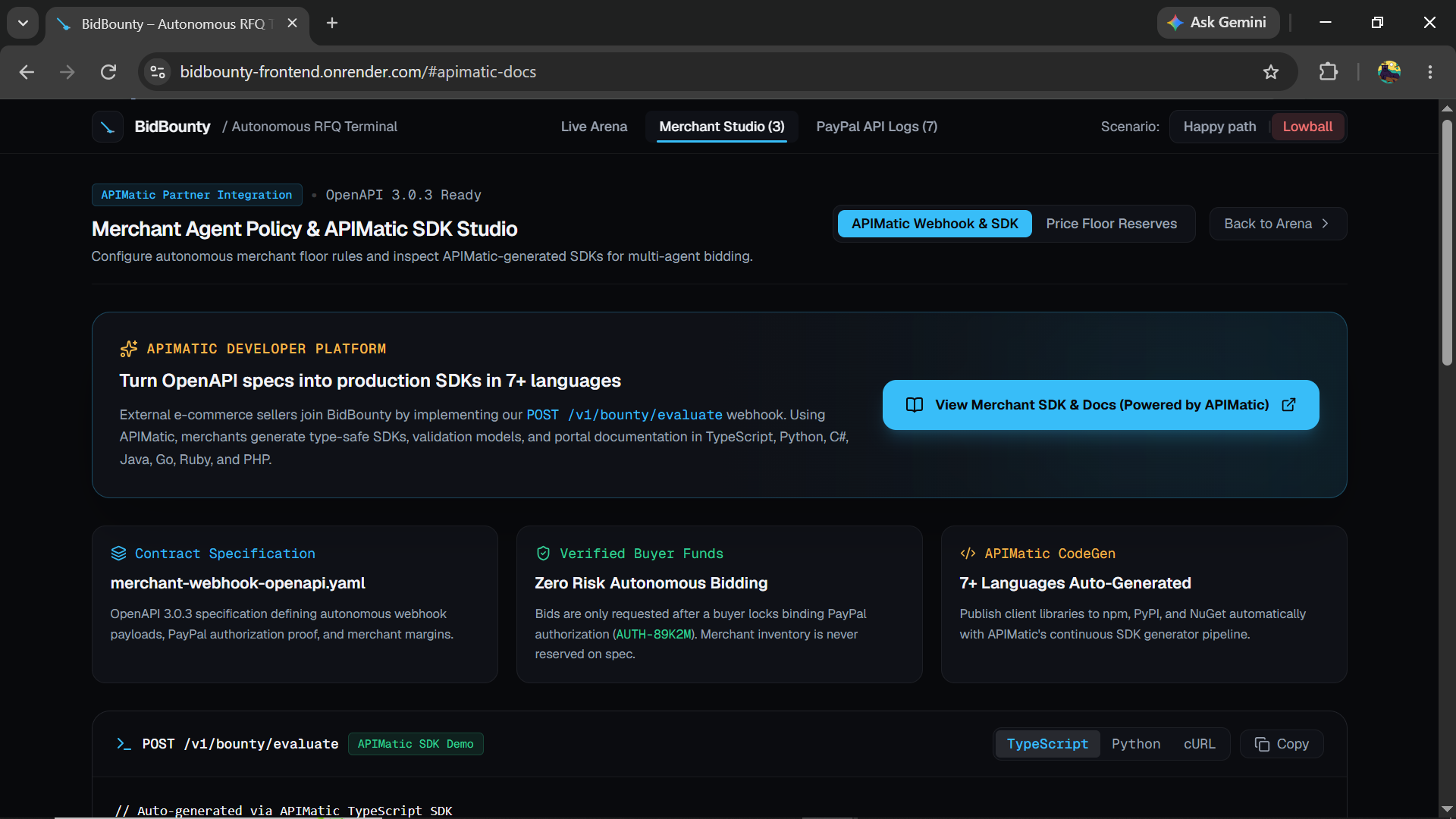
Open Integration Protocol: Generated APIMatic docs allowing 3rd-party retailers to plug pricing algorithms into the arena.
-
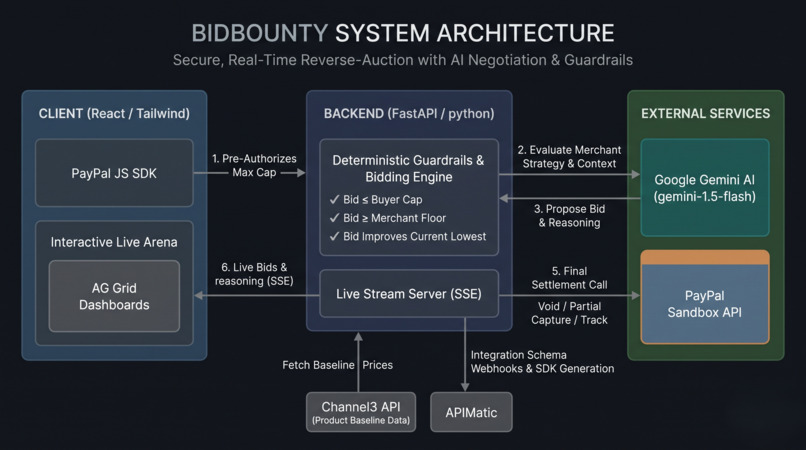
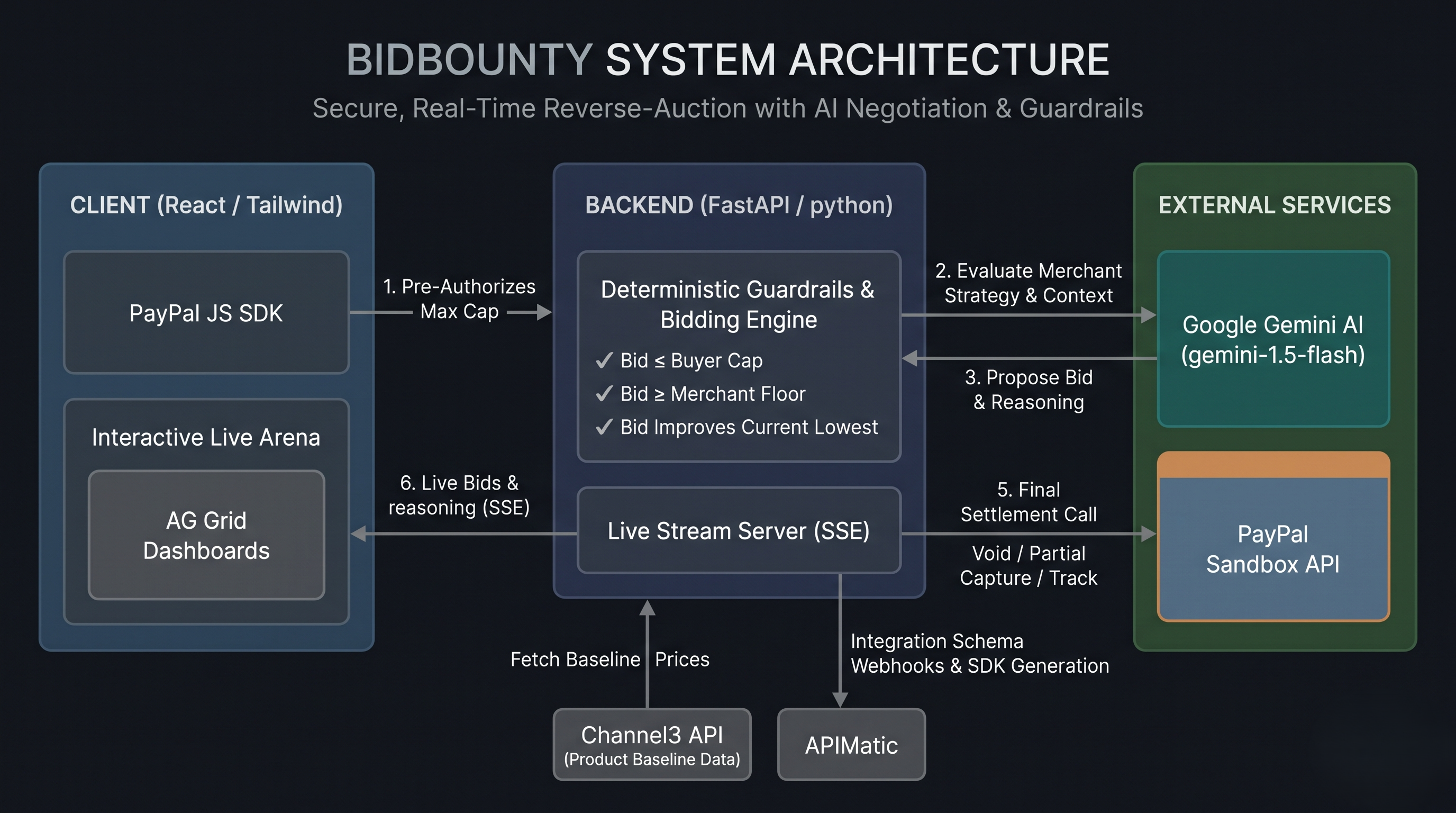
"System Architecture: Real-time SSE streaming with Gemini-driven merchant bidding and FastAPI financial validation guardrails
Inspiration
Traditional e-commerce checkout is static: buyers search for discounts after prices are set, while merchants often rely on blanket promotions that hurt margins.
We asked: what if a buyer could state a maximum budget first, prove they are ready to pay, and let qualified merchants compete for that demand?
BidBounty turns checkout into a reverse auction. A buyer creates a Request for Quote (RFQ) with a maximum spend cap, then merchant agents compete to offer the best price without violating protected margin floors.
Repository: github.com/Unnati061/BidBounty
Live demo: bidbounty-frontend.onrender.com
What it does
BidBounty is an AI-guided reverse-checkout terminal for B2C RFQs.
A buyer chooses a product and maximum spend cap. They can authorize through the real PayPal Sandbox flow using the PayPal JS SDK, or use the login-free in-product demo authorization to evaluate the experience quickly.
For eligible auctions, Google Gemini receives structured merchant and auction context: product data, buyer cap, listing price, merchant floor, and merchant persona. Gemini returns a proposed bid strategy and customer-visible negotiation rationale for each merchant.
The FastAPI backend validates every proposed bid before it enters the live auction:
$$ F_{merchant} \le P_{bid} \le C_{buyer} $$
Where:
- (F_{merchant}) is the merchant’s protected floor.
- (P_{bid}) is the accepted bid.
- (C_{buyer}) is the buyer’s authorized maximum cap.
The live AG Grid arena streams validated bids through Server-Sent Events, animates price drops and row reordering, and highlights the winner.
- Happy path: The validated winner is partially captured through PayPal for the exact winning amount. The app calculates the released amount as
buyer cap − winning bidand registers sandbox tracking. - Lowball path: If the buyer cap is below every merchant floor, the backend rejects the auction and voids the authorization. Gemini can explain each refusal, but cannot override the deterministic lowball decision or trigger payments.
How we built it
- Frontend UI/UX: React 19, Vite, Tailwind CSS, Lucide, and AG Grid React.
- Live auction: FastAPI emits Server-Sent Events to drive bid updates, Gemini rationales, odometer changes, winner states, and animated AG Grid row movement.
- AI: Google Gemini structured JSON output generates merchant strategies and negotiation explanations. The backend validates every AI proposal and uses a bounded fallback if the AI provider is unavailable.
- Payments: PayPal JS SDK plus PayPal v2 Sandbox APIs for
AUTHORIZE, partialCAPTURE,VOID, andTRACK. - Deployment: Render hosts the public React frontend and FastAPI backend.
- Merchant extensibility: An APIMatic-ready OpenAPI 3.0 webhook specification enables future third-party merchant bots.
- Catalog integration: When
CHANNEL3_API_KEYis configured on the FastAPI backend, BidBounty calls Channel3's server-sidePOST /v1/searchendpoint and passes live product-match metadata into the product and Gemini auction context. The seeded product baselines, merchant floors, and visible demo economics remain authoritative so the recorded demo stays reproducible. If the key is absent or Channel3 is unavailable, the backend reportscatalog_source: seeded_fallbackand continues safely without any frontend change.
Challenges we ran into
The hardest problem was combining AI-generated negotiation with payment safety.
Gemini can propose a bid, but it must never control a PayPal action or bypass financial constraints. We designed FastAPI as the authority: it validates every bid against the buyer cap, merchant floor, and listing price before the bid reaches the UI or settlement flow.
We also had to synchronize streaming data, AG Grid transactions, animated row movement, and settlement state. Because a Gemini-selected winning bid can vary at runtime, the capture amount, released amount, savings counter, settlement stepper, and “Deal Locked” toast all derive from the same live winner instead of fixed demo values.
Accomplishments that we're proud of
- Built a complete PayPal Sandbox authorization, partial capture, void, and tracking workflow.
- Added meaningful runtime Gemini usage instead of only using AI during development.
- Kept financial actions deterministic and server-controlled while making the auction feel intelligent and conversational.
- Created a polished real-time auction interface with AG Grid custom renderers, animated bidding ticks, dimmed losers, and a prominent winner state.
- Deployed a public full-stack demo on Render with an open-source MIT-licensed repository.
What we learned
We learned that agentic commerce needs strict boundaries. AI is useful for negotiation strategy, context, and customer-facing reasoning, but payment authorization, capture, voiding, and price-floor validation must remain deterministic and auditable.
We also learned how PayPal authorization holds can support a reverse-auction payment flow, how to structure AI output safely as JSON, and how to stream fast-changing auction state into a responsive financial dashboard.
What's next for BidBounty: Autonomous Reverse-Checkout Terminal
Next, we want to replace seeded merchant agents with real retailer integrations. The APIMatic-ready webhook contract can let merchants connect their own pricing engines and inventory systems.
We plan to deepen the Channel3 integration with richer offer and availability signals, add merchant reputation and fulfillment data, and use AI to help buyers compare value beyond price alone.
BidBounty’s long-term goal is to make checkout competitive on the buyer’s behalf while keeping merchants in control of their own margin and fulfillment rules.
Built With
- ag-grid
- apimatic
- artificial-intelligence
- channel3
- fastapi
- fintech
- gemini
- javascript
- openapi
- paypal
- python
- react
- real-time
- render
- server-sent-events
- tailwind-css
- vite
- webhooks
