-
-

智能分析页面
-
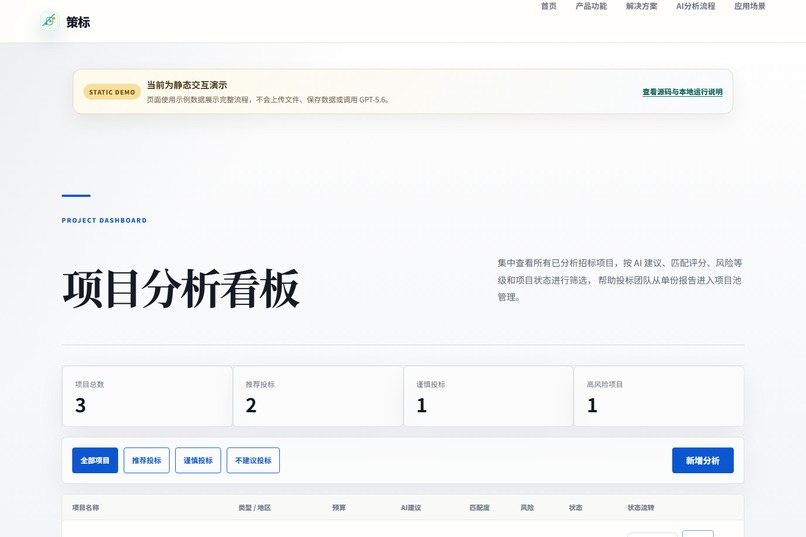
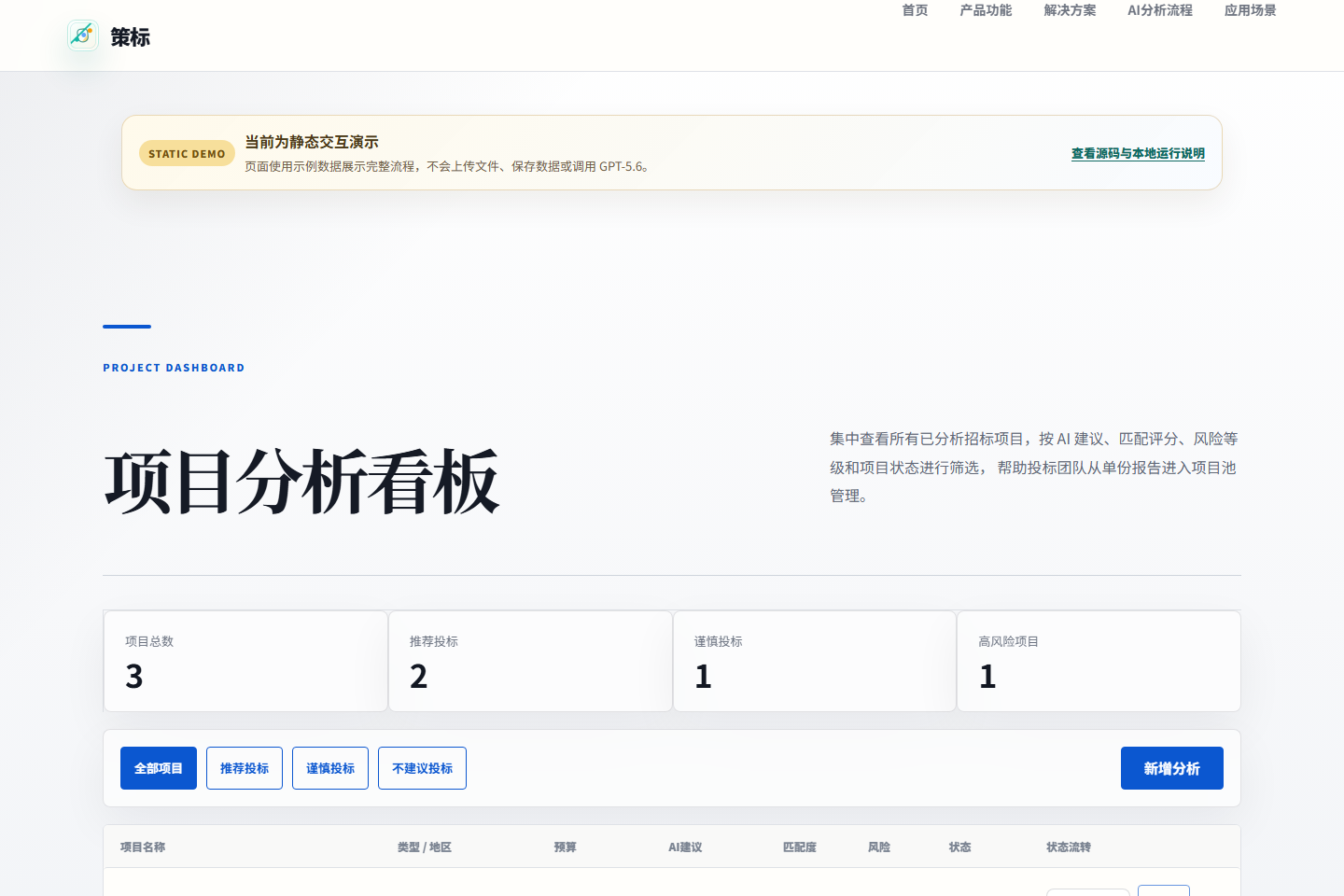
项目分析看板
-
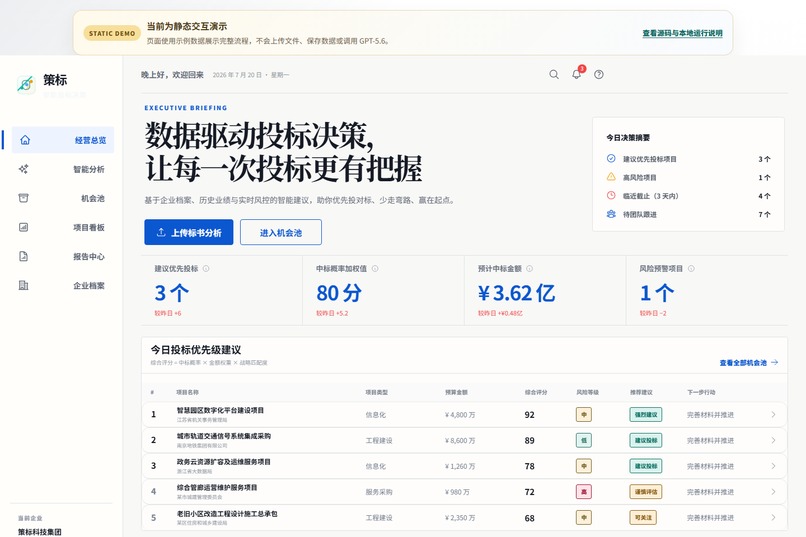
总览
Inspiration
Enterprise bidding teams often need to review hundreds of pages before answering one deceptively simple question: Is this project worth bidding on?
The process involves much more than summarizing a tender. Teams must identify qualification requirements, compare them with company certificates, find relevant past experience, inspect payment and delivery conditions, prepare mandatory materials, and catch clauses that could invalidate the entire bid.
This work is time-consuming, repetitive, and vulnerable to human oversight—especially when multiple deadlines overlap.
We built Bid Strategy to transform complex tender documents into structured, explainable, and actionable decisions. Our goal was not to replace professional judgment, but to give bidding teams a reliable first review and help them focus their attention where it matters most.
What it does
Bid Strategy is an AI-powered tender analysis and decision workspace.
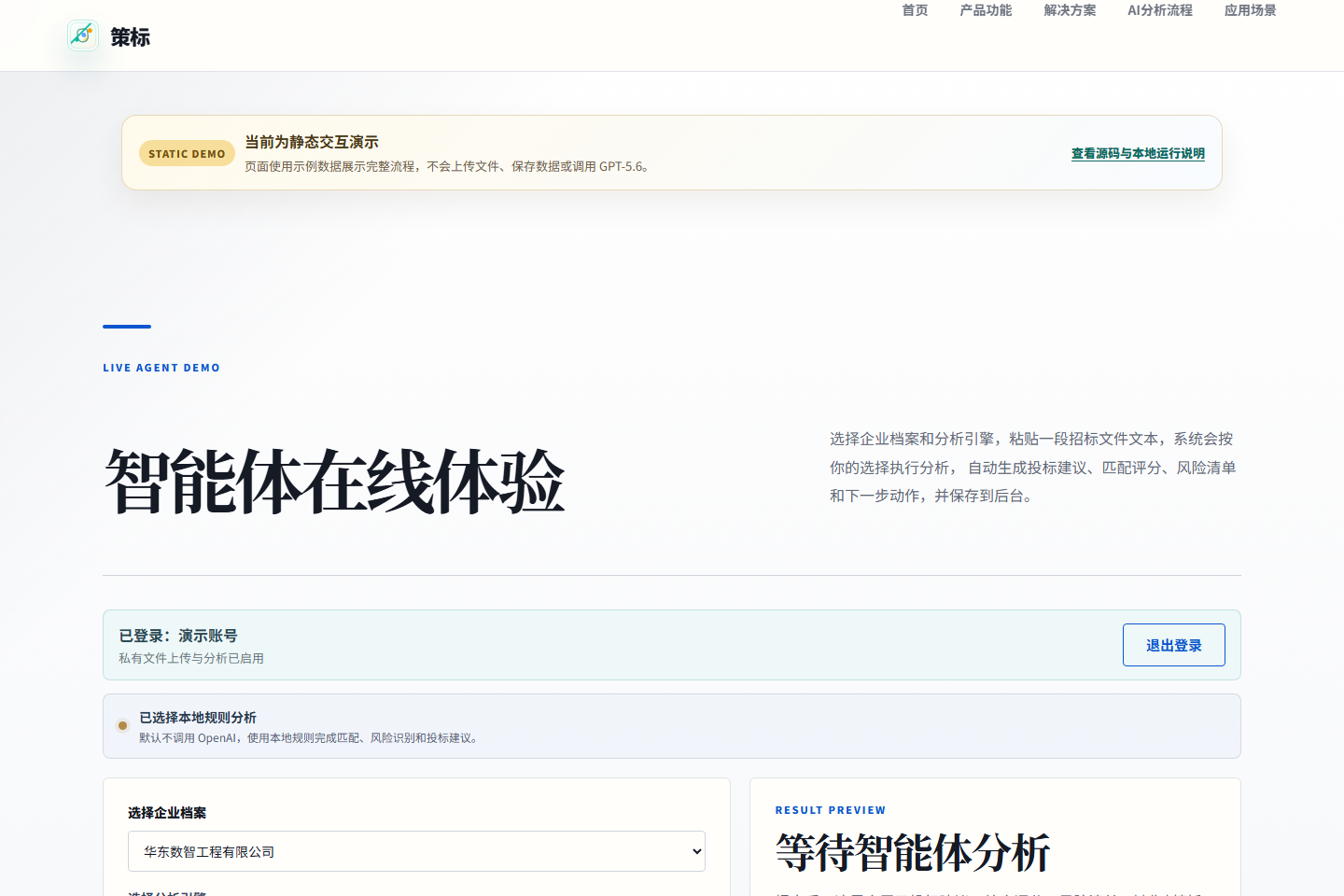
A user can upload a tender PDF or paste its text, select a company profile, and receive a structured report containing:
- Project name, procurement method, region, budget, and deadline
- Required qualifications and missing certificates
- Relevant historical project experience
- Commercial, technical, deadline, and disqualification risks
- A checklist of required bidding materials
- A transparent match score
- A recommendation: Recommended, Proceed with Caution, Do Not Bid, or Manual Review
- Concrete next actions for the bidding team
The result depends on the selected company profile. A project that is suitable for one company may be inappropriate for another because of differences in qualifications, experience, service regions, project capacity, or internal no-bid conditions.
A simplified representation of the displayed score is:
$$ S = 0.35Q + 0.25E + 0.25R + 0.15T $$
where:
- (Q) is the qualification match score
- (E) is the relevant experience score
- (R) is the risk-control score
- (T) is the technical-response score
The numerical score does not make the decision by itself. A mandatory missing qualification or another high-risk condition can override an otherwise strong result.
Bid Strategy also turns analysis findings into work. Users can manage opportunities, track project status, assign follow-up tasks, receive deadline reminders, add project notes, ask questions about completed reports, and export reports as PDF or Word documents.
How we built it
We built Bid Strategy as a full-stack web application using Vue 3, Vite, Python, and Django.
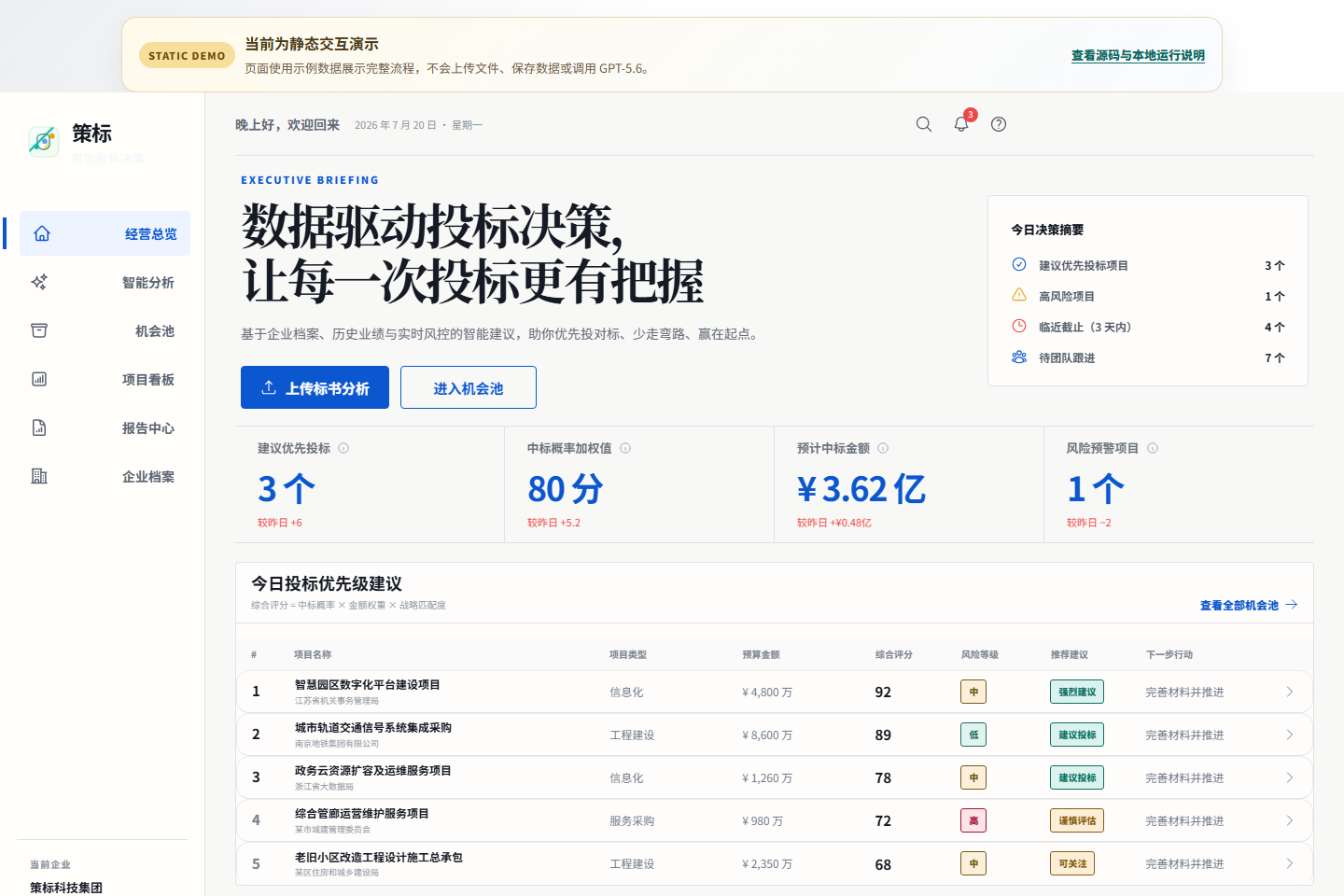
The Vue frontend provides an operational dashboard where users can immediately see opportunities requiring attention, recommended bids, high-risk projects, average match scores, and upcoming deadlines. Separate views support intelligent analysis, opportunity management, company profiles, reports, reference tenders, and account administration.
The Django backend manages authentication, account-level data isolation, APIs, administrative tools, and a relational data model covering:
- Company profiles
- Qualifications and certificates
- Historical project experience
- Tender projects and documents
- Analysis reports
- Risks and missing materials
- Project notes
- Follow-up tasks and reminders
- Reference tenders and contracts
For document processing, Bid Strategy first attempts local PDF text extraction with pypdf. If the extracted content is too limited, the system can switch to vision-based recognition for scanned pages. The extraction process is designed to preserve page order, clause numbers, tables, amounts, dates, qualification requirements, and scoring rules.
We implemented a hybrid analysis architecture. A deterministic local engine performs information extraction, tender classification, qualification matching, experience matching, risk detection, scoring, and initial decision-making.
When an AI provider is available, the system performs a deeper review using the tender text, company profile, and local result as context. The response must follow a strict structured schema with required fields, controlled decision values, bounded scores, and explicit risk sources.
If the external AI service is unavailable, Bid Strategy automatically falls back to the local engine and labels the report accordingly.
The application is configured for deployment on Vercel, with PostgreSQL-compatible production database support and Vercel Blob integration for persistent document storage.
Challenges we ran into
One of our biggest challenges was the inconsistency of real tender documents. Some PDFs contain searchable text, while others are scans, embedded images, complex tables, or poorly encoded content. A parser may successfully open a document while returning almost no useful information.
We addressed this by measuring the quality of extracted text. If the number of meaningful characters is too low, the system treats the document as a likely scan and attempts vision recognition.
Another challenge was preventing confident but unsupported AI conclusions. A fluent summary is dangerous if it invents a qualification or overlooks a mandatory clause. We introduced strict structured outputs, preserved the local rule-based analysis, and instructed the AI not to invent missing evidence. Uncertain results are marked for manual review.
We also discovered that document analysis alone was not enough. Recommendations such as “obtain an authorization letter” or “confirm the bid guarantee” could still be forgotten. We therefore converted findings into assignable tasks with deadlines, reminders, completion states, and project notes.
Deployment created an additional challenge. Local file storage worked during development, but serverless filesystems do not provide reliable persistence. We separated temporary document processing from permanent external storage and stored document metadata in the database.
Accomplishments that we're proud of
We are proud that Bid Strategy:
- Connects tender analysis directly with company-specific capabilities
- Supports both searchable and scanned PDF documents
- Continues operating when external AI services are unavailable
- Produces structured and explainable recommendations
- Identifies qualification, commercial, technical, and deadline risks
- Preserves uncertainty instead of presenting assumptions as facts
- Converts report findings into trackable team actions
- Isolates company, project, report, and document data by account
- Supports follow-up questions about completed reports
- Exports professional reports in PDF and Word formats
- Combines analysis, opportunity management, reference materials, and execution in one workspace
Most importantly, we moved beyond building a simple AI summarizer. Bid Strategy connects document understanding with business context and real operational follow-through.
What we learned
We learned that reliable document AI begins with validating the input. A successful extraction request does not necessarily mean that useful content was extracted.
We also learned that enterprise AI systems need graceful degradation. External models, networks, and recognition services can fail. A dependable product should remain useful, communicate reduced capability clearly, and avoid hiding uncertainty.
Another major lesson was that explainability must be part of the architecture. By storing scores, risks, missing qualifications, evidence, material states, and actions as structured data, we can reuse the same analysis across dashboards, reports, tasks, exports, and future analytics.
Finally, we learned that the best interface for an enterprise AI product is not always a chatbot. Bidding teams need prioritized opportunities, evidence, risks, deadlines, and actions. Conversation is valuable, but it works best as one capability inside a broader decision workspace.
What's next for Bid Strategy
Our next priorities are to:
- Improve table extraction and multi-document analysis for appendices, amendments, and scoring sheets.
- Link every conclusion to its original page and clause.
- Add certificate expiration checks and more advanced qualification-equivalence rules.
- Create configurable scoring models for different industries and procurement methods.
- Introduce collaborative review, approvals, and detailed audit trails.
- Compare multiple bidding opportunities side by side.
- Use confirmed bidding outcomes to evaluate and improve future recommendations.
- Integrate tender feeds, calendars, document systems, and team notifications.
- Support multilingual tender documents and cross-language analysis.
Our long-term goal is for Bid Strategy to become an intelligent operating system for bidding teams—helping organizations select the right opportunities, avoid preventable disqualifications, coordinate preparation work, and make every bidding decision with stronger evidence.
Built With
- artificial-intelligence
- django
- javascript
- machine-learning
- openai-api
- postgresql
- pypdf
- python
- rest-api
- sqlite
- vercel
- vercel-blob
- vite
- vue.js


Log in or sign up for Devpost to join the conversation.